




Abstract
Purpose:
This article focuses on the development of supplementary education, evolving under the label “homework support,” in Sweden between 2006 and 2018. Particular attention is paid to the significance of the private market for national policy.
Design/Approach/Methods:
Through a theoretical model on policy enactment, the interaction between national policy and local practice is highlighted. By analyzing how the local practice appears in documents related to state-regulated decision-making, the study gains further insights in the development of homework support in Sweden.
Findings:
This article argues that when private companies, offering supplementary tutoring, were established on the outskirts of the educational landscape in Sweden, the political educational discourse changed. Even though homework support became a given part of the political discussion about the school, the situation became difficult for private companies.
Originality/Value:
The article adds to the international field of shadow education. It describes the establishment of the private tutoring market’s entry into the Swedish educational landscape, which in the long term has provided a basis for a further Scandinavian development. Furthermore, the article contributes to theory development by a model that focuses on the interaction between policy formulation and local enactment.
Introduction
Sweden has had an international reputation for having one of the most equitable school systems in the world. In the 1940s, when the political decision on comprehensive primary education was made, an objective was formulated emphasizing school as the main actor in realizing national social goals such as equality of opportunity. This objective has largely constituted the point of departure of school policy in Sweden ever since (Telhaug et al., 2006). In line with this, “A school for all” has been the motto characterizing the Swedish school system and related political discussions since the middle of the 20th century when merged compulsory schooling was launched. One of the main aims of public schooling in the modern Swedish welfare state remains ensuring an equal distribution of life opportunities, and the Swedish Education Act accordingly states that all children and young people are to have equal access to education, regardless of gender, where they live, and other social and economic factors (SFS 2010:800). However, massive changes in the Swedish education system, in which marketing and free school choice have played significant roles, have in recent decades changed the image of the homogeneous Swedish school system. A far-reaching deregulation of the welfare sector in Sweden began in the 1990s and opened up the possibility for private actors, including for-profit ones, to establish and develop in, for example, schools, health, and care. For the education system, this meant in the long run, among other things, that parents were free to choose a school for their children in a market consisting of both public and private actors. Through neoliberal trends and decentralization, the Swedish education system has now become one of the most market-oriented school systems in the world (Dahlstedt & Fejes, 2019; Imsen et al., 2017).
Despite the fact that this market system is politically controversial, it is also considered to be so strongly entrenched that it is in many ways difficult to deviate from. For example, the School Commission that was appointed by the government in 2015, whose mission was to propose changes to improve and strengthen the knowledge and equality in the Swedish school (Commission directive, 2015:35), stated that although the Swedish school system today is considered weakened and partly fragmented, “the independent schools and freedom of choice have come to stay” (SOU 2016:38, p. 19, quoted also in SOU 2017:35). In line with the development of the welfare market, a number of political and private efforts have been made aiming at increasing the individual’s chances of maneuvering and finding successful paths within the framework of the market. Subsidization of private welfare services is a relatively new phenomenon in Sweden but has been seen in a number of different welfare sectors in recent times. In a way, this way of trying to strengthen welfare is the opposite of the traditional Swedish model and it has been said that the “Swedish welfare model is gradually losing its characteristics” (Lapidus, 2019, p. 1). The political financial support for private homework support is an example of how this trend is put into practice.
Long-standing trust in the public school system has been identified as a reason why the numbers of pupils using and companies offering private supplementary tutoring have been limited in Sweden (Bray, 2011; Hallsén & Karlsson, 2019). In recent years, political and public debate has paid increasing attention to education conducted outside the public school system, though still referring to the content and organization of the same. This development must be understood within the context of the neoliberal currents characterizing the development of the school system in recent decades, in which citizens have largely been assigned the role of consumers in a market. It can also be traced to the opportunities indirectly created by Swedish tax policy reforms in 2006, together with the proactive behavior of private companies in the educational sector. The private tutor market’s entry into the Swedish educational landscape over a decade ago also laid the foundation for additional developments in Scandinavia. In recent years, this has become particularly evident in Denmark, where the private market, inspired by the establishment of Swedish tutoring companies, has gained a strong foothold in the Danish field of education (Christensen & Ørberg, 2015). The encounter between the growth of supplementary education and the strong dependence on public schooling as a guarantor of equality in Sweden has contributed to ambiguity concerning private supplementary tutoring that has characterized Swedish political debate for over a decade.
This article highlights the development of national policy on supplementary education in Sweden between 2006 and 2018. Particular attention is paid to analyzing the significance the private homework tutoring market has had for the national policy discussion and the political position on supplementary education in the form of homework support.
Homework support: The Swedish form of “shadow education”
Supplementary tutoring, often called “shadow education” (Bray, 1999), has become a global phenomenon involving a growing number of students and a growing variety of forms that in different ways complement the public education system (Aurini et al., 2013; Bray, 2017). Although shadow education is now found worldwide, it has mainly been the object of research in East Asia. It is also in this part of the world that supplementary tutoring seems most widespread, and many studies have noted the large proportion of pupils participating in such education in East Asian countries (Bray & Kwo, 2014; Zhang & Bray, 2017, 2019). In recent years, however, supplementary tutoring has been targeted, both by policymakers and researchers to a greater extent in Europe (e.g., Guill & Bos, 2014; Ireson & Rushforth, 2011; Kobakhidze, 2018; Silova, 2010; Smyth, 2008). The trend is a continued spread of the phenomenon as well as the political attention around it in this part of the world (Bray, 2021).
In Sweden, as in the other Nordic countries, the field of shadow education has recently been identified as an interesting research area and has attracted increased attention (Forsberg et al., 2019; Hallsén & Karlsson, 2019; Lapidus, 2019). How shadow education takes shape, as well as its consequences for individuals, nations, and mainstream education, is highly dependent on the context. In Sweden, supplementary education—related to the content and organization of public school but conducted outside of it—has in many ways a rather short history. Although it is not a new phenomenon in the Swedish educational landscape, its role has historically been limited and it has not been nationally regulated until recently. The rise of shadow education in Sweden has occurred under the label “homework support” (Läxhjälp), as this was the term used in political discourse when the private supplementary tutoring market emerged in the early 2000s.
Although homework is a natural part of most children’s schooling in Sweden, there are currently no regulations regarding homework in the national governing documents for public schools. The last time homework was mentioned in school-regulating documents was in the 1980 curriculum (Lgr 80), which described homework as a given part of schooling: “homework assignments for pupils form part of the school’s work” (Lgr 80, p. 50, my translation). The last two curricula for primary schools in Sweden, from 1994 (Lpo 94) and 2011 (Lgr 11), do not deal with homework at all, and the same applies to the Education Act (SFS 2010:800). In Sweden, as in many other countries, it has usually been the parents who have helped children with their homework (Borgonovi & Montt, 2012), and homework has been highlighted as one of the most important links between home and school (Karlsson et al., 2019). Historically in Sweden, homework support organized by private companies has existed to only limited and local extents and has never previously been regulated at the national level. The reason why supplementary education in Sweden has developed under the label of homework support may concern the fact that homework has long been considered a natural part of the Swedish education system, while private tutoring has been both unusual and somewhat controversial for much of Swedish history.
Arguments, thought styles, and policy enactment
The theoretical perspective applied here is based on a curriculum theory approach focusing on the relationships among education, society, and politics (see, e.g., Lundgren, 1979). The concept of policy enactment (Ball, 1993; Ball et al., 2012) is used to illuminate the interaction between national policy and local practice and how they create new points of departure for each other for the overall purpose of ensuring stability and promoting change (Hallsén, 2013). In educational research, the concept of policy enactment has usually been applied to the public school system (see, e.g., Ball et al., 2012; Lingard & Ozga, 2009), though its relevance to supplementary education has been noted in recent years (Hallsén & Karlsson, 2019; Zhang, 2019). Various ideas and stakeholders influence the relationship between national policy and local practice. When national policy is to be put into action, it must be made relevant to the local context and adapted to the situation prevailing there (Ball, 1993; Ball et al., 2012). Several conditions in turn frame the national policy. The formulated policy is not based solely on the actual forms and results of the practice it intends to influence. In addition, ideas and beliefs about the practice constitute opportunities and limitations determining what national policy formulation appears possible. Mary Douglas cited Durkheim (1925/2002) and Fleck (1935/1997) when describing what she called “thought styles” as a medium of communication in social entities, such as a society (Douglas, 1987, 1996). Cultural bias colors our thoughts and contributes to a certain style of thought in a given society. Ideas about education and the changes considered socially possible at a certain time are framed by the thought styles allowed in public fora—that is, by the general conception of education in the collective thought at a given time. These thought styles are transformed and reproduced in society, for example, through the media. Thought styles influence the policy enactment process, since both the policy formulated in the national arena and the actions that take shape in a local arena are framed by the thought styles prevalent in contemporary society.
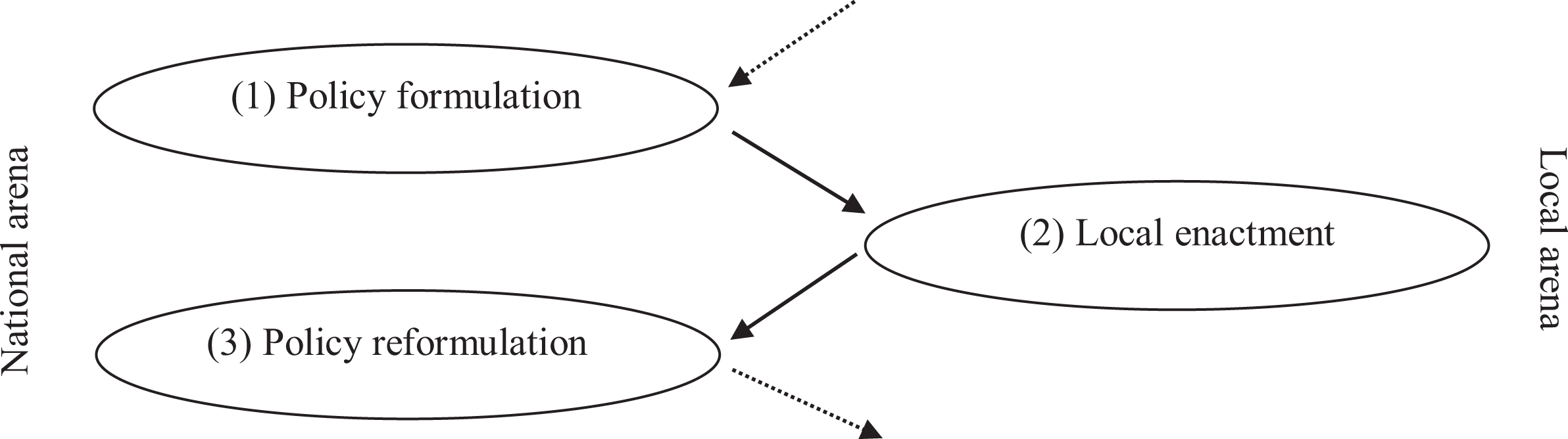
The following model (see Figure 1), inspired by Ball (1993) and Ball et al. (2012), is used to analyze the interaction between national policy formulation and local enactment, here emphasizing the national arena. Through this, we will gain further insight into the development of supplementary education in Sweden.
The interaction of policy enactment.
In Phase 1—policy formulation—a policy is expressed at a national level. Of course, the policy is in one way or another intended to influence the practice it targets. However, it must also be seen as a product of conflicts and negotiations, taking into account many different ideas, ideologies, and opinions. Not least in the formulation phase, the policy must take into account the thought styles surrounding the practice it is intended to influence. There may be a need to act at a national level to show decisiveness when a local practice becomes the object of media and public discussion. The policy formulated in the national arena creates points of departure and preconditions for the actions taken in the local arena. In Phase 2—local enactment—the formulated policy is to be put into practice. At the local level, the formulated policy encounters guidelines and requirements, not always compatible, from other sources. In addition, there may be local needs and desires that could not be foreseen or taken into account in the national policy formulation. Through translation, interpretation, and adaptation, the policy is understood and reworked to be relevant and implementable in a local arena (Ball et al., 2012). This means that the consequences of the formulated policy may differ from the original intentions for the policy. This creates the starting point for the third phase of the model. In Phase 3—policy reformulation—the consequences of the original policy formulation are addressed. The policy is reformulated, either to better align with what has actually taken shape in a local arena or to adjust and regulate the local arena in a desired direction. This national-level reformulation creates new points of departure and new preconditions for actions taken later on.
This study focuses on the national arena and examines arguments formulated in the national policy on supplementary education in Sweden. This means that the local arena is made visible in this study through how it is treated in the national policy. Political action in the national arena is framed by its social and temporal contexts and by the thought styles that are allowed space in contemporary society. Arguments form an important part of social communication, not least in a political context. In this study, I will focus on arguments concerning homework support formulated in national educational policy.
Arguments serve to support a particular description of a situation, to convince people of a particular course of action, and to demonstrate values (Toulmin, 1958/2003). In an argument, someone claims something, supporting this claim by citing relevant facts and information. In policy, which is intended to maintain or change existing orders, claims are understood as possible courses of action, whereas facts and information refer to situation descriptions (Hallsén, 2013). A situation is described, often as problematic, and a course of action is proposed as a solution or a way to address this problematic situation. Note that in the process of formulating policy arguments, the situation description does not necessarily precede the course of action. It can also be the reverse, namely, that the situation described is used to justify the direction of a course of action. In other words, the solution could be predetermined, and a problem or situation is identified to legitimize it (Bacchi, 2009; Hallsén, 2013).
For a course of action to be legitimized, the situation described must relate to the common perceptions of the object of action. This means that the thought styles connected to the educational landscape, no matter how “true” they are, could be as important as the actual shape and outcome when national policy arguments on supplementary education are formulated.
Data and analytical approach
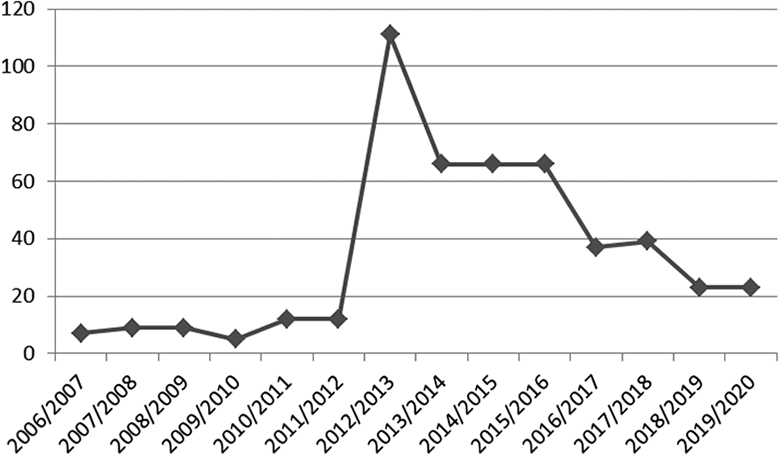
The data used for this analysis comprise documents related to state-regulated decision-making, including budget bills, governmental reports, and regulatory documents formulated at a national level, as well as political parties’ standpoints expressed, for example, in party manifestos. All these national documents focus on homework support and in various ways relate to the framing and regulating of the private supplementary tutoring market. The analyzed policy texts were published between 2006 and 2018. The diagram below shows the number of parliamentary documents addressing homework support each year; these documents were identified using the search function on the Swedish parliament website (riksdagen.se, 2020).
Figure 2 shows how homework support emerged as a political issue in 2012 and how political involvement in the issue then declined, though remaining, after 2012, at a higher level than before the peak. The arguments made in these policy documents constitute the basis for the present analysis. By studying the arguments in these documents and the understanding of local, ordinary school and homework support as well as the relationship between them that appears in these documents, the intention is to make the development visible in two periods. The documents and the arguments used in the following section were chosen to illustrate the discussion at the national policy level regarding supplementary education in Sweden.
Numbers of parliamentary documents addressing homework support (läxhjälp) between 2006 and 2019.
Policy enactment at the boundary of public education in Sweden
This section describes the development of private supplementary education in Sweden from a policy enactment perspective. In the first stage described below, lasting from 2006 to 2014, disputed political decisions about tax relief for domestic services created an opportunity for private actors to offer homework support and thus for a private supplementary tutoring market to become established and to develop in the Swedish educational landscape. In the second stage, lasting from 2014 to 2018, the private companies’ tax benefits were removed and were more or less replaced by a state grant to public schools and nonprofit organizations. Over time, an expressed political agreement emerged attaching supplementary education more closely to public schools.
The rise of private supplementary education and political ambiguity
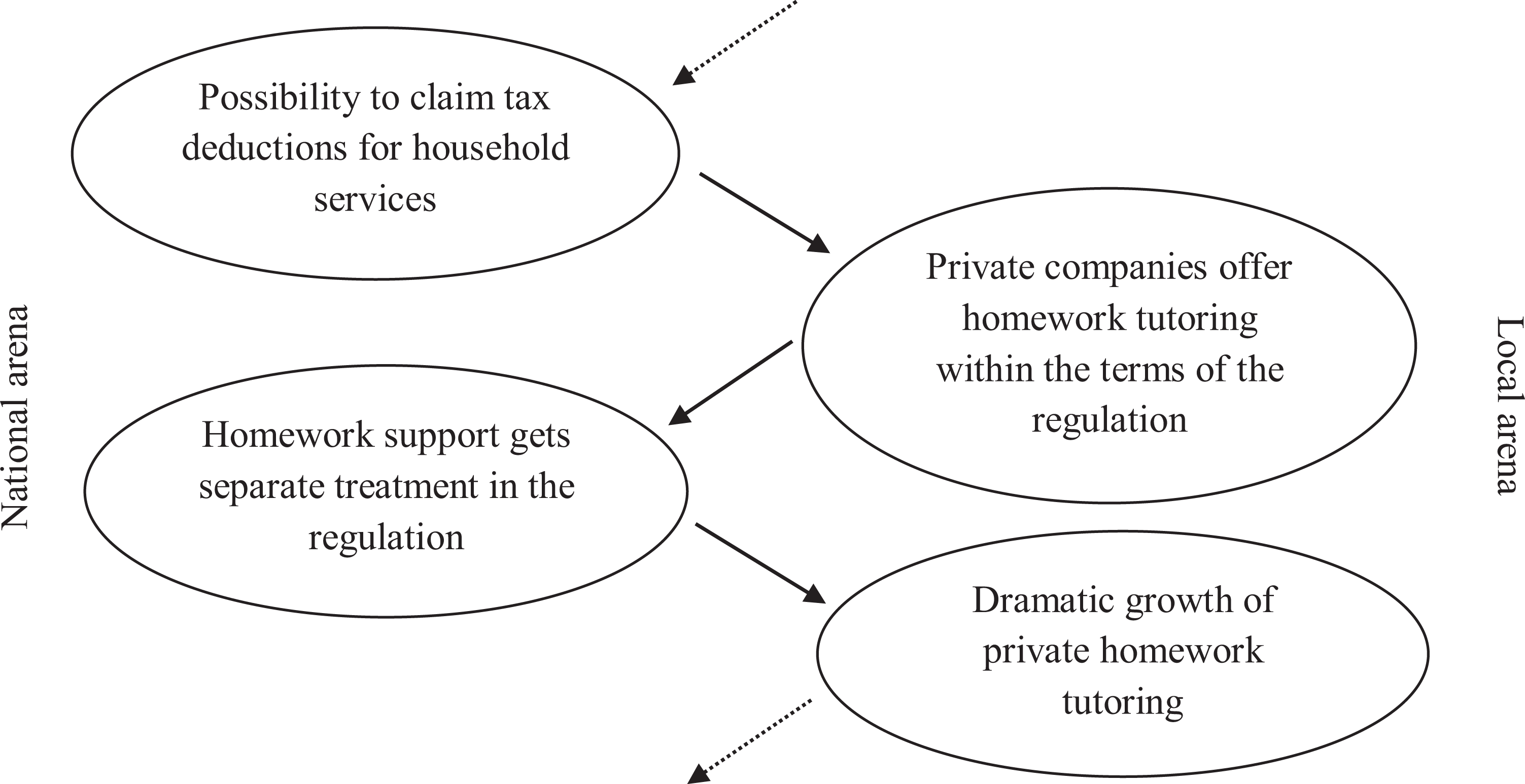
The growth and development of the homework tutoring market in Sweden was linked to the opportunity that existed between 2007 and 2015 to claim tax deductions for domestic services (SFS 2007:346). Overall, the tax deduction provisions (referred to using the acronym RUT) were intended to reduce the black market in household services (mainly for cleaning) and to promote women’s opportunities in the labor market (Government Bill 2006/07:94). These regulations were introduced by the right-wing parties after they had won an election and taken government power in 2006. The tax deduction regulations, launched in 2007, made it possible to claim deductions for homework support carried out in the home in the form of tutoring. In the tax deduction regulations, the possibility of parents’ claiming deductions for homework tutoring for their children was not expressed directly, but only mentioned in a subordinate clause. This possibility was identified by private companies. myAcademy, a company already in existence at the time, played an active role in designing the opportunities to use the tax deduction for homework support. This company approached the Swedish Tax Agency for clarifications regarding the limits of the law. This resulted in a reformulation of the law affirming that homework support for children up to 16 years old, for which specialists were not required, could be offered within the framework of tax deductions for household services (myAcademy, 2015). More companies were accordingly established and gained ground in the Swedish educational landscape by offering home-based homework tutoring. Initially, the possibility only applied to primary school children as part of babysitting, with the consequence that these companies offered homework tutoring under the label “supervision with a pedagogical focus.” This led to discussions of the distinction between babysitting and homework support. The boundaries were considered blurred and questions were raised regarding, for example, what activities were considered babysitting and how old a child could be and still have a babysitter. In 2013, homework support was distinguished from babysitting and received separate treatment in the regulations (Government Bill 2012/13:14, regarding a report from the Parliamentary Committee on Taxation 2012/13: SkU10). Another argument for this regulatory change was that a separate text concerning homework support would make it easier to control the private market. The new formulation in the regulation required that homework support should be connected to the curriculum and to the Education Act. On the one hand, private tutoring was somewhat limited by the regulation; on the other hand, this regulatory change directly identified private tutoring as an option for families, eligible for tax deduction. In this way, the reformulation gave the private market active political support and demand for the services grew dramatically. This development in turn led to political disagreement and debate.
The advocates for treating homework support separately argued that the designation of homework support within the context of the regulations would facilitate the control of this emerging private market. The argument in this case was based on a description of a situation in which the private market was acting within an undefined area of opportunity, for example, with an unclear connection to the public school system. Changes in the regulations could arguably address this problem. The proponents of the private homework tutoring market further claimed, in the parliamentary and media debate, that an improved private homework tutoring market would increase the opportunities for ambitious young people, and possibly even retired people, to find employment (Parliamentary Records 2012/13:37). It was also claimed that the regulatory change would enable more families to use homework support by making it cheaper. This, it was argued, would not only increase general levels of knowledge among young people but also, in the long run, advance the equality of Swedish public schools, helping address increasing achievement gaps between different groups of children (Parliamentary Records 2012/13:37). The Minister of Education declared: “Without the deduction, only rich families can afford [homework support]. With the deduction, it becomes available to more people” (Björklund, 2012, my translation). With this he dismissed the warnings of the Swedish National Agency for Education that a tax deduction for homework tutoring could increase the differences in study results within the country (Parliamentary Committee on Taxation 2012/13: SkU10). Criticism of this regulatory change, including from the opposition parties, National Agency for Education, Tax Agency, and teachers’ unions, mainly expressed worries about the threatened equity of public schooling as an argument for not allowing tax deductions for private homework tutoring within the home. The critics did not believe that homework support should be the privilege of the children of parents who paid higher taxes and thus could claim the deduction (Parliamentary Committee on Taxation 2012/13: SkU10). Despite this criticism, the regulatory change was implemented with the justifying argument that all measures that might improve pupils’ knowledge and school achievement were to be understood as positive. In this argument, homework support was described as a measure not only upholding the historical image of Swedish public schooling as a guarantor of national equality but also addressing the contemporary situation of the Swedish school system’s declining performance in international knowledge surveys such as Programme for International Student Assessment (PISA). This, together with a narrative of teachers not succeeding in their job, can be seen as a thought style that had been reproduced and strengthened, not least via intense media reporting. Politicians at the national level may have seen themselves compelled to respond to this thought style and to be seen as acting to address the perception of Swedish schooling as failing.
The rise of the private homework support market, 2006–2014.
Figure 3 illustrates, from a policy enactment perspective, how private companies in the local arena used the opportunity that appeared within the terms of the regulation on tax deductions for household services and started to offer private homework tutoring. The growing market and the limited control of its content and organization were handled in the national arena by homework support receiving separate treatment in the regulation on tax deductions for household services. With this, private homework tutoring was identified as a legitimate alternative for families to benefit their children’s schooling. The change in regulation resulted in the dramatic growth of the private homework tutoring market.
Shifting boundaries of public education and changed political discourse
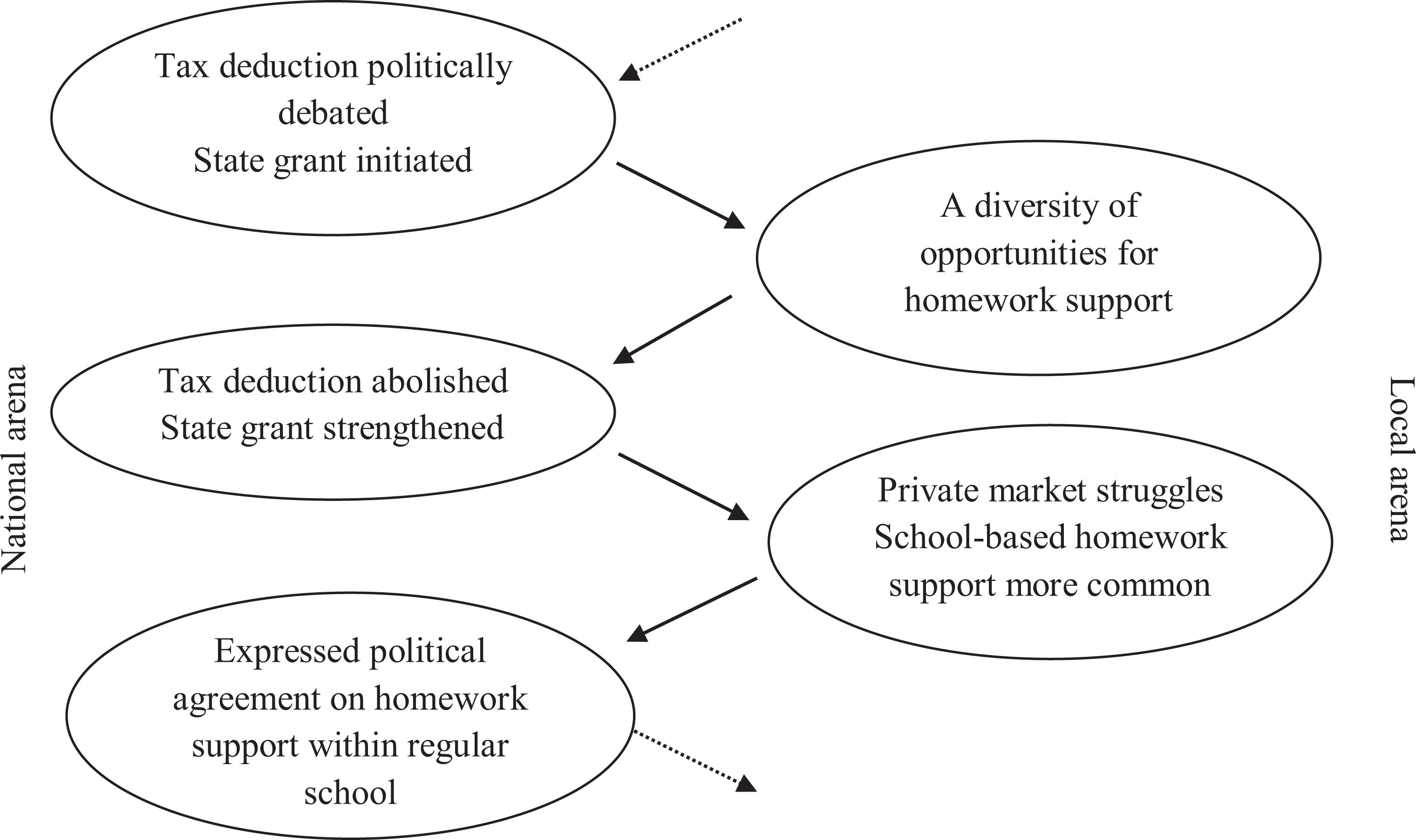
In parallel with the tax subsidies for private homework tutoring, in 2014, the right-wing government initiated state grants to school principals and nonprofit organizations to provide homework support for pupils in Swedish schools. This homework support was to be conducted outside of ordinary school hours and be free of charge. The regulation stated that money was to be given “for the homework support that the application for state grant funding refers to, [and that] school principals should use teachers who may conduct teaching according to the regulations that apply to teaching in the school system” (SFS 2014:144 § 4, my translation). This can be seen as a way that the right-wing government in power responded to the criticism that had emerged in the debate, mainly from the left wing, of the private homework tutoring market. When the Swedish government was replaced after the 2014 election, the new left-wing Prime Minister, Stefan Löfven, who had expressed a negative attitude toward the growth of the private homework tutoring market within the RUT framework in the earlier debate, confirmed in his government declaration that the tax deduction for homework support was to be abolished:
1
The Swedish school system must be cohesive and equitable. Special measures will target schools where the conditions are most challenging. Tax subsidies for those who can afford private homework support will be abolished. Homework support must be given to all pupils, regardless of their ability to pay. (Löfven, 2014, p. 7)
After 2016, the size of the government grant increased dramatically. The National Agency for Education, which channels this funding to schools and school principals, emphasized that the school principal was to be responsible for setting the goals for the local homework support activities. In the long run, this should lead to improved opportunities for all pupils to develop their learning, thereby contributing to increased equality. This state funding meant that money was invested by the state in activities outside the regular education system partly to strengthen equality within ordinary public schooling at the system level, but also to enable individual pupils to get help with their schooling that they might otherwise not get. The regulations regarding the homework support to be carried out, both within the framework of the school principals’ activities and through nonprofit organizations, were very loose and there was little follow-up.
The matter of tax relief for private tutoring disappeared from the political and public debate, and a vague political consensus emerged in what the political parties expressed, namely, that homework support should be offered to everyone. Before the 2018 Swedish election, no political parties expressed support for the earlier possibility of allowing tax deductions for private homework tutoring. However, most of the parties in one way or another affirmed that homework support was something that all school pupils should be entitled to free of charge. The left-wing Social Democrats, which became the largest party after the election, wrote in their 2018 election manifesto that they would “make billion [SEK] investments in more equal preschool and school [through, for example,] greater opportunity for homework support…introducing a homework support guarantee and compulsory holiday school for children at risk of not being eligible for upper secondary school” (Socialdemokraterna, 2018, my translation). The Moderate Party, the second largest party after the election and representing the right wing, proposed in its 2018 election manifesto that Sweden should “introduce compulsory homework support, through an obligation to offer homework support from grades four to nine” (Moderaterna, 2018, my translation). None of the political parties represented in the Swedish parliament expressed in their manifestos before the 2018 election anything countering this political orientation toward providing homework support.
This changed political discourse implies a broad-based political agreement that all pupils have the right to receive support with their schoolwork outside regular school hours but within the school’s purview. The framework for how this was to be conducted—for example, what the support should consist of, who should provide it, who should be offered support, and how the support should be followed up—was very loosely defined. Furthermore, there seemed to be a lack of clarity concerning the boundaries between public schooling and supplementary education. This lack of clarity in the directives on what the state grant funding could be used for and how the funded activity was to relate to the public schooling, in combination with the private market’s continued, but unregulated, place in the educational landscape, led to a differentiated and complicated range of supplementary education offerings.
While free-of-charge homework support provided within the school is becoming more common, the situation of private homework tutoring companies has become more difficult. Today, the for-profit market is struggling to find new competitive alternatives of homework support. Regarding the decision that high school students should conduct their education at a distance in spring 2020, as a way to reduce the spread of COVID-19, the private companies’ marketing of various supplementary education offerings has expanded significantly.
Figure 4 illustrates, from a policy enactment perspective, how the debated tax deduction for private homework tutoring and the initiated state grant to school principals and nonprofit organizations increased the types of homework support offered to families. As the tax deduction for homework tutoring as a domestic service was abolished at the same time as the state grant for public options was dramatically strengthened, the situation of the private tutoring companies became harder as more homework support was provided within the school. In conjunction with the strengthening of public homework support, the associated political debate has faded. A political consensus seems to have been achieved in which the regulation of private homework tutoring is at the time not an issue and public homework support is taken for granted in the Swedish educational landscape.
A changed political discourse, 2015–2018.
Discussion
The emergence of private tutoring within the framework of tax deductions for domestic services legitimized homework support as part of the Swedish educational landscape. The tax subsidies for private tutoring were justified on the basis of improving educational results. They were also linked to the idea of school as an equality guarantor—a thought style that has characterized Swedish schooling throughout its modern history. When allocation of the tax subsidies was advocated, the same thought styles were activated, but now with reference to everyone being entitled to homework support. The establishment of the private tutoring market and the associated debate redrew the boundaries of public education in Sweden. From having been assigned a role in solving problems in the school system, in many ways, private tutoring instead became a problem for the politicians to solve. However, it is obvious from the analysis that the arguments for private tutoring and for homework support available to all were both legitimized based on the historically anchored thought style of educational equality and in the more contemporary thought style of the Swedish school system’s declining results. This analysis illustrates the importance of contextualizing shadow education and an awareness that supplementary education takes different forms in different countries and contexts. The development of supplementary education in the Swedish context must be understood in relation to the great trust in the public education system that has historically existed, in combination with a more contemporary distrust of the same.
The dramatic growth of the private tutoring market between 2012 and 2014 led to the establishment of many new companies offering tutoring to school children in their homes. However, when active political support was withdrawn from the market in 2015, these private companies were placed in a problematic position in which the supply of private tutoring services was greater than the demand for them. As a way of managing a reduced customer base, these companies, which were no longer bound by the tax reform regulations, began to add other forms of homework support, such as web-based support and homework support classes. The changed political discourse that had certainly laid the foundations for homework support as a natural part of the Swedish educational landscape led, in the long run, to further diversification of the support that took shape.
While homework support provided within schools has become an accepted part of the Swedish educational landscape in recent years, in contrast, the private tutoring market has partly been described as threatening the equitability of the Swedish school system. In managing the emerging private market, politicians have counteracted the market by offering public alternatives, tying supplementary education more closely to conventional school activities. This has blurred the boundaries between public schooling and shadow education. The regulation regarding state funding for homework support states that financial support will be given for activities rooted in the Education Act and the curriculum but conducted outside regular teaching hours. However, the activities that are part of the school’s regular assignments and those that are additions to these assignments, financed by the state grant, can be difficult to distinguish. This blurring of the distinction between regular and supplementary education can have consequences for both the schools and the individual students. A school’s responsibility to offer pupils support within the framework of regular schooling does not diminish just because the school has received a state grant for homework support. Thus, a problem may arise, for example, when a pupil is entitled to support for school work but does not want to participate in the offered optional homework support.
There is now for the most part an expressed political consensus that homework support should mainly be the responsibility of the schools and that it is favorable for the Swedish education system and for the pupils in it. However, there is still considerable ambiguity as to what this politically advocated homework support should consist of and how it should be organized. In the long run, the question of tax-subsidized private homework support is linked to the question of how a welfare state should be organized and what role private actors should play in building a future welfare state. It is quite possible that the private tutoring market will again strengthen its position in the Swedish educational landscape, without building its activities on a dependence on state tax deductions. Developments in other Nordic countries, especially in Denmark, point in such a direction. There are also signs that the private companies are responding to the demand that has arisen in the wake of the decision to let Swedish high school students carry out their schooling at a distance as part of managing the spread of the COVID-19 virus.
Decisions on the content and form of homework support are mainly made at the local level, within the framework created by national policy formulations. What is happening in the local arena, concerning both the form that state-funded public homework support take given current regulations, as well as what actions and services will develop in the private market, will certainly create new points of departure for further national policy formulations.
Footnotes
Author’s note
This article is based on the paper “Policy Enactment at the Boundary of Public Education in Sweden: The Rise of Private Supplementary Education and a Changed Political Discourse” presented at the World Education Research Association (WERA) conference, August 5–8, 2019, at Tokyo University. It was written within the project “Homework Support as Shadow Education” (Forsberg et al., 2019), funded by the Swedish Research Council.
Declaration of conflicting interests
The author(s) declared no potential conflicts of interest with respect to the research, authorship, and/or publication of this article.
Funding
The author(s) disclosed receipt of the following financial support for the research, authorship, and/or publication of this article: This work was supported by the Swedish research council (Grant No. 2015-01754).
