




Abstract
Purpose
The purpose of the paper is to investigate the impact of various types of intergovernmental fiscal transfers on local public education expenditure at the county level in China and to estimate the leakage of categorical subsidies for rural compulsory education.
Design/Approach/Methods
It is a quantitative study. The paper constructs a quantile regression model and adopt data collected in 2007 for 1,985 counties in China to examine the impact of relevant fiscal transfers.
Findings
The results reveal that most intergovernmental fiscal transfers exert a substitution effect on the local education expenditure, whereas subsidies for rural compulsory education from the Central Government have a crowding-out effect on education investments from local financial resources. Although the subsidy program generally narrows the education expenditure disparity across counties, there are heterogeneous effects across different regions.
Originality/Value
The paper estimates and compares the impact of fiscal transfers on both the level and disparity of local public education in different regions, and provides a possible explanation for the crowding-out effect of fiscal transfers in China.
Introduction
The year of 2001 constitutes a critical transitioning point for China's fiscal policy for compulsory education since the Chinese economic reform. Before 2001, a relatively decentralized management system was adopted to implement China's fiscal policy for compulsory education. The Central Committee of the Communist Party of China issued the Decision on the Reform of the Education System in May 1985, proposing the regional and procedural implementation of a 9-year compulsory education system in China to decentralize compulsory education to local authorities and promote a multilevel management system that distributes responsibilities to local governments. In accordance with the arrangements of this system, various levels of governments were responsible for compulsory education expenditure designated from them—the provincial, prefectural and county/ district authorities were responsible for the funding for urban elementary and junior high schools, whereas township governments were responsible for the public funding in rural areas. China is vast in rural areas with a large population of school-aged children where township governments have long been burdened with the expenditure for compulsory education. The Chinese government is a five-level organization with the Central Government in the hierarchy, followed by provincial, municipal, county/district level, and township level governments. Public resources have been very limited when it comes to the lowest level of township governments. The Project “County- and Township-Level Fiscal Policies and Their Effects on the Farming Community” conducted by Development Research Center of the State Council reveals that township governments were responsible for 78% of the funding for compulsory education in China in 2001, whereas county and provincial governments and the Central Government only contributed 9, 11, and 2 percent of the pool, respectively. The heavy burden of rural compulsory education expenditure imposed on township governments, which are scarce in finance, inevitably hinders fiscal input in rural compulsory education and leads to a series of severe consequences, including the deterioration of school facilities, the delayed payment of teacher salaries, the declining education quality, and the increasing dropout rates in rural elementary and junior high schools.
Another problem hindering the development of compulsory education in China is the disparity of such input across regions. Considerable disparities economic development and financial capacity have been observed between Eastern, Central, and Western China, across provinces and within provinces. Moreover, the heavy reliance on local governments to fund compulsory education and the lack of fiscal transfer payments for compulsory education by governments in higher levels to local governments continues to enlarge the disparity in for the investment in compulsory education across areas. Huang (2012) calculated that the Gini coefficient for the disparity in recurrent expenditure per pupil 1 in elementary and junior high schools across counties 0.3 or higher and that for operating funds per pupil are 0.6 or higher between 1996 and 2001 in China. This disparity in fiscal input across counties further leads to differences in educational opportunity, process, and outcomes for school-age children and unequal development of compulsory education that is very similar to the economic development across areas.
To resolve the problems of inadequate fiscal input in compulsory education and disparity in the financial input, the Central Government planned a series of policies in the financial arrangements for compulsory education in 2001. The State Council announced the Decision on Education Reform and Development in Basic Education in 2001, proposing a rural compulsory education management system in which the expense responsibility of compulsory education is reassigned to the county governments, and central and provincial governments are requested to increase public resources to support rural education. In December 2005, the State Council announced the Notice on the Deepening of Reformation Mechanisms for Guaranteeing Funding for Rural Compulsory Education, proposing the implementation of a new mechanism to guarantee the funding for rural compulsory education. The new mechanism incorporates rural compulsory education into the scope of guarantee for public finance and attempts to establish a sound system of fiscal transfer for compulsory education between the higher-level central and provincial governments and lower-level local governments to accomplish a shared system in compulsory education expenditure by different levels of governments. In June 2010, the Central Government announced the National Outline for Medium- and Long-term Education Reform and Development (2010–2020), further clarifying the responsibilities of various levels of government in terms of providing public education services and shifting compulsory education expenditure responsibilities partly from the county level to the provincial level.
A review of related policy documents from 2001 reveals that reform can be broadly divided into two groups. The first part is the institutional arrangement that remains intact where lower-level local governments are still the main supply of compulsory education so local governments and schools can maximize the effectiveness in schools’ operation and management. The second part is the changed portion of the system, which shifts more compulsory education expenditure responsibilities to higher levels of government. The “county-based” reform of 2001 redistributes the responsibilities of collecting and allocating rural compulsory education funds from township governments to county governments. The reform of 2005 that attempts to establish the funding guarantee system further reinforces the input responsibilities of the Central Government and provincial governments by implementing a new mechanism that guarantees shared responsibility for rural compulsory education funding between levels of governments. The responsibility of provincial governments of raising funds for public education was then finalized in the process by 2005. Fiscal transfer is a key component for the Central Government and provincial governments in fulfilling their responsibilities to allocate resources to local compulsory education.
Over the past decade, the Central Government has continuously expanded fiscal transfers for compulsory education to more categories and meanwhile, continuously made efforts to support local governments through transfers. This approach has enabled a successful shift of responsibility for compulsory education expenditure to higher levels of government. Currently, fiscal compulsory education transfers from the Central Government to local governments are implemented in multiple fields, including teacher salary, school operating spending, waive of tuition and other fees, free textbooks and meal plans, construction and maintenance of school facilities and so forth. In 2011, the total amount of resources guaranteed by the new mechanism plus the transfer payments of Rural Tax Reform from the Central Government to local governments for rural elementary schools was more than 146 billion CNY, which accounted for 26.2% of the total government budgets for elementary and junior high schools in rural areas. The corresponding proportions in Central and Western China, which have been traditionally supported by Central Government, were over 40%. 2 Transfers made by the Central Government greatly increased fiscal input for compulsory education, thereby reducing the disparity between input in urban and rural areas. According to the Statistical Bulletin on the Implementation of National Education Funds published by the Ministry of Education, the budgeted operating expenditure per pupil in rural elementary schools and rural junior high schools in 2001 were 550.96 CNY and 656.18 CNY, respectively, which only constituted less than 70% of that in urban schools. However, the educational spending in rural elementary and middle schools substantially increased to 9,246.00 CNY and 12,477.35 CNY in 2016 and was over 90 percent of the financial resources allocated to urban schools 3 . Although the input standard for compulsory education has been significantly improved after reform, disparity across counties remains severe. According to the analysis of the latest county-level data, the Gini coefficient of the disparity across counties for the elementary school operating expenditure per pupil in 2010 is 0.3, which is almost the same as that in 2001.
After 2001, the Central Government employed a wide range of policy instruments to reform the fiscal policy of compulsory education. Fiscal transfer is one of the instruments that has been the essential one to advance the policy change. According to the fiscal federalism, fiscal transfers from high-level governments to impoverished areas help the fiscal insufficiencies of local governments, balance the across-region fiscal capacity, and reduce the gap in public services across regions when there is a decentralized system for the supply of public services, the local governments are suffering from financial difficulties, and the disparity in local financial capacity is large (Gramlich, 1977; Winkler, 1989; Boadway & Shah, 2007). However, this theory needs to be applied to the practice with cautious. The expenditure intention of local governments is also a very important factor to contribute to the educational spending disparity across areas. As a matter of fact, education is in an intense competition with other categories of public expenditures because local governments in China are currently very tight in both revenues and expenditures with increasing government debts and loans. If local governments do not favor for education, they may only allocate a small portion or none from the transfers received from higher levels of governments to public education. Under such an extreme circumstance, fiscal transfers will have little effect on narrowing down the gap in educational spending across counties. Furthermore, different local governments may have different input intentions, resulting in variations in improvements in public education expenditure standards across areas after receiving transfers. If public education expenditure is improved less in the lagging areas than that in the leading areas after the transfers from higher levels of government, transfers may worsen the spending disparity in education across counties. In this study, we draw data from 2007 for 1,985 counties and county-level cities in China using quantile regression method to answer the following two questions:
Can current fiscal education transfers facilitate the growth of local public education expenditure?
Do such transfers reduce or enlarge the spending disparity in public education expenditure across counties?
Studies on the effects of fiscal transfers on local education expenditure conducted by Western scholars increased exponentially from the beginning of the 1960s, gradually becoming a specialized field of study. Renshaw (1960) and Sacks and Harris (1964) respectively analyze data collected between 1949 and 1954 and in 1960. The researchers find that in the United States, local education expenditure per pupil increases by 0.16 USD and 0.52 USD, respectively, for each dollar transferred by state governments. In the 1970s, the emergence of the median voter theorem (Bradford & Oates, 1971; Wilde, 1971) and budget-maximizing Model (Niskanen, 1971; Romer & Rosenthal, 1978) provided a new research paradigm for local fiscal behaviors. These researchers advance the popularity of function-based empirical research and enhance the understanding of the function for local education expenditure. According to relevant studies in the United States, local education expenditure function generally includes institutional factors such as the fiscal revenue of regional residents, tax price, fiscal transfers, the statuses and structures of local educated populations, and public education costs (Huang, 2012). Meanwhile, scholars start to categorize types of fiscal transfers and independently evaluate the effects of general or block grants, categorical grants, and matching grants on public education expenditure. Empirical results related to various types of fiscal transfers differed substantially. Tsang and Levin (1983) review relevant studies published in the United States in the 1960s and 1970s and show that the minimum and maximum impacts of fiscal grants for general education provided by state governments are 0.16 and 1.06, respectively, and those of categorical fiscal education grants are between 0.17 and 1.80. The development of quantitative techniques 4 in the 1990s also leads to the application of various new methods for studies on local public education expenditure. These methods enable the assessment of heteroscedasticity and endogenous problems, neither of which could be addressed by traditional ordinary least squares method, thereby improving the accuracy and reliability of the estimates.
Compared to Western countries, relevant studies on local educational expenditure emerged around 2000 in China. Existent evidence in China has focused on the qualitative understanding of current conditions and problems in local public education finance, whereas very few has employed empirical approaches. Zhang, Zhang, and Zhu (2004) find that fiscal transfers from the Central Government not only fail to increase public education expenditure but also result in a drop in the resources for education from local governments based on the data from more than 100 counties in one province. Wang (2007) analyzes provincial data between 1999 and 2002 and observes a considerable leakage problem in categorical education transfers between the Central Government and provincial governments with 67% of the categorical education grants were reallocated by local governments for other purposes. Huang (2009) reveals that after receiving categorical education transfers from higher levels of government, the proportion of local fiscal revenue allocated to elementary education is decreased, resulting in the limited effect of intergovernmental fiscal transfers for local elementary expenditure using county-level data. The prior discussion highlights that in China, the implementation of fiscal transfers for education is not effective in term of increasing local educational expenditure per pupil. The main reason behind this scene is that the promotion mechanism for government officials in China is based on the evaluation of local economic development, and hence the officials commonly put the spending priority on achieving good performance indicator for the evaluation or increasing the chance of promotion through means such as investing more in infrastructure to facilitate economic development. Therefore, officials are less concerned about those expenditures that do not immediately produce economic benefits during their terms (Zhou, 2007; Yin & Zhu, 2011; Fu & Zhang, 2007; Huang, 2012). Moreover, other scholars have indicated that the lack of an effective system in place to monitor the allocation of transfers, the tightening resources for local fiscal expenditures, and the increasing burden of local governments for the educational expenditure are all possible factors for the relatively large degree of public fund leakage in the transfer (Song, 2005; Jiang & Zhang, 2008; Huang, 2012).
Although considerable progress has been made in the local educational expenditure in China, there are questions remain open. Earlier research seems to favor for provincial data for the empirical analysis. However, county (district) governments are primarily responsible for the compulsory, education and related expenditure in China. Education expenditure data at the provincial level contain the fiscal inputs from multiple levels of government such as provincial, municipal, county level, and township level. Therefore, using provincial data to analyze the effect of basic education transfers is not appropriate. Other studies that draw on county-level data in recent years have focused on the effect of transfers on local public education expenditure (e.g., Wang & Yang, 2008; Huang, 2009), whereas few have analyzed the effects of transfers on the disparity in the education expenditure across counties. According to the general principles of public education expenditure, disparities in the financial capacity and expenditure willingness are the two primary factors influencing the education expenditure disparity across regions (Monk, 1990). Therefore, to examine the effect of fiscal transfers on the across-region education expenditure disparity, researchers may need to simultaneously analyze the following two types of potential effect: (a) the distribution effect about whether the transfer funds are more likely to be allocated to poor areas. The method to obtain the distribution effect is relatively simple by calculating the correlation between transfers received by local governments and local financial capacity. A negative correlation confirms the presence of the distribution effect, whereas a positive correlation confirms its absence; (b) the incentive effect of whether transfers can effectively increase local public education expenditure, or a significantly positive coefficient of transfers in the estimation, and whether the growth of public education expenditure in poor areas is greater than that in wealthier areas, or a negative coefficient of transfers on local education expenditure. To measure the incentive effect, we will use the quantile regression approach to estimate the effects of various types transfers on counties with different levels of education expenditure. Subsequently, we combine the distribution and incentive effects to comprehensively examine the effects of China's current fiscal transfer system on public education expenditure disparity across areas.
Data, Methodology, and Models
Data
In this study, we analyze data in the county level from the Fiscal Statistics of Prefectures, Cities, and Counties published by the Budget Division and Treasury Division of the Ministry of Finance and the China County Statistical Yearbook released by the National Bureau of Statistics of China. Administrative units at the county level include county-level cities, counties (autonomous counties, banners, and autonomous banners), and districts. Since the China County Statistical Yearbook contains only socioeconomic development statistics for county-level cities (district data are missing), we, therefore, eliminate the district data when merging the two datasets. Moreover, the Tibet Autonomous Region is eliminated to prevent outliers because of the special demographic and geographical characteristics as well as a wide range of priority policies customized for the area. 5 The final data consists of fiscal, economic, and education statistics for 1,985 counties from 30 provinces in 2007.
Since the province-managing-county reform in 2004 when the county-level government has been the direct authority for local educational expense, it is the county-level data that can reflect the public education expenditure in China. However, due to the difficulties of getting the most recent year county-level data and the fact that the institutional system since the PMC reform has not dramatically changed, we believe it is safe to draw reliable statistical inference about the rural-urban and regional gap in the educational spending based on data in the year of 2007.
Methodology and Model
To simultaneously examine the effects of transfers on local public education expenditure and revenue disparity across areas, we employ quantile regression approach for the empirical analysis. While the ordinary least squares (OLS) approach estimates the conditional mean of dependent variables, the quantile regression estimates the conditional quantiles of independent variables. The features of quantile function enable us to estimate and compare the effects of fiscal transfers on local public education expenditure for counties with different levels of expenditure and determine whether such transfers could reduce public education expenditure disparity across areas. In addition, the quantile regression has several other features that make it better than OLS regression in this study. The quantile regression relaxes the assumption of heteroscedasticity and its estimates are more accurate when there are outliers in the data. Hao and Naiman (2007) provide an in-depth discussion on quantile regression.
The quantile regression model applied in this study can be expressed as follows:

Local public education expenditure per pupil at the county level is the dependent variable and percentile is represented in Equation 1 with a superscript “p.” While the quantile regression allows the dependent variable to be with any percentile, we select the 10th, 20th, 40th, 60th, 80th, and 90th for our analysis to represent the counties in each percentile. A high percentile indicates the high level of public education expenditure per pupil at the county level. By estimating the quantile regression, we can estimate the coefficients of transfers on educational expenditure in counties with different levels, and simultaneously observe how the coefficients of transfers will vary with the levels of local educational expenditure.
The variables associated with public education expenditure per pupil can be broadly categorized into three types: education provision, education demand, and education cost. We attempt to include these three groups of variables in the model.
Variables Associated with the Education Provision
The financial capacity of the government is a key factor influencing local education provision. Local fiscal revenue and transfers distributed by higher levels of government are the two most important components of local financial resources.
In this study, local fiscal revenue is the amount that extracts the revenues submitted to higher levels of governments from the total revenues. Local governments with more local fiscal revenue will generally allocate more funds to education. Therefore, we predict that the estimated coefficient of this variable would be positive. The local fiscal revenue per pupil is derived from dividing the total fiscal revenue at the county level by the total number of pupils enrolled in elementary and junior high schools (FisR in the model).
The various types of fiscal transfers are the main explanatory variables in this study. In analogous to previous studies, the transfers are classified based on the transfer targets and the classifications and statistics of fiscal transfers for local governments in 2007. 6 We categorize the fiscal transfers received by local governments at the county level into three types: the general or block transfers, categorical transfers for education, and other categorical transfers. General transfers include all transfers without specific recipients or limitations on the use such as sales tax and value-added tax (VAT) returns, tax base returns, system subsidies, general transfer subsidies, transfer subsidies for ethnic regions, rural tax reform subsidies, transfer subsidies for financial relief in rural areas and townships, settlement subsidies, and transfer subsidies for enterprise and institution budgets. We then divide the total amount of these items above by total enrollments into elementary and junior high schools to get the per-pupil general transfers (Gt in the model). The per-student equation for this variable can be expressed as follows:
General transfer per student (Gt)=(sales tax and VAT returns+tax base returns+system subsidies+general transfer subsidies+transfer subsidies for ethnic regions+rural tax reform subsidies+transfer subsidies for financial relief in rural areas and townships+settlement subsidies+transfer subsidies for enterprise and institution budgets+other financial transfers) / sum of students in local elementary and junior high schools
Categorical education transfers refer to categorical subsidies for rural compulsory education provided by the Central Government to local governments at the county level. Although categorical education transfers from the Central Government to local governments at the county level may be allocated to various fields, including exemptions for tuition and other fees, teacher salaries, and school facilities, we can only identify the categorical transfer to rural compulsory education subsidies in the county-level data we have. This subsidy is a comprehensive categorical transfer made by the Central Government to local governments at the county level. It was implemented in 2006 after the implementation of student tuition and fees waive in rural elementary and junior high schools. We include the per-pupil categorical education transfer (CtE) after dividing the total rural compulsory education subsidies by the total members in elementary and junior high schools. Likewise, the per-pupil other categorical transfer (Ct) is dividing the total of other categorical transfer by the total number of students in elementary and junior high schools.
For the convenience of comparing the effects of the three types above of fiscal transfers on local public education expenditure at the county level, we replicate the method employed by Tsang and Levin (1983). First, we categorize the effects of transfers into three types corresponding to the types of transfer payments. When the estimated coefficients of the three transfers were β i <0 (i=1, 2, 3), we observe the dilutive effect of transfers on local education expenditure. When 0<β i <1, we have a substitutive effect. When β i >1, we have stimulative effects of transfer.
In addition to the provision of education, local governments at the county level are responsible for social and economic development in the region and the provision of other public services. Therefore, various forms of expenditure compete for limited financial resources in local governments. To control for the potential effects of other forms of expenditure on education expenditure, local education fiscal effort is selected as a variable to reflect the relative input into education (compared with other forms of non-education-related expenditure) by local governments. This variable is constructed in the model as the percentage of total fiscal expenditure on education of the total local fiscal expenditure.
Variables Associated with the Demand for Education
The number of pupils in elementary and junior high schools per household is used as a proxy variable for public education demand of residents. We construct this variable (FamPup) by dividing the total enrollments in elementary and junior high schools by the number of local households in 2007.
Earlier research indicates that the number of pupils per household has positive and negative effects on local public education expenditure at the same time (Ladd, 1975; Feldstein, 1978). The positive effect comes from the concurrent increase of demand for public education and its positive effect on local public education expenditure while the negative effect is that the decreasing in the family income per member because of more pupils in the household will mediate the demand for education and then result in a declining in local educational expenditure.
Variables Associated with the Education Cost
The total number of pupils (Pup) in elementary and junior high schools is a proxy for local education cost.
Descriptions of variables and statistics.
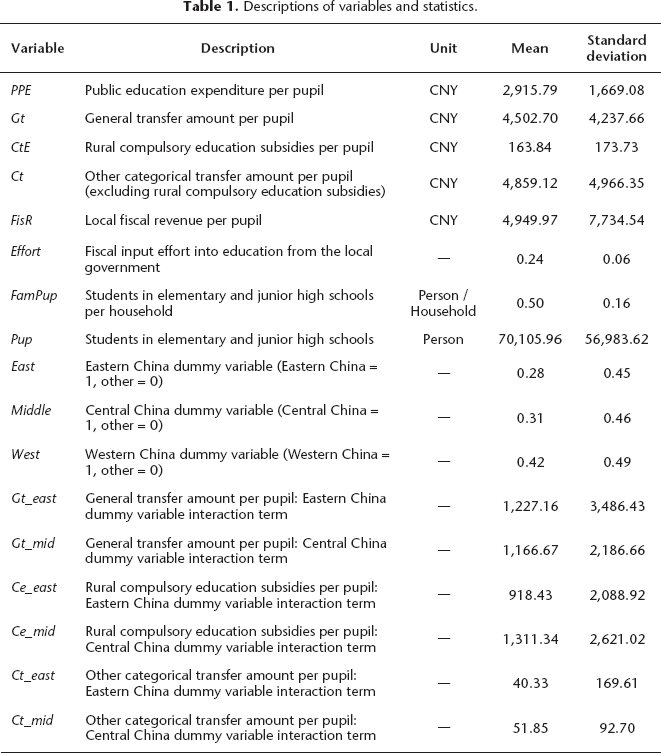
Descriptions of variables and statistics.
Previous research has frequently used the number of pupils to determine whether there exist economies of scale in the supply of local education. When the Pupil variable coefficient is negative, we confirm that there are economies of scale in the production of education (Cohn & Geske, 1990). Although this inference seems rational, it may not be applicable to China. The assumption for this inference is that the government is adequate in financial resources for education. Economy of scale, or the decreasing marginal cost with an increase in the number of pupils, is achieved in education when the educational resources are appropriately allocated and efficiently used. However, fiscal investment into local education in China is evidently inadequate. Given that, the decrease in per-pupil educational expenditure may reflect the drop in the per-pupil educational input standard or the quality of local education, instead of the traditional economy of scale, if the growth of the total budget for local education cannot keep up with the growth of the number of pupils at schools. Without controlling for variables associated with local education production, the model may not be able to provide a definitive explanation for the coefficient of the pupil enrollment.
We also construct six interaction terms in the model by multiplying the three transfer types with the regional dummies to examine whether the effect of the transfers will operate differently between East, Central and West China that are distinguished in social and economic development. Western China is the reference group for the regional dummy variables. 7
As shown in Table 2, the coefficients of the three types of transfers on local public education expenditure at the county level are all positive. However, the coefficients of the different types of transfers are differed to some degree in the scale, and vary with the percentiles of local educational expenditure.
Effects of Transfer Types on Education Expenditure
Of the three transfer types, the categorical subsidies for rural compulsory education have the greatest influence on local public education expenditure per pupil, with the coefficients estimated between 0.26 and 0.43. These coefficients suggest that for every additional unit increase in rural compulsory education subsidies provided by the Central Government, local public education expenditure per pupil at the county level will be increased by 0.26 CNY to 0.43 CNY. Compared to the estimated coefficients for general transfers ranges between 0.11 and 0.20, the effect of rural compulsory education subsidies on local education seem to be more evident. These results are in line with the principles of transfer and the intuitive perceptions. Rural compulsory education subsidies are a categorical grant designated to education only with very strict limitations, scrutiny and report system on the use of the fund. The regulations for the process along with the request of additional local money to supplement for the rural compulsory education from the Central Government are contributing factors to the positive effect of rural compulsory education subsidies. The general transfer, on the other hand, aims to make ends meet for local governments by enlarging the fund pool for local governments with no specific requirements for the allocated resources. For such reason, the local governments have certain discretion to reallocate the received general transfers based on the structure and preference of local public expenditures. Given that local governments may spare very limited portion of the general transfers to local education, it is not surprising that the effect of general transfer on educational expenditure is not as prominent as that of categorical transfers to education. The coefficient of local fiscal capacity has a similar magnitude (0.10 to 0.20) to that of general transfer on the educational expenditure, which echoes for the median voter theorem that the effect magnitudes of the general transfer and the local financial capacity may be the same because both indicate the expenditure preference of local governments (Bradford & Oates, 1971). Furthermore, the point estimation of the six percentile regressions of local financial capacity and those of general transfers are not significantly different. 8
Quantile regression estimation results.
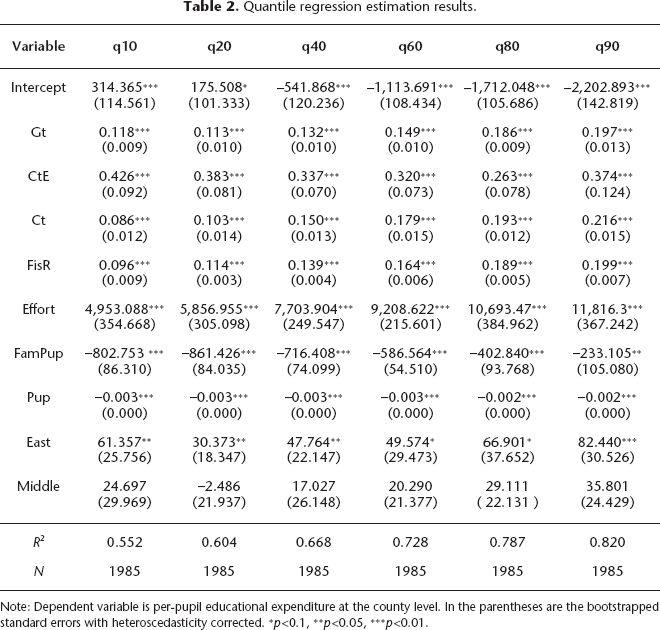
Quantile regression estimation results.
Note: Dependent variable is per-pupil educational expenditure at the county level. In the parentheses are the bootstrapped standard errors with heteroscedasticity corrected. *p <0.1, **p <0.05, ***p <0.01.
Although rural compulsory education subsidies are more effective than other types of transfers in terms of promoting local public education expenditure per pupil, the effects produced by rural compulsory education subsidies are still substitutive, and the leakage proportions of these funds are between 57% and 74%. 9 According to the fiscal operations of local governments, the conversion of categorical funds occurs in two ways. The first is to allocate the categorical subsidies to other fields through certain inbox operations. In recent years, the Central Government has established a fine monitoring system for the categorical transfer to education from the implementation, allocation to the application of categorical funds for compulsory education. The increasing effort in the assessment and report system also prevents the local govern from the direct use of categorical funds to other purposes. The second way to realize the leakage of categorical funds to guarantee its use on education without any operations against the regulations, but at the same time reduce the supplementary funds from local finance pool to support public education. In other words, local governments rely only on the transfer payments from higher levels of governments and save their own financial resources that ought to be allocated to education for other expenditure items. This process forms a unique “pooling” phenomenon, where higher levels of government continually transfer funds to the “education fund pool” that is supposed to be composed by local and higher levels of governments while local governments continually withdraw the local proportion for the education for other expenditure items. Under this circumstance, the categorical education transfers will produce a crowding-out effect on local fiscal input into education, which perhaps is the main reason for the leakage of rural compulsory education subsidies.
The estimation of the impact coefficients of the other categorical transfers is between 0.09 and 0.22. This magnitude is similar to that for general transfers. Other categorical transfers consist of a variety of categorical grants with a specific use. Although most of these categorical transfers are not directly related to education, few is targeted at local education such as the categorical construction funds for the renovation and maintenance of rural elementary school buildings in Western China. We were unable to identify and separate these items, which limits our explanation to the effect of other categorical grants on educational expenditure.
General Transfers
As displayed in Figure 1, the coefficient for the general transfers is significantly positive and increases with the percentiles of local educational expenditure. According to the point estimation in Table 2, public education expenditure per pupil in counties in the 10th percentile of education expenditure increased by 0.118 CNY for every additional increase of general transfers. By contrast, public education expenditure per pupil in counties in the 90th percentile is increased by 0.197 CNY. 10 These results show that from the perspective of the incentive effect produced by transfers, general transfers exacerbate the expenditure disparity across counties. Because of the lack of monitory by Central Government concerning the purpose of general transfers, the implementation and allocation of general transfer payments by local governments reflect their own fiscal expenditure preferences and structures. Therefore, based on the estimated coefficient of general transfers, we infer that the counties spending more in education are more likely to allocate general transfer payments to education than those counties with lower spending in education.
Regarding to the distribution effect of transfers, the Pearson Correlation of 0.35 indicates a significantly positive relationship between per-pupil general transfers and local financial capacity, suggesting that counties with low financial capacity are not guaranteed with more general transfer funding while those with adequate public finance receive more resources. This phenomenon is probably associated with the purposes of different general transfer types from the Central Government. The first type of general transfer is distributed to local governments based on local financial capacity and aims to attenuate the capacity gap across counties. It is normal to expect a negative relationship between general transfer and local financial capacity. In the meanwhile, another general transfer that includes the tax returns and subsidies for counties in the transition of systemic change after the 1994 Tax Reform, which noticeably decrease the tax revenue for wealthy areas, are positively correlated with local finical capacity because these transfer payments are allocated by the base values of value-added tax (VAT) and affluent counties are usually with high VAT. Compared to the general transfers for the balance of local finance capacity, the transfer payments for the tax returns and subsidies for the systematic change constitutes a higher proportion of the total general transfer payments and thus are of more power in the correlation dynamics, which will offset the negative relationship between general transfers and local financial capacity.
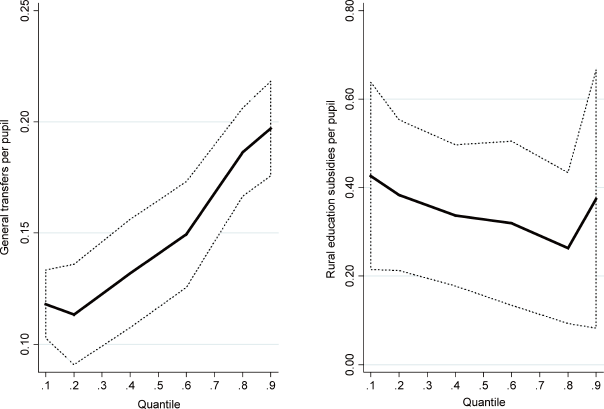
Effects of general transfers per pupil on local rural compulsory education subsidies.
Results from the analysis show that the general transfer payments for local governments have very limited distributive and incentive effect on local educational expenditure. Counties with higher levels of education expenditure not only receive more general transfers from top tier governments but also allocate a larger proportion of the received transfer payments to public education, which leads to our conclusion that general transfers enlarge the across-county disparity in per-pupil educational expenditure.
As visualized in Figure 1, the coefficient for the rural compulsory education subsidies ranges between 0.263 and 0.426 whereas the counties in the lowest 10th percentile have the largest coefficient and those in the 80th the smallest estimate. Counties in the 90th percentile are estimated to have the second largest coefficient of 0.374. Overall, the effects of rural compulsory education subsidies decreased with the increase in local education expenditure. Regarding the incentive effect of transfers, rural compulsory education subsidies seem to reduce public education expenditure disparity across counties to some extent as reflected by the largest coefficient estimated by the model. Although the rural compulsory education subsidy funds provided by the Central Government are mainly concentrated in counties in Central and Western China with small portion allocated to East China, this subsidy program provides resources for pupils with the same amount without taking across-county disparities in finance capacity, demand for education, education cost and price. From this point of view, counties in the Central and West China with lower finance capacity share the same amount with those wealthier counties. The Pearson correlation of −0.034 between the subsidies and local finance capacity further suggests that the significant incentive effects of the categorical education transfers on education expenditure disparity across counties are attenuated by the negative distributed effects resulted from the “fit-to-all” per-pupil subsidy.
Heterogeneous Effect across Regions
Comparing the Effects of General Transfers
As presented in Table 3, the results for all interaction terms between general transfers and the regional dummy variables are negative, suggesting that the effects of general transfers on local public education expenditure at the county level in Western China are more evident than that in the Central and Eastern China. The calculation of the results shows that the coefficients of general transfers in Western China ranges between 0.15 and 0.24, Central China between 0.07 and 0.24, and Eastern China between 0.10 and 0.15.
Regression results across regions.
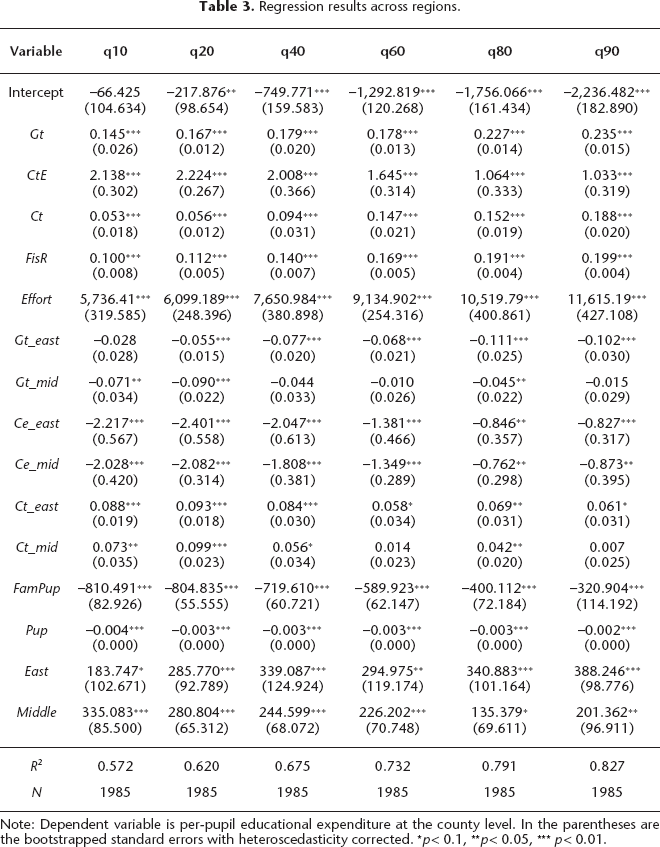
Regression results across regions.
Note: Dependent variable is per-pupil educational expenditure at the county level. In the parentheses are the bootstrapped standard errors with heteroscedasticity corrected. *p < 0.1, **p < 0.05, *** p < 0.01.
The incentive effect of transfers in Eastern China increases firstly with the level of local educational expenditure and then decreases, as displayed in Figure 2. The overall change of the coefficients across all percentiles for counties in this area is not that noticeable with a range between 0.1 and 0.15. The coefficients of the general transfers are evidently higher than those for Eastern China and are rising with the level of educational expenditure. To be specific, every additional increase in the general transfers will boost the spending of counties in the 10th and 90th percentile by 0.074 CNY and 0.235 CNY. The latter is more than three times larger than the former. The upward trends for all three regions suggest that general transfers fail to have the incentive effect on local educational expenditure disparity. With respect to the distribution effect of general transfers, its correlations with educational expenditure in East, Central and West China are 0.43, 0.20 and 0.32 with counties in the East have the largest estimate. We then infer that the general transfers are very limited in the incentive and distribution effect and thus enlarge the spending gap across counties within all three regions.
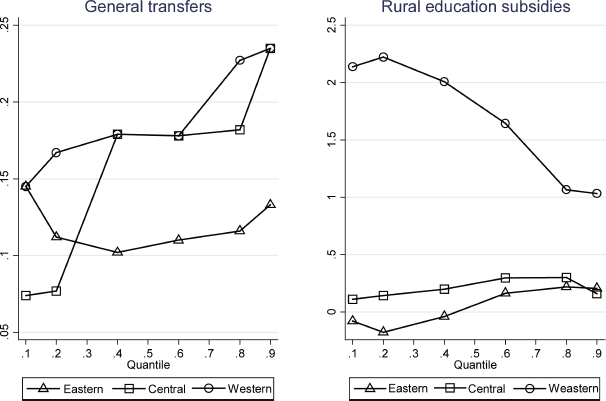
Changes in the impact coefficients of general transfers and rural compulsory education subsidies in Eastern, Central, and Western China.
Rural compulsory education subsidies effectively prompt local governments at the county level in Western China to increase their fiscal input into education. The coefficients of these subsidies in Western China are between 1.03 and 2.14, suggesting that the occurrence of the incentive effect. It may be the case that rural compulsory education subsidies motivate local governments at the county level in Western China investing in compulsory education. After receiving rural compulsory education subsidies from higher levels of government, local governments in Western China not only allocate the funds to education but also increase the portion of local fiscal input into education to achieve an ideal funding effect. By contrast, the estimated coefficients of the rural compulsory education subsidies in Central China are between 0.11 and 0.30. Notwithstanding an incentive effect, the leakage proportion of the funds is between 70% and 89%. The coefficients in Eastern China are relatively low with a range between −0.08 and 0.22, suggesting the presence of the dilutive or substitutive effect. The leakage percentage for counties in the East is between 78% and 108%. The facts that the Central Government intend to allocate rural compulsory education subsidies to rural elementary and junior high schools in Central and Western China as stated in the policy design 11 , and that the effects rural compulsory education subsidies on local public education expenditure in Central and Western China are more evident than those in Eastern China together lead to our conclusion that rural compulsory education subsidies significantly reduce public education expenditure disparity across counties within Eastern and Western China.
The pattern of the subsidies coefficients against local educational expenditure varies across regions, as also shown in Figure 2. In Eastern and Central China, the coefficients of rural compulsory education subsidies increase with the percentile of local education expenditure. The Pearson's correlations between rural compulsory education subsidies and local financial capacity are −0.09 and 0.004 in the East and Central part of China, which can nearly be ignored. These results indicate that rural compulsory education subsidies fail to have the distribution and incentive effect in Eastern and Central China and worsen the spending disparity across counties within the two regions. Western China, on the other hand, witnesses the coefficients declining with the level of educational expenditure. The coefficient of the subsidy program for counties in the 10th percentile is 2.138 whereas that for the 90th counties falls to 1.033. Rural compulsory education subsidies have better incentive effect in the West than that in the rest of China. The correlation between the subsidy and local financial capacity is positive suggesting that the distribution of the rural education subsidies associated with local financial capacity will weaken the incentive effect.
Comparing Effects of other Transfers
According to the results in Tables 2 and 3, the coefficients of the local fiscal revenue increase with the percentile of education spending, suggesting that counties with higher levels of education expenditure are more willing to invest in education. Specifically, each additional unit of local fiscal revenue per pupil will raise the investment in education by 0.1 CNY for the counties in the 10th percentile. Counties in the 90th percentile invest 0.2 CNY in education with an additional increase in the local fiscal revenue. The doubled effect reveals that well developed counties not only have adequate financial resources but also have a higher likelihood of making investment in education. The disparities in financial resources 12 as well as spending preference constitute one of the major reasons for the large spending gap across counties. The education effort of local governments significantly and positively influences local education expenditure. This finding is consistent with prior research. The number of pupils in elementary and junior high schools per household is significantly and negatively associated with local education spending. As alluded earlier, we are unable to provide a decisive explanation—economies of scale or the inadequacy in local fiscal inputs, to this phenomenon because of the lack of variables related to local education production and efficiency. The results of the dummy variables in Table 2 show that local public education expenditure per pupil at the county level in Eastern China is higher than that in Central and Western China. However, no significant statistical differences are observed for the expenditure between Central and Western China.
Conclusion and Discussion
In this study, we examine the effects of general transfers, categorical education transfers, and other categorical transfers on local public education expenditure using quantile regression method with county-level data in China in 2007. We highlight the leakage problem of rural compulsory education subsidies and the potential effects of general transfers and rural compulsory education subsidies on the spending disparities across counties.
Although the financial incapability has been commonly cited as the main reason for the inadequacy and inequity of the public investment to compulsory education, another critic is the inferior preference of local government for education. Regardless of the funding sources for education, the spending decision has been largely made by the lower county-level governments since 2004. The findings of the high leakage of transfer payments and the crowding-out effect reveal an insufficient interest of local government in public education investment. It is thus not surprising that most local governments aim to distribute educational spending at the lowest cost to insure the basic needs for the personnel and routine operation of the government. Despite the Compulsory Education Law that teachers in the elementary and middle school should receive the same amount of salary and benefits as the public servants, this provision has not achieved in most counties. Teachers in rural education are paid with lower salary and benefits to assure the basic living. Local governments are reluctant to allocate resources for additional teachers’ salary and benefits as long as there are not mandatory orders and categorical transfers from upper level governments.
First, we select rural compulsory education subsidies to represent as one of the categorical education transfers from the Central Government. Although the effect of rural compulsory education subsidies on local public education expenditure at the county level is better than those of general transfers and other categorical transfers, the effect of rural compulsory education subsidies on local public education expenditure is substitutive with a leakage percentage over 50. As the Central Government increases its categorical transfers for compulsory education in rural area, local governments will reduce their local financial input into education, resulting in a crowding-out effect. Despite the series of documents issued during the earlier policy stages to prohibit local governments from allocating categorical education transfers to other purposes and hence squeezing local supplementary education input after receiving funds from higher levels of government, these efforts fail to obtain the desired goals. The Central Government then continues to enforce regulations on the allocation and implementation of transfer funds and eliminates most of the methods used by local governments to directly misappropriate categorical education funds. However, indirect methods of misappropriating categorical education funds still exist. The Central Government may have two ways to this problem. On the one hand, the Central Government can mandate that local governments should maintain a certain level of local fiscal input to education when allocating the categorical transfer payments, and establish a system to scrutinize the process during and after the implementation. This mandate, however, has strong political implications, and will inevitably impose considerable resources on Central Government or the evasion of local governments. Moreover, this approach constitutes a substantial intervention on local fiscal decisions, and thus will weaken the discretion of local governments in allocating resources to some extent. Otherwise, the Central Government can establish a matching transfer program that will award the counties that supplement the categorical transfer with local revenue to further reduce the unit price of local education supply, and thus, stimulate local government increasing the total spending in education. Compared with the first approach, the second awarding policy is featured with “incentive compatibility”. It does not directly interfere with local expenditure decisions but rather rely on matched funding to alter local spending preference and structure, and to simulate the objectives of the Central Government with those of local governments. By designing reasonable and feasible matching rates, the Central Government may be able to not only improve the fund efficiency but also achieve fiscal neutrality by enhancing the fairness of educational expenditure (Huang & Zhong, 2011).
Second, we find that general transfers exacerbate public education expenditure disparity across counties. Counties that spend more in education not only receive more general transfer payments than those with less spending in education, but also are more likely to invest in education. When receiving the same amount of general transfers, the growth in education expenditure in counties with higher levels of education expenditure is larger than those with lower levels of education expenditure. By contrast, the effects of rural compulsory education subsidies on local public education expenditure decrease with local education expenditure, suggesting that rural compulsory education subsidies mitigate public education expenditure disparity across counties. However, rural compulsory education subsidies have a weak negative correlation with fund reallocation and local financial capacity across counties. The negative correlation may have limited the positive effects of rural compulsory education subsidies on local education expenditure to some extent. In this case, we firstly recommend that the Central Government improves the existing general transfer structures by increasing transfer funds to balance wealth across areas and reduce transfer funds for the systematic change. This will increase general transfers to areas with low financial capacity so they can have adequate resources to provide public goods and services. The Central Government could also replace the current system of allocating categorical education transfers. Even though the categorical transfers have been customized based on different contexts in Eastern, Central, and Western China, counties with different financial situations are funded with the same amount per pupil within the region. Prior research has confirmed that (Wang, 2003; Huang, 2010) public education expenditure disparity is no longer caused by the regional gap (e.g., between Eastern, Central, and Western China and across provinces) but rather from the spending difference across counties within specific area and each province. Therefore, future categorical education funds in China may be better to be allocated with the consideration of county-level public finance and demand for education. The Central Government may need to eventually replace the currently applied “base grants plus coefficient adjustments” transfer formula design with a more appropriate design based on transfer equations by accounting for disparities across counties in finance capacity and demand for education.
Finally, a comparative analysis of Eastern, Central, and Western China reveal that general transfers exert a deteriorated effect on public education expenditure disparity across counties for all three regions. The leakage percentage of rural compulsory education subsidies in Eastern and Central China are over 70%, and rural compulsory education subsidies seem to enlarge the spending gap across counties in public education expenditure. In the opposite, rural compulsory education subsidies have stimulative effect in Western China by not only increasing local education fiscal input at the county level but also reducing public education expenditure disparity across counties. The only limitation is that the allocation of rural compulsory education subsidies presents a positive correlation with local financial capacity, which mediates the incentive effect of this categorical transfer on local education spending in Western China. If the Central Government can change the allocation of the categorical transfer payments that are related with local financial capacity, rural compulsory education subsidies may play a more important role in closing the spending gap across counties in Western China. At the same time, it is alarming that such a subsidy program operates differently across Eastern, Central, and Western China, that could be attributed to a variety of factors. It could be the consequence of much more education debt from old days and the not so well-developed economies in Western China, the priority that Western China has been in the policy design with more allocated transfer funds or the differentiated implementation of the transfer policy across areas. We cannot be conclusive about the answer to this question because of the lacked statistics and data. Yet, the reasons for the different effects of categorical transfers on across-county spending gap in compulsory education are worth extension in the future research.
Funding
This work has been supported by the National Social Science Foundation of China in Education (Grant No.: BFA140039).
Footnotes
1
According to education funding statistics in China, operating funds include personnel and operating funds. Personnel funds are primarily used to pay teacher salaries and benefits and operating funds are primarily used to ensure the normal operation of schools and school activities.
2
Calculated from the statistics reported in the Tax Rebates and Transfer Payments in the General Public Budget from the Central Government to Local Governments and China Educational Finance Statistical Yearbook.

4
These methods include, but are not limited to, 2-Stage Least Squares (2SLS), Generalized Least Squares (GLS), Nonlinear Least-square Interactive Technique (NLIT), and Instrumental Variable Method (IV).
5
Tibet covers an expansive land area and is sparsely populated. In addition, this autonomous region has many preferential policies that render its transfer amount per pupil higher than in those other parts of the country; this causes Tibet samples to exhibit a significantly higher public education expenditure value per pupil at the county level than neighboring samples or county areas with a socioeconomic development level similar to those of provinces. Therefore, Tibet samples contain many outliers.
6
Please refer to the 2017 Government Expenditure Classifications announced by the Ministry of Finance of the People's Republic of China.
7
The Eastern China regions are Beijing, Tianjin, Hebei, Liaoning, Shanghai, Jiangsu, Zhejiang, Fujian, Shandong, Guangdong, and Hainan; the Central China regions are Shanxi, Jilin, Heilongjiang, Anhui, Jiangxi, Henan, Hubei, and Hunan; the Western China regions are Inner Mongolia, Chongqing, Sichuan, Guizhou, Yunnan, Xiaxi, Guangxi, Gansu, Ningxia, Qinghai, and Xinjiang.
8
The estimated values for general transfers and local financial resources at each of the six percentile points (q10, q20, q40, q60, q60, and q90) were 0.118 and 0.096, 0.113 and 0.114, 0.132 and 0.139, 0.149 and 0.164, 0.186 and 0.189, and 0.197 and 0.199, respectively. Based on the F- test results, none of the six pairs of estimated values indicated a significant statistical difference (P=0.05).
9
Leakage proportion=(1–impact coefficient estimated value of rural compulsory education subsidies) x 100, where (1–0.26) x 100%=74% and (1–0.43) x 100%=57%.
10
According to F-test results, the estimated coefficient for regression analysis of the counties in the 10th percentile was 0.118, whereas that of the counties in the 90th percentile was 0.197. The coefficients achieved significant statistical difference based on a significance measure of P=0.01.
11
Among the samples, the average rural compulsory education subsidies per pupil of the subsidized local governments at the county level in Eastern, Central, and Western China were 169.73 CNY, 190.86 CNY, and 192.94 CNY, respectively. Significantly more subsidies were received by Central and Western China than Eastern China.
12
In the samples, the Gini coefficient for intercounty local fiscal revenue per pupil disparity reached 0.56 after adjustment for the total number of students in the various counties.
Acknowledgement
This is an adapted version from our article originally published in Chinese by Education Journal (the Chinese University of Hong Kong), 2014, 42(2), 1–21. We appreciate Education Journal for permitting us to translate and reproduce the article in English.
Notes on Contributors
Bin Huang, PhD (CUHK), Chair Professor and Dean of School of Public Administration, Nanjing University of Finance & Economics. He mainly focus on the quantitative research on the compulsory education finance, human capital investment in rural China, and the impact evaluation of education policies. He published over 30 book and academic papers in the field of education finance and economics. He is now leading the research project of National Social Science Foundation in Education “The impact evaluation of compulsory education fiscal policies after 2000”.
Yunxia Dong, instructor of Nanjing Xiaozhuang University. Her research interests include education finance and economics.
Jingjing Miao, postgraduate student of School of Public Finance and Taxation, Nanjing University of Finance & Economics. Her research interests include educational policies evaluation and education finance.
Caiqun Xu, Ph.D. candidate at Warner School of Education, University of Rochester. She conducts quantitative research on the educational and labor market outcomes of the community college upward transfer students to explore the viable pathway to baccalaureate education for underrepresented students. She also focuses on the evaluation of various educational policies both in China and the U.S. and is now working on a project of evaluating the school counseling mandates across states.