




Abstract
Purpose
The study uses the data of listed companies in China from 2012 to 2020 to investigate the impact of top managers’ high-quality university educational backgrounds and their native places on Chinese enterprises’ participation in public good.
Design/Approach/Methods
A linear regression method was used.
Findings
Higher education plays an important role in the promotion of public good. From the perspective of behavior and intensity, high-quality higher education highlights a unique role in the depth and intensity of corporate philanthropy. There is regional heterogeneity among top managers in promoting enterprises’ participation in public good: Top managers born in Midwest China are more likely to promote enterprises’ participation in public good.
Originality/Value
This study empirically tested the theoretical results of past domain-specific research, focusing on the impact of top managers’ background (education and place of origin) on the engagement of listed companies in public good. It proposes a set of innovative and comprehensive indicators to measure companies’ engagement in public good, and explores the influence of managers’ higher education quality on the firm's engagement in economic and educational causes, as well as the level of such engagement.
Introduction
In recent years, China has proposed the realization of common prosperity as a strategic goal of socialism with Chinese characteristics. One of the meanings of common prosperity is to narrow the income gap by expanding the proportion of middle-income groups, and the key to this narrowing is education. Li (2021) suggests that while the middle-income group is mainly characterized by income level, this group's expansion depends on the development of education, especially higher education. By increasing people's understanding of public good, higher education can give full play to the role of the three distributions, promote educational equity, and thus move toward the goal of common prosperity.
Higher education has long been considered to be related to both public and private good (Kelleher, 2000). In recent years, interest in the unique social and public benefits of higher education has been increasing (Carpentier & Courtois, 2020; Durán Del Fierro, 2023). In this respect, research indicates that higher education contributes to balancing public services across regions and promoting shared educational achievements (Li & Zhu, 2022; Yuan et al., 2022; Zhou & Shi, 2022). In China, higher education plays an important and unique role in promoting common prosperity (Hu & Yao, 2023).
Under the socialist patriotic cultural values advocated by Chinese society, people not only pursue individual interests but also take the initiative to help others: the rich help the poor and the weak support the strong, pursuing the realization of common happiness for the whole population. This is reflected in the spirit conveyed by university education. As China's higher education system undergoes reforms and development, the vital role it plays in promoting public good and educational equity is reflected in the engagement of firms in public causes, typically initiated by top managers.
More specifically, higher education is thought to nurture among young talent a sense of social responsibility to develop their home country. Construction projects such as the Double First-Class construction of colleges and universities have the fundamental function and logical purpose of cultivating first-class talents (Ye & Wu, 2023). This highlights the responsibility of high-quality colleges for exporting social talents, serving societal development, and promoting equity in society. Such emphasis on nurturing students’ social responsibility, patriotism, and civic duty is reflected in the mottos and values of prestigious universities such as Tsinghua University, which espouses the motto of “self-discipline and social commitment,” and Peking University, which advocates values of “patriotism, advancement, democracy, science.” Colleges and universities provide a consistent supply of talent to the labor market. Significantly, these individuals actively assume social responsibility and progress through the ranks in their respective enterprises, including top managerial positions. Thus, driven by social responsibility, top managers play an active role in guiding firm activities toward public good to generate public benefits, thereby narrowing the income gap and promoting common prosperity.
As such, it is widely assumed that top managers provide the key stimulus for the development and promotion of social and public welfare and, in turn, reduce social disparities. However, given the relative novelty of this domain, few studies have explored the impact of higher education on public good, and even fewer have investigated such impact from the perspective of talent training. Addressing this gap, this study examines the degree to which the top managers of listed companies in China influence their companies toward generating public good. This study further discerns the influence of region (eastern, central or western China) and educational background in this regard and conducts a heterogeneity analysis at the regional level.
Literature review
Definition of public good
In contrast to social and public undertakings, causes for public good emphasize direct public interest. Here, causes for public good refer to activities that benefit or help other people or the society at large (Wu, 1995), while “[p]ublic interest refers to the welfare or well-being of the general public, and mainly refers to welfare services that benefit the public, such as social relief” (Ci Hai Editorial Committee, 2010). Therefore, public good is manifested in charitable activities such as poverty alleviation, supporting people suffering difficulties, disaster relief, rescuing orphans, providing assistance to older adults and the disabled, and helping the disadvantaged population to receive education and medical support (Zhang, 2019; Zhao, 2017). This study focuses on the economic and educational foundations of public good.
In addition to helping the poor and the weak, public welfare supports education, science, culture, and other aspects (Shang, 2019). In the social context of China's socio-economic transition, corporate philanthropy plays an important role, as both a catalyst and a mediator, in solving a series of social problems, such as the widening gap between rich and poor, imbalance in the supply of public services, and the lack of social governance (Xiao et al., 2020). The government's overall commitment to developing social programs includes actively promoting the role of private resources in improving people's livelihoods and giving enterprises a strong impetus for development through a series of policies and incentive mechanisms (Guan, 2020).
Public benefit of higher education
In the context of China's market economy, Sun (1999) argues that the benefit of higher education can be considered from three aspects: company, personal, and public. Public benefit refers to the benefit to members of society other than individuals who directly utilize the results of higher education, such as the person who receives the higher education. With the reform and development of higher education in China, higher education is expected to play an increasingly important role in facilitating educational equity, promoting social public benefit, and providing social services (Lu, 2023; Yu, 2001). Certainly, Carnoy et al. (2014) found that individuals who received higher education had a more comprehensive and profound understanding of society and tended to be more tolerant of and fair to others. The public benefit of education is also reflected in its contribution to economic growth and the narrowing of the wage gap (Yin & Huang, 2010), as well as increasing the total payoff of education for low-income households (Chevalier & Ellison, 1999; Dale & Krueger, 2002; Jia & Li, 2021; Li et al., 2012; Zhou & Xie, 2020).
Social responsibility as a driver of firm engagement in public good
Social responsibility refers to both individual and corporate responsibility for societal development and progress. Corporate decision-making reflects a two-way interaction between social responsibility and public welfare. Social contract theory suggests that there is a reciprocal relationship between enterprises and society, and that enterprises are required to fulfill their social responsibility. Among the multidimensional aspects of social responsibility is the requirement for philanthropic behavior (Carroll, 1979). Working society requires that all members, and the youth in particular, feel a sense of social responsibility to facilitate organizational efficacy and teamwork (Horng et al., 2019). The influence of higher education in cultivating university students’ sense of social responsibility plays a pivotal role in the development and evolution of society (Long et al., 2009). High-quality higher education often involves goals and initiatives that foster civic engagement and social service capacity (Chen, 2023; Qian & Zhao, 2022), including social responsibility actions that promote sustainable development (Castro et al., 2022). As such, high-quality university education of top management can ensure the effective engagement of companies in public good. In the Chinese cultural context, Dai et al. (2014) found that some private enterprises, compared with state-owned enterprises, have to carry out more socially responsible behaviors, and make public “political contributions” to obtain political and social legitimacy. The corporate social responsibility (CSR) revealed by public welfare behavior is a positive financial signal for a company (Wang & Yang, 2019). Fulfillment of CSR depends on social contributions and participation in public welfare (Li & Du, 2022).
Top managers with high academic qualifications and firm engagement in public good
There are various motivations for companies to engage in activities beneficial to the public. From a purely altruistic perspective, studies have found that CEOs who experienced poverty at a younger age or grew up in underdeveloped regions tended to promote firm engagement in charity with the intention to repay society (Xu & Li, 2016; Zhai et al., 2020). Meanwhile, a focus on public good highlights CSR (Brown et al., 2006; Porter & Kramer, 2002), which may have a promotional effect and increase business performance (Gu & Ouyang, 2017; Strahilevitz & Myers, 1998). Certainly, scholars have identified a two-way interaction between corporate donation and performance (Liu et al., 2022; Zhai et al., 2020).
The personal background of top managers significantly influences their strategic decisions. With this in mind, the key to guiding companies toward public good may lie in nurturing a sense of responsibility among top managers. According to Hambrick and Mason's (1984) upper echelons (UE) theory, strategic decisions and company outcomes are closely related to top managers’ backgrounds, with their values and cognitive foundations playing a vital role in company performance (Brown et al., 2006; Lee et al., 2018). As such, consideration of top managers’ personal characteristics is necessary to understand and explain corporate behavior.
Therefore, in terms of common prosperity, there is a strong basis for determining whether top managers’ higher educational background and region of origin result in a higher propensity to increase firm engagement in causes for public good. To the best of our knowledge, no studies have examined corporate behavior toward public good in terms of the influence of top managers’ high-quality educational background and place of origin. Addressing this gap, this study empirically examines how differences in top managers’ educational background and place of birth impact the engagement of their respective companies in activities that benefit the general public.
Materials and methods
Data and methodology
The bulk of data used in this study were extracted from the China Stock Market & Accounting Research (CSMAR) Database, with the remaining data obtained from the common prosperity database developed by the CSMAR in collaboration with the sustainable development and CSR research team at East China Normal University.
The following econometric model was used to examine how differences in top managers’ personal backgrounds affect firm engagement in public good:

Variables and measurement
The explained variable was companies’ engagement in public good. This study divided the causes of public good into economic and educational causes. The explanatory variable was the proportion of top managers in the company by place of origin and higher educational background. This study uses several control variables: total assets, return on assets, Tobin's Q, cash asset ratio, and whether the company was a state-owned enterprise. To prevent the interference of extreme values, continuous variables were winsorized at 1% and 99%.
This study defined “high-quality universities” as universities that are directly subordinate to the Ministry of Education of China (hereinafter MOE-subordinate universities) or those that were part of “Project 985.” The construction of MOE-subordinate universities and “Project 985” is an important strategy in China, cultivating lists of top colleges and universities with richer resource support and higher target requirements. In response to state policy, “Project 985” universities and MOE-subordinate universities have become the main force of the Double First-Class Initiative in China, promoting the nation's technological innovation and economic development (Cai et al., 2021; Ha & Zhan, 2018). Many social elites are graduates of these universities (Jia & Li, 2021; Li et al., 2012). In China, having a university degree is not a mandatory requirement to become a top manager. However, it is estimated that 82.36% of top managers possess a university degree, while only 7.57% graduate from MOE-subordinate universities or “Project 985” universities. Therefore, the majority of top managers do not have a degree from these “high-quality” universities, while some have received no higher education at all.
Descriptive analysis
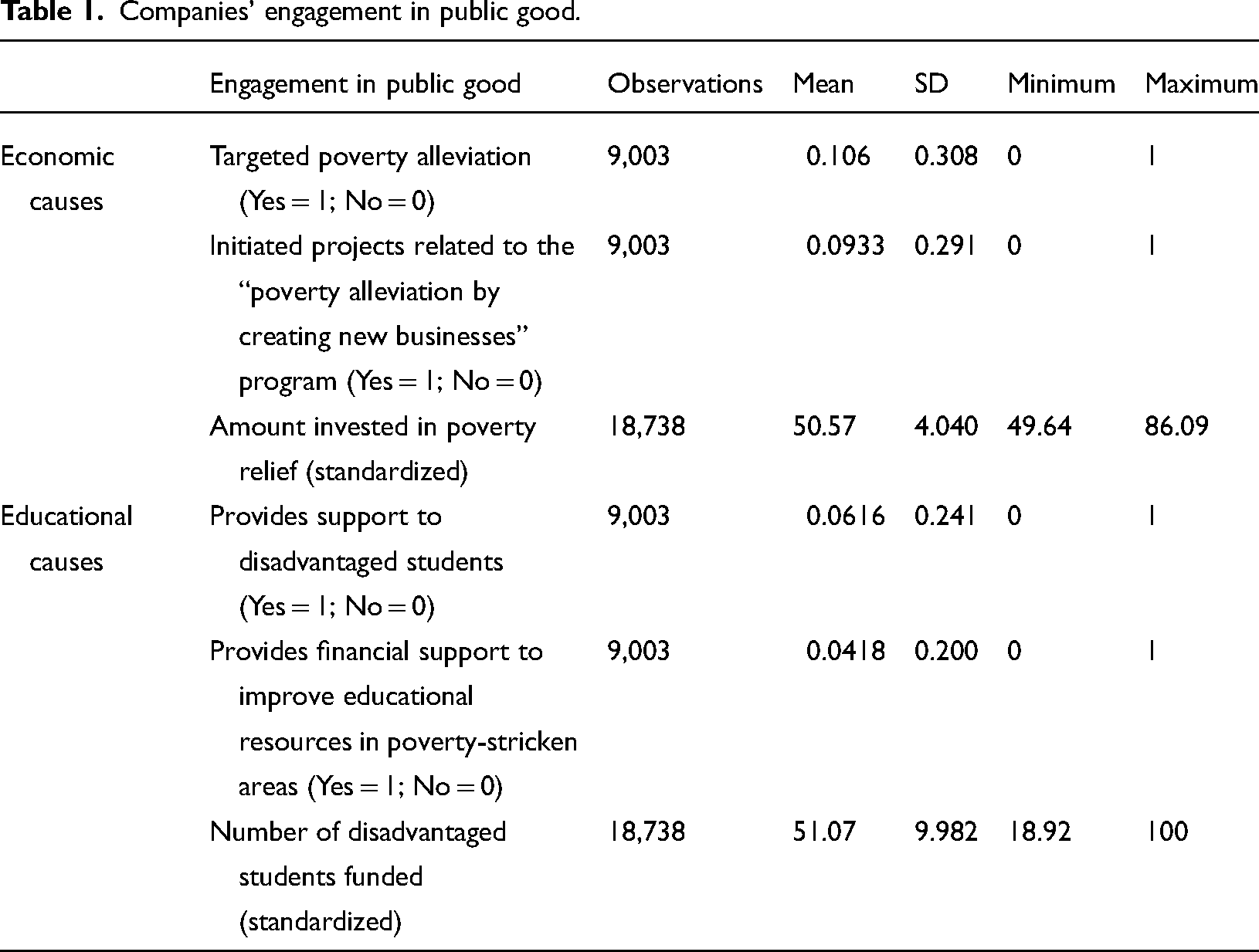
This study analyzed firm engagement in causes for the public good in terms of frequency and investment. As Table 1 shows, although educational causes remained an important component of companies’ engagement in public good, more companies engaged in economic causes than in educational causes.
Companies’ engagement in public good.
Results
Impact of top managers’ higher educational background and place of origin on firm engagement in economic causes
Companies engage in public good through various causes. This study first investigated the impact of top managers’ academic qualifications and place of origin on their companies’ engagement in economic causes. It used three indicators to measure firm engagement: targeted poverty alleviation (via financial support), having projects in the government-driven “poverty alleviation through creating new businesses” program (hereinafter poverty alleviation program), and the actual amount invested in poverty relief.
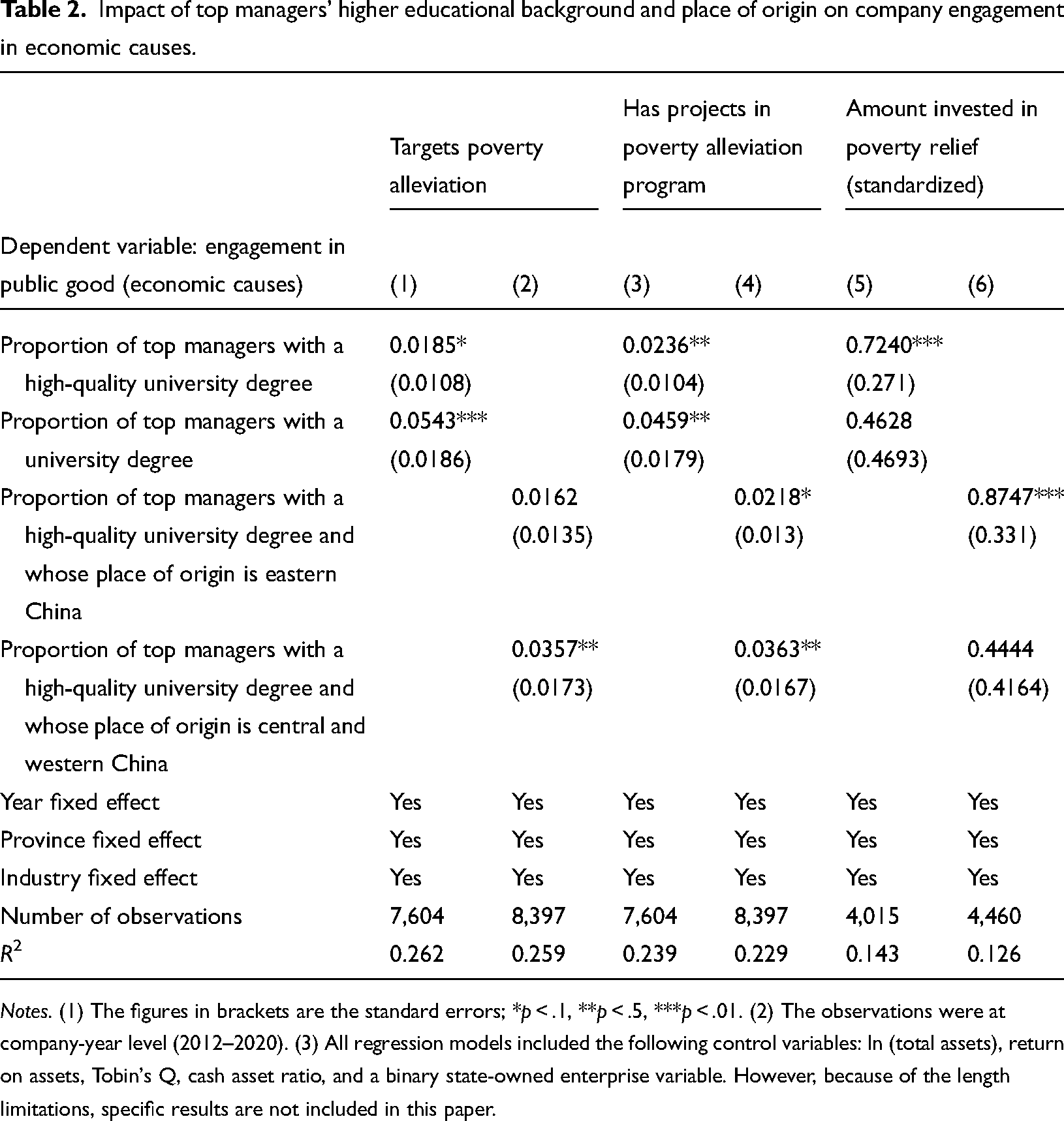
In Table 2, Models (1) and (2) show the results when targeted poverty alleviation was the dependent variable. The values of R2 suggest that, in general, the independent variables were able to explain 25.9%–26.2% of the dependent variables. The coefficients of top managers with a high-quality university degree and those with only a university degree were 0.0185 (p < .1) and 0.0543 (p < .01), respectively. Therefore, regardless of the type of university from which they graduated, top managers with a university degree had a significant positive impact on their companies’ engagement in targeted poverty alleviation. Moreover, the coefficient for top managers who had a high-quality university degree and originated from central and western China was 0.0357 (p < .05), indicating that the combined effect of university degree and place of origin, specifically from central and western China, had a significant positive impact on companies’ engagement in targeted poverty alleviation.
Impact of top managers’ higher educational background and place of origin on company engagement in economic causes.
Notes. (1) The figures in brackets are the standard errors; *p < .1, **p < .5, ***p < .01. (2) The observations were at company-year level (2012–2020). (3) All regression models included the following control variables: ln (total assets), return on assets, Tobin's Q, cash asset ratio, and a binary state-owned enterprise variable. However, because of the length limitations, specific results are not included in this paper.
In Models (3) and (4), the poverty alleviation program was defined as the dependent variable. The values of R2 suggest that, in general, the independent variables were able to explain 22.9%–23.9% of the dependent variables. The coefficients of top managers with a high-quality university degree and those with a university degree were 0.0236 (p < .05) and 0.0459 (p < .05), respectively. Therefore, regardless of the type of university, having top managers with a university degree had a significant positive impact on companies’ engagement in the poverty alleviation program. That said, managers with a degree from a high-quality university degree had a more significant impact in this respect. Moreover, the coefficients of managers with a high-quality university degree and whose place of origin was eastern, central, and western China were 0.0218 (p < .1) and 0.0363 (p < .05), respectively. Therefore, as in the previous case, managers with a university degree who originated from central and western China had a greater effect on companies’ participation in the poverty alleviation program.
Financial contribution to poverty relief was also an important indicator of companies’ engagement in economic causes. In Table 2, the values of R2 in Models (5) and (6) show that the independent variables were able to explain 12.6%–14.3% of the dependent variables, indicating that top managers’ place of origin and educational background had a significant impact on companies’ financial contributions to poverty relief. The coefficients of managers with a high-quality university degree and those with the combined effect of a high-quality university degree and place of origin from eastern China were 0.724 (p < .01) and 0.8747 (p < .01), respectively. This suggests that the effect of place of origin was different in this dimension compared with the previous two dimensions.
Impact of top managers’ higher educational background and place of origin on firm engagement in educational causes
Educational causes for public good are an important way of promoting economic development and common prosperity. Therefore, this study investigated the impact of top managers’ academic qualifications and place of origin on firm engagement in educational causes. It used three indicators to measure firm engagement in educational causes: providing support to disadvantaged students, providing financial support to improve educational resources in poverty-stricken areas, and number of disadvantaged students funded.
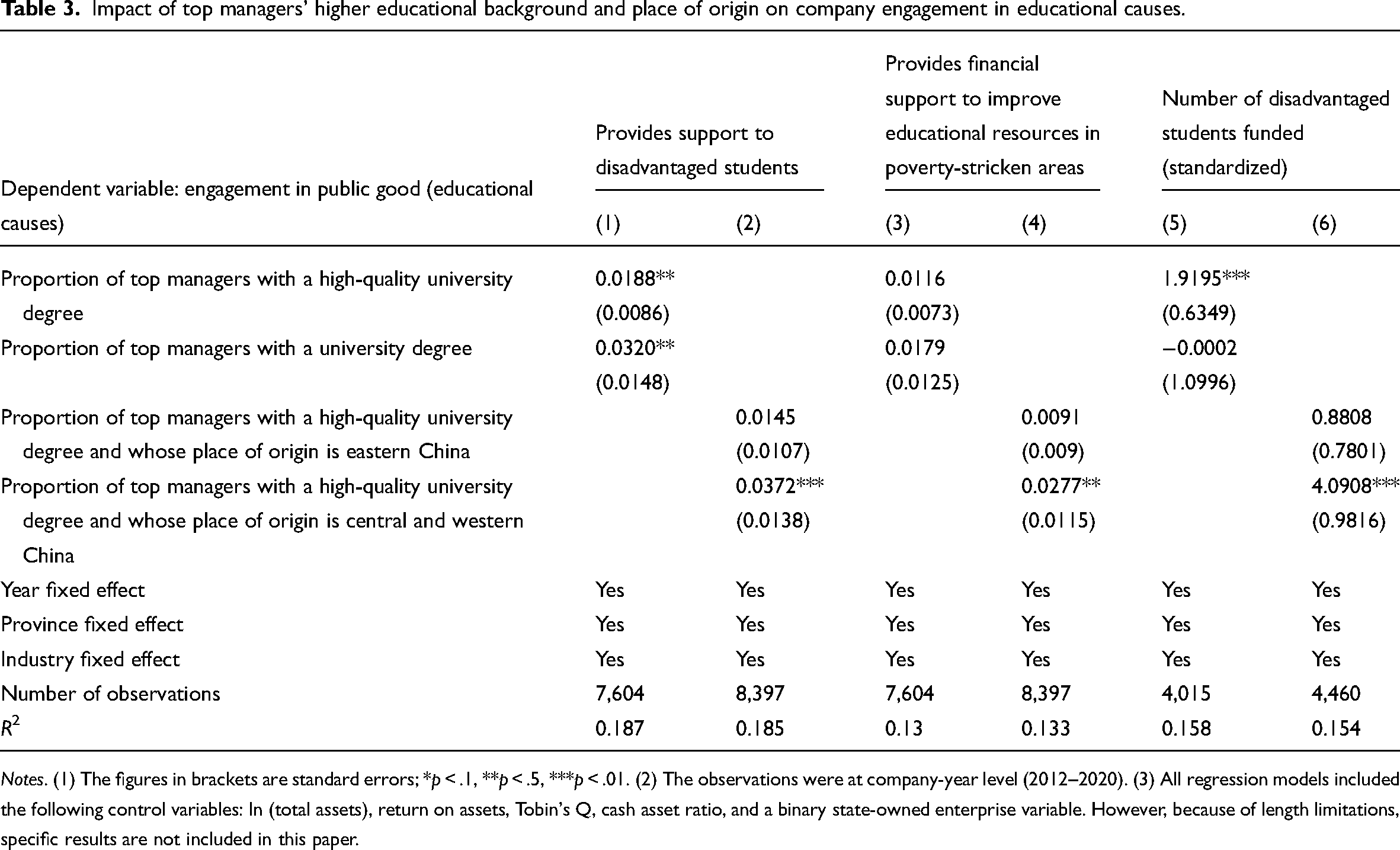
In Table 3, Models (1) and (2) present the results when providing support to disadvantaged students is the dependent variable. The values of R2 show that the independent variables were able to explain 18.5%–18.7% of the dependent variables. The coefficients of top managers with a high-quality university degree and proportion of top managers with a university degree were 0.0188 (p < .05) and 0.032 (p < .05), respectively. However, having more top managers with a high-quality university degree appeared to have a greater impact. The coefficient of top managers with a high-quality university degree whose place of origin was central and western China was 0.0372 (p < .01), while that of top managers with a high-quality university degree whose place of origin was eastern China was statistically insignificant. These results suggest that having more top managers with a high-quality university degree and whose place of origin was eastern China had no effect on their companies’ support of disadvantaged students.
Impact of top managers’ higher educational background and place of origin on company engagement in educational causes.
Notes. (1) The figures in brackets are standard errors; *p < .1, **p < .5, ***p < .01. (2) The observations were at company-year level (2012–2020). (3) All regression models included the following control variables: ln (total assets), return on assets, Tobin's Q, cash asset ratio, and a binary state-owned enterprise variable. However, because of length limitations, specific results are not included in this paper.
This study then used the provision of financial support to improve educational resources in poverty-stricken areas as the dependent variable. In Table 3, the values of R2 for Models (3) and (4) show that the independent variables were able to explain 13%–13.3% of the dependent variables. More specifically, the coefficients of top managers with a high-quality university degree and proportion of top managers with a university degree were positive, but not statistically significant. However, the coefficient of top managers with a high-quality university degree whose place of origin was central and western China was positive (0.0277, p < .05).
This study then introduced the number of disadvantaged students funded as the dependent variable to explore company engagement in educational causes. In Table 3, the values of R2 in Models (5) and (6) show that the independent variables were able to explain 15.4%–15.8% of the dependent variables. The coefficient of top managers with a high-quality university degree was 1.9195 (p < .01), indicating that having more top managers with high-quality university degrees positively influenced the number of disadvantaged students funded by the companies. The coefficient of top managers with a high-quality university degree whose place of origin was central and western China was also positive (4.0908, p < .05). These findings suggest that top managers with a high-quality university degree and whose place of origin was eastern China had limited influence on their companies’ engagement in educational causes, while top managers who originated from central and western China played a more important role in promoting public good at the educational level.
How higher educational background and place of origin affect firm engagement in economic and educational causes
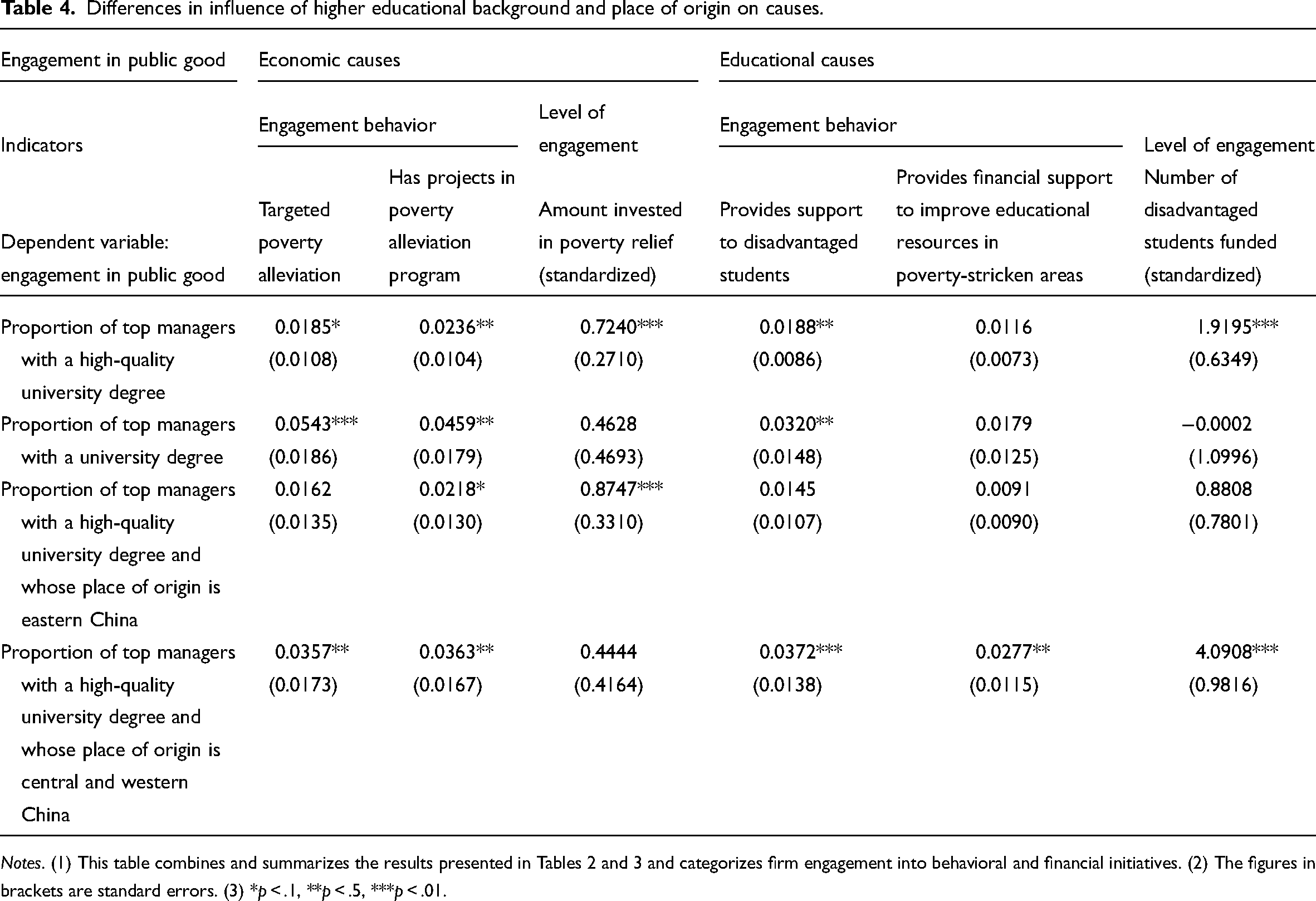
To provide a more intuitive examination of the influence of manager background on firm participation in different types of public good, this study combined the results of the analyses above in Table 4.
Differences in influence of higher educational background and place of origin on causes.
Notes. (1) This table combines and summarizes the results presented in Tables 2 and 3 and categorizes firm engagement into behavioral and financial initiatives. (2) The figures in brackets are standard errors. (3) *p < .1, **p < .5, ***p < .01.
Further comparison revealed that high-quality university education was significantly positively correlated with firm participation for most causes. The particular influence of managers with a high-quality university degree was reflected in the level of engagement indicators, including the number of disadvantaged students funded and the amount of funding that contributed to poverty relief. Meanwhile, participation of firms in such behavior generally increased when managers had a university degree, regardless of university. These findings suggest that, in terms of the level of firm engagement in public good, high-quality higher education has a more prominent impact on achieving common prosperity than does general higher education.
Managers’ place of origin was found to have a varying impact on firm engagement for most causes. Compared with top managers from eastern China, a significant positive correlation was found between managers who held a high-quality university degree and originated from central and western China and almost all types of causes. These findings suggest that companies whose managers had a high-quality higher education and tended to come from central and western China management were more actively engaged in public good, thus making a greater contribution to common prosperity. This may be due to top managers from central and western regions having a better understanding of poverty than their peers from eastern regions, resulting in their exhibiting a stronger sense of social responsibility and greater willingness to encourage their companies to engage in public good.
Discussion and conclusion
Discussion
The findings of this study are as follows. First, higher education plays an important role in promoting public good, and firms with top managers who have a high-quality university degree tend to engage in causes for public good more frequently. More specifically, results showed that top managers with a general or high-quality university degree were more likely to actively guide their company toward economic public good causes (i.e., targeted poverty alleviation, participating in government-driven poverty alleviation programs, and providing larger financial contributions to aid poverty relief) and educational causes (i.e., providing support to disadvantaged students, offering financial aid for educational resources in poverty-stricken areas, and funding disadvantaged students).
Second, in terms of the type and level of engagement, this study found that higher education has a positive impact on companies’ general contributions toward public good, with high-quality higher education having a stronger impact on the degree of such engagement. Further comparison revealed that higher education has a positive impact on both engagement behavior and level of participation in public good activities. In this respect, high-quality higher education was found to have a particularly marked impact on the level of engagement. More specifically, a university degree was found to play a more active role in firm participation in the poverty alleviation program and the provision of support to disadvantaged students. High-quality higher education played a particular role in the level of such engagement (i.e., intensity and depth), and companies with a higher proportion of top managers who had received high-quality higher education tended to contribute more financial support to poverty relief and disadvantaged students. In this sense, education “quality” can be considered to play a greater role in achieving common prosperity.
Third, firm engagement is regionally heterogeneous. In this study, top managers who originated from the central and western regions and received a high-quality university degree were a major force driving firm engagement in public good. Comparison of top managers’ regions of origin revealed that top managers who received high-quality higher education and originated from the central and western regions were the key driving force in firm engagement in public good. More specifically, these managers were found to have a positive impact on their companies’ provision of financial support to targeted poverty alleviation, participation in the poverty alleviation program, provision of support to disadvantaged students, provision of financial support to improving educational resources in poverty-stricken areas, and the number of disadvantaged students funded. In contrast, the proportion of top managers who originated from eastern regions was found to have no impact on companies’ engagement in most of the public good causes explored in this study.
Policy implications
These findings have several policy implications. First, behavior beneficial to public interest can be guided through preferential policy and by encouraging top managers to actively assume social responsibility and engage in public good. From its findings, this study suggests that the government actively promote firm engagement in public good and implement preferential policies to motivate such engagement. Prioritizing certain resources for companies engaged in public good or providing such firms with more opportunities for long-term government–private cooperation may motivate more companies to contribute to the public good. Preferential tax policies to reduce the financial impact of supporting disadvantaged students and improving educational resources in poverty-stricken areas for firms may also be effective, as well as other policies that encourage the reduction of the regional poverty gap and promote people's quality of life.
Second, the government should develop high-quality higher education and improve the quality of higher education to promote the level of firm engagement in public good. The results of this study demonstrate that higher education, especially high-quality higher education, is an important driving force behind firm engagement in public good, with high-quality higher education shown to play a key role in promoting the level of such engagement. To leverage such a relationship, the government should continue developing high-quality higher education, with a particular focus on the quality of higher education. Such strategies should be combined with a focus on promotional activities targeting top managers with high-quality academic degrees to guide their companies toward public good and increase their level of active engagement therein. Emphasizing educational “quality” opens a clear pathway for promoting the development of causes beneficial to the general public and common prosperity.
Third, the coverage of high-quality higher education should be expanded in the central and western regions of China, and emphasis should be placed on causes beneficial to public interest to achieve common prosperity through poverty alleviation measures. According to the findings of this study, relevant parties—such as universities—should provide students in central and western regions with more opportunities to receive high-quality higher education, thus giving full play to the public benefits brought about by high-quality higher education. In this respect, the government should work on fostering a sense of social responsibility among students through higher education, so that students from central and western regions continue to become top managers who incorporate a sense of social responsibility into their decision-making and strategic planning. In turn, such managers will guide their companies toward public good from multiple dimensions and at multiple levels, thereby improving social welfare.
Conclusion
Despite its benefit for society, companies exhibit wariness toward engaging in causes for public good and are often cautious about taking direct action. In the announcements on the involvement of listed companies in supporting poverty relief, declarations such as “the said donation does not have a material impact on the current and future operating performance of the company” were fairly common. As such, it is important that the government pay attention to removing any restrictions and barriers that might hinder companies’ engagement in public good.
The contribution of this study is twofold. First, few empirical studies have investigated the impact of higher education on public good in terms of top managers. Addressing this gap, this study employed empirical data to test the theories and results of past domain-specific research, focusing on the impact of top managers’ background (education and place of origin) on the engagement of listed companies in public good. The findings of this study thus contribute to the development of corresponding research. Second, this study proposed a set of innovative and comprehensive indicators to measure companies’ engagement in public good and explored the influence of managers’ quality of higher education on the firm's engagement in economic and educational causes, as well as the level of such engagement. In this regard, this study's findings further underscore the significance of high-quality higher education for societal development.
These contributions notwithstanding, this study has some limitations. First, it did not include non-listed companies or micro and small enterprises. Second, the data used for the analysis were mainly at the company-year level and did not cover the complexities at the individual level within companies. Future studies should cover a broader scope of companies to obtain a more comprehensive understanding of the motives, means, and effects of company engagement in public good and the promotion of common prosperity.
Footnotes
Contributorship
The two authors of this paper were jointly responsible for conceptualization, methodology, project administration, and supervision of the research. Xiaolan Zhou was responsible for investigation and original draft writing, and Kailin Wu was responsible for review writing and editing.
Declaration of conflicting interests
The authors declared no potential conflicts of interest with respect to the research, authorship, and/or publication of this article.
Funding
The authors disclosed receipt of the following financial support for the research, authorship, and/or publication of this article: This study was supported by the Youth Project of the National Natural Science Foundation of China, “Theoretical and Empirical Analysis of International Trade Policies of Chinese Automobile Sector” (71603159).
