




Abstract
Purpose
This study examines the career and educational search competencies (CESC), a capability which may be necessary for a successful transition from high school to work or postsecondary education, of students from Shanghai and Hong Kong.
Design/Approach/Methods
The data for this study was taken from the Main Study of PISA 2012 in Shanghai and Hong Kong. Regression analysis was used to examine the relative impact of different forms of career and educational exploratory activities on students’ CESC.
Findings
Results showed a consistent pattern of socio-economic inequality in student's self-reported CESC in the two Chinese cities, which was largely mediated by the family capital or resources. Besides, career and educational exploratory activities initiated by schools, enterprises or the students themselves were found to have significant positive associations with CESC regardless of socioeconomic status.
Originality/Value
The paper provides empirical evidence for enhancing students’ career search capacity through engaging in career exploration in the face of structural barriers. In light of this, the roles of schools, business sectors, and governments in students’ capacity building are discussed.
Introduction
The structural influence of gender and family background on adolescents’ postsecondary transition, which has been shown in many nationwide longitudinal transition studies across different countries (Fletcher, 2012; Iannelli & Smyth, 2008; Lamb, 2001; Lamb & McKenzie, 2001; Rumberger, 2010), may be explained by a number of possible reasons. For example, it might be that adolescents from a lower class flounder or experience failure in their transition from school to work because of structural barriers such as lack of material resources, social networks and career information and resources. As shown in previous studies, career and educational search competencies (CESC) is a capacity which has a substantial effect on the transition from high school to work or to postsecondary education (Liu, Huang, & Wang, 2014; Loyalka, Song, Wei, Zhong, & Rozelle, 2013). The present study will examine how gender and socio-economic background affect adolescents’ self-reported CESC. It will also examine how students’ CESC are associated with their engagement in career and educational exploratory activities (CEEA) initiated by schools, enterprises or students themselves.
An international comparative perspective will be introduced by drawing on data from the Programme for International Student Assessment (PISA), a large-scale international educational study organized by the Organization for Economic Co-operation and Development (OECD). In particular, data analysis is conducted for two participating Chinese cities, Shanghai and Hong Kong. While both of these cities have undergone considerable development in career guidance and expansion in higher education in recent years, this paper may reveal commonalities and differences between these two cities, with regard to the effect of student background (socio-economic status, gender and family capital) on career and educational search competencies. It may also cast light on how career interventions may affect students’ search competencies in the two Chinese cities, which share similar cultural roots but display divergent social, economic, and political conditions and development.
Relationship between Career and Educational Search Competencies (CESC) and Students’ Postsecondary Transition
Nationwide longitudinal transition studies conducted in Australia, the United States and European countries have shown that students of a low socio-economic status (SES) were less likely to be employed (Fletcher, 2012; Lamb, 2001; Lamb & McKenzie, 2001) and less likely to complete higher education (Iannelli & Smyth, 2008; Rumberger, 2010) than their high SES counterparts. A possible reason for these inequalities may lie in the difference in students’ ability to obtain information about employment and postsecondary education. In this paper, we define the ability to obtain education and career-related information and prepare for job application and admission to postsecondary education as career and educational search competencies (CESC). In the following we will review the previous findings on the relationship between CESC and students’ postsecondary transition, and the knowledge gap regarding CESC in the current literature.
As for career search competency, Liu, Huang, and Wang (2014) had conducted a meta-analytic review of 47 job search intervention experiments. They identified two important components of career search competency, namely job search skills and self-presentation skills. They found that the odds of obtaining employment were more than 3 times higher for job seekers participating in a job search intervention that included teaching job search skills and improving self-presentation than those in the control group. This indicates that career search competencies are crucial for increasing the likelihood of obtaining employment which, in turn, is essential for a successful school-to-work transition.
Regarding educational search competency, it has received less attention in research (Perna, 2006). Based on the analysis of data from the National Education Longitudinal Study (NELS), a large-scale longitudinal study in the United States, Plank and Jordan (2001) showed that increased information about higher education was significantly and positively associated with students’ enrollment in postsecondary institutions. Furthermore, a review by the U.S. Government Accounting Office (GAO) on the High School and Beyond (HS&B) Survey and nine more studies, reported that high school students in the U.S. generally had poor knowledge about federal financial aid (U.S. GAO, 1990). Many of them overestimated or underestimated the cost of college attendance, and had misconceptions about eligibility to apply for financial aid.
Knowledge about the availability of financial aid was found to be associated with postsecondary school enrollment. Specifically, students who were aware of the availability of financial aid were more likely to enroll in postsecondary schools than those who were not. A review by Perna (2004) indicated that there was a positive relationship between students’ awareness of college costs and financial aid and their application for admission to a four-year college or university and enrollment in a four-year institution.
Similar findings have also been shown in Chinese cities. In an experimental study in Shaanxi Province of China, Loyalka et al. (2013) compared the college choice and the likelihood of receiving financial aid, of two groups of students. One group were students who received information intervention, that is, who were provided with information on college costs and financial aid, whilst the other group were students who did not receive such information. Results showed that the treatment group was significantly more likely to choose to attend college and to receive financial aid than the control group. Taken together, all these findings demonstrate that the ability to obtain information about postsecondary education and student financing, that is, educational search competencies, appears to be important for students’ application, enrollment, and therefore, successful transition into postsecondary education.
Knowledge Gap in CESC
Despite the significant role of CESC in students’ transition, which has been evidenced in the above findings, little has been known about how CESC vary among different student populations. In earlier research, inconsistent findings were found regarding the relationship between CESC and other student characteristics such as socio-economic background and gender. For instance, while Hossler, Schmit and Bouse (1991) reported a negative relationship between family income and students’ knowledge of postsecondary costs and financial aid, Horn, Chen and Chapman (2003) reported a positive relationship between the two. The U.S. GAO (1990) report showed that while students from low-income families were more aware of grant programs, students from high-income families were more aware of loan programs. A more recent study by Verhaeghe, Li and Van de Putte (2013) further revealed socio-economic inequalities in getting access to job-finding resources: labor market entrants whose parents had a lower educational level and employment status had less access to labor market information and job information than those whose parents were better educated and had higher status jobs.
Apart from socio-economic background, gender is another student characteristic which has been studied in this regard. While some studies did not find any gender differences in the awareness of financial aid (U.S. GAO, 1990) or record any effects on female participants regarding the effectiveness of career search intervention (Liu et al., 2014), others reported a greater likelihood of attending college by female students upon receiving information intervention (Loyalka et al., 2013). To address these inconsistent findings, the present study aims at filling the knowledge gap in the current literature regarding CESC, a variable which may be contributing to the success of students’ transition, of different student populations, male and female, high and low SES, and students from families with a different amount of capital available.
Role of Career and Educational Exploratory Activities (CEEA)
Another focus of this study is to examine how CESC is associated with career intervention. We propose that career and educational exploration may be an important step for the acquisition of career and educational search competencies and thus a successful transition. According to Stumpf, Colarelli and Hartman (1983), the career exploration process comprises self-exploration and environmental exploration, which means that a person evaluates his or her own goals, values, interests and abilities, as well as gathers information about the world of careers and job opportunities, respectively.
Based on a meta-analysis of 47 experiments, Liu et al. (2014) found that job search interventions had increased a person's career search competency. Taking into account that career exploration is one of the elements in many of these job search intervention experiments (e.g., Koen, Klehe, & van Vianen, 2013; Proudfoot, Guest, Carson, Dunn, & Gray, 1997), it can be argued that career exploration may have the potential to enhance career search competency. In this paper, we will examine how career exploratory activities are associated with students’ self-reported career search competency, and will extend our investigation to educational search competency to make up for aspects seldom covered in the current literature. Furthermore, while previous studies focused on the possible difference in the engagement in career exploratory activities among different student populations (Cheung & Arnold, 2010; Rogers & Creed, 2011; Verhaeghe et al., 2013), this study will explore the possible interaction effect between career exploratory activities, gender and socio-economic status on students’ CESC.
Putting the Research in the Context of Two Chinese cities
The present study will introduce an international comparative perspective by analyzing the data from two Chinese cities, namely Shanghai and Hong Kong, both having outstanding performance in PISA 2012. While most of the studies on career and educational search and exploration reviewed above come from the United States, little evidence is available to show whether inferences from these studies can be applied to these two well developed Chinese cities.
In particular, there are great disparities between the development of career and educational guidance in Western societies and those in Mainland China. Despite its long history of vocational guidance, Mainland China lags behind in career development and counseling practice because of several decades of tumultuous political upheavals and disruptions after 1949 (Zhang, 1998; Zhang, Hu, & Pope, 2002). However, in the past almost 26 years, since Deng Xiaoping's southern tour of Shenzhen in 1992, the pace of economic transition has accelerated. The transitions from a planned economy to market-oriented economy and from state-guaranteed job security to market-oriented employment have led to an increasing demand for career guidance and counseling services.
Shanghai has been widely recognized as a pioneer in career guidance in Mainland China and has exerted substantial influences to other provinces (Zhou, Li, & Gao, 2016). This is exemplified by its mandating of career guidance courses in all secondary schools in 1993 and setting up of web-based career information for all students in 1998 (Zhang et al., 2002). While the development in career guidance in Shanghai is closely related to the change in China's economic system, which has given free career choice to students, it is also due to the change in the secondary and higher education systems in China. In the late 1980s and early 1990s, the introduction of vocational education in senior secondary level has created a need for career guidance of secondary students (Zhang, 1998). More recently, the higher education expansion policy implemented in China since 1999 has resulted in a rapid increase in college graduates, and thus a highly competitive job market and a strong demand for career services (Li, Whalley, & Xing, 2014; Zhou et al., 2016).
Hong Kong, which had been under the British colonial rule until 1997, has followed a different path from other cities in China in its development of career guidance. Despite the long history of career guidance in Hong Kong which dates back to 1950s, career guidance tended to be focused on information dissemination, which could be in the form of career talks and university visits, with little emphasis on self-exploration (Ho & Leung, 2016; Leung, 2002). The limited and fragmented provision of career guidance services might be due to the fact that career guidance, like education and social services, was only one of the means used by the colonial government in maintaining social stability and cohesion (Leung, 2002). This situation, however, has been changed when the New Academic Structure (NAS) was implemented in 2009, in which career development was highlighted by the Hong Kong Government as one of the major aims of secondary education (Curriculum Development Council, 2009). Similar to Shanghai, Hong Kong has undergone a rapid expansion in higher education system, especially in the self-financing sub-degree sector, since 2000. Higher education decision making has become more complicated than before, which creates a strong impetus for formulating policy pertaining to career guidance. In 2011, the Career Guidance Team of the Education Bureau put forward recommendations on career guidance for secondary schools which covered new principles of career guidance and new roles and responsibilities of career guidance personnel under the NAS. In particular, a paradigm shift in career guidance had been recommended which moved away from career information dissemination towards life planning education (Education Bureau, 2011, 2014a).
Compared with other parts of China, Shanghai and Hong Kong have had considerable development in career guidance in recent years. Both of them have also witnessed a rapid growth in higher education in the last two decades, which may have affected students’ decision making in postsecondary education and work. However, it is not clear from the existing literature how effective career guidance is, or how competent students are in educational and career search in both cities. It is interesting to investigate how the post-handover Hong Kong, and the post-reform Shanghai, differ on the matter of their students’ engagement in different types of career and educational exploratory activities and comprehension of career and educational search skills. The international nature of PISA has opened up an opportunity for comparing these two Chinese cities in this regard. In this study, we will examine the convergent and divergent patterns of adolescents’ career and educational search and exploration in Shanghai and Hong Kong.
Research Questions
The three research questions guiding this study are as follows:
How do students’ career and educational search competencies and participation in career and educational exploratory activities vary among Shanghai and Hong Kong?
To what extent are the career and educational search competencies of students in the two Chinese cities affected by student characteristics including socio-economic status, gender and family capital?
To what extent are the career and educational search competencies of students in the two Chinese cities associated with career and educational exploratory activities initiated by school, enterprises and the students themselves after the student background characteristics have been taken into account?
Methods
Data
The data for this study was taken from the Main Study of PISA 2012. PISA is a triennial international study which assesses 15-year-olds’ reading, mathematical and scientific literacy and collects contextual information including family and school backgrounds. Sixty-five countries and regions participated in the PISA 2012 Main Study. Among them were Shanghai and Hong Kong, where the student sample size was 5,177 and 4,670 respectively. The student samples were representative of the 15-year-old student population in its respective society.
Operationalization of the Major Constructs
All variables for the present study were selected from the database of the Student Questionnaire and Educational Career Questionnaire of the PISA 2012 Main Study. The independent variables were the student characteristics, that is, SES, gender and family capital or resources, and the career and educational exploratory activities (CEEA) participated in by the students. Table 1 shows the descriptive statistics of gender, SES and the four types of family capital for the two Chinese cities.
Descriptive statistics of gender, SES and family capital for Shanghai and Hong Kong.
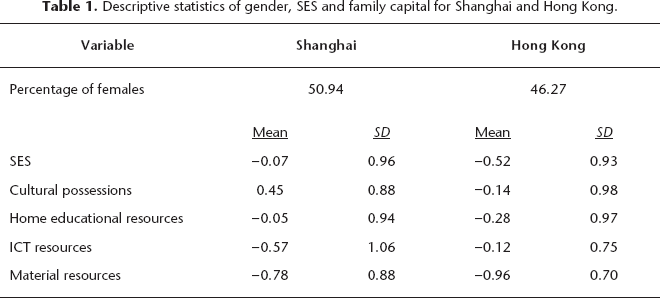
For socio-economic status, an index of SES was constructed by using the highest parents’ educational level and occupational level as reported by the students. It was standardized across all participating countries and regions with a mean of zero and a standard deviation of one. A positive value of SES represents a higher socio-economic status than the entire student sample, and vice versa. The index of Shanghai is around the OECD average (-0.07) and that of Hong Kong is much lower (-0.52).
For family capital, four PISA indices of resource were used, namely cultural possessions, home educational resources, information and communication technology (ICT) resources, and material resources. They were standardized across the 34 OECD countries with a mean of zero and a standard deviation of one. A positive value represents more resources than the OECD countries, and vice versa. The questionnaire items and operationalization of the four types of family resources can be found in the PISA 2012 Technical Report (OECD, 2014). The four indices of family capital of the two Chinese cities are generally lower than OECD average, except that Shanghai shows a higher level of cultural possessions than OECD countries. Besides, the family resources are all higher in Shanghai than Hong Kong except for the ICT resources.
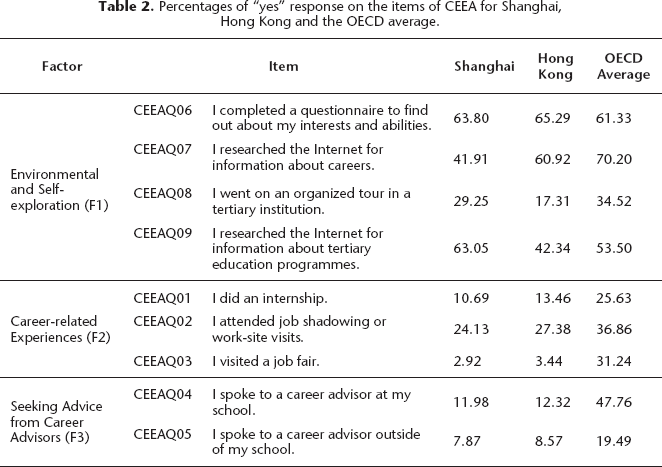
The questionnaire items for measuring CEEA are shown in Table 2. They are nine dichotomous items to which students responded “yes” or “no, never”. The Cronbach's Alpha for these items was 0.64, which was within the acceptable range of reliability. With respect to their content, these nine items were classified as either “environmental and self-exploration” (F1), “career-related experiences” (F2) or “seeking advice from career advisors” (F3). They correspond to the CEEA initiated by the students (F1), enterprises (F2) and schools (F3) respectively. To confirm this hypothesized three-factor structure, a confirmatory factor analysis (CFA) was conducted on all sampled students from the two Chinese cities by using LISREL 9.10 Student Edition. Results showed that the goodness-of-fit indices indicated good fit of the model (NFI=0.96; TLI=0.94; CFI=0.96; GFI=0.97; RMSEA=0.08).
Percentages of “yes” response on the items of CEEA for Shanghai, Hong Kong and the OECD average.
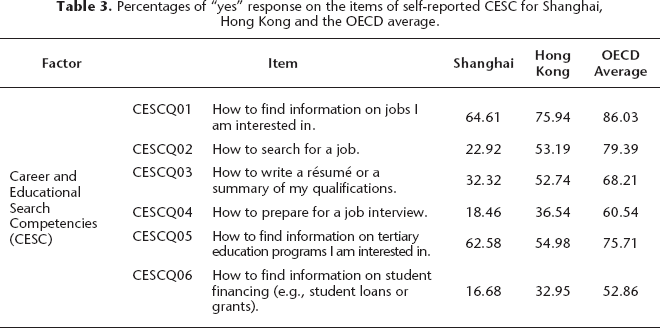
The only dependent variable used in this study is the self-reported career and educational search competencies (CESC). Table 3 shows the six items for measuring CESC, on which students answered whether they had acquired the competencies, on a 3-point nominal scale (1=Yes, at school; 2=Yes, out of school; 0=No, never). As students might acquire the search competencies both in and out of school, they were allowed to respond by choosing both 1 and 2. To present the construct of CESC as a coherent whole, these two responses were merged in the present study so that each item would be on a dichotomous scale (either a “yes” or “no, never” response). The Cronbach's Alpha for these six items was 0.76, which indicated that they had an acceptable level of internal consistency. Being similar in their content, these six items were hypothesized to have a single-factor structure. A CFA was then conducted to confirm this hypothesized factor structure. The goodness-of-fit indices indicated good fit of the model (NFI=.99; TLI=.97; CFI=.99; GFI=.99; RMSEA=.08).
Percentages of “yes” response on the items of self-reported CESC for Shanghai, Hong Kong and the OECD average.
Results
Descriptive Analysis of CEEA and CESC
Table 2 and 3 show the percentages of “yes” responses on the nine items of CEEA and the six items of CESC respectively for the two Chinese cities and the OECD average. Overall, the participation of CEEA of the two Chinese cities was lower than the OECD countries except in “completing a questionnaire” (CEEAQ06) and “researching the Internet for tertiary education information” (CEEAQ09). When comparing the two Chinese cities, more Shanghai students reported education-related exploratory activities such as “going on an organized tour in a tertiary institution” (CEEAQ08) and “Internet search for tertiary education information” (CEEAQ09), whereas more Hong Kong students reported career-related activities such as “doing an internship” (CEEAQ01) and “attending job shadowing or worksite visits” (CEEAQ02). As for CESC, the two Chinese cities consistently had a lower percentage of students reporting the six types of CESC than the OECD average. Hong Kong students appeared to be stronger than Shanghai students except for findintg information on interested tertiary education programs (CESCQ05).
Regression Analysis on the Effects of Student Characteristics and CEEA on CESC
Effects of Gender and Socio-Economic Status on CESC
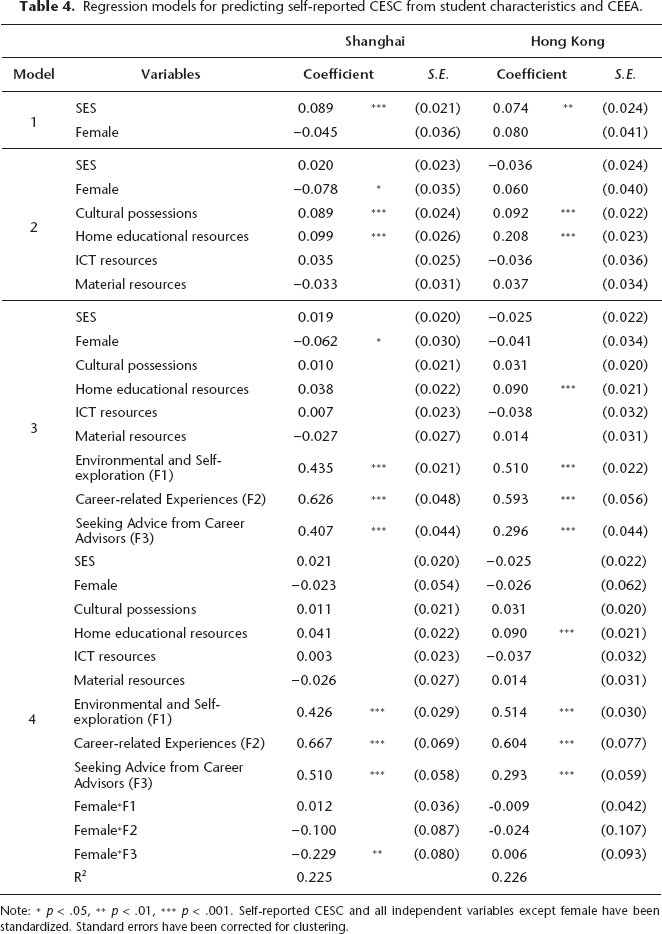
Multiple linear regression analyses were conducted for each of the two Chinese cities to determine if students’ CESC could be predicted by their socio-economic status and gender (see Table 4). Model 1 showed that SES had significant positive effects on CESC in the two Chinese cities. The significant regression coefficients of the two cities indicated that for an increase in one standard deviation of SES, students’ CESC would increase by about 0.1 standard deviations. The effect of SES appeared to be slightly stronger in Shanghai than in Hong Kong. On the other hand, gender effect was insignificant for both Shanghai and Hong Kong.
Regression models for predicting self-reported CESC from student characteristics and CEEA.
Note:
p < .05,
p < .01,
p < .001.
Self-reported CESC and all independent variables except female have been standardized. Standard errors have been corrected for clustering.
Effect of Family Capital on CESC
By incorporating the four variables of family capital into Model 1, regression Model 2 was constructed for each of the two Chinese cities (see Table 4). It can be seen that cultural possessions and home educational resources had significant positive effects on CESC across the two Chinese cities. The regression coefficients indicated that for an increase in one standard deviation of cultural possessions, students’ CESC would increase by about 0.1 standard deviations. For an increase in one standard deviation of home educational resources, their self-reported CESC would increase by 0.1 to 0.2 standard deviations. ICT resources and material resources did not have any significant effect on students’ self-reported CESC in any of the two cities.
Model 2 also shows that there were substantial changes to the regression coefficients of SES upon the incorporation of family resources or capital. In particular, the coefficients of SES for the two cities all reduced in their magnitude and became insignificant. These changes in the coefficients of SES signified that socio-economic status might manifest itself in the self-reported CESC partly through the cultural and educational resources provided by family.
For the gender effect, the negative coefficient of gender for Shanghai slightly increased in magnitude and changed from insignificant to significant. Interesting as it was, we speculated that this finding was due to the more family resources possessed by girls than boys, and so after controlling for family resources, girl tended to have even lower CESC in Shanghai. This was tested by comparing the family capital between both genders. Results from independent sample t-tests indicate that female students in Shanghai had significantly higher levels of cultural possessions (Female: Mean=0.57, SD=0.83; Male: Mean=0.34, SD=0.92; t(5,045)=9.47, p<.001), home educational resources (Female: Mean=0.01, SD=0.92; Male: Mean=–0.10, SD=0.96; t(5,131)=4.34, p<.001), and ICT resources (Female: Mean=–0.53, SD=1.05; Male: Mean=–0.62, SD=1.07; t(5,165)=3.10, p<.01) than male students. These results may explain why once the family resources were controlled for in Model 2, the females’ disadvantage in CESC became evident in Shanghai.
Effect of CEEA on CESC
Model 3 was constructed by incorporating the three factors of CEEA into Model 2 for the two cities (see Table 4). The results show that after accounting for the SES, gender, and family resources or capital of students, the three types of exploratory activities consistently had significant positive effects on their self-reported CESC in the two Chinese cities. Among the three types of activities, “career-related experiences” (F2) had the strongest effects, which were approximately 0.6 standard deviations of CESC. It was followed by “environmental and self-exploration” (F1), ranging from about 0.4 to 0.5 standard deviations of CESC, and “seeking advice from career advisors” (F3), the effects of which ranged from 0.3 to 0.4 standard deviations of CESC. These findings clearly show the value-adding effects of CEEA on the self-reported CESC regardless of students’ socio-economic background.
Effect of Interaction between Gender and CEEA on CESC
To examine the existence of any interplay between the students’ characteristics and CEEA, interaction terms were constructed among SES, gender, and the three variables of CEEA and incorporated into the model. While no significant interaction effects were found between SES and gender, and SES and CEEA (not reported in this paper), the interaction between gender and CEEA did have a significant effect on CESC in Shanghai (see Table 4). Model 4 shows that for Shanghai, the regression coefficient of the interaction term between gender and “seeking advice from career advisors” (F3) was about −0.2 and significant. It indicated that this type of CEEA benefitted boys more than girls in Shanghai. All the interaction terms were not significant for Hong Kong, which indicated that the three types of CEEA might benefit boys and girls equally in nurturing career and educational search competencies in Hong Kong.
The results from Model 4 are of interest, because they indicate a specific gender difference in one of the two Chinese cities which may be explained in light of its unique socio-cultural context. It may not be surprising to find negligible interaction terms for Hong Kong because of its fairly equal access to career education for both genders, yet, this is not so in Mainland China, where gender inequality persists. In Shanghai, the significant main effects of gender in Model 2 and 3 showed that girls were generally disadvantaged after the socio-economic background, family resources and CEEA were taken into account. The absence of main effect of gender as shown in Model 4 for Shanghai, and the significant interaction term further showed that gender inequality was largely mediated by the less access to career advice of female students from career advisors. Future studies may see whether the interaction between CEEA and gender found in Shanghai are generalizable to non-Chinese and non-OECD countries where there is still a high degree of gender inequality.
Discussions
The findings of this study have revealed the convergences and divergences in students’ self-reported CESC, their participation in CEEA, the socio-economic and gender inequality in CESC, and the effect of CEEA on students’ CESC in Shanghai and Hong Kong. Specifically, both cities displayed a generally lower participation in CEEA and lower levels of CESC when compared with OECD countries. For some of the career exploratory activities, students from both cities were comparable in their participation, but for the others, Hong Kong students had higher participation than Shanghai students. However, for the educational exploratory activities, Shanghai students had higher participation than Hong Kong students. These findings might be related to the more proactive policy and practice in career guidance in Hong Kong and educational guidance in Mainland China in recent years (Education Bureau, 2014b, 2015; Zhang et al., 2002). In 2014, the National Higher Education Entrance Examination (i.e., Gaokao) system in China has undergone a reform, which breaks down the conventional demarcation between science and arts track. It can be anticipated that there may be an increase in the demand for career counseling services of Shanghai students for choosing secondary school subjects and college majors. Further study may find out how changes in educational system as such are related to students’ participation in CEEA.
As for self-reported CESC, Hong Kong students were in general more competent than Shanghai students, except for finding information on tertiary education programmes. The finding that Shanghai students felt more capable than Hong Kong students in quest of tertiary education programs might be related to the ample opportunities of pursuing higher education in Shanghai. According to statistics by the OECD and the World Bank, the gross enrollment rate in tertiary education for Shanghai was over 80 percent in 2009, which was exceedingly high and surpassed the rate of Hong Kong (55 percent), and Mainland China as a whole (22 percent) (OECD, 2011; The World Bank, 2015). The number of higher education institutions in Shanghai was 61 (OECD, 2011), which was much more than in Hong Kong (19) (Education Bureau, 2014c). The lower number of university places and higher education institutions in Hong Kong might limit the choice of higher education programs that students were interested in.
The regression models have shown a consistent pattern of socio-economic inequality in self-reported CESC in the two Chinese cities, which is largely mediated by parents’ investment in cultural possessions and home educational resources. In addition, they have revealed how the various types of CEEA might be brought into play to enhance students’ CESC. On one hand, this study substantiates the relationship between socio-economic background and CESC, which may be a contributor to the socio-economic inequality in postsecondary transition as evident in many previous studies (Fletcher, 2012; Rumberger, 2010). On the other hand, it provides evidence on the positive role of CEEA in the acquisition of CESC, a finding which is consistent in both Chinese cities.
Another notable finding in this study is the interaction effect of CEEA and gender in Shanghai, which was not found in Hong Kong. This suggests that CEEA may have different effects in societies where there is a higher degree of gender inequality. While this finding reveals the differential effects of CEEA in different social contexts, it draws our attention to the disadvantage faced by females notwithstanding the rapid development in career guidance in pioneering societies like Shanghai. An implication from this finding is that in societies where career guidance services are more well-developed, more emphasis can be put on equality than on quantity in provision, and more attention should be given to disadvantaged groups including females, people with disabilities and rural populations (Zhou et al., 2015).
Practically speaking, this study suggests the possibility of building the capacity of students in overcoming the difficulties throughout the career and educational search process. In particular, as shown in the regression models, socio-economically disadvantaged students are more likely to report poorer CESC and be less effective in career search. This might be due to what Freeman (1979) called the “null environment” experienced by lower class students, that is, an environment that neither encourages nor discourages them in their pursuit of educational and career goals (Betz, 1989).
Richardson (2000) argued that the responsibility for building the capacity for career development should be borne by both the individual and the social system. She claimed that an individual could only be empowered when the social system was committed to empowering them. Putting this claim in the present study, while a person has to be responsible for making use of the opportunities for developing his or her CESC, it is the responsibility of education and career assistance providers to provide such opportunities. In the following, we will briefly discuss how schools, business sectors, and governments may take a role in providing CEEA for students which may help to build their CESC.
Given that some students may have limited access to career information and resources from their parents, schools represent an important avenue where students may gain access to information and resources which are otherwise beyond their reach. This is evidenced by the present finding that students’ CESC was enhanced by their seeking advice from career advisors either in school or outside school.
Stanton-Salazar (2011) has put forward the concept of “empowerment agents”, which means that instead of merely providing institutional resources and support, career guidance teachers should possess a “critical consciousness” about the societal structures, institutional policies and practices, and environmental conditions which hinder students’ efforts to achieve their educational and career goals. The present finding regarding the effect of “seeking advice from career advisors”, is statistically significant though still relatively small compared with other CEEA factors. It may suggest that additional efforts can be made to heighten the critical awareness of career guidance teachers so that they may be motivated to be an empowerment agent for students and be committed to striving for a vision of social justice, as an anchoring value for career guidance (Arthur, 2014).
Noting that schools alone may have limited resources for developing students’ career and educational search and life planning skills, many countries, including the United Kingdom, the United States, Canada and Australia, have tapped the resources of the business sectors, not only in terms of funding but also expertise, benefitting schools by various forms of school-business partnership (DEEWR, 2010). In contrast, it was not until the last decade when school-business partnership was advocated in Hong Kong. The findings here provide some evidence that in Chinese cities, students’ participation in career exploratory activities provided by business sectors such as internship and job shadowing was relatively low. These activities may be effective for the CESC capacity building of students.
From a public policy perspective, governments could take the initiative to encourage volunteerism in business sectors and among community members. The Business-School Partnership Programme (BSPP) launched by the Hong Kong Government is one such attempt to promote co-operation and alliances between business sectors and schools (HKSAR Government, 2015). However, it is still open to question whether government can facilitate a meaningful collaboration between business sectors and schools so that the resources mobilized can benefit students and improve their life opportunities. Further studies are also needed to investigate how a trust relationship can be established and maintained within the school-business partnership for the capacity building of students and schools.
In sum, evidence from the present study has demonstrated a disadvantage of low SES students in developing educational and career search competencies, a pattern which was consistent in the two Chinese cities. Nevertheless, such competencies may be enhanced by various forms of CEEA, no matter what socio-economic background a student belongs to. It might be suggested that well-designed educational and career exploratory activities catering for student interests and needs might make a difference. We also found that one of the CEEA, “seeking advice from career advisors”, benefitted boys much more than girls in Shanghai, which was not the case in Hong Kong. Further investigation is needed to examine the nature and reasons of gender-biased practices in CEEA in regions other than Shanghai in Mainland China or in other Chinese societies.
Footnotes
Acknowledgement
The authors are grateful for the support received from the Education Bureau of the Hong Kong SAR Government for the HKPISA2012 project. Opinions expressed in this article are the authors’ and do not necessarily reflect those of the granting agency.
Notes on Contributors
Esther Sui Chu Ho is Professor in the Department of Educational Administration and Policy and Director of the Hong Kong Centre for International Student Assessment at The Chinese University of Hong Kong. She has been the Project Manager of HKPISA–2000, 2003, 2006, 2009, 2012, 2015; Consultant of Macau–PISA–2003; China–PISA 2006 Trial Study and Shanghai–PISA 2009 Main Study. She was a Fulbright Scholar at Pennsylvania State University (2004) and Johns Hopkins University (2010); Research Associate for project Education and Development in South China. Teaching consultant at the World Bank in the District Primary Educational Program, India; and Principal Investigator of Home School Collaboration Project. Her research interests focus on parental involvement in children's education; home-school community collaboration; school effectiveness and school reform; decentralization and school-based management; research methodology in education; and multilevel analysis in educational research.
Kwok Wing Sum is Research Associate of the Hong Kong Centre for International Student Assessment at The Chinese University of Hong Kong. He has previously been the Research Associate of government-commissioned research projects titled “Further Evaluation on the Implementation of the Medium of Instruction Guidance for Secondary Schools” and “The Effect of Medium-of-Instruction Policy on Educational Advancement in HKSAR Society”. His research interests include youth transition to higher education or work, and expansion and privatization of higher education.
Raymond Sin Kwok Wong is Emeritus Professor in the University of California Santa Barbara. His research interests include social stratification and mobility, comparative sociology, economic sociology, sociology of education, and quantitative methods.