




Abstract
Purpose
—The aim of this study is to explore the relationships between dimensions of teacher efficacy and affective well-being while focusing on the roles of demographic characteristics (gender, grade level, educational background, and seniority).
Design/Approach/Methods
—1,115 primary and 541 secondary school teachers in Hong Kong participated in the questionnaire survey. A series of t-tests, ANOVA, correlation analysis, and hierarchical multiple regressions were conducted.
Findings
—The younger teachers reported lower scores for well-being and efficacy than their senior counterparts, and the female and primary school teachers reported significantly higher levels of teacher efficacy for student engagement than their respective counterparts. Of the dimensions of affective well-being, pleasant affect was more closely related to teacher efficacy than negative affect, and the activated pleasant dimension of enthusiasm had the strongest influence. Of the three dimensions of teacher efficacy, efficacy for student engagement was most strongly associated with affective well-being.
Originality/Value
—The study revealed that teachers’ affective well-being is not only important in itself, but also contributes to classroom teaching. The enthusiasm and passion possessed and maintained by teachers could play important roles in enhancing their self-efficacy. Furthermore, maintaining a good affective well-being status and even a modest level of anxiety contributes to their efficacy for student engagement, a dimension on which teachers reported the least confidence. Suggestions were put forward on how to improve teacher efficacy and well-being.
Introduction
According to Klusmann, Kunter, Trautwein, Lüdtke, and Baumert (2008), teacher success depends on both the quality of instruction and the well-being of the teacher him/herself. Both aspects of teacher success depend on the extent to which teachers engage in or detach from their work under specific demanding or supportive environmental conditions (Bakker & Demerouti, 2007). While continuous effort has been taken to improve the quality and effectiveness of teachers’ classroom teaching, teacher well-being has not attracted enough attention from international scholars until the last decade (Aelterman, Engels, Van Petegem, & Verhaeghe, 2007; Liu, Song, & Pei, 2018; Milfont, Denny, Ameratunga, Robinson, & Merry, 2008; Spilt, Koomen, & Thijs, 2011). Teaching is one of the most stressful occupations (Johnson et al., 2005). Teacher well-being not only is important to individuals, but also has profound implications for organizational commitment, work effectiveness, and job performance (Diener, Suh, Lucas, & Smith, 1999; Maslach, Schaufeli, & Leiter, 2001; McInerney, Korpershoek, Wang, & Morin, 2018). Empirically, teachers’ personal characteristics, such as their emotion regulation strategies, self-regulatory patterns, and task flexibility, have also been found to impact their well-being and instructional performance (Klusmann et al., 2008; McInerney, Korpershoek, Wang, & Morin, 2018; Yin, Huang, & Wang, 2016). The association between teacher well-being and instructional quality is also well established. For example, teacher job satisfaction has been found to be related to both teacher commitment and teacher effectiveness (McInerney et al., 2018). Teacher well-being is related to a favorable classroom emotional climate, sound student-teacher relationships, and desirable levels of student motivation and achievement (Becker, Goetz, Morger, & Ranellucci, 2014; Reyes, Brackett, Rivers, White, & Salovey, 2012; Spilt, Koomen, & Thijs, 2011). In sum, environmental factors and personal characteristics have a joint effect on teacher well-being, which in turn, influences the smooth delivery of classroom teaching and the quality of instruction (Hall-Kenyon, Bullough, MacKay, & Marshall, 2014; McInerney et al., 2018; Pillay, Goddard, & Wilss, 2005).
Although these two aspects of teacher success have received extensive attention, limited attention has been paid to teachers’ sustainable personal growth. Teacher efficacy, defined as the extent to which teachers believe themselves capable of fulfilling certain teaching-related tasks and requirements in given contexts, reflects an important aspect of teacher personal growth. Although the mechanism by which teachers build efficacy and achieve personal growth deserves further empirical investigation, the prerequisites for teacher efficacy should be the success for both teaching quality and teacher well-being. Previous studies even have conceptualized teacher efficacy as either an indicator of teaching effectiveness and teaching quality (e.g., Yin, Huang, & Lee, 2017) or as a dimension of broadly defined professional well-being (e.g., Horn, Taris, Schaufeli, & Schreurs, 2004). Further, Tschannen-Moran, Hoy, and Hoy (1998) suggested that teacher efficacy depends on individual teachers’ subjective assessment of the external environment and their internal capabilities based on four sources of information: mastery experiences, associated emotional arousal, modeling, and social persuasion. Therefore, it is reasonable to assume that teachers’ efficacy can be altered by enhancing their subjective well-being and orienting their subjective assessments or by improving their instructional quality and increasing the amount of mastery experiences.
Compared with other aspects of teachers’ subjective well-being, positive and negative affect or affective well-being, defined as the recent occurrence of specific positive emotions (such as contentment) and negative emotions (such as anxiety), respectively, have received limited attention. The influence of positive and negative affect on individuals’ cognitive inclinations has been well documented. Anxious people are inclined to evaluate themselves negatively and pay preferential attention to external threats (Hallion & Ruscio, 2011). Affect also exerts power on one's reasoning, interpretation, judgement, and decision making (Blanchette & Richards, 2010). Meanwhile, the emotional side of teaching has been widely recognized and emotion-rich interactions between teachers and students are believed to be critical for students’ academic achievements and social and emotional learning. Empirically, forms of negative affect such as anxiety, depression, and worrying have been found to impede working memory and performance (McInerney et al., 2018; Owens, Stevenson, Hadwin, & Norgate, 2012), whereas forms of positive affect such as passion and enthusiasm are positively related to job performance and efficacy (McInerney et al., 2018). Therefore, investigating how teachers’ affective well-being may influence their efficacy for classroom teaching should be a promising way to understand teacher efficacy.
In addition, a few studies have reported individual differences either in teacher efficacy (Brandon, 2000; Klassen & Chiu, 2010) or in subjective well-being (Antoniou, Polychroni, & Vlachakis, 2006; DeNeve & Cooper, 1998), but none of them has considered the relationships between the two constructs after controlling for the demographic differences. Yet the examination of individual differences is a necessary first step in the process of knowledge acquisition. Thus, this study explores individual differences in teacher well-being and efficacy in terms of gender, grade level, educational background, and seniority, and then analyzes the relationship between teacher affective well-being and teacher efficacy.
Literature Review
Teacher Efficacy
Of the various types of teacher beliefs, teacher efficacy is one of the most widely explored. Researchers have made considerable effort to define and measure teachers’ individual and collective efficacy beliefs and to examine the potential effects of these beliefs on teaching and learning. Following Bandura's (1997) social cognitive theory, Tschannen-Moran and Hoy (2001) defined teacher efficacy as the extent to which teachers believe themselves to be capable of fulfilling three common types of teaching task in a classroom context. They also developed the Ohio State Teacher Efficacy Scale to measure three dimensions of teacher efficacy, namely efficacy for instructional strategies (IS), efficacy for classroom management (CM), and efficacy for student engagement (SE). According to Tschannen-Moran and Hoy (2001), efficacy for IS refers to teachers’ confidence in their abilities in terms of teaching planning, course delivery, and student assessment; efficacy for CM is the extent to which teachers believe that they can cope with disruptive behaviors in the classroom and launch teaching activities smoothly; and efficacy for SE is characterized by teachers’ positive evaluation of their capacity to promote student learning, motivate and engage students, and facilitate student growth. Unlike collective efficacy, which reflects how teachers of a faculty believe they can operate in concert and exert significant power on student achievement (Goddard, Hoy, & Hoy, 2000), teachers’ self-efficacy reflects teachers’ confidence in their own capability of classroom teaching and is the focus of this study.
Researchers have demonstrated that teacher efficacy is positively related to teachers’ positive attitudes toward their jobs, teaching commitment, and classroom performance, which are in turn related to student motivation and achievement (Tschannen-Moran & Hoy, 2001). Teacher efficacy is especially important when dealing with difficult or less motivated students (Bandura, 1997; Ross & Gray, 2006; Tschannen-Moran & Hoy, 2001). Unlike teacher well-being indicators, such as job satisfaction and burnout, or teaching quality indicators, such as student academic achievement and motivation, teacher efficacy combines teachers’ positive attitudes toward their jobs and abilities with their self-assertion of and confidence in their teaching performance. Therefore, affective well-being and teacher efficacy are distinct constructs, with the latter building on the former but referring to a broader range of professional or personal growth (Horn, Taris, Schaufeli, & Schreurs, 2004; Straume & Vittersø, 2015).
Generally, two processes are involved in shaping teacher efficacy. The first is the collection of information: there are four sources of efficacy information: one's own mastery experiences (mastery experiences), experience-associated physiological arousal (emotional arousal), vicarious experiences (modeling), and verbal persuasion (social persuasion) (Bandura, 1997; Tschannen-Moran et al., 1998). The second is cognitive assessment: teachers evaluate task complexity and personal competence based on the information collected in the first step and form their efficacy beliefs. These processes are cyclical, as current efficacy may direct teacher behavior, yielding new information for subsequent assessment.
Teacher Affective Well-Being
Teaching is an emotional endeavor (Yin, 2016). Teachers are responsible for not only students’ academic results, but also their mental health (Pillay et al., 2005). In addition to cognitive well-being indicators such as teaching satisfaction, teachers’ emotional and affective well-being and its effects must be explored. Further, Warr (1990) suggested that “a particular level of pleasure may be accompanied by high or low levels of arousal, and a particular level of arousal may be either pleasurable or un-pleasurable” (p. 195). Thus, Warr's (1990) affective well-being model combines both the valence and the arousal levels of emotions and thus reflects individuals’ subjective well-being comprehensively. The affective well-being model has four dimensions: (a) enthusiasm, an activated pleasant dimension characterized by cheerfulness, enthusiasm, and optimism; (b) contentment, a deactivated pleasant dimension characterized by calmness, contentedness, and relaxedness; (c) anxiety, an activated unpleasant dimension characterized by tension, unease, and worry; and (d) depression, a deactivated unpleasant dimension characterized by depression, gloom, and misery. Warr's (1990) affective well-being model contributes to a comprehensive understanding of teacher affective well-being and aids the extensive exploration of how these affective components relate differently to teacher efficacy, the construct reflecting teachers’ sustainable personal growth (Diener, Suh, Lucas, & Smith, 1999; Horn et al., 2004; Straume & Vittersø, 2015).
As previously mentioned, whereas teacher competence generally refers to teachers’ knowledge and skills as deployed in classroom instruction and other teaching-related activities, teachers’ perceived competence or teacher efficacy is highly related to their cognitive assessment of their competence and environmental constraints. Studies have found that anxious people or individuals experiencing predominantly negative affect tend to underestimate their competence, evaluate themselves poorly, and overestimate environmental constraints (Blanchette & Richards, 2010; Hallion & Ruscio, 2011). Positive relationships have also been demonstrated between extraversion and positive affect and between neuroticism and negative affect; extroverts tend to appraise stressful situations as challenges, whereas introverts are affected by negative cognitions and tend to perceive their environments as lacking resources (Gallagher, 1990; Rusting & Larsen, 1997). Research has also highlighted that the arousal level of a given affect may contribute to cognitive processing, and that forms of negative affect such as anxiety and sadness relate differently to the decision-making process (Raghunathan & Pham, 1999). Thus, teachers with a higher well-being status may perceive their environments as more supportive and believe themselves to be more capable. In other words, teacher affective well-being may impact teacher efficacy, which derives from teachers’ cognitive assessment of their capacity to fulfill certain job requirements and of the contextual facilitators or constraints (Tschannen-Moran et al., 1998; Tschannen-Moran & Hoy, 2001).
Preliminary evidence has also been obtained on the relationship between teachers’ well-being, mainly indicated by job satisfaction or dimensions of burnout (emotional exhaustion, depersonalization, and reduced personal accomplishment), and their task effectiveness or instructional quality (Klusmann et al., 2008; Pillay et al., 2005). Teachers’ job satisfaction has also been found to contribute positively to students’ attachment to school (Wei & Chen, 2010). In addition, emotional contagion between teachers and students has been widely observed, and a positive classroom emotional climate and sound teacher-student relationships have been shown to favorably affect student motivation and behaviors (Becker et al., 2014; Reyes, Brackett, Rivers, White, & Salovey, 2012). Anxiety, in contrast, is thought to compromise the functioning of working memory and reduce performance (Owens, Stevenson, Hadwin, & Norgate, 2012). As the emotional aspect of teacher well-being, teachers’ affective well-being may thus affect teachers’ efficacy by impacting their mastery experiences and emotional arousal.
The Roles of Demographic Characteristics
Studies of the relationships between demographic characteristics and teacher well-being have explored the variation in teacher job satisfaction and burnout with gender, age/experience, and rank. For example, Oshagbemi's (2000) analysis of university teachers’ job satisfaction revealed that female teachers were slightly more satisfied than male teachers and that teachers’ job satisfaction increased with age and rank. Antoniou et al. (2006) found that female school teachers reported higher levels of stress and burnout than their male counterparts, that younger teachers experienced greater burnout, and that older teachers also felt more stressed in terms of seeking government support. Lau, Yuen, and Chan (2005), however, suggested that although younger and less experienced teachers were found to experience greater burnout than their senior counterparts, the effects of demographic characteristics on teacher burnout are not that salient. Little work has been done on individual differences in teachers’ affective well-being.
A few studies have provided preliminary and competing evidence of how teacher efficacy varies across gender, years of experience, and grade level. For example, Brandon (2000) found that gender difference in teacher self-efficacy for specific teaching tasks only existed in pre-service teachers, and experienced female teachers reported no significantly lower self-efficacy than their male counterparts. However, using a sample of both pre- and in-service elementary teachers, Riggs (1991) found that female teachers reported significantly lower efficacy for teaching science than their male counterparts, indicating the urgency of addressing gender equity in society and improving female students’ learning experience in science. Klassen and Chiu (2010) found that female teachers experienced greater stress and reported lower self-efficacy for CM. They also found that teachers at lower grade levels (elementary and kindergarten) reported higher levels of self-efficacy for CM and SE.
In addition, Klassen and Chiu (2010) found a non-linear relationship between self-efficacy and years of experience: self-efficacy first increased and then decreased with the accumulation of experience. Tschannen-Moran and Hoy (2007) claimed that the sources of efficacy information differ between novice and experienced teachers, arguing that mastery experiences are the most important source of information for experienced teachers, whereas novice teachers with limited mastery experiences obtain efficacy information mainly from contextual sources such as teaching resources and interpersonal support/verbal persuasion (i.e., learning from others’ mastery experiences). From a different perspective, Ng, Nicholas, and Williams (2010) tracked 37 pre-service teachers through several stages of their careers and found that with the increase of their professional responsibility, the participants’ beliefs about good teaching evolved from “a belief in being in control through expertise to a belief in being in control through charisma and building relationship with their students” (p. 278). Early-career teachers seemed to regard good teaching as control- or technically oriented (emphasizing IS and CM), whereas those with greater experience valued relationally or practically oriented teaching (emphasizing SE).
Teachers’ evaluation tendencies, the amounts of mastery experiences and associated emotional arousal, as well as the power of modeling and social persuasion, may also vary across different gender, grade levels, educational backgrounds, and seniorities. However, given the limited and competing empirical evidence, extra effort is needed to advance this line of inquiry.
The Need to Address Teacher Well-Being in Hong Kong
In Hong Kong, annual surveys on teacher work stress and well-being conducted by the Hong Kong Federation of Education Workers (HKFEW) have consistently highlighted the increasingly heavy workload and health problems experienced by Hong Kong teachers (HKFEW, 2017). As an international city marked by a fusion of East and West, Hong Kong has a strong tradition of following global trends in educational reform. However, implementing these reform initiatives has proved so challenging that symptoms of mood disorders and even suicidal tendencies have been widely reported by Hong Kong teachers (Cheng, 2009). Chong and Chan (2010) also found that Hong Kong teachers reported many subjective health complaints, such as tiredness, eye strain, and sleep problems.
The heavy workload and health problems of Hong Kong teachers deserve more attention from both scholars and practitioners. Using a sample of Hong Kong primary and secondary school teachers, this study sheds light on the influence of teachers’ affective well-being on their efficacy beliefs. The effects of demographic characteristics on teacher affective well-being and teacher efficacy are also analyzed. More specifically, this study will address three research questions as follows:
Research question 1: How are teachers’ demographic characteristics (gender, grade level, educational background, and seniority) related to dimensions of their affective well-being?
Research question 2: How are teachers’ demographic characteristics (gender, grade level, educational background, and seniority) related to dimensions of their efficacy?
Research question 3: How are dimensions of teachers’ affective well-being related to their efficacy beliefs?
Method
Participants and Procedures
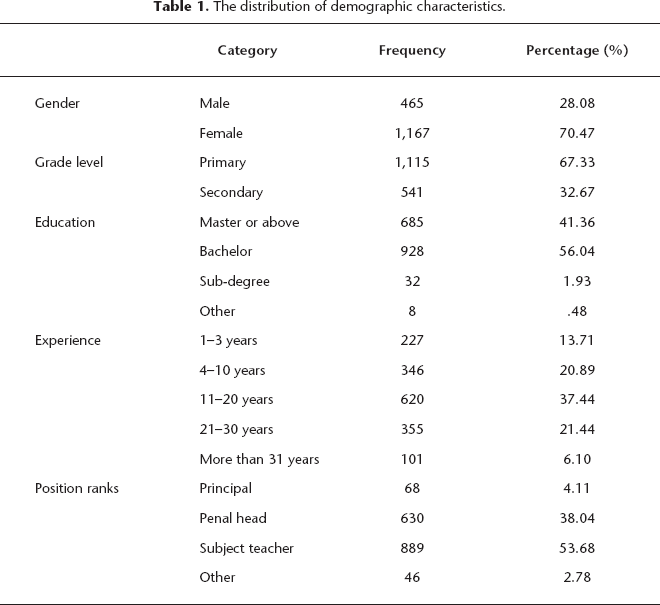
The participants were primary and secondary school teachers in Hong Kong. We invited 60 primary and 30 secondary schools to participate in a questionnaire survey conducted between November 2015 and March 2016. The nature, purposes, and procedures of our study were explained to the schools and teachers in order to obtain the principals’ approval and recruit as many participants as possible. As a result, 1,656 valid copies of 3,000 questionnaires were finally received, making a valid response rate of 55.2%. Table 1 shows the sample distribution in terms of gender, grade level, educational background, years of experiences, and position ranks. Frequency and corresponding percentage of each category have been presented.
The Distribution of Demographic Characteristics.
Instruments
The questionnaire used in the study had three parts. The first part introduced the study. The second part was designed to collect the participants’ demographic information, such as details of their gender, grade level, and educational background. The third part comprised two scales assessing the teachers’ affective well-being and efficacy beliefs. Specifically, teacher affective well-being was measured by a 12-item scale following Warr's (1990) approach. Each dimension of teacher affective well-being was measured by three items, and all four dimensions showed good reliability. In this study, the Cronbach's α coefficients for anxiety, depression, contentment, and enthusiasm were .91, .89, .81, and .88, respectively. The results of confirmatory factor analysis also indicated an acceptable level of construct validity (χ2 = 626.76, df = 48, p <.001, Root Mean Square Error of Approximation (RMSEA) = .081, Comparative Fit Index (CFI) = .96, Tucker-Lewis Index (TLI) = .95).
Teacher efficacy was measured using a 12-item scale developed by Tschannen-Moran and Hoy (2001). Each dimension of teacher efficacy was measured by four items, and all three dimensions showed good reliability. In this study, the Cronbach's α coefficients for efficacy for IS, efficacy for CM, and efficacy for SE were .62, .83, and .74, respectively. Confirmatory factor analysis also indicated good construct validity (χ2 = 412.85, df = 51, p < .001, RMSEA = .065, CFI = .94, TLI = .93). The Chinese version of this has been validated in Hong Kong by Yin et al. (2017), and their results supported its reliability and construct validity.
Analysis
Most of the data processing has been conducted using SPSS 20. Missing data were calculated and replaced using the expectation maximization algorithm. Information on reliability was obtained by calculating Cronbach's α coefficient for each dimension. Descriptive statistics (M, SD) were also obtained. A series of t-tests and one-way analysis of variance (ANOVA) were then conducted to test how affective well-being and efficacy vary across different groups of teachers. Finally, correlation analysis and hierarchical multiple regressions were conducted to examine the relationships between dimensions of variables.
In order to obtain information on construct validity, confirmatory factor analysis is conducted using Mplus. The fit indices used in the study included the chi-square value (χ2), RMSEA, CFI, and TLI. According to the literature, data fit is excellent when CFI and TLI are greater than .95 and acceptable when CFI and TLI are no less than .90. For RMSEA, data fit is excellent when less than .06 and acceptable when under .08.
Results
Mean Comparison
The results of mean comparison have been reported in Table 2–6. Each table reports the sample sizes of sub-groups (n) together with the group mean scores (M) and standard deviations (SD). The results of t-statistics/ANOVA and significant information have also been provided for each comparison.
Gender Difference in Teacher Efficacy and Well-Being.
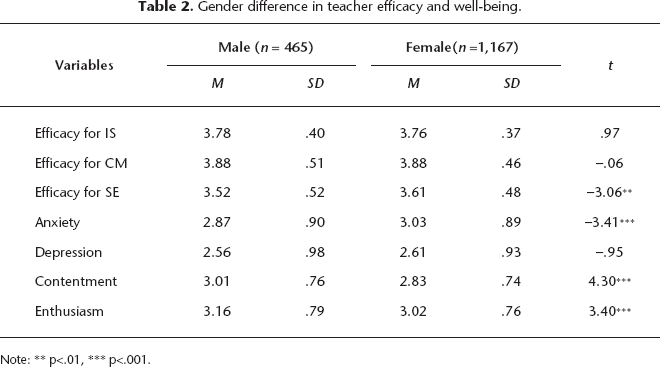
p<.01
p<.001.
Grade Level Difference in Teacher Efficacy and Well-Being.
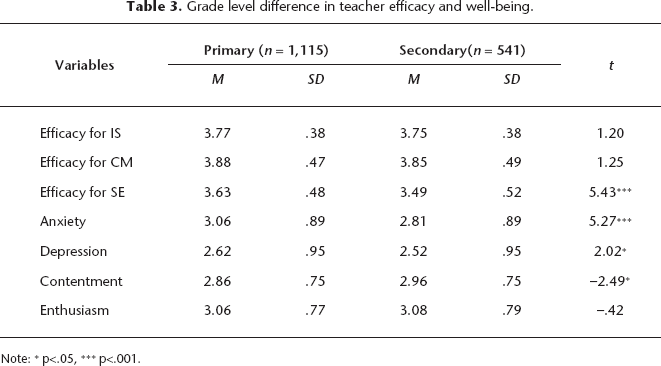
p<.05
p<.001.
Educational Background Difference in Teacher Efficacy and Well-Being.
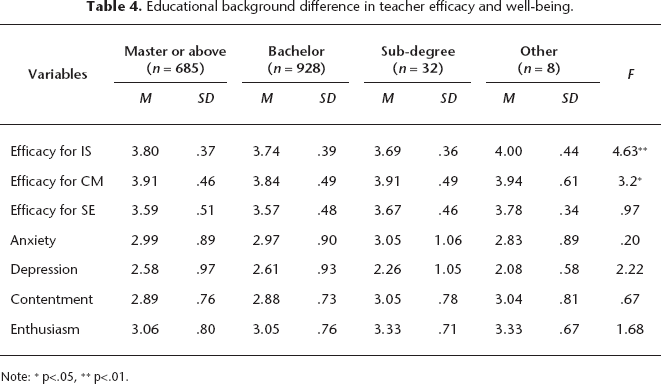
p<.05
p<.01.
Experience Difference in Teacher Efficacy and Well-Being.
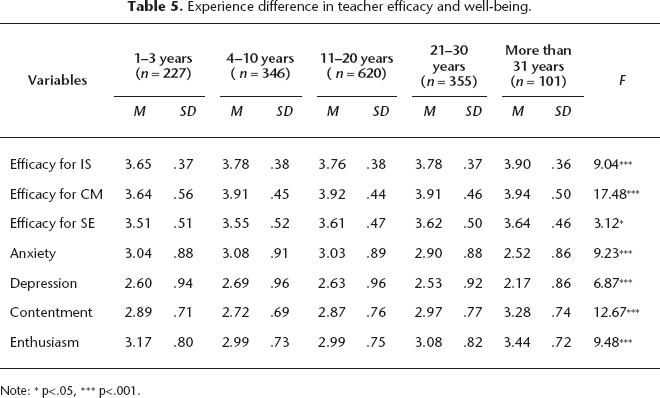
p<.05
p<.001.
Position Ranks Difference in Teacher Efficacy and Well-Being.
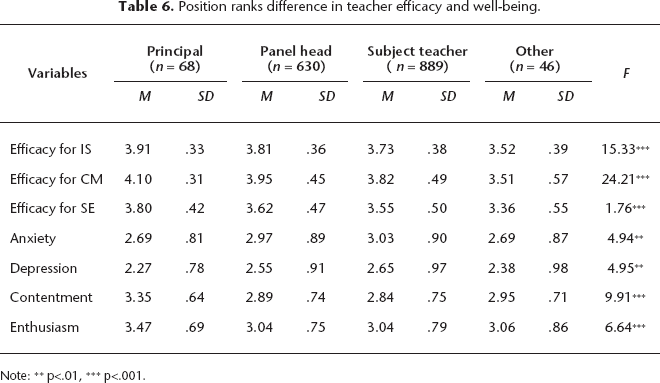
p<.01
p<.001.
Gender difference
As shown in Table 2, a total of 465 male teachers and 1,167 female teachers participated in the survey. Female teachers were far more than male teachers, which is generally consistent with Hong Kong teachers’ gender distribution. Significant gender differences were found in their efficacy for SE and the well-being dimensions of anxiety, contentment, and enthusiasm. Compared with their female counterparts, the male teachers reported higher levels of contentment and enthusiasm and less anxiety. However, the female teachers scored higher on average for efficacy for SE. No significant gender differences were found in depression, efficacy for IS, or efficacy for CM.
Grade level difference
The results obtained for the 1,115 primary school teachers and 541 secondary school teachers showed that teachers in different grade levels differed significantly in their efficacy for SE, anxiety, depression, and contentment (see Table 3). The primary school teachers reported higher levels of anxiety and depression and less contentment. They also scored higher on average for efficacy for SE.
Educational background difference
As shown in Table 4, most of the participants had a Bachelor's degree (928) or a Master's degree or higher (685). Teacher affective well-being was not found to differ significantly with educational background. However, teachers with Master's degrees or higher reported significantly stronger efficacy beliefs for IS and CM than their counterparts with Bachelor's degrees.
Seniority Difference
The results in Table 5 and Table 6 showed that the school teachers’ efficacy for IS, CM, and SE increased as they accumulated experience and achieved career progression. Teachers with more experience and higher ranks reported more contentment and enthusiasm and less anxiety and depression.
Correlation and Regression Analysis
The results of the correlation analysis as well as descriptive results (sample mean (M) and standard deviation (SD)) are represented in Table 7. As shown in Table 7, the three dimensions of teacher efficacy were moderately correlated with each other, and strong correlations were found between anxiety and depression and between contentment and enthusiasm. Anxiety and depression were weakly and negatively related to the dimensions of teacher efficacy, whereas contentment and enthusiasm were positively related to the dimensions of teacher efficacy.
Descriptive Statistics and Correlations.
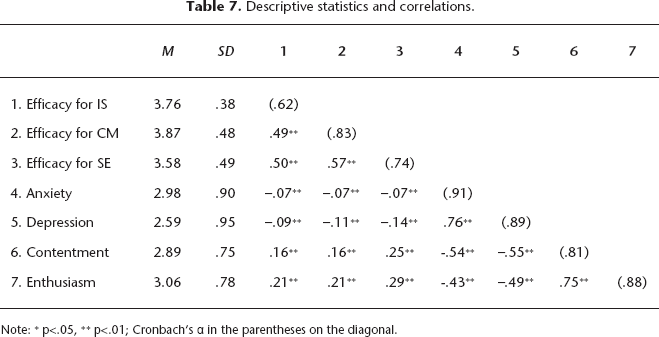
Note: * p<.05
p<.01
Cronbach's α in the parentheses on the diagonal.
Hierarchical multiple regressions were conducted to examine the relationships between the four dimensions of teacher affective well-being and each dimension of teacher efficacy after controlling for gender, grade level, educational background, and seniority. Demographic variables were first input into the regression, followed by the deactivated dimensions of affective well-being (contentment and depression) and finally the activated dimensions (enthusiasm and anxiety). The results of 3-step hierarchical multiple regressions have been presented in Table 8. Adjusted R square and F for each step were also reported.
The Results of Hierarchical Multiple Regression.
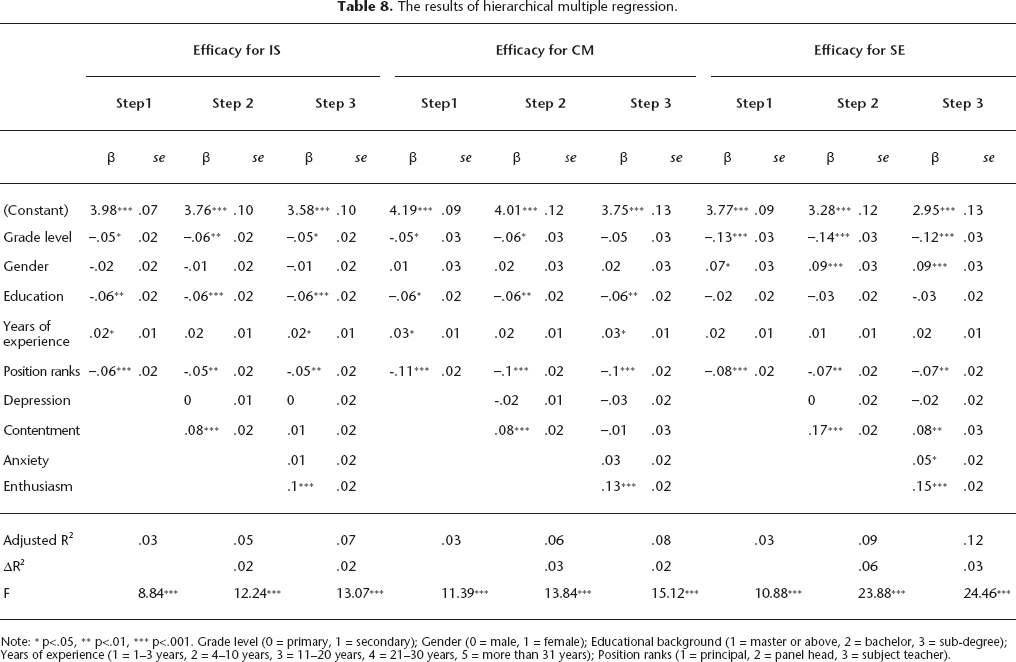
p<.05
p<.01
p<.001
Grade level (0 = primary, 1 = secondary); Gender (0 = male, 1 = female); Educational background (1 = master or above, 2 = bachelor, 3 = sub-degree); Years of experience (1 =1–3 years, 2 = 4–10 years, 3 = 11–20 years, 4 = 21-30 years, 5 = more than 31 years); Position ranks (1 = principal, 2 = panel head, 3 = subject teacher).
When considering the impacts of demographic variables exclusively (Step 1), teacher efficacies for IS and CM decreased with the increase of grade level and increased with the increases of educational level, years of experiences, and position ranks; teacher efficacy for SE decreased as grade level increased, and increased with the increases of position ranks. Female teachers had higher levels of efficacy for SE than male teachers.
When the deactivated dimensions of affective well-being were added to the model (Step 2), the pleasant dimension of contentment was found to significantly and positively relate to all three dimensions of teacher efficacy, but no significant relationship was found between depression and efficacy.
Finally, the results of Step 3 show that the effects of the deactivated pleasant dimension of contentment were overwhelmed by those of the activated pleasant dimension of enthusiasm. That is, only enthusiasm was significantly and positively related to all three dimensions of teacher efficacy. However, contentment and anxiety were also found to be significantly and positively related to teacher efficacy for SE. These results were consistent with those of t-tests and one-way ANOVA.
Discussion
Through a series of analytical procedures, this study examined the differences between teachers with various demographic characteristics and explored the relationships between dimensions of teacher efficacy and affective well-being. The results of correlation analyses generally suggest that teacher affective well-being is significantly associated with dimensions of teacher efficacy. The results also indicate that (a) teacher well-being/efficacy is positively related to both educational background and seniority, (b) a modest level of anxiety may be beneficial, (c) the activated pleasant dimension of affect (enthusiasm) has the greatest influence on teacher efficacy, and (d) the influence of affective well-being on efficacy for IS/CM and efficacy for SE operates by distinct mechanisms, discussed as follows.
The clearest results were found for the positive relationships between teacher efficacy and educational background and seniority, respectively. The differences observed between teachers with different educational backgrounds indicated that Master's programs are particularly effective in selecting and cultivating excellent teachers. Teacher with more years of experience are likely to have accumulated more experience of IS and CM. The more familiar teachers are with teaching materials and practices, the more content and less anxious they will feel. These results are consistent with Tschannen-Moran and her colleagues’ propositions that efficacy beliefs developed in the period of education as well as the beginning years could remain relatively stable and have profound implication for their efficacy in later years, while mastery experiences accumulated with teaching years are also important sources of efficacy information (Tschannen-Moran & Hoy, 2001, 2007). However, considering the severe job uncertainty and high work stress of Hong Kong teachers, these differences may also imply that only psychologically strong teachers who demonstrate competence can retain their jobs and achieve promotion (Cheng, 2009; Chong & Chan, 2010). In sum, these results endorse the importance of improving young teachers’ well-being and efficacy.
The results for gender and grade level are also interesting. Although the female teachers and the primary school teachers reported significantly higher levels of anxiety and lower levels of contentment than their male and secondary school counterparts, respectively, they showed significantly higher levels of teacher efficacy for SE. The results for affective well-being are generally consistent with our daily observations in Chinese schools. Compared with their male or secondary school counterparts, female or primary school teachers are more likely to interact closely with their students and encourage student personal growth, taking a maternal role. They may thus be more eager to ensure that students devote themselves to their learning and to help and guide their students as much as possible. However, female and primary school teachers’ higher expectations of students’ learning and achievement may also make them more prone to anxiety and ill-being. Comparing the results of this study with those of previous ones, it could be concluded that gender and grade level may interact with each other to predict teachers’ well-being: with the increase of grade level and a decrease in teacher-student interaction intensity, female teachers’ well-being status are becoming better than their male counterparts (Antoniou et al., 2006; Oshagbemi, 2000).
Further, anxiety is not always harmful. Rather than being content with their work and attributing students’ failure to a lack of ability, teachers who assume more responsibility for motivating their students may feel more anxious and exert more effort to help students at risk (Jordan, Glenn, & McGhie-Richmond, 2010). The active reactions of anxious teachers may enhance their mastery experiences and teacher efficacy for SE. However, the regression analysis results reveal significant and positive relationships between teacher efficacy for SE and both anxiety and contentment. As evidence is limited, more work is needed to explore the role of anxiety in teaching and its contribution (or otherwise) to teacher efficacy.
In addition, contentment was significantly related to the three dimensions of efficacy when the activated dimensions of teacher affective well-being were not included. However, enthusiasm was the only dimension significantly related to all three dimensions of teacher efficacy in the full model. These results suggest that positive emotions are of importance and the effort to analyze people in positive ways is worthwhile (Diener et al., 1999). The results also highlight that the arousal level of affect plays a critical role in determining individuals’ cognitive processes and behaviors (Raghunathan & Pham, 1999). Compared with the pleasant-deactivated dimension of contentment, enthusiasm is more closely associated with vigor and engagement (McInerney et al., 2018). The significant effects of both contentment (Step 2) and enthusiasm (Step 3) suggest that pleasant affect is a more important predictor of teacher efficacy than unpleasant affect. In addition, the activated pleasant dimension of enthusiasm had a greater influence on teacher efficacy than its deactivated counterpart.
Finally, different results were obtained for efficacy for IS/CM and efficacy for SE. Specifically, differences in gender and grade level were only found to significantly affect teacher efficacy for SE; years of experience and educational background were more significantly related to teacher efficacy for IS/CM than to efficacy for SE; and anxiety and contentment were positively related only to teacher efficacy for SE (Step 3). These results indicate that distinct mechanisms or patterns may underlie the development of efficacy for IS/CM and efficacy for SE. For teachers, the use of diverse instructional strategies and the maintenance of classroom disciplines are more control- or technically oriented, but it is a relational-oriented and emotional endeavor to keep students motivated and engaged (Ng et al., 2010). Female teachers, who reported higher efficacy for SE, were found to have higher level of emotional exhaustion than their male counterparts (Lau et al., 2005). Unsurprisingly, therefore, affective well-being was found to relate most strongly to teacher efficacy for SE and female and primary school teachers, who generally build closer emotional relationships with their students, reported higher levels of efficacy for SE. Considering the importance and difficulty of motivating students to learn, more effort should be made to research the emotional side of teaching.
Implications
The results of this study show that primary and secondary school teachers in Hong Kong experience high levels of stress. Teachers at an early stage of their careers face the greatest pressure. Accordingly, the less experienced teachers involved in this study reported a lower well-being status and sense of efficacy. Research has shown that 20%–50% of teachers leave the teaching profession within their first 5 years (McInerney, Ganotice Jr., King, Marsh, & Morin, 2015). Due to the high stress and uncertainty of their jobs, many young teachers in Hong Kong either leave the profession voluntarily or are forced out. Therefore, interventions designed to improve young teachers’ well-being and efficacy should be important components of teacher training and school development.
To improve their well-being, teachers should be provided with time and opportunities to take breaks, travel, and receive occupational therapy. They should also be encouraged to participate more in lectures, discussions, and creative activities (Paterson, 2008). Special psychological counseling may also be useful. In addition, individual-level factors such as teacher resilience have been found to be critical to teaching career longevity and classroom success (Klusmann et al., 2008); school level factors such as trusting climate, social support, and organizational justice (Aelterman et al., 2007; Ross, Romer, & Horner, 2012) are also important.
To improve teacher efficacy, schools should seek to reduce the difficulty of tasks undertaken by young teachers and enhance their mastery experiences. Tschannen-Moran and Hoy (2007) showed that mastery experience is available for experienced teachers to build efficacy, while contextual factors, such as teaching resources and interpersonal support/verbal persuasion, may be the only sources of efficacy information for novice teachers. Constructive communication between colleagues and peer observation may thus improve teacher efficacy through social pervasion and modeling. External intervention programs could also be implemented to improve teacher efficacy. However, evidences from previous studies have suggested that the beliefs held by experienced teachers do not change after participating in intervention programs, while interventions designed for novice teachers have been more successful (Hoy & Spero, 2005; Jordan et al., 2010).
Last but not least, the regression results highlight the importance of enthusiasm. Thus, researchers and educators are advised to address not only the stressful and unsatisfactory experiences of frontline teachers, but also the positive psychological dimensions of teaching. By encouraging teachers to participate in school decisions and eliciting their opinions on good teaching and approaches to reform, schools can enhance teachers’ enthusiasm and help them to build resistance to external stressors.
Limitations
Several limitations in this study should be noted. First, all of the data were collected by self-reported measures, and thus our results may suffer from the common-method bias. Even though teachers know their own emotions and beliefs of efficacy best, further research should use more data sources (e.g., peer-rating or supervisor-rating) to get more objective data. Secondary, the cross-sectional design of the study makes it difficult to claim any causal relationships. The potential reverse causality between efficacy and affective well-being calls for future longitudinal or experimental designs. Finally, the efficacy and well-being instruments are all developed in Western contexts. Although the reliability and validity results found in current study may serve as preliminary evidence for the applicability of these instruments in Chinese contexts, further research and results are desired.
Footnotes
Acknowledgement
This work was supported by the General Research Fund of Hong Kong SAR [grant number CUHK14413314]. We are grateful to the Centre for University and School Partnership in the Chinese University of Hong Kong for their help with data collection.
Notes on Contributors
Shenghua Huang is a PhD student at the Department of Curriculum and Instruction in the Chinese University of Hong Kong. Her research interests include teacher emotion and educational leadership. Her recent publications appear in Teaching and Teacher Education, Journal of Management & Organization, and International Journal of Environmental Research and Public Health.
Hongbiao Yin is an Associate Professor at the Department of Curriculum and Instruction, Associate Director of the Centre for University & School Partnership, Faculty of Education, Chinese University of Hong Kong. His research interests include teacher emotion, curriculum reform, and learning & teaching in higher education. His recent publications appear in Teaching and Teacher Education, Higher Education, and Educational Psychology.