




Abstract
Purpose
The purpose of this paper is to explore the current status of, and developmental trends affecting, the participation in supplementary tutoring by compulsory education students in China.
Design/Approach/Methods
Based on the data from the China Family Panel Study (CFPS) conducted by the Peking University Institute of Social Science Survey in 2010, 2012, 2014, and 2016, the paper uses the method of multilevel linear model to comprehensively analyze problems involving a multilevel data structure.
Findings
The paper finds that the proportion of compulsory education students participating in supplementary tutoring (and the expenditure on such tutoring) increased annually before declining in 2016. Students with higher socioeconomic status, higher school quality, and better academic performance have a higher tutoring participation rate and also spend more on tutoring. Students in China's three northeastern provinces and eastern coastal areas have higher participation rates in tutoring and higher tutoring expenditures.
Originality/Value
Supplementary tutoring in China already has its own developmental patterns and trends; however, few scholars have empirically studied the developmental patterns and trends of supplementary tutoring in compulsory education based on longitudinal survey data.
Introduction
Supplementary tutoring refers to supplemental educational activities provided outside of the formal education system to improve students’ academic performance. Such tutoring is often referred to in international academic circles as representing a “shadow education system” (Stevenson & Baker, 1992), that is education taking place in the shadow cast by mainstream schooling. In the past two decades, supplementary tutoring has spread rapidly around the world. In developed countries, emerging market countries, and even in countries still lagging behind in terms of economic development, various forms of supplementary tutoring can be seen everywhere. In the past ten years, supplementary tutoring has developed rapidly in China. The majority of primary and secondary school students rushed to various tutoring centers after school and during holidays to seek extracurricular instruction and assistance. Compulsory education students and their families have been keen to invest in supplementary tutoring activities, expanding educational competition beyond the school campus. The fierce competition around supplementary tutoring not only increases the academic burden of students and the financial burden of their families, but also interferes with the healthy development of in-school education and may also maintain and expand social inequality. To date, the vast majority of empirical research on supplementary tutoring has been based on cross-sectional data used to describe the current status of such tutoring. Empirical research on the long-term development trends affecting supplementary tutoring using tracking panel data is basically nonexistent. This article uses data from the China Family Panel Study conducted by Peking University to conduct an empirical study on the current situation and long-term trends affecting supplementary tutoring for compulsory education students in China. We explore the patterns behind the recent development of supplementary tutoring at the compulsory education stage. Our hope is that the research conclusions contained in this paper will help to clearly show the overall development of supplementary tutoring activities in compulsory education and provide a scientific theoretical basis for the government to introduce supplementary tutoring policies and measures.
Review of Existing Research
Research on the Scale of Participation in Supplementary Tutoring by Compulsory Education Students
In East Asian societies deeply influenced by Confucian traditional culture, such as China, Japan, and Korea, it is a common phenomenon for compulsory education students to participate in supplementary tutoring. According to the 2004 China Urban Residents Education and Employment Survey, the proportion of urban primary school students and regular junior high school students in mainland China participating in supplementary tutoring was 73.8% and 65.6%, respectively. The China Family Panel Study (2012) found that 24.6% of all compulsory education students surveyed participated in supplementary tutoring—with a participation rate of 30% among junior high school students and 22.6% among primary school students.
Bray, Zhan, Lykins, Wang, and Kwo (2014) surveyed Hong Kong secondary school students during the 2011/2012 school year and found that the proportion of students in the 9th and 12th grades participating in supplementary tutoring was 53.8% and 71.8%, respectively. According to a 2007 survey in Japan, 15.9% of students enrolled in the first year of primary school participated in supplementary tutoring, and the tutoring participation rate increased in subsequent grades, reaching 65.2% for students in the third year of junior high school. Based on a comparative analysis of survey data from the 2015 Programme for International Student Assessment (PISA), Chen and Zhi (2018) showed that the highest participation rate for supplementary tutoring among the 22 countries and regions included in the study was Thailand—where the tutoring participation rate for mathematics, foreign languages, and natural sciences was 91.2%, 89.4%, and 89.7%, respectively. Countries with higher tutoring participation rates include Greece, Korea, and Bulgaria, which each have mathematics and foreign language tutoring rates of over 80%. In contrast, the supplementary tutoring participation rate in Iceland is low (below 60% for mathematics, science, and foreign language tutoring). The lowest participation rate for supplementary tutoring is in Denmark—where the participation rate for mathematics, foreign languages, and natural sciences is 31.3%, 32.4%, and 23.9% respectively. The proportion of Chinese students participating in mathematics, foreign language, and language tutoring ranges from 65.7% to 74.0%.
There is a sizeable difference in supplementary tutoring between urban and rural areas and among different regions. A survey of 12 countries in Eastern Europe and Asia showed that, for each country, the supplementary tutoring participation rate was higher in urban areas than rural ones; the largest gap was in Kazakhstan, where the difference was 24.2%. Based on research from nine countries with economies in transition, the proportion of urban students participating in tutoring is 7.5 percentage points higher than that of rural students. The biggest difference was in Lithuania, where the gap between urban and rural areas was 17%. A 2004 survey of urban students in mainland China (Xue & Ding, 2009) showed that urban students in the eastern region had the highest participation rate for supplementary tutoring, followed by the central region and then the western region. The proportion of students in large and medium-sized cities attending supplementary tutoring is higher than that of small cities. Based on data from the China Family Panel Survey (2012), the proportion of students participating in supplementary tutoring in municipalities/provincial capitals, prefecture-level cities, county seats, and rural areas was 56.1%, 50.9%, 36.5%, and 13.9%, respectively. The analysis by Tsang et al. (2010) of urban-rural differences in supplementary tutoring for junior high school students in mainland China shows that the proportion of urban students participating in supplementary tutoring is much higher than that of rural students.
There are also significant inter-school differences in supplementary tutoring participation rates. According to the research of Tseng, in Hong Kong China and Taiwan China, the proportion of students in higher-ranking schools participating in supplementary tutoring is significantly higher than that of students in lower-ranking schools. Research by Xue and Ding (2009) found that the proportion of students in higher-quality schools participating in supplementary tutoring (and the level of expenditure on such tutoring) was significantly higher than those of ordinary and poorer-performing schools. According to data from the China Family Panel Survey (2012), the proportion of students participating in supplementary tutoring in “top” schools is 35.2%, which is significantly higher than the proportion of students from regular schools participating in such tutoring. Bray et al. (2014) also found that students in higher-quality schools are more likely to participate in supplementary tutoring.
There is a significant difference in the participation in supplementary tutoring among students from different socioeconomic backgrounds. Southgate used the OECD's Programme for International Student Assessment (PISA) data to analyze the relationship between socioeconomic status and supplementary tutoring participation rates among students in 36 countries and regions around the world. There was a positive correlation between the socioeconomic status of student families and participation in supplementary tutoring in 21 of the countries. In China, students from higher family socioeconomic backgrounds are generally more likely to participate in supplementary tutoring than students from lower socioeconomic backgrounds. The same holds true in Hong Kong China: family socioeconomic status has a significant positive correlation with student participation in supplementary tutoring.
There is a sizeable difference in supplementary tutoring participation by students with different grades. Bray et al. (2014) used data from the 1994–1995 TIMSS (Trends in International Mathematics and Science Study) project—which covered 8th and 9th grade students from 41 countries and regions—and found that in more than three-quarters of countries and regions (31), students participate in supplementary tutoring mainly for remediation; students from 3 countries and regions participate in supplementary tutoring mainly for enhancement; in the remaining 7 countries and regions, students’ reasons for participating in supplementary tutoring were mixed, that is, “remediation” and “enhancement” were both common. However, in East Asian societies such as Japan, Korea, and China, supplementary tutoring mainly serves students with excellent grades, and the focus is primarily on enhancement and not remediation.
Research on Supplementary Tutoring Expenditures for Compulsory Education Students
Supplementary tutoring fees have become an important expense for the families of primary and secondary school students in many countries. Bray and Kwok (2003) conducted a study of supplementary tutoring among primary and secondary school students in Hong Kong China and found that approximately 90% of households were spending between 1% and 15% of their monthly income on tutoring expenditures. Tansel and Bircan (2008) conducted a study on supplementary tutoring expenses for primary and secondary school students in Turkey. They was found that, in 1994, 80%–87% of households spent 1%–15% of their income on supplementary tutoring. Jelani and Tan (2012) showed that, in 2010, the average monthly expenditure on supplementary tutoring for participating primary school students in Malaysia was approximately 43.87 USD. Mark Bray et al. (2014) found that the average monthly supplementary tutoring expenditure for Hong Kong secondary school students in 2010 was about 201.80 USD, representing 8.7% of monthly household income. Among them, for families included in the lowest income group, supplementary tutoring expenses accounted for more than 30% of household income; for families included in the highest income group, supplementary tutoring expenses accounted for less than 3% of household income. Xue and Ding (2009) showed that the average supplementary tutoring expenditure for urban students in China in 2004 was 1,187.68 CNY (143.61 USD), accounting for 4.23% of household income. Supplementary tutoring expenses represented 2.87% of household income for families from the high-income group and 6.12% of household income for families from the low-income group. Qu and Xue (2015) used data from the China Family Panel Survey (2012) to find that the average annual expenditure for students participating in supplementary tutoring during the compulsory education period was 2,227.24 CNY (185.60 CNY per month), accounting for 10.41% of household net income and 44.29% of total household education expenditures.
Supplementary tutoring activities consume a significant amount of social resources in many countries. South Korea is a particularly prominent example here: the nation's total household expenditure for supplementary tutoring in 2006 was estimated at 24 billion USD, or 2.8% of GDP (Kim & Lee, 2010). Turkey's estimated supplementary tutoring expenditure in 2004 was 2.9 billion USD, equivalent to 0.96% of gross national product (Tansel & Bircan, 2006). In 2002, Egypt estimated that Egyptian families spend around 18 million USD on supplementary tutoring each year before college, equivalent to 1.6% of GDP (The World Bank, 2002). A 2010 survey in Japan showed that household expenditures on supplementary tutoring totaled approximately 12 billion USD (Dawson, 2010). A survey in Hong Kong China in 2010 showed that junior high school students’ tutoring expenses were close to 255 million USD (Synovate, 2011).
There is a sizeable difference in the supplementary tutoring investment for students from families with different socioeconomic backgrounds. Kim and Lee (2010) found that, generally speaking, in Korea, the higher a family's household income, the more the family spent on supplementary tutoring. They also found that students with outstanding academic performance (top 10%) had supplementary tutoring expenses far beyond those for students with grades in the average range (30%–70%). Additionally, families with high levels of parental education and/or higher educational requirements spent more on supplementary tutoring. Furthermore, students who were able to choose a school in an area not covered by the government's equal opportunity policy generally spent less on supplementary tutoring. Xue and Ding (2009) used survey data of urban students in mainland China from 2004 to show that the level of supplementary tutoring expenditures for students from higher socioeconomic backgrounds is generally greater than for students from lower socioeconomic backgrounds. Tansel and Bircan (2008) studied the supplementary tutoring expenditures of primary and secondary school students in Turkey and reached the following general conclusions: families with higher levels of parental education and family income spent more on supplementary tutoring; urban families spent significantly more on supplementary tutoring than rural families; families with more children had lower supplementary tutoring expenditures; and single-mother families spent significantly more on supplementary tutoring than other families. Jelani and Tan (2012) studied supplementary tutoring expenditures for primary school students in Malaysia and found that Chinese and Indian families spent significantly more on supplementary tutoring than Malay families; high-income families had higher tutoring expenses; single-parent families spent more on supplementary tutoring than non-single-parent families; and families with students enrolled at higher-rated schools spent more on supplementary tutoring than families with students enrolled at lower-rated schools. Bray et al. (2014) researched supplementary tutoring among middle school students in Hong Kong China in 2011 and found that the tutoring expenditures of high-income families were also higher.
There is a sizeable difference in supplementary tutoring expenditures for families from urban/rural areas and across different geographic regions. Xue and Ding's 2004 study (2009) of urban students in mainland China showed that the eastern region had the highest level of expenditure per student on supplementary tutoring, followed by the central region and then the western region. Students in large and medium-sized cities had higher supplementary tutoring expenditures than students in smaller cities. Tsang et al. (2010) analyzed the urban-rural differences in supplementary tutoring for junior high school students in mainland China, showing that the average expenditure per urban student participating in tutoring is much higher than that per rural student. A study in Turkey (Tansel & Bircan, 2008) found that urban families spend 66% more per student on tutoring than families from rural areas, mainly because cities are able to provide more practical tutoring centers. There are major differences in supplementary tutoring among students from different quality schools. Research by Xue and Ding (2009) shows that the level of expenditure on supplementary tutoring is significantly greater for students from high-quality schools than it is for students from average and lower-performing schools.
Summary of Existing Research
It is increasingly common around the world for compulsory education students to participate in supplementary tutoring. Studies have shown that there are significant differences in the participation rate of supplementary tutoring (and the expenditures on such tutoring) among students from urban/rural areas, different regions, varying qualities of schools, and disparate family backgrounds. The large number of compulsory education students participating in supplementary tutoring not only adds to student academic burden, it also—to a certain extent—increases educational differentiation and social stratification. Supplementary tutoring has thus become a mechanism to maintain and strengthen social stratification. It also hinders the development of a virtuous cycle among social classes and of normal social mobility. Existing research provides a valuable perspective to understand the current situation and impact of the expansion of supplementary tutoring. It also provides a reference point for policy makers to introduce supplementary tutoring intervention policies. However, most of the empirical research on supplementary tutoring in China is limited in size, scope, and time and does not accurately reflect the full and current status of supplementary tutoring participation by Chinese compulsory education students. Additionally, compulsory education students in China have participated in supplementary tutoring activities for a long period of time. As a result, supplementary tutoring in China already has its own developmental patterns and trends; however, few scholars have empirically studied the developmental patterns and trends of supplementary tutoring in compulsory education based on longitudinal survey data. This study is based on nationally representative tracking data and not only accurately reflects the current situation of participation by compulsory education students in supplementary tutoring, but also describes the developmental patterns and trends around supplementary tutoring participation by compulsory education students in China over the past ten years.
Research Data and Methods
Research Data
The data used in this paper are from the China Family Panel Studies (CFPS), funded by the 985 Program of Peking University and carried out by the university's Institute of Social Science Survey. The CFPS were conducted in 2010, 2012, 2014, and 2016. The number of compulsory education students included in the studies from each of those years was 4,746, 3,899, 4,125, and 3,179, respectively. The variables used in the statistical analysis included in this paper are shown in Table 1. Based on the description of variables contained in the data set, in this paper, “supplementary tutoring” refers to supplemental educational activities provided outside of the formal education system to improve students’ academic performance and/or talent development. It includes non-school-based academic- and talent-focused training. Both types of training activities help students improve their position as they prepare for future competition.
Description of variables.
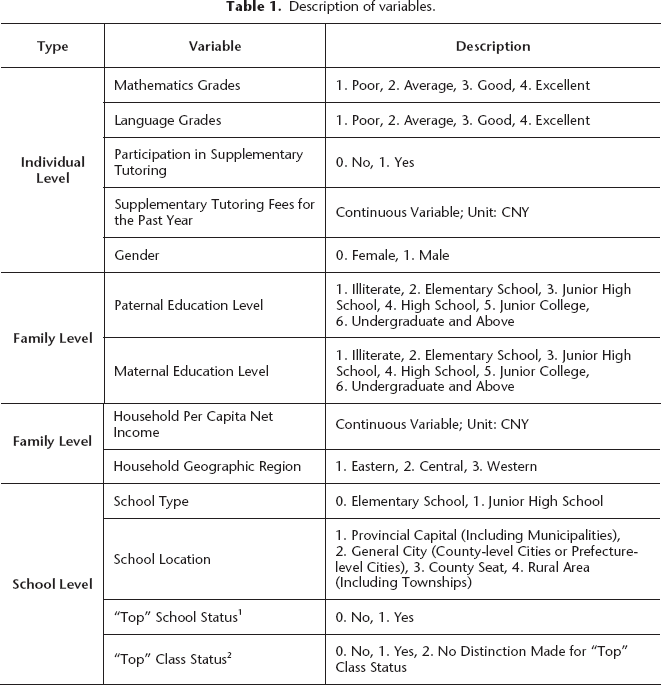
Description of variables.
The participation rate in (and expenditure on) supplementary tutoring are affected by many levels and factors such as schools, classes, individuals, and families. Therefore, it is likely that the data found in the study of the participation in supplementary tutoring (and related expenditures) follow a multilevel structure with nested relationships. Conventional ordinary least squares regression can only analyze problems involving a single level of data and cannot comprehensively analyze problems involving a multilevel data structure. The more recently developed multilevel linear model method can be used to comprehensively analyze problems involving a multilevel data structure. Analysis utilizing a multilevel linear model is superior to conventional statistical methods in three key respects: first, it can obtain better effect estimates for individual units; second, it is possible to model the effects between various levels and conduct hypothesis testing; third, it is possible to break down the variance and covariance components among the different levels. This paper employs the multilevel linear model method to estimate the participation rate of students in supplementary tutoring and the factors that influence the expenditure on such tutoring. Use of this method helps improve the accuracy of the conclusions contained in our research.
Model_0
This model breaks down the total difference in the student participation rate and expenditure for supplementary tutoring into two levels: individual and school-level differences. It is primarily used to explore whether there is a significant difference in the student participation rate and expenditure for supplementary tutoring among different schools. The model is as follows:


Where Yij represents the student participation rate and expenditure for supplementary tutoring for the i-th student of the j-th school; β0j represents the average supplementary tutoring student participation rate and expenditure of students in school j; γ00 represents the student participation rate and expenditure for supplementary tutoring for all students collectively; μ0j represents the random effect among schools; δ2 represents the difference in the student participation rate and expenditure for supplementary tutoring at the student level; and τ00 represents the difference in the student participation rate and expenditure for supplementary tutoring at the school level.
Model_1 builds on Model_0 by incorporating student-level variables. It is primarily used to examine the influence of student-level variables on the student participation rate and expenditure for supplementary tutoring. The model is as follows:


Model_2 builds on Model_1 by incorporating school-level variables. It is primarily used to examine the influence of school-level variables on the student participation rate and expenditure for supplementary tutoring. The model is as follows:


The Current Scale of Participation by Chinese Compulsory Education Students in Supplementary Tutoring
As can be seen from Table 2, the nationwide proportion of compulsory education students participating in supplementary tutoring in 2016 was 15.7%. The difference between the participation rates in the eastern and central regions was small (19.1% and 19.8%, respectively). The western region was much lower at 9.0%. Schools located in municipalities/provincial capitals had the highest proportion (50.0%) of students participating in supplementary tutoring, four times higher than the 12.2% rate for households in rural areas (including townships). The proportion of junior high school students participating in supplementary tutoring (19.2%) was significantly higher than that of primary school students (14.6%). The proportion of students participating in supplementary tutoring in “top” schools (19.1%) was significantly higher than that of regular schools (13.9%). The proportion of boys participating in supplementary tutoring was 15%, lower than the 16.5% rate for girls, though the difference between the two was not significant. There were significant differences in the supplementary tutoring participation rate among students with differing grades in language and mathematics. The better a student's language and math grades, the more likely he or she was to have participated in supplementary tutoring. There were also significant differences in the supplementary tutoring participation rate among students from families with differing parental education levels. Students from families with higher parental education levels were more likely to have participated in supplementary tutoring. The supplementary tutoring participation rate among students from families with household per capita net income in the top quartile was 35.2%. The supplementary tutoring participation rate among students from families with household per capita net income in the bottom quartile was nearly four times lower at 9.3%.
Differences in the scale of supplementary tutoring participation among compulsory education students in 2016 (%).
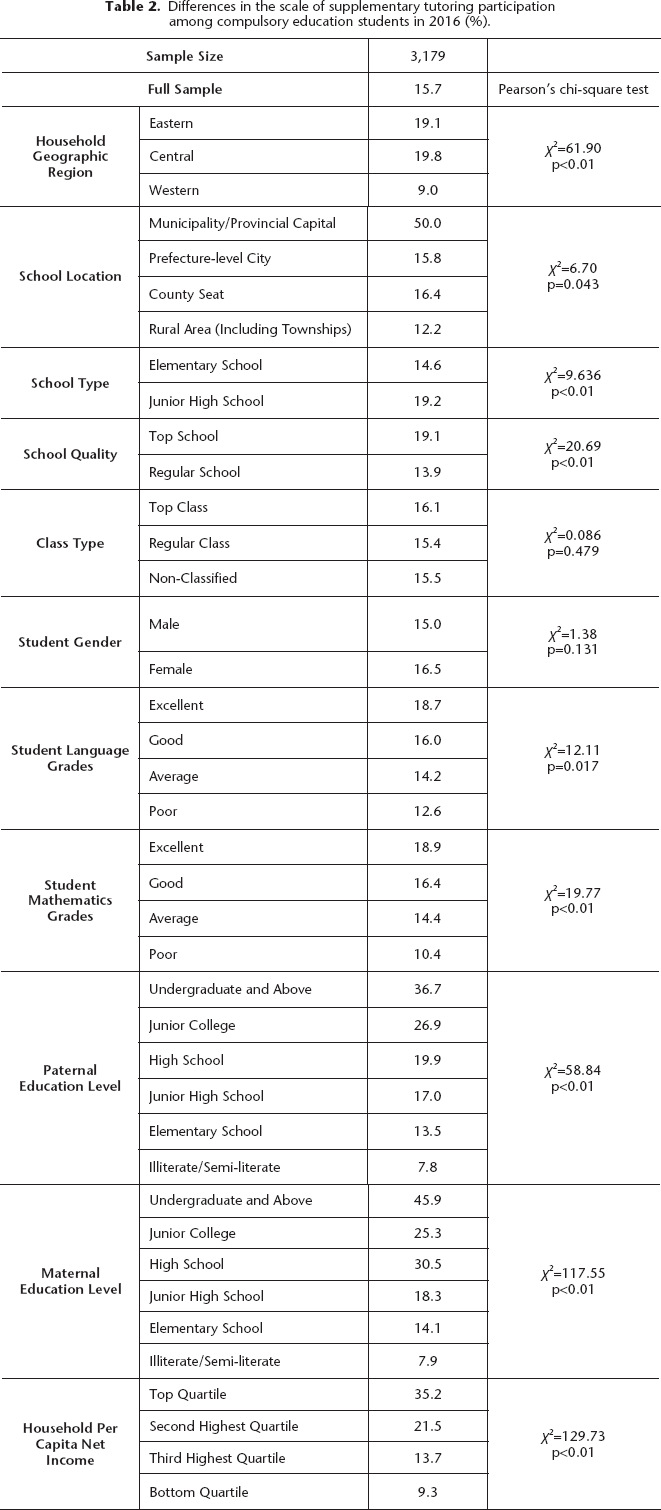
Differences in the scale of supplementary tutoring participation among compulsory education students in 2016 (%).
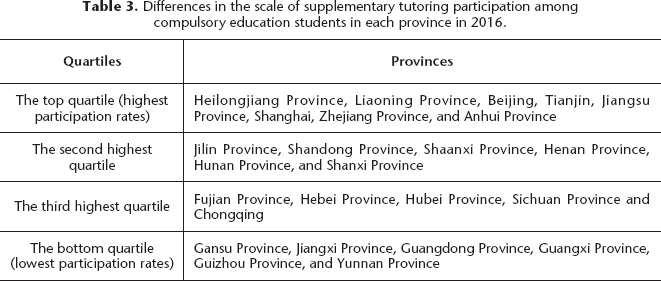
We grouped China's provinces and certain cities into quartiles on the basis of student supplementary tutoring participation rates. Heilongjiang Province, Liaoning Province, Beijing, Tianjin, Jiangsu Province, Shanghai, Zhejiang Province, and Anhui Province were grouped into the top quartile (highest participation rates). The second highest quartile included Jilin Province, Shandong Province, Shaanxi Province, Henan Province, Hunan Province, and Shanxi Province. The third highest quartile included Fujian Province, Hebei Province, Hubei Province, Sichuan Province and Chongqing. The bottom quartile (lowest participation rates) included Gansu Province, Jiangxi Province, Guangdong Province, Guangxi Province, Guizhou Province, and Yunnan Province. In general, students from the three northeastern provinces and the eastern coastal areas had the highest participation rate in supplementary tutoring, followed by students in the central region, and then students in the southwestern region.
Differences in the scale of supplementary tutoring participation among compulsory education students in each province in 2016.
As can be seen from Table 4, overall, from 2010 to 2014, the proportion of compulsory education students participating in supplementary tutoring was on the rise; however, the proportion of students participating in supplementary tutoring declined in 2016. The proportion of students from different regions participating in supplementary tutoring increased from 2010 to 2014 but declined in 2016. In 2010, the proportion of students participating in supplementary tutoring in the eastern region was significantly higher than that of the central region and the western region. From 2012 to 2016, the proportion of students participating in supplementary tutoring in the eastern and central regions was relatively close, and both remained significantly higher than the western region. From 2010 to 2014, the proportion of “top” class and regular class students participating in supplementary tutoring increased. Moreover, the proportion of students from “top” classes participating in supplementary tutoring was higher than that of students from regular and non-classified groups. In 2016, the proportion of students from all three groups participating in supplementary tutoring decreased, but there was no significant difference. Similarly, from 2010 to 2014, the proportion of students participating in supplementary tutoring from different school locations, school types, school qualities, genders, grades, parental education levels, and household per capita net incomes increased. However, there were different degrees of decline in 2016.
Proportion of students participating in supplementary tutoring (%).
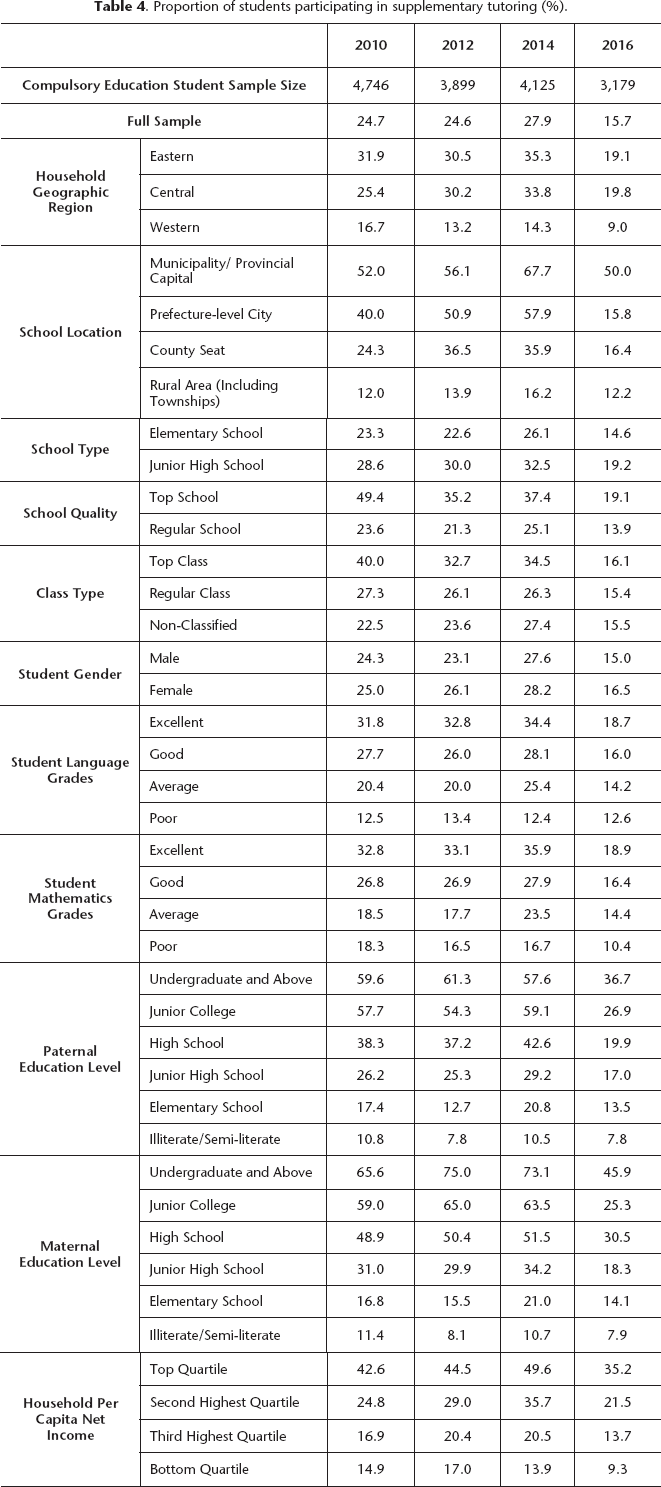
Proportion of students participating in supplementary tutoring (%).
The Current Level of Expenditure on Supplementary Tutoring for Chinese Compulsory Education Students
As can be seen from Table 5, the average expenditure for compulsory education students participating in supplementary tutoring in 2016 was 2,311.97 CNY. The average expenditure on supplementary tutoring in the eastern region was the highest at 3,022.07 CNY, followed by the central region at 2,432.43 CNY, and then the western region at 1,625.56 CNY. The average expenditure on supplementary tutoring was the highest for students attending schools located in municipalities/provincial capitals (3,000.00 CNY). The average expenditure on supplementary tutoring in rural areas (including townships) was the lowest (936.94 CNY). The difference between the two groups was over 300%. The average expenditure for supplementary tutoring for primary school students was 1,972.12 CNY. For junior high school students, the average expenditure was 3,049.93 CNY. The average expenditure on supplementary tutoring for students from “top” schools was 3,019.91 CNY. For students from regular schools, the average expenditure was 2,059.97 CNY. The average expenditure on supplementary tutoring for students from “top” classes was 3,328.84 CNY, which was greater than the average amount spent for students in the regular (2,206.49 CNY) and non-classified (2,043.84 CNY) groups. The difference in the average expenditure on supplementary tutoring for students of different genders was not significant. Students with “good” grades in language and mathematics had the highest average expenditure on supplementary tutoring. Students with parents holding undergraduate degrees (and above) had the highest average expenditure on supplementary tutoring. Students with parents in the “illiterate/semi-literate” grouping had the lowest average expenditure on supplementary tutoring. Students from families in the top quartile for household per capita net income, had the highest expenditure on supplementary tutoring (4,472.05 CNY). Students from families in the bottom quartile for household per capita net income, had the lowest expenditure on supplementary tutoring (1,321.27 CNY). The difference between the two groups was over 300%.
Differences in the expenditure on supplementary tutoring for compulsory education students in 2016 (CNY).
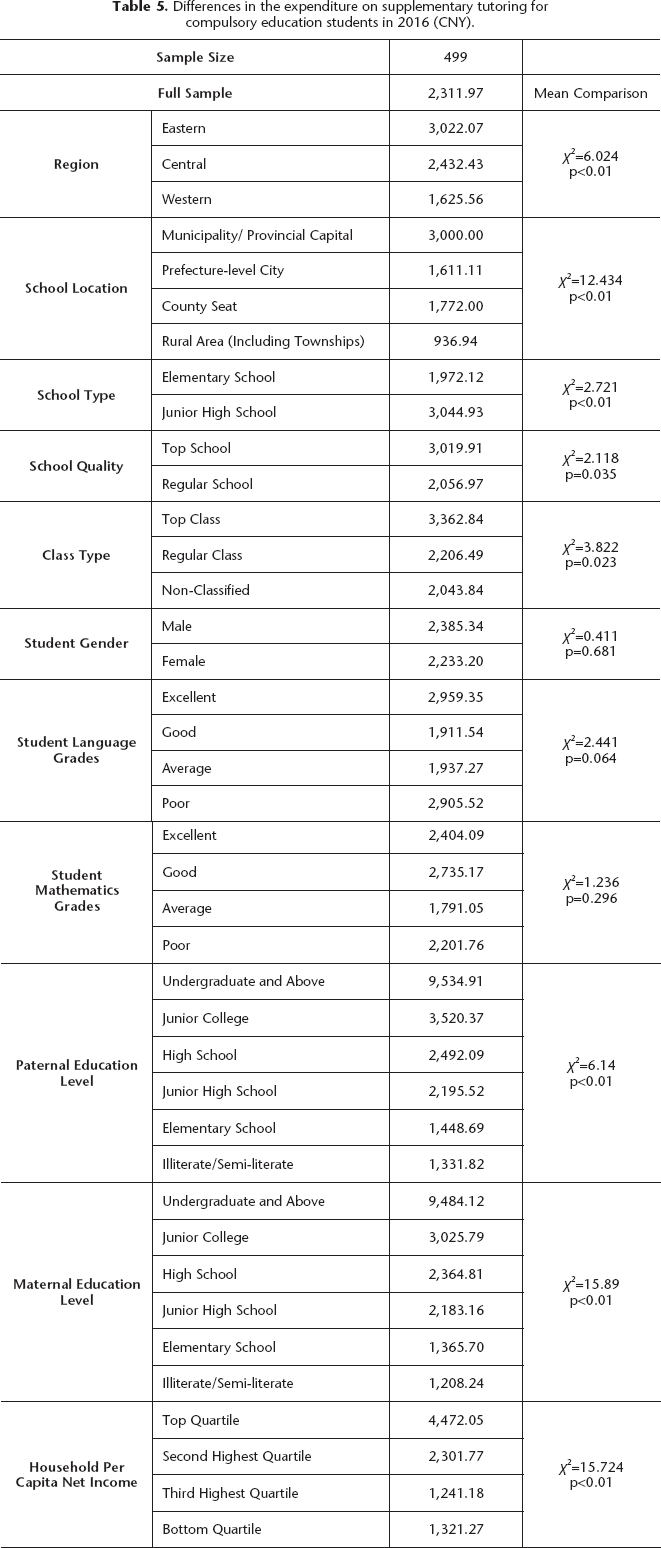
Differences in the expenditure on supplementary tutoring for compulsory education students in 2016 (CNY).
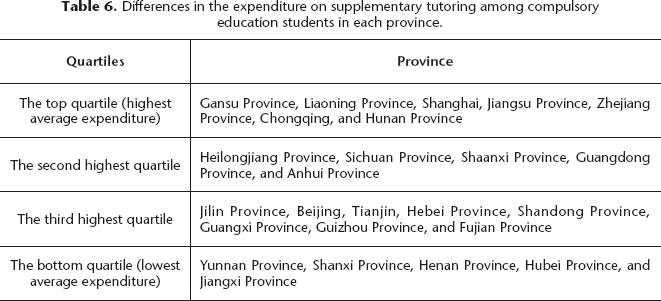
We grouped China's provinces and certain cities into quartiles on the basis of average expenditure per student on supplementary tutoring. Gansu Province, Liaoning Province, Shanghai, Jiangsu Province, Zhejiang Province, Chongqing, and Hunan Province were grouped into the top quartile (highest average expenditure). The second highest quartile included Heilongjiang Province, Sichuan Province, Shaanxi Province, Guangdong Province, and Anhui Province. The third highest quartile included Jilin Province, Beijing, Tianjin, Hebei Province, Shandong Province, Guangxi Province, Guizhou Province, and Fujian Province. The bottom quartile (lowest average expenditure) included Yunnan Province, Shanxi Province, Henan Province, Hubei Province, and Jiangxi Province.
Differences in the expenditure on supplementary tutoring among compulsory education students in each province.
As can be seen from Table 7, overall, from 2010 to 2014, the average expenditure on supplementary tutoring for compulsory education students showed an upward trend, though there was a decrease in the average expenditure on supplementary tutoring in 2016. Expenditure on supplementary tutoring in the eastern and western regions increased from 2010 to 2014 but decreased in 2016. Supplementary tutoring expenditures for students in “top” classes increased year by year; supplementary tutoring expenditures for students in the regular and non-classified group increased from 2010 to 2014 but decreased in 2016. Supplementary tutoring expenditures for students from the “poor” grades group increased year by year; supplementary tutoring expenditures for students from the other grades groups increased from 2010 to 2014 but decreased in 2016. Supplementary tutoring expenditures for students with mothers holding undergraduate degrees (and above) increased year by year; supplementary tutoring expenditures for students from the other parental education groups increased from 2010 to 2014 but decreased in 2016. Similarly, supplementary tutoring expenditures on students from different school locations, school types, school qualities, genders, paternal education groups, and household income groups increased from 2010 to 2014 before decreasing (though by different degrees) in 2016.
Trends in the expenditure on supplementary tutoring for Chinese compulsory education students (CNY).

Trends in the expenditure on supplementary tutoring for Chinese compulsory education students (CNY).
The number of compulsory education students in China was 152.20 million in 2016, 144.59 million in 2012, 138.357 million in 2014, and 142.424 million in 2016. It is possible to infer the aggregate national expenditure on supplementary tutoring for compulsory education students for the years from 2010 to 2016. The aggregate expenditure was 48.099 billion CNY in 2010, 79.221 billion CNY in 2012, 108.377 billion CNY in 2014, and 51.697 billion CNY in 2016. Except for the decline in 2016, the other years demonstrated an upward trend. The aggregate fiscal expenditure on compulsory education in China was 779.497 billion CNY in 2010, 966.206 billion CNY in 2012, 1.273378 trillion CNY in 2014, and 1.42083 trillion CNY in 2016. From this, we can calculate the approximate annual percentage of aggregate fiscal expenditure on compulsory education represented by expenditures on supplementary tutoring: 6.17% for 2010, 8.20% for 2012, 8.51% for 2014, and 3.64% for 2016. These amounts respectively correspond to 0.12%, 0.15%, 0.17%, and 0.07% of China's annual GDP.
The proportion of aggregate fiscal expenditure on compulsory education and GDP represented by expenditures on supplementary tutoring.
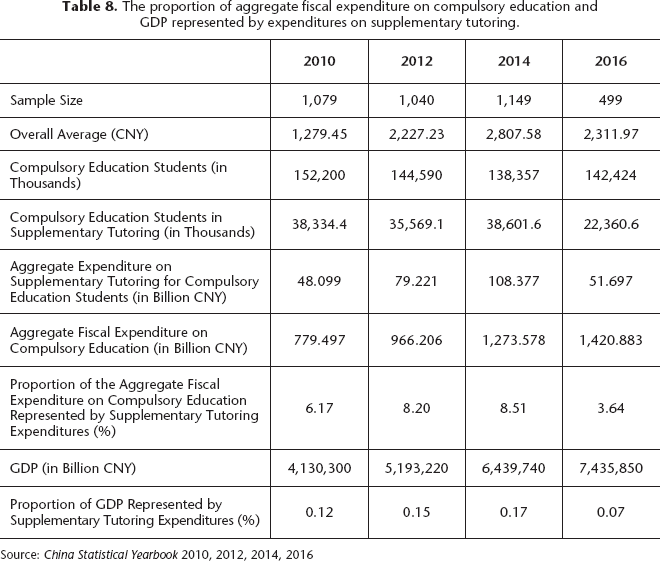
Source: China Statistical Yearbook 2010, 2012, 2014, 2016
When estimating the factors affecting student participation in supplementary tutoring, we first examine Model_0 without any independent variables at both the student and school levels (see Table 9 for specific results). On one hand, P<0.01 can be used to show that students from different schools have extremely significant differences in their supplementary tutoring participation. On the other hand, from ICC=0.281, we see that 28.1% of the total difference in student participation in supplementary tutoring is attributable to differences among schools. Adding student-level variables to create Model_1, we find that boys’ supplementary tutoring participation rates are significantly lower than girls’. Higher levels of maternal education correlate to higher rates of supplementary tutoring participation. Higher levels of family per capita net income also correlate to higher rates of supplementary tutoring participation. Paternal education levels, student language grades, and student mathematics grades have no significant effect on supplementary tutoring participation rates. Adding school-level variables to create Model_2, we find that aside from the significant positive correlation between household per capita net income and supplementary tutoring participation rates, the other factors have no significant impact on student participation in supplementary tutoring.
Factors affecting participation in supplementary tutoring: Results of a multilevel linear model analysis
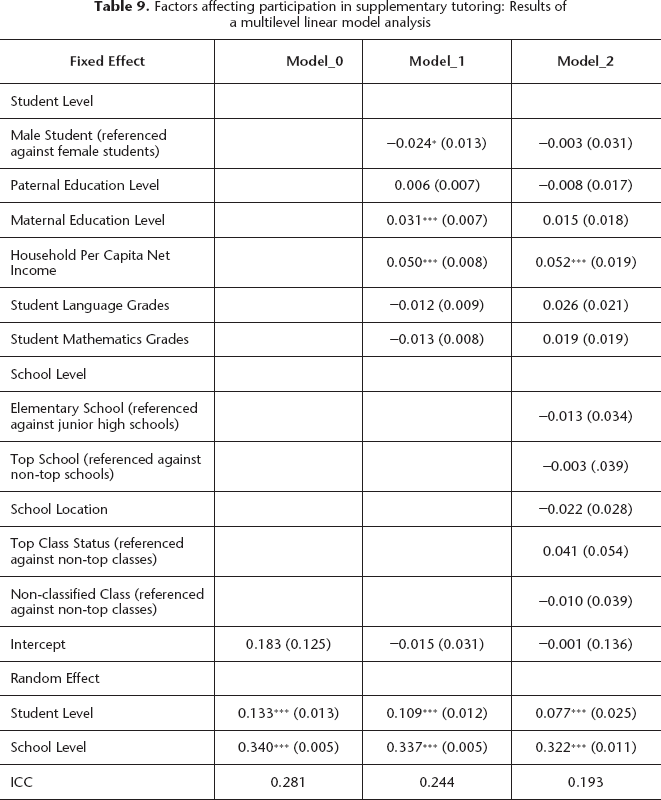
Factors affecting participation in supplementary tutoring: Results of a multilevel linear model analysis
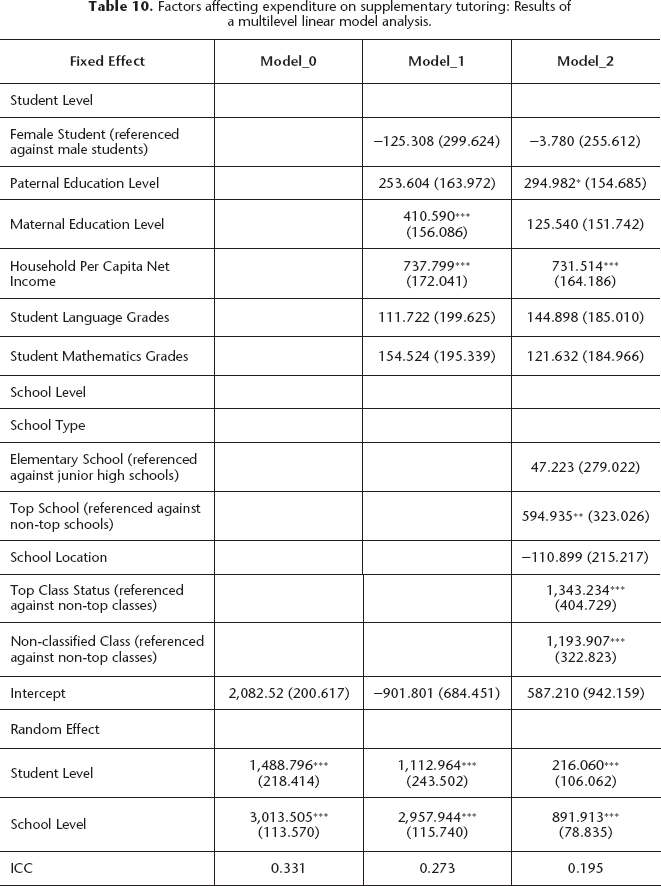
Similarly, in Table 10, we can see that there are significant differences in the expenditures on supplementary tutoring among students. Among them, 33.1% of the total difference in expenditure for student supplementary tutoring is attributable to differences among schools. Adding student-level variables to create Model_1, we find that maternal education level and household per capita income have a significant positive impact on expenditures on supplementary tutoring. Specifically, higher levels of maternal education and household per capita income correlate to higher levels of supplementary tutoring expenditure. Adding school-level variables to create Model_2, we find that student-level variables, paternal education level and household per capita income have a significant positive correlation with supplementary tutoring expenditures. At the school level, the supplementary tutoring expenditures for students at “top” schools are significantly higher than for students at schools without the “top” distinction. Similarly, the supplementary tutoring expenditures for students in “top” classes are significantly higher than for students in classes without the “top” distinction.
Factors affecting expenditure on supplementary tutoring: Results of a multilevel linear model analysis.
Based on the foregoing research into the participation and expenditure for supplementary tutoring by compulsory education students in China, we are able to reach the following main conclusions:
In 2016, 15.7% of the students surveyed participated in supplementary tutoring, and the average per student expenditure was 2,311.97 CNY. In 2016, the number of compulsory education students in China was 142.24 million. Therefore, approximately 22,360,600 students in the country participated in supplementary tutoring at a total cost of roughly 51.617 billion CNY, which was equivalent to 3.64% of the aggregate fiscal expenditures on compulsory education in that year, representing 0.07% of GDP.
Student participation in (and expenditure on) supplementary tutoring varies based on family, school, and regional characteristics. Students from families with higher socioeconomic status have higher participation rates in supplementary tutoring. Students from “top” schools are more likely to participate in supplementary tutoring than are students from regular schools. Students with better grades also have higher supplementary tutoring participation rates. Students from the three northeastern provinces and the eastern coastal areas have the highest participation rates in supplementary tutoring, followed by students in the central region, and then students in the western region. With respect to expenditures on supplementary tutoring, students with higher socioeconomic status typically spend more on supplementary tutoring. The per-student expenditure on supplementary tutoring is higher for students in “top” schools and “top” classes than it is for students in regular schools and classes. Supplementary tutoring expenditures are highest for students in the northeastern and eastern regions, Hunan province, Chongqing, and Gansu Province. Students in the central and southwestern provinces have lower supplementary tutoring expenditures.
The percentage of Chinese compulsory education students participating in supplementary tutoring in 2010, 2012, 2014, and 2016 was 24.7%, 24.6%, 27.9%, and 15.7%, respectively, and the average supplementary tutoring expenditure in each of those years was 1,279.45 CNY, 2,227.23 CNY, 2,807.58 CNY, and 2,311.97 CNY, respectively. Approximately speaking, there were 152.2 million compulsory education students in China in 2010, 144.59 million in 2012, 138.357 million in 2014, and 142.424 million in 2016. From this, it can be inferred that the number of compulsory education students participating in supplementary tutoring was approximately 38,344,400 in 2010, 35,569,100 in 2012, 38,601,600 in 2014, and 22,360,600 in 2016. The aggregate annual expenditure on supplementary tutoring for compulsory students was 48.099 billion CNY in 2010, 79.221 billion CNY in 2012, 108.377 billion CNY in 2014 and 51.697 billion CNY in 2016. Expressed as a percentage of the total annual fiscal expenditure on compulsory education, these amounts represent 6.17% for 2010, 8.20% for 2012, 8.51% for 2014, and 3.64% for 2016. Furthermore, they correspond to 0.12%, 0.15%, 0.17%, and 0.07% of China's annual GDP for those years. Overall, from the survey data collected in the four panel studies, we see that the student participation in (and expenditure on) supplementary tutoring increased year by year, except for a decrease in 2016. Average expenditure on supplementary tutoring increased year by year for students from the central region, students in “top” classes, students with poor grades, and students whose parental education level was at undergraduate or above.
The results of our research demonstrate that significant numbers of Chinese compulsory education students participate in supplementary tutoring and that they spend a great amount of money to do so. There are profound cultural, educational, economic, and political reasons behind this. From the cultural point of view, China is deeply influenced by Confucian culture, and the value of learning and being excellent has been highly respected since ancient times. The idea of “wanting boys to become dragons and girls to become phoenixes”—wanting children to receive the best education possible—is a consistent parental desire and pursuit. Obviously, these concepts have an important impact on student participation in supplementary tutoring. For educational reasons, students participate in supplementary tutoring in order to obtain more and higher-quality educational resources. Presently, the school education system in China is still based on examinations. Participating in supplementary tutoring can provide students with both quantitative and qualitative educational advantages, positioning them more favorably when taking entrance examinations. For economic reasons, parents hope to invest more in student education through supplementary tutoring, thereby improving the human capital of their children. If participating in supplementary tutoring allows students to receive higher education in the future and to improve their academic performance and educational rate of return, then it is a wise choice for students to participate in tutoring. For political reasons, according to the Maximally Maintained Inequality Theory (MMI) (Raftery & Hout, 1993) and the Effectively Maintained Inequality Theory (EMI) (Lucas, 2001), there are differences in the educational opportunities available to children from families of different classes. When compulsory education is not fully universalized, parents with higher socioeconomic status will always look for ways to maximize their children's educational opportunities. When compulsory education is universalized, due to the uneven development of compulsory education in China, there will remain a certain gap in the quality of education among regions, between urban and rural areas, and among different schools. Currently, the focus of competition is not on the opportunity to receive an education, but on the quantity and quality of the education received. In order to effectively maintain social inequality, families with higher socioeconomic status will strive to involve their children in supplementary tutoring in order to obtain a higher quality education for them and help them secure an advantage in future studies and employment. This helps explain why students with higher socioeconomic status have higher supplementary tutoring participation rates and average supplementary tutoring expenditures.
As indicated by our multilevel linear model, students with better grades have higher participation rates and expenditures for supplementary tutoring than students with lower grades. Supplementary tutoring expenditures for students from “top” schools and “top” classes are significantly higher than those for students from schools and classes without that designation. Moreover, the statistical description also shows that students with better grades have a higher supplementary tutoring participation rate. The participation rate and expenditures for supplementary tutoring by students from “top” schools were significantly higher than those students from regular schools, and the participation rate and expenditures for supplementary tutoring by students from “top” classes were significantly higher than those students from regular classes. Moreover, the supplementary tutoring expenditures for students from “top” classes increased year after year. This shows that—although there are two main types of supplementary tutoring in China: “remedial” and “enhancement”—the dominant type of supplementary tutoring is “enhancement.”
Additionally, compared to 2010, 2012, and 2014, the participation rate and average expenditure for supplementary tutoring decreased in 2016. One possible reason for this is that governmental policies have reduced the supply and demand for supplementary tutoring. On one hand, in 2014, the Ministry of Education issued its Notice on Measures for Professional Ethics Violations by Primary and Secondary School Teachers (Teacher [2014] No. 1). The Notice makes clear that it constitutes a violation of professional ethics for primary and secondary school teachers “to organize or require students to participate in paid remedial classes inside or outside the school, or to organize and participate in off-campus training organizations that offer paid remedial classes.” In 2015, the Ministry of Education formulated and issued its Rule Prohibiting Primary and Secondary Schools and In-Service Primary and Secondary School Teaches from Providing Paid Supplementary Classes (Teacher [2015] No. 5). Additionally, the Ministry of Education has conducted two rounds of “self-examination work.” Following the most recent round in July of 2016, the Ministry of Education issued its Notice on Implementation of Self-Examination Work Regarding the Governance of Primary and Secondary Schools Providing Paid Supplementary Classes and the Illegal Acceptance of Gifts by Teachers. The Notice pointed out that the Ministry of Education launched a three-month self-examination focusing on paid supplementary classes at primary and secondary schools and the illegal acceptance of gifts by teachers. The Ministry of Education adopted a series of measures prohibiting the provision of supplementary tutoring by in-service teachers, thereby reducing the supply of supplementary tutoring. On the other hand, in 2014, the Ministry of Education issued its Implementation Opinion on Further Improving the Transition from Primary School to Junior High School without an Entrance Examination. As of 2017, most cities have already achieved a test-free admissions system for junior high school based on student proximity to school. The implementation and expansion of a location-based admissions policy has, to some extent, reduced the pressure on parents and students, thereby reducing the demand for supplementary tutoring. Of course, follow-up research in this area is needed to confirm these conclusions.
In the eastern provinces and cities, the participation rate and average expenditure for supplementary tutoring are generally higher than they are in other provinces and cities. When the quality of the school education system fails to meet expectations, some families with higher incomes will seek higher quality educational resources from the shadow education system. In addition, during the compulsory education stage, the school education system is more inclined to provide standardized education, failing to meet the demand for differentiated education held by certain families. Therefore, those families may choose to enroll their children in supplementary tutoring classes. This, in turn, leads to the differentiation of market-based education resources available to students from different families outside of the school education system. Therefore, the participation rate and expenditure for supplementary tutoring in certain economically developed provinces and cities are naturally higher. It is worth noting that the average expenditure on supplementary tutoring in the central region has increased year by year. The reason may be that the shift in industrial production from the eastern region to the central region coupled with the government's policy to promote central region development has helped fuel a constant rise in the central region. The rapid development of the economy in the central region has promoted the growth of household income. Education is an important component of family investment and the emphasis by families on education has also led to increased investment in supplementary tutoring. Therefore, it is not surprising that the expenditure on supplementary tutoring in the central region has continually increased in recent years. In addition, students from the three northeastern provinces have higher participation rates and expenditures for supplementary tutoring. Due to the economic slowdown experienced by the three northeastern provinces in recent years, teacher salary levels in the region are relatively low. Therefore, many in-service teachers may elect to participate in supplementary tutoring to increase their income, thereby stimulating the demand for compulsory education students to participate in such tutoring. Students in Hunan Province in the central region and Chongqing and Gansu Province in the western region have higher levels of expenditure on supplementary tutoring. According to data released by the Ministry of Education in 2016, the undergraduate admission rate in Hunan, Chongqing, and Gansu was 27.06%, 27.19%, and 20.80%, respectively, each lower than the national average of 30.69%. Lower undergraduate admission rates make the competition for student education in these areas more intense. As a result, parents seek more and higher quality supplementary tutoring options for their children outside of school. This has caused Hunan, Chongqing, and Gansu to invest more in supplementary tutoring.
The foregoing conclusions and discussion raise the following main policy implications:
Strengthen the supervision of supplementary tutoring activities provided by off-campus training organizations and prohibit in-service public-school teachers from providing supplementary tutoring. The participation rate and average expenditure for supplementary tutoring decreased in 2016. A possible reason for this is that, in recent years, the government's policy of monitoring off-campus training organizations and the policy of prohibiting the participation by in-service public-school teachers in supplementary tutoring have—to a certain extent—inhibited the demand for and supply of supplementary tutoring. In the future, the government should strengthen supervision over the provision of supplementary tutoring services by off-campus training organizations, prohibit the participation by in-service public-school teachers in supplementary tutoring, and prevent public schools from forming interest alliances with off-campus training organizations. Lower teacher salary levels stimulate the need for in-service public-school teachers to provide supplementary tutoring services. Therefore, the government should raise the salary level of in-service public-school teachers.
The government should provide certain subsidies for supplementary tutoring for families with lower socioeconomic status and students with poor academic performance. The higher participation rates and expenditures for supplementary tutoring for students from higher socioeconomic backgrounds has expanded the imbalance of compulsory education resources provided to students from different class groups and has increased the differences in the high school and higher education opportunities available to students from varying socioeconomic backgrounds. This results in class solidification and social reproduction. The government can provide supplementary tutoring subsidies to families with lower socioeconomic status and students with poor academic performance. Tuition vouchers, allowances, and similar tools can help these students participate in supplementary tutoring to narrow the gap with other students, thereby (a) reducing differences in educational opportunities afforded to students from different family backgrounds, and (b) mitigating the maintenance effect that supplementary tutoring can have on class solidification.
High schools (and especially high-quality high schools) should increase their enrollment quotas for students from rural areas and with lower socioeconomic backgrounds. This would help promote the equal distribution of high school education enrollment opportunities among students from different class groups and between urban and rural areas. Supplementary tutoring expands the gap among different class groups and between urban and rural areas in terms of the amount and quality of benefits received from compulsory education. The amount and quality of high school educational opportunities received by students from rural and disadvantaged families are significantly less than those received by students from urban and privileged families. In order to achieve the goal of the Party's 19th National Congress Report to “Strive to allow every child to enjoy a fair and quality education” and to promote rational mobility between social classes, high schools (and especially high-quality high schools) should increase their enrollment quotas for students from rural areas and with lower socioeconomic backgrounds, thereby promoting the equal distribution of high school education enrollment opportunities among students from different class groups and between urban and rural areas.
Finally, the data from the four tracking surveys used in this article only cover a six-year time span; therefore, they may not fully reflect the development trends of supplementary tutoring in China. Additionally, there were relatively more missing samples in 2016, causing the subsample size to be smaller than in 2010, 2012, and 2014. 2016 saw a 23% reduction compared to 2014. This reduction in sample size may have affected certain of our research results. Therefore, additional evidence and longer-term follow-up survey data are needed to further reveal the development trends affecting participation in supplementary tutoring by compulsory education students in China.
Funding
National Natural Science Foundation of China—“Family Capital, Shadow Education and Social Reproduction” Project (Project Approval Number: 71774112); National Natural Science Foundation of China—“Facing the Shadow Education System: Research on Supplementary Tutoring in Compulsory Education in China” Project (Project Approval Number: 71373165).
Footnotes
1
In the 1950s, China began large-scale economic construction, and it was urgent to train a large number of talents, but education was backward, talent shortage, and lack of educational resources. In order to get talents quickly, early and great, the government has adopted the policy of centralizing scarce educational resources to run “top” school. Under the condition of scarce educational resources, the public educational resources should be concentrated on the “top” schools. Through the input of educational resources, it will be helpful to improve the conditions for running “top” schools and the quality of education, and form the “top” schools with high-quality educational resources.
2
The “top” class refers to the students who have excellent test scores in a class according to the test scores of the students’ major subjects such as English and mathematics, and at the same time, they have better teachers and teaching equipment.
Notes on Contributors
Haiping Xue, Director, Institute of Educational Economics and Management, College of Education, Capital Normal University; Professor; Doctoral Advisor; primarily engaged in educational economics and management research.
Chenchen Fang, Doctoral Candidate, Institute of Educational Economics, Department of Education, Beijing Normal University; primarily engaged in educational economics research.