




Abstract
As Russia and the United States continue to reduce their Cold War arsenals, global inventories of nuclear weapons will continue to decline. Yet eight of the nine nuclear states continue to produce new or modernized nuclear weapons.
EXCESSIVE SECRECY PROHIBITS THE PUBLIC FROM KNOWing the exact number of nuclear weapons in the world. Nuclear weapon states shield details about their arsenals and generally have only imprecise knowledge about the size and composition of other countries’ inventories; this creates uncertainty, mistrust, and misunderstandings. More transparency would alleviate this, and in fact, Britain, France, and the United States have recently taken steps to provide additional nuclear data to the public.
We estimate that the world's nine nuclear weapon states possess nearly 22,400 intact nuclear warheads. The vast majority of these weapons—approximately 95 percent—are in the U.S. and Russian arsenals. Nearly 8,000 warheads—nearly one-third of the worldwide total—are operational to some degree (not necessarily fully operational) and ready to launch on relatively short notice. We estimate that approximately 1,880 warheads are on different levels of alert: Russia, 960 warheads; United States, 810; France, 64; and Britain, 48.
The stockpiles of the nations that are not recognized as nuclear weapon states under the Nuclear Non-Proliferation Treaty—Israel, India, Pakistan, and North Korea—are minuscule in comparison with those of Russia and the United States and are especially difficult to estimate. India and Pakistan have a combined total of approximately 150 nuclear warheads, just a few more than what is carried on a single U.S. Trident submarine. Though Israel has not acknowledged it possesses nuclear weapons, the U.S. intelligence community estimates that it has an arsenal of approximately 80 warheads. North Korea remains a mystery, but it may have enough fissile material for nine warheads.
We calculate that more than 128,000 nuclear warheads were built since 1945, all but 2 percent by the United States (55 percent) and the Soviet Union/Russia (43 percent). After peaking in 1986, global nuclear weapon levels have declined, as illustrated in the figure “Total Nuclear Weapons Worldwide, 1945–2010.” Since the end of the Cold War, more and more warheads in the U.S. and Russian stockpiles have been moved from operational status to various reserve, inactive, or contingency categories. Traditionally, arms control agreements have not only failed to require the destruction of warheads, but have also ignored both nonstrategic and non-deployed warheads. The recently renegotiated and signed Strategic Arms Reduction Treaty (New START) continues this trend, although the U.S. and Russian governments have pledged that a possible future agreement will include non-deployed and nonstrategic weapons.
NUCLEAR WEAPONS INVENTORIES, 2010
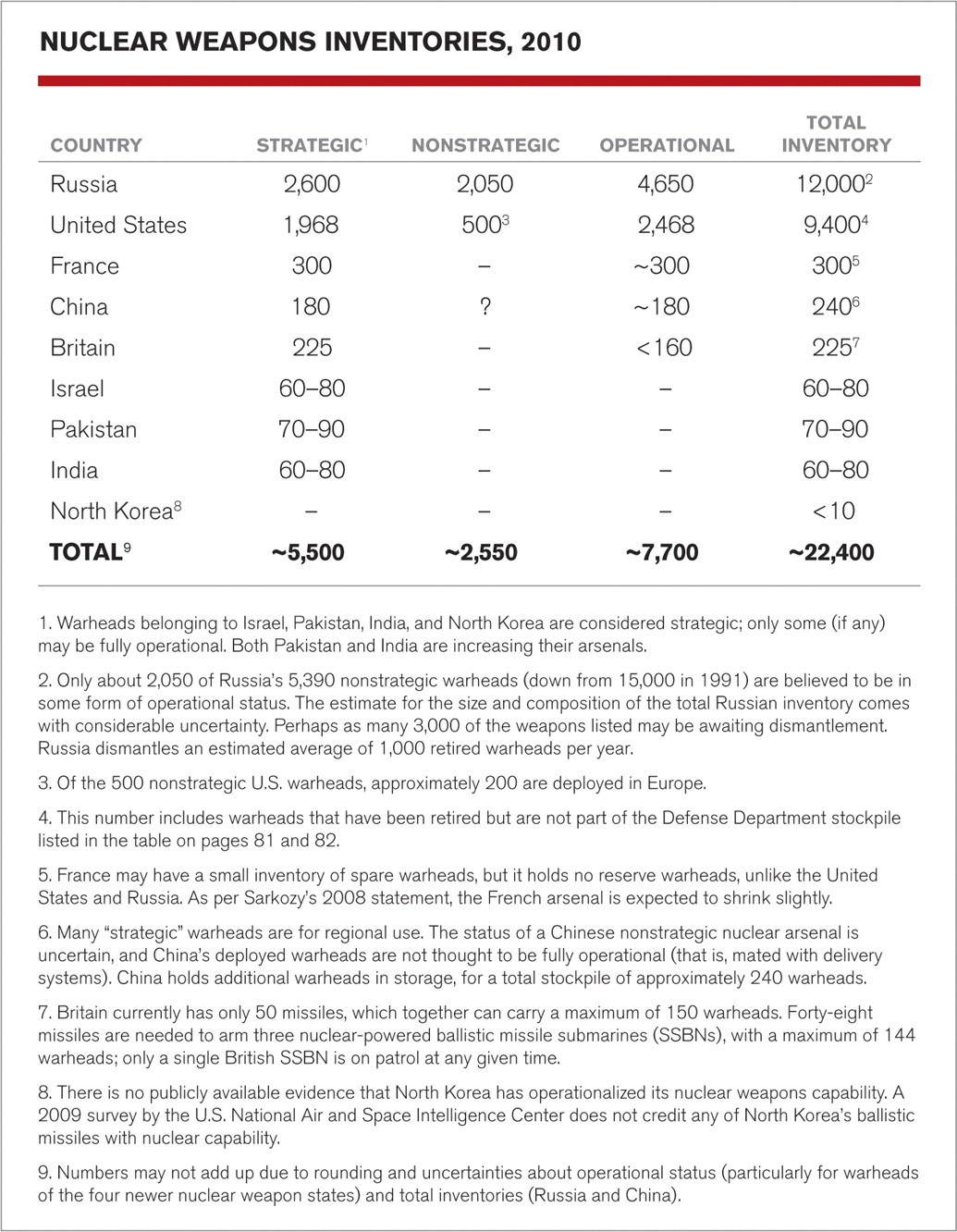
Warheads belonging to Israel, Pakistan, India, and North Korea are considered strategic; only some (if any) may be fully operational. Both Pakistan and India are increasing their arsenals.
Only about 2,050 of Russia's 5,390 nonstrategic warheads (down from 15,000 in 1991) are believed to be in some form of operational status. The estimate for the size and composition of the total Russian inventory comes with considerable uncertainty. Perhaps as many 3,000 of the weapons listed may be awaiting dismantlement. Russia dismantles an estimated average of 1,000 retired warheads per year.
Of the 500 nonstrategic U.S. warheads, approximately 200 are deployed in Europe.
This number includes warheads that have been retired but are not part of the Defense Department stockpile listed in the table on pages 81 and 82.
France may have a small inventory of spare warheads, but it holds no reserve warheads, unlike the United States and Russia. As per Sarkozy's 2008 statement, the French arsenal is expected to shrink slightly.
Many “strategic” warheads are for regional use. The status of a Chinese nonstrategic nuclear arsenal is uncertain, and China's deployed warheads are not thought to be fully operational (that is, mated with delivery systems). China holds additional warheads in storage, for a total stockpile of approximately 240 warheads.
Britain currently has only 50 missiles, which together can carry a maximum of 150 warheads. Forty-eight missiles are needed to arm three nuclear-powered ballistic missile submarines (SSBNS), with a maximum of 144 warheads; only a single British SSBN is on patrol at any given time.
There is no publicly available evidence that North Korea has operationalized its nuclear weapons capability. A 2009 survey by the U.S. National Air and Space Intelligence Center does not credit any of North Korea's ballistic missiles with nuclear capability.
Numbers may not add up due to rounding and uncertainties about operational status (particularly for warheads of the four newer nuclear weapon states) and total inventories (Russia and China).
Although the total number of nuclear warheads around the world is decreasing due mainly to U.S. and Russian reductions, this trend may obscure the fact that most nuclear weapon states continue to modernize or update their nuclear arsenals and that nuclear weapons remain integral to their national security outlooks. Brief summaries follow for the nine nuclear weapon states.
Of the more than 70,000 warheads that the United States has produced since 1945, more than 60,000 have been disassembled—more than 13,000 of these since 1990. However, the United States has retained nearly 14,000 plutonium cores (pits) from its dismantled warheads, storing them at the Pantex Plant. It also stores some 5,000 canned assemblies (secondaries) at the Y-12 facility in Tennessee.
The United States is modifying existing warheads under so-called life extension programs, and the 2010 Nuclear Posture Review leaves the door open for replacement warheads in the future. 1
Based on statements from Russian officials and U.S. assessments of Russian dismantlement rates, we estimate the number of intact Russian warheads to be approximately 12,000, of which about 4,650 are considered operational. 2
Over the past two decades, two trends have emerged: Russia has been decreasing its deployed/operational forces, and at the same time it has been reducing its number of intact warheads via an ongoing dismantlement effort. The former has outpaced the latter, leaving a large backlog of warheads to be eventually taken apart.
Russia has continued to reproduce existing nuclear warhead designs, as opposed to the U.S. approach of extending the life of warheads, but production of new systems is thought to be slow. 3
The British arsenal peaked in the 1970s at 350 warheads, and Britain is estimated to have produced approximately 1,200 warheads since 1953.
France expects to deploy the M51 SLBM with a modified warhead on the Terrible SSBN this year, and it has already begun to introduce its new nuclear cruise missile, the Air-Sol Moyenne Portée-A.
The U.S. intelligence community predicts that China will increase its total number of warheads on long-range ballistic missiles from about 50 to well over 100 in the next 15 years.
GLOBAL NUCLEAR WEAPONS INVENTORIES, 1945–2010
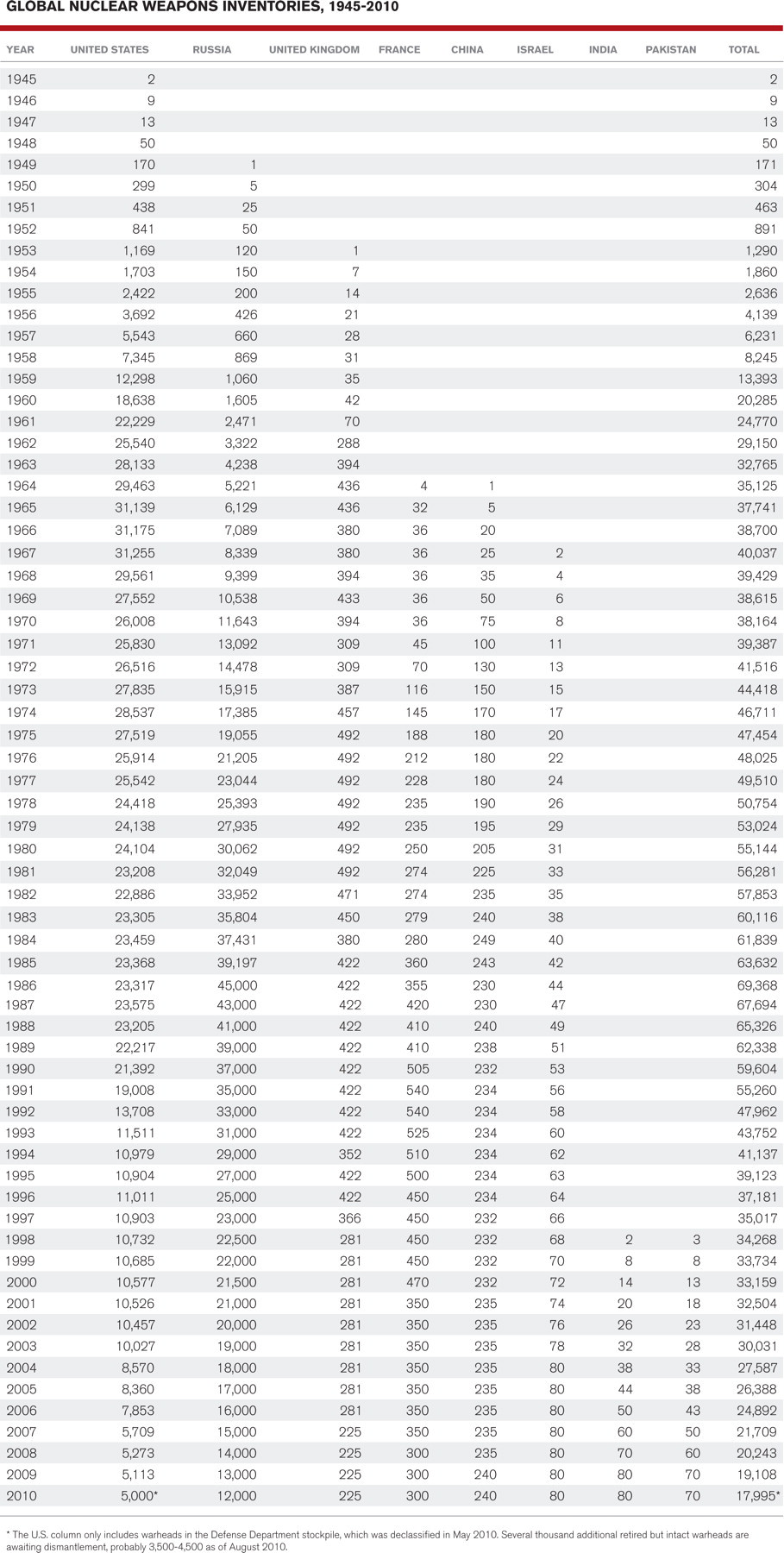
The U.S. column only includes warheads in the Defense Department stockpile, which was declassified in May 2010. Several thousand additional retired but intact warheads awaiting dismantlement, probably 3,500–4,500 as of August 2010.
Footnotes

Occasionally, statements from Russian officials give a benchmark to help calculate the levels of the Russian arsenal, but these statements generally lack details and the dates are often ambiguous. In 1993, Viktor Mikhailov, then Russia's minister of atomic energy, declared that Russia had 45,000 warheads in its stockpile in 1986. In a statement a decade later, he said that nearly half of them had been dismantled. See “Country Dismantles Nearly Half Its Nuclear Arsenal,” Interfax, April 27, 1997 (transcribed by the Foreign Broadcast Information Service in FBIS-TAC-97-117, April 27, 1997). The U.S. Defense Department and Central Intelligence Agency have estimated that Russia dismantled slightly more than 1,000 warheads per year during the 1990s, though how firm those estimates were is not known.