




Abstract
On March 26, 2010, North Korea attacked the South Korean vessel Cheonan, killing 46 people and making it one of the deadliest encounters in Korea in recent years. This attack followed a year of mounting tensions in which Pyongyang tested the first stage of a long-range missile in the guise of putting a satellite into orbit and then conducted its second underground nuclear test. Following the attack, the Obama administration backed South Korea’s decision to punish North Korea with tough trade sanctions. The author writes that this was not necessarily a wise move, as punitive measures, however justifiable, will be met tit-for-tat by North Korea. Pyongyang reacted to the July 2006 U.N. Security Council sanctions for its missile tests, the author writes, by conducting a nuclear test; its response to tougher U.N. sanctions in June 2009 for its second nuclear test was to reprocess more plutonium. The author looks at recent interactions, discussions, and disputes among North Korea, South Korea, and the United States, and writes that the only way to make the waters off Korea safer and to stop further nuclear proliferation is to resume the Six-Party Talks soon, negotiate in earnest, and start a parallel peace process for the Korea.
In the last two years the situation on the Korean Peninsula has gone from somewhat hopeful to dangerously bad. On March 26, 2010, North Korea sank a South Korean Navy corvette, the Cheonan, killing 46 people, the deadliest encounter in Korea in two decades. This attack followed a year of mounting tensions in which Pyongyang tested the first stage of a long-range missile in the guise of putting a satellite into orbit and then conducted its second underground nuclear test.
North Korea earns its fair share of media headlines and op-ed criticisms for its nuclear ambitions, adversarial behavior, over-the-top rhetoric, and human rights abuses. Yet North Korea’s attention-grabbing behavior—the missile and nuclear tests, the attack on the Cheonan—has obscured South Korea’s role. For example, at Six-Party Talks in 2007, North Korea promised to disable its plutonium facility in exchange for energy aid provided by South Korea (among others). When South Korea reneged, North Korea responded with missile and nuclear tests in the spring of 2009. The Cheonan attack was also a case of action and reaction. North Korea carried out the attack to avenge the destruction of one of its ships by South Korea last November.
Predictably, most accounts have focused on North Korea’s actions; oddly, they have ignored the obvious causes and focused on the opaque, attributing the Cheonan attack to internal motives. Kim Jong-il, it was said, was shoring up the shaky succession of his son Kim Jong-un with a show of force, or the regime was distracting the North Korean people from its own economic malfeasance.
What little is known about North Korea does not support these claims. Its leadership transition seems to be proceeding smoothly, with no signs of a succession struggle. And far from being on the ropes, the North’s economy has been growing for 9 of the past 10 years, along with its foreign trade, according to South Korean data. The gross domestic product even grew about 3.7 percent in 2008 and 2009—years that were not good elsewhere.
While “North Korea is on the verge of collapse” has been a conventional narrative in Washington for two decades, it has recently been bolstered by a South Korean disinformation campaign—one that deflects attention from Seoul’s role in spurring Pyongyang’s misbehavior.
The attack on the Cheonan is not an incident that can be assessed on its own. To understand that deadly day in March requires first understanding the relationships among North Korea, South Korea, and the United States.
Pyongyang’s strategy
Since the late 1980s, Pyongyang’s aim has been to get Washington to end enmity and reconcile, and it has used its nuclear weapon programs both as bait and bludgeon to achieve that aim. Progress has come when Washington and Seoul have moved in tandem to reconcile with Pyongyang. The worst crises—in March 1993, when North Korea announced its withdrawal from the Nuclear Non-Proliferation Treaty (NPT), and May 1994, when the country abruptly removed its spent nuclear fuel rods from the reactor at Yongbyon—occurred after Seoul successfully impeded reconciliation between the United States and North Korea. Hardliners in Seoul have regarded any improvement in relations between Washington and Pyongyang with suspicion and have sought to impede engagement, which was the case in late 1992, late 1993, and early 1994. North Korea has reacted badly to U.S. disengagement, especially when it saw the United States as following South Korea’s lead—and that is the case today.
By escalating tensions and raising the stakes, Pyongyang is underscoring its need for Washington to re-engage—while at the same time strengthening its negotiating position. What the United States risks in resisting engagement is that Pyongyang could be prompted to make more plutonium by restarting its nuclear reactor at Yongbyon (which was shut down in 2007) and to conduct more nuclear and missile tests.
A high point in engaging the North
October 2007 marked a high point in engagement when North and South Korea held their second-ever summit meeting, which yielded a potentially far-reaching accord extending economic relations. At the same time, the Six-Party Talks involving North Korea, South Korea, the United States, China, Russia, and Japan yielded an agreement on the second phase of denuclearization; North Korea pledged to provide “a complete and correct declaration of all its nuclear programs” and to disable its nuclear facilities at Yongbyon, thereby making it more difficult and time-consuming to resume plutonium production. In return, the other parties committed to provide North Korea with energy aid, and the United States promised to relax sanctions under the Trading with the Enemy Act and to take North Korea off its list of state sponsors of terrorism. Nothing was said about verification to assess the accuracy of North Korea’s declaration, which was left to a later phase of denuclearization.
Two months later, South Korea elected a president, Lee Myung-bak, who was determined to get tough with the North in the belief that Pyongyang would become more pliable under pressure of sanctions and isolation. In an effort to impede Washington from moving to end enmity and seek peace with Pyongyang, Lee jettisoned the “Sunshine Policy” of his predecessors, which since 1999 had encouraged engagement between North and South Korea and earned former South Korean President Kim Dae-jung the Nobel Peace Prize in 2000. Seoul’s change of heart was conspicuous at the Six-Party Talks.
Seoul stalls the Six-Party Talks
When President George W. Bush took office in 2001, North Korea had enough plutonium for one or two nuclear weapons, had verifiably frozen its plutonium program, had not conducted a nuclear test, and was observing a moratorium on longer-range missile tests. Bush’s confrontational strategy led the North to unfreeze its plutonium program and make six to eight weapons. That prompted the administration to enter into Six-Party Talks, which eventually yielded a September 2005 Joint Statement in which North Korea committed to “abandoning all nuclear weapons and existing nuclear programs.” In return, the other parties promised energy aid; the United States and Japan pledged to normalize relations with the North; and the United States, South Korea, and North Korea committed to negotiating peace on the peninsula. After U.S. financial sanctions derailed engagement and led to the North’s first nuclear test, the Six-Party Talks resumed, producing agreements in February 2007 and October 2007 to implement the September 2005 accord.
In June 2008, North Korea declared that it had separated 38 kilograms of plutonium—an amount that was at the lower end of U.S. intelligence estimates. In a side agreement with Washington, Pyongyang pledged to reveal its uranium enrichment and proliferation efforts, including its help for Syria’s nuclear reactor. Many in Washington questioned whether the declaration was “complete and correct.” So did Seoul and Tokyo.
The day that Pyongyang turned over its declaration, the White House announced its intention to fulfill its obligations, but with a caveat: North Korea had to cooperate on verification. Secretary of State Condoleezza Rice acknowledged Washington was moving the goalposts: “What we’ve done, in a sense, is move up issues that were to be taken up in phase three, like verification, like access to the reactor, into phase two” (Rice, 2008).
That did not satisfy South Korea or Japan. They demanded a written verification protocol, and President Bush went along. U.S. officials gave North Korea a draft that included highly intrusive verification measures, such as “full access upon request to any site, facility or location.” On July 30, 2008, the White House announced a delay in delisting North Korea as a state sponsor of terrorism until Pyongyang agreed to these measures (U.S. State Department, 2008b).
North Korea did not take long to retaliate. It stopped disabling the Yongbyon facilities and instead moved to restore them, a move announced by a Foreign Ministry spokesman who accused the United States of “outright violation” of the October 2007 accord in failing to delist North Korea (Korean Central News Agency, 2008). The country then tried to ship weapons technology by air to Iran in a transparent threat to resume proliferation forsworn a year earlier in that accord.
With the disablement in jeopardy, U.S. negotiator Christopher Hill, armed with a revised draft protocol, flew to Pyongyang to meet with his counterpart, Kim Gye Gwan. Stopping short of accepting it, Kim agreed to allow “sampling and other forensic measures” at the three declared sites at Yongbyon: the reactor, reprocessing plant, and fuel fabrication plant. This should have been enough to ascertain how much plutonium North Korea had produced, but in case it was not, he also agreed to “access, based on mutual consent, to undeclared sites” (U.S. State Department, 2008a).
Again, an oral commitment was not good enough for South Korea or Japan; they insisted it be put in writing. Nevertheless, in mid-October 2008 President Bush delisted North Korea as a sponsor of terrorism, much to the dismay of Tokyo.
Disabling the reactor at Yongbyon resumed with nearly 60 percent of the 8,000 fuel rods unloaded from the reactor, but the question of how to dispose of the nuclear fuel remained unanswered. Only half of the energy aid promised to North Korea in return for disabling its reactor had been delivered: Japan maintained that it would not contribute its share of energy aid unless Pyongyang first reinvestigated the abductions of Japanese citizens in the 1970s and 1980s.
South Korea now sided with Japan, insisting that aid deliveries be suspended unless North Korea accepted more intrusive verification. The allies persuaded the United States to go along. The issue came to a head at the seventh round of the Six-Party Talks in December 2008. There was no disguising the threat posed by the United States, South Korea, and Japan that, unless North Korea accepted a written protocol on verification, energy aid shipments would be stopped. North Korea’s envoy, Kim Gye Gwan, made it clear that the North would retaliate for any reneging on energy aid: “We’ll adjust the speed of our disablement work if it doesn’t come in.”
Obama picks up where Bush left off
As a presidential hopeful, Barack Obama said he would be willing to meet without preconditions with the leader of North Korea (among other states) during the first year of his administration, and he stood firm when his rivals attacked his stance (Lizza, 2008). Yet candidate Obama also promised to mend fences with allies that had been treated shabbily by his predecessor. The contradiction between his two campaign pledges would be exposed in the case of Korea.
Preoccupied with reversing a global financial meltdown and forestalling a looming depression while waging two wars, President Obama stayed on Bush’s course in North Korea. He did not move expeditiously to re-establish either the suspended energy aid or direct contact with Pyongyang.
The administration’s posture became what Secretary of State Hillary Clinton deemed “strategic patience.” Sustaining the renege on energy aid and failing to re-engage quickly conceded the initiative to North and South Korea.
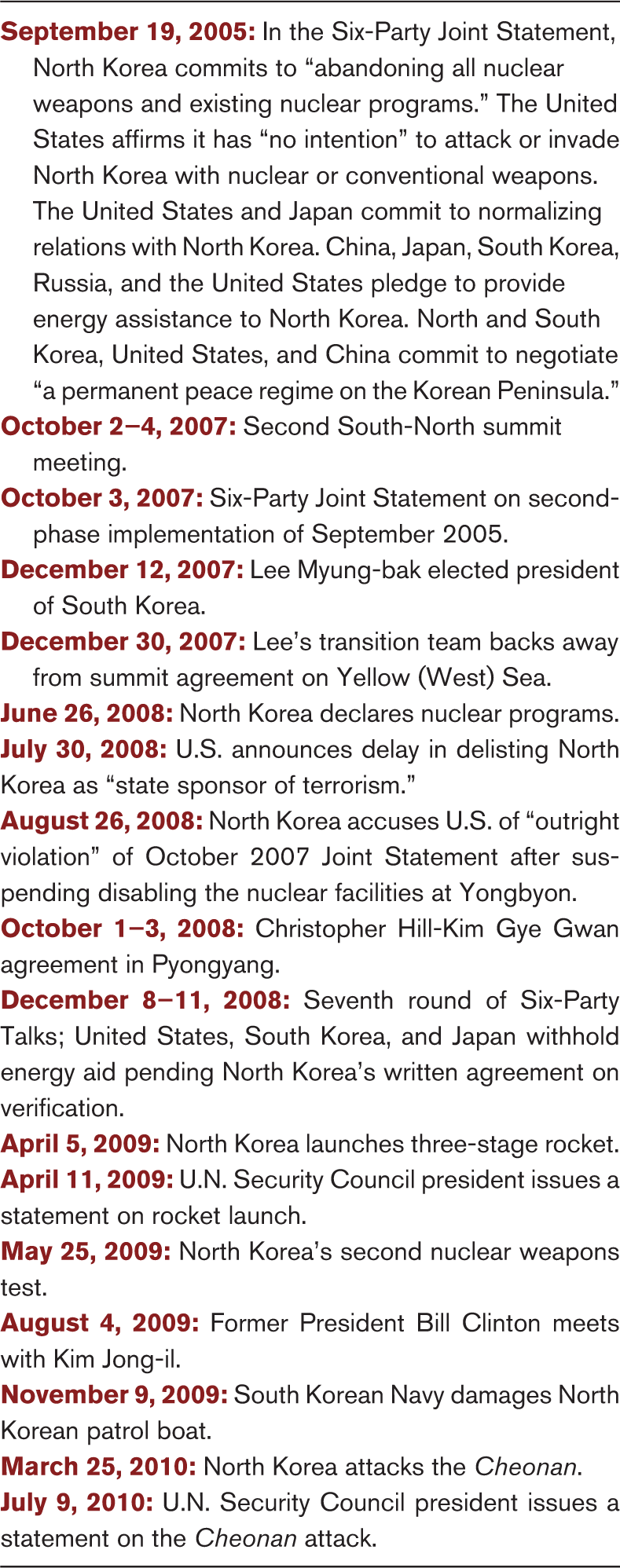
North Korea timeline
“Slamming on the brakes”
In Seoul, President Lee Myung-bak was faring badly in early 2009, with his approval rate down to 34 percent in polls and with his party and government split over North Korea (Ha, 2008). Some of his aides worried that getting tough with Pyongyang promised little political gain and risked further capital flight or, worse, a firefight in coastal waters. Hardliners, however, were ready to make common cause with Tokyo. If Washington and Pyongyang were to speed up talks too much, a senior South Korean official told the South Korean newspaper Chosun Ilbo, Japan could help by “slamming on the brakes” ( Chosun Ilbo, 2009a).
After North Korea’s rocket launch in April 2009, Obama deferred to South Korea and Japan and sought punitive sanctions in the U.N. Security Council. China and Russia were opposed. From its talks in Pyongyang in January and reports in North Korean media, Beijing believed that condemnation of the launch and imposition of sanctions would prompt retaliation by Pyongyang and delay the Six-Party Talks that, in China’s view, represented the only way to end North Korea’s missile and nuclear programs. Yet Beijing was not about to bear the blame in Washington for blocking U.N. action. Nor did Obama want to pick a fight with China over North Korea. The two sides agreed to a statement by the president of the Security Council that condemned the launch in contravention of Resolution 1718, thereby covering space launch vehicles and closing the loophole some saw in earlier resolutions (Reuters, 2009). The Security Council then imposed new sanctions on three North Korean firms involved in missile trading.
Pyongyang’s reaction was all too predictable (Sigal, 2009). Noting that Japan and others had tested space launch vehicles (but leaving unsaid that South Korea planned a launch that summer), North Korea’s Foreign Ministry rejected the Security Council action and listed four steps it would take in response. Denouncing the Six-Party Talks as having turned into “an arena which infringes upon our sovereignty and which aims only at disarming us and overthrowing our system,” the ministry spokesman said, Pyongyang “will no longer be bound to any agreement.” (This called into question North Korea’s commitment in a September 2005 Six-Party joint statement to “abandon all nuclear weapons and existing nuclear programs.”) Second, “we will actively examine the construction of a light-water reactor plant of our own,” ostensibly a threat to enrich uranium to fuel it, which could take years. Third, the Yongbyon nuclear facilities “will be restored to the original state for normal operation.” He stopped just short of saying the reactor would be restarted, which could have been accomplished in months, if not weeks. Fourth, the 6,500 spent fuel rods removed during disabling “will be reprocessed” (Korean Central News Agency, 2009b). Extracting another bomb’s worth of plutonium put Pyongyang in position to conduct another nuclear test without further depleting its stock of plutonium, a test it carried out in May 2009.
Demolishing a bridge over Korea’s troubled waters
The new government in Seoul did more than impede the Six-Party Talks and U.S.-North Korean engagement. It challenged Pyongyang directly in the contested waters off the Korean coast.
At the end of the Korean War in 1953, a sea boundary was unilaterally imposed by the allies north of the Military Demarcation Line (MDL) on land. North Korea has long rejected this so-called Northern Limit Line (NLL), which is also not recognized internationally, in favor of an extension of the MDL seaward.
At the October 2007 South-North summit meeting, Lee’s predecessor, Roh Moo-hyun, signed a wide-ranging accord with North Korea’s Kim Jong-il that offered a way around the NLL dispute by pledging “to discuss ways of designating a joint fishing area in the West [Yellow] Sea to avoid accidental clashes and turning it into a peace area and also to discuss measures to build military confidence” (North-South Declaration, 2007).
Within days of Lee’s election, however, his transition team backed away from this provision (Jung, 2007). Lee also backed away from a 2000 summit agreement that had committed North Korea to abide by the provisional boundary until a permanent boundary could be negotiated.
North Korea’s response was to build up its artillery near the disputed waters. In late March 2008 it accused South Korea of violating “its” territory in the Yellow Sea and launched short-range missiles into the contested area, a provocative reminder of the risks of leaving the issue unresolved. At the same time, Pyongyang repeatedly urged that a permanent peace treaty replace the armistice agreement, a step that Seoul resisted.
Throughout 2009 the two waged a war of words. In mid-January a North Korean military spokesman lashed out at the South’s defense minister “for making full preparations for the possible third West Sea skirmish” and added ominously, that “we will preserve … the extension of the Military Demarcation Line in the West Sea already proclaimed to the world as long as there are ceaseless intrusions into the territorial waters of our side in the West Sea” (Korean Central News Agency, 2009a).
South Korea was not to be out-blustered. In February 2009, its defense minister said that the country “will clearly respond to any preemptive artillery or missile attack by North Korea” in the Yellow Sea (Yonhap, 2009).
To naval officers on either side, the message was clear: Shoot first and ask questions later.
South Korea’s announcement that it would participate in the U.S. Proliferation Security Initiative—to interdict North Korean arms shipments—triggered a new volley of words. In a May 2009 statement that accused the South of violating the Korean armistice, which “prohibits any form of blockade,” the North Korean military declared that it viewed the South’s action as “a declaration of war” and that it was no longer bound by the armistice agreement; further, North Korea said it would “not guarantee the legal status” of five South Korean islands in the territorial waters it claimed (Korean Central News Agency, 2009c). The next day North Korea underscored its words by firing a short-range missile into the Yellow Sea, and South Korea put its forces on alert.
Pyongyang made one last attempt to re-engage with Washington and Seoul in August 2009. Capitalizing on an opportunity to repatriate two American journalists who had strayed across North Korea’s border with China, Kim Jong-il invited former President Bill Clinton for talks on August 4 and renewed an invitation for U.S. special envoy Stephen Bosworth to come to Pyongyang. Later that month, the chair of South Korea’s Hyundai Asan, which runs the Mount Kumgang resort in North Korea, met with Kim Jong-il and soon reached an agreement to resume tours there. On the occasion of Kim Dae-jung’s funeral, Kim Jong-il sent his two top officials on North-South relations to meet with President Lee on August 23 and extend a personal invitation for a third North-South summit, and on August 28 Pyongyang agreed to another reunion of Korean families divided by the war.
All these initiatives came to naught. President Lee killed off the potential summit meeting and specified denuclearization as a prerequisite for major aid, saying, “If North Korea demonstrates a willingness to change, we will offer support” ( Chosun Ilbo, 2009b). Seoul also backed away from the deal to resume tours at Mount Kumgang. Bosworth’s visit was delayed until December; and with no commitment from Seoul to resume shipments of energy aid, he could do little more than reiterate long-standing U.S. positions on the need to resume the Six-Party Talks and denuclearize in return for improved relations.
North Korea takes its revenge on the Cheonan
With little to stay his hand, Kim Jong-il turned up the heat. In October 2009, the North Korean Navy released a report accusing the South of sending 16 warships into the contested waters, according to North Korea’s state-run Korean Central News Agency, which noted, “The reckless military provocations by warships of the South Korean navy have created such a serious situation that naval clash may break out between the two sides in these waters” (Korean Central News Agency, 2009d).
On November 9, the two navies exchanged hostile fire. When a North Korean patrol boat crossed the NLL, the South fired warning shots at it. The North returned fire, and the South opened up, crippling the North Korean vessel and causing an unknown number of casualties. North Korea demanded an apology from the South, which did not respond.
On November 12, North Korea’s party newspaper, Rodong Sinmun, talked about avenging the attack: “The South Korean forces will be forced to pay dearly for the grave armed provocation perpetrated by them in the waters of the north side in the West Sea of Korea” (Korean Central News Agency, 2009e). Five days later, Kim Jong-il went to a naval base with his military high command and, according to North Korean accounts, ordered the navy to train a “do-or-die unit of sea heroes” (Lee and Ser, 2010). With the March 2010 attack on the Cheonan, just south of the contested waters, Kim’s orders were carried out.
Negotiating a way out
Following the attack, the Obama administration backed South Korea’s decision to punish North Korea with tough trade sanctions. Yet punitive measures, however justifiable, will be met tit-for-tat by North Korea and will not prevent another Cheonan any more than they have stopped North Korea from making more nuclear weapons. Recall that Pyongyang’s reaction to U.N. Security Council sanctions in July 2006 for its missile tests was to conduct a nuclear test, and that its response to tougher U.N. sanctions in June 2009 for its second nuclear test was to reprocess more plutonium.
South Korea asked the U.N. Security Council to condemn North Korea for the attack, which China was reluctant to do for fear it would only exacerbate tensions. Seoul wanted Washington to pressure Beijing to take sides against Pyongyang, but the Obama administration could ill-afford to antagonize China with the global economic recovery in jeopardy. The two sides compromised with a U.N. Security Council president’s statement that condemned the Cheonan sinking without naming North Korea.
Pyongyang deplored the result but moved to reopen talks, agreeing to a U.S. proposal to discuss the Cheonan incident in the Military Armistice Commission at Panmunjom. It also expressed readiness to resume Six-Party Talks. Seoul demurred. A senior South Korean official said it would stall talks until Pyongyang apologized for the sinking of the warship and proved its willingness to denuclearize the Korean Peninsula (Kim, 2010).
Seoul also pressed Washington to send a carrier task force to the Yellow Sea to join in antisubmarine exercises, which Beijing denounced as provocative.
Many officials in Seoul are still determined to show who is boss on the Korean Peninsula. Unfortunately, that is North Korea’s game, and one that it is brutally effective at playing. Since both sides believe there won’t be war, they are each tempted to take risks to out-muscle the other.
The only way to make the waters off the Korean Peninsula safer and to stop further nuclear proliferation is to negotiate in earnest—Six-Party Talks must be resumed, and a parallel peace process for the Korean Peninsula must begin. Pyongyang’s acceptance of responsibility for sinking the Cheonan would be a suitable starting point. Face-saving gestures are essential to make that possible. Getting Seoul to go along will not be easy.
Footnotes
Author biography