




Abstract
Keywords
India continues its efforts to develop a triad of offensive nuclear forces. Fighter bombers constitute the only fully operational leg, backed by short-range ballistic missiles. But significant additions to the arsenal are around the corner: Two ballistic missiles are being deployed with the country’s army, two longer-range types are under development, the first of a class of nuclear-powered ballistic missile submarines has been launched, and a nuclear-capable cruise missile might be in the cards.
Historically, the Nuclear Non-Proliferation Treaty (NPT) has had a long-standing principle of denying nuclear technology to countries that have not signed the treaty. That changed in August 2008, when the Safeguards Agreement went into force between India and the International Atomic Energy Agency (IAEA, 2008). This agreement meant that India would allow the IAEA to inspect its civilian nuclear facilities; in return, India would be allowed to import nuclear technology from countries that are party to the NPT—even though India is not. What this agreement also meant is that India can free up its domestic uranium reserves for use in military reactors to produce plutonium for weapons in its emerging triad of nuclear weapons delivery platforms.
All Indian nuclear delivery systems are dual-capable (they can carry either nuclear or conventional warheads), and the operational status of these systems is ambiguous. This not only makes the size, composition, and readiness of India’s nuclear arsenal difficult to determine, but it also has troubling implications for stability on the subcontinent, especially in the case of a war with Pakistan; for example, preparations for an Indian launch of a conventionally armed nuclear-capable ballistic missile could be misidentified by Pakistan as a pending nuclear attack, triggering nuclear escalation of the conflict.
We estimate that India’s nuclear stockpile includes 60–80 assembled nuclear warheads, with only about 50 fully operational, though we predict this number will grow over the next decade.
Insisting that it opposes an arms race and Cold War concepts or postures, India says its nuclear doctrine is “based on the principle of a minimum credible deterrent and no-first-use as opposed to doctrines or postures of launch-on-warning” (Indian MOD, 2005: 14). In 2007, Defense Minister Shri A. K. Antony said that the nation’s minimum deterrence capability would be “commensurate with the size and geostrategic position of India in the world” (Press Information Bureau, 2007).
But exactly how large such a deterrence force would be is unclear, and India has yet to quantify what force level its minimum deterrent requires. In response to our 2009 Nuclear Notebook on Pakistani nuclear forces, India’s Army Chief Gen. Deepak Kapoor responded that, “there is a difference between having a degree of deterrence which is required for one’s own protection, and going beyond that degree of deterrence.” Kapoor said that if our estimate of 70–90 Pakistani nuclear weapons were correct, “then I think they [Pakistan] are going well beyond the so-called requirement of deterrence” ( Times Now TV, 2009). Although not official policy, the general’s remark suggests that the Indian nuclear stockpile of 60–80 nuclear warheads would also exceed the “requirement of deterrence.”
Aircraft
As we wrote in 2008 in our Nuclear Notebook on India, fighter bombers continue to be the mainstay of India’s nuclear strike force, and India’s Mirage 2000 H, Jaguar IS/IB, and possibly MiG-27, are the likely aircraft assigned nuclear missions (Thapar, 2008).
Known as the Vajra (“divine thunder”), the single-seat Mirage 2000H is a multirole aircraft deployed with Squadrons 1 and 7 of the 40th Wing at Maharajpur Air Force Station on the outskirts of Gwalior, approximately 270 kilometers (170 miles) southeast of New Delhi; we estimate that one of the squadrons has a secondary nuclear mission. 1 The Jaguar IS/IB, known as the Shamsher (“sword”), was nuclear-capable when deployed by both Britain and France. We estimate that two of the four operational squadrons, which have approximately 76 Jaguar IS variants, have a secondary nuclear strike mission. Further, the Hindustan Aeronautics–assembled, Soviet-origin MiG-27 Flogger, known as the Bahadhur (“valiant”), may also have a nuclear strike mission, although indications are scarce and circumstantial.
Land-based missiles
When we last looked at India in our Nuclear Notebook in 2008, India had four land-based, nuclear-capable ballistic missile types either deployed or under development. That number is now five: The short-range Prithvi I has been deployed since 1998; the short-range Agni I and medium-range Agni II were declared operational, but reliability issues with both missiles continue to delay their full operational service; the longer-range Agni III is still under development after four flight-tests; and the newest of the types, the near-intercontinental ballistic missile (ICBM) Agni V, is also under development. The land-based leg of India’s triad has been slow to develop, prompting the government to reorganize missile production to deliver missiles faster.
The CIA only identifies one of three Prithvi versions, which comprise the bulk of India’s ballistic missile force, as having a nuclear role. This is the Prithvi I (the army version), which is 9 meters (30 feet) long and about 1 meter (3 feet) in diameter, weighs 4,000 kilograms, and has a range of 150 kilometers (93 miles). Though we know that Prithvi missiles are deployed with the 333rd and 355th Missile Groups, nothing is known about deployment areas; due to the missiles’ small size, it is difficult to identify Prithvi bases, not to mention which ones are nuclear. The Prithvi is still the mainstay of the Indian Strategic Forces Command.
Deployed with the 334th Missile Group, the two-stage Agni I has been tested to a range of 700 kilometers (435 miles). A successful army test-launch apparently occurred in the spring of 2010, indicating that the missile might finally have become operational.
The Agni II, an improved version of the Agni I, has a range of 2,000 kilometers (1,240 miles), can carry a 1,000-kilogram payload, and is road- or rail-launched. It takes only 15 minutes for the missile to be readied for firing ( Times of India, 2009). The missile has been test-flown six times; however, due to problems in second-stage separation, two launch failures in 2009 confirmed that the missile was not yet ready, as we estimated in 2008. For the May 2009 flight-test, which failed, an Agni II was randomly selected from the army’s pool of missiles to conduct “a repeat launch” (Subramanian, 2009). A successful flight on May 19, 2010, however, demonstrated some progress toward making the Agni II fully operational.
The Agni III, which is under development, is a two-stage, solid-fuel missile of 17 meters (56 feet) in length, nearly 2 meters (6.6 feet) in diameter, and a launch weight of 50 tons. It has a range of 3,000-plus kilometers (1,860 miles) and is rail-mobile. When referring to the Agni III in 2008, a spokesperson for the Indian Army’s Eastern Command said, “India can even strike Shanghai” ( Times of India, 2008).
The Agni III was test-flown for the fourth time on February 7, 2010, when it was pushed to its “full range,” peaking at 350 kilometers, and reaching nearly 3,000 degrees Celsius during reentry (Press Information Bureau, 2010). After the February 2010 test, defense officials said that the Agni III was “declared operational,” but it will need additional flight-tests before the missile can become operational with the army (Chakravarty, 2010).
V. K. Saraswat, the head of the Indian Defense Research and Development Organization (DRDO) and scientific adviser to the Indian defense minister, is responsible for developing the Agni missiles. Saraswat said Agni III is “the full deterrence that the country needs” because it is “a real mobile system and hence it has a strategic advantage” (Chakravarty, 2010). Another government scientist, Avinash Chander, who heads India’s Integrated Guided Missile Development Program, added that the Agni III is also “the weapon which provides us a platform with an anti-satellite capability,” although India has not yet performed an antisatellite test (Chakravarty, 2010).
In 2008, the DRDO announced plans to build the Agni IV, which might be a “technology demonstrator” between the Agni III and Agni V. The Agni IV will have a range greater than 5,000 kilometers (3,110 miles), capable of targeting Beijing. The flight-test of the three-stage Agni V is expected to occur sometime before December 2010. 2
Rumors about development of an intercontinental-range ballistic missile have been around for years. But after the Agni III test, Saraswat said that Indian scientists were not engaged in developing such a project at the moment (Chakravarty, 2010).
Between 2015 and 2020, India’s nuclear missile force will consist primarily of Agni III and Agni IV missiles, defense officials say. Theoretically to overwhelm ballistic missile defenses, these Agni missiles will all carry enhanced warheads (Shukla, 2008). Some industry officials have said that both weapons will have multiple independently targetable reentry vehicles (MIRVs). Given the fact that even nuclear weapon states experience great challenges in their development of MIRV technology—and considering the failures with the Agni I and Agni II—we remain skeptical, as we were in 2008, to rumors that India will add MIRVs to its missiles in the near future. In addition, missiles with multiple warheads would invite serious questions about the credibility of India’s minimum deterrent doctrine.
Naval weapons
In 2008, we referenced two naval weapon systems that were being developed for the sea-based leg of India’s nuclear triad. Those missile systems were the Dhanush (“bow”) and the Sagarika (“oceanic”); development of both systems continues today.
Indian nuclear weapons capabilities, 2010
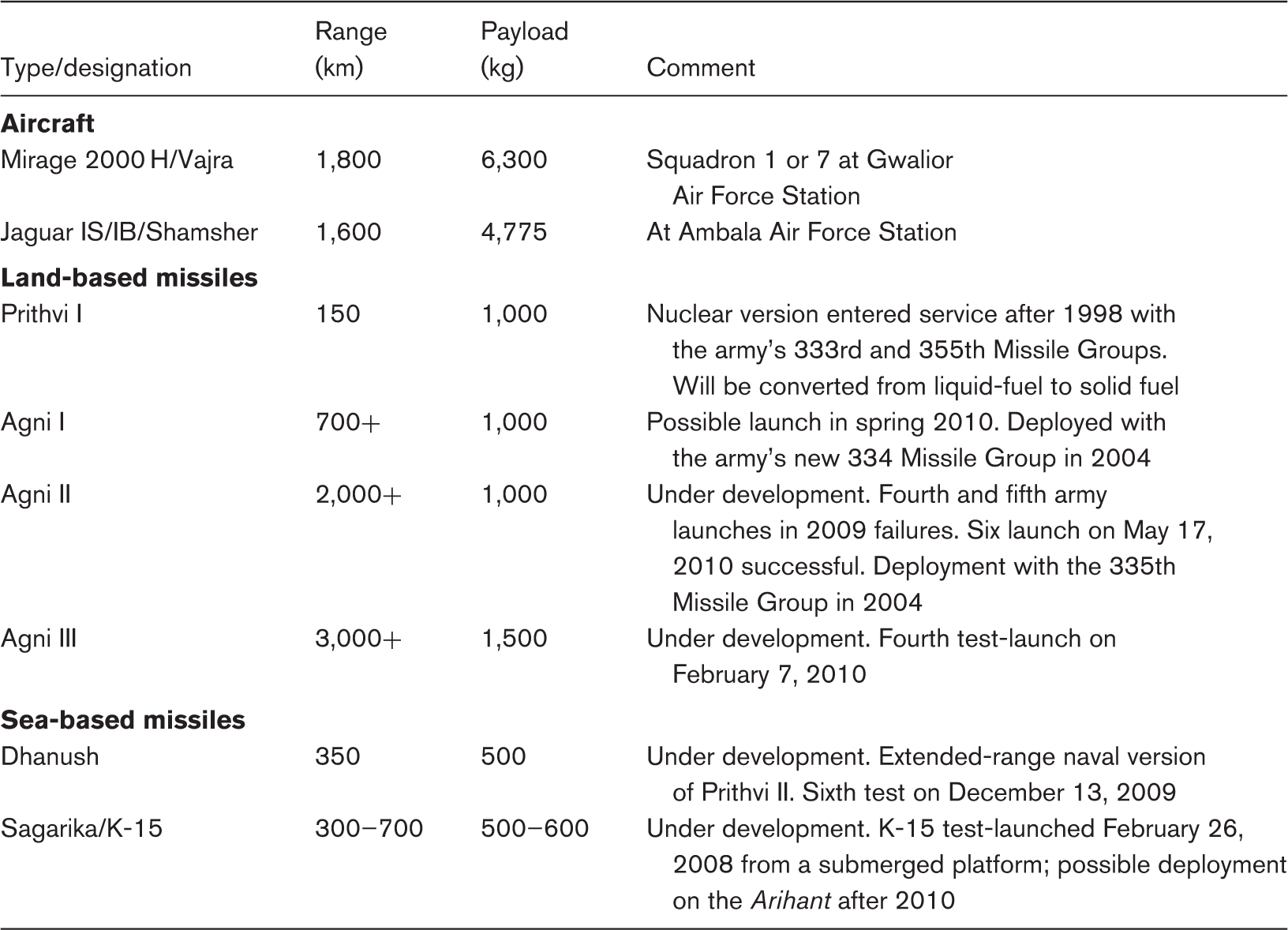
Arihant is thought to be equipped with 12 vertical launch tubes for the Sagarika submarine-launched ballistic missile, which has a range of approximately 300 kilometers (more than 180 miles), according to U.S. intelligence (U.S. Air Force, National Air and Space Intelligence Center, 2009). Adm. Nirmal Verma, chief of the Indian Navy, said after the launch of the Arihant that the submarine would come equipped with its complement of ballistic missiles (Unnithan, 2009). In February 2008, a version of the Sagarika, the K-15, was test-launched from a submerged platform near Visakhapatnam; media reported the range to be 700 kilometers (435 miles), well beyond the estimate of U.S. intelligence (Reuters, 2008). Following this test, the DRDO announced that the K-15 would be integrated with the Advanced Technology Vessel, the program name for the Arihant ( Agence-France Presse, 2008).
The payload capability of approximately 500 kilograms (kg) is considerably smaller than the 1,000 kg for the nuclear ballistic missiles, suggesting that a smaller warhead must have been developed for the Sagarika/K-15.
Another naval missile rumored to have nuclear capability is the Dhanush ship-launched ballistic missile, which was successfully launched from the Subhadra on December 13, 2009, the sixth test-launch of the missile. However, its utility is compromised by its short range—350 kilometers (220 miles); to reach land targets, the ship carrying the missile would need to be close to enemy shores, making it highly vulnerable to detection and counterstrike. Moreover, the Indian Defense Ministry has identified its payload as only about 500 kg, half that of the Prithvi I and the other nuclear-capable missiles, which suggests that a smaller warhead has been developed (Indian MOD, 2010).
Cruise missiles
In 2007, the Advanced Systems Laboratory (ASL) in Hyderabad began developing an intermediate-range land-attack cruise missile known as the Nirbhay (“fearless”) because, as the ASL director said, “the need was felt for a subsonic cruise missile that will be capable of being launched from multiple platforms in land, air, and sea.” Media at the time compared this subsonic cruise missile to the U.S. Tomahawk sea-launched cruise missile and the Pakistani Babur cruise missile, reporting that the Nirbhay would have a range of 1,000 kilometers (620 miles) and the alleged capability of carrying 24 types of warheads (although not at the same time). Though a technology-demonstration test is still pending, it remains unclear whether the missile will be nuclear capable, which would require development of a small, lightweight warhead.
Footnotes
1
Some sources list a third Mirage squadron, No. 9, at Gwalior, but the Indian Air Force list does not. Moreover, commercial satellite images show only 18 Mirages at the base, not enough for three squadrons.
2
Daily Times (2009) . Despite the headline, a 5,000-kilometer missile would not be an ICBM, which requires a range of at least 5,500 kilometers.
Notes
Nuclear Notebook is prepared by Robert S. Norris of the Natural Resources Defense
Council (NRDC) and Hans M. Kristensen of the Federation of American Scientists.
Direct inquiries to NRDC, 1200 New York Avenue, N.W., Suite 400, Washington, D.C.,
20005 (or 202-289-6868), and visit  for more nuclear weapons data.