




Abstract
With or without a follow-on agreement to START, the number of warheads in the Russian nuclear arsenal continues to shrink. But that doesn't mean Moscow has given up modernizing its strategic nuclear forces.
The landmark Strategic Arms Reduction Treaty (START) between the United States and Russia expired on December 5, 2009. Negotiations are in the final phase on a follow-on treaty intended to reduce deployed strategic warheads to between 1,500 and 1,675 and strategic launchers to between 500 and 1,100. When the follow-on treaty is signed, it will enter into force after ratification by the Russian Duma and U.S. Senate.
Although the follow-on treaty will further reduce Moscow's strategic forces, strategic nuclear force modernization is still a priority in Russia. In a November 2009 speech to the Federal Assembly, President Dmitry Medvedev said that in 2010 the Russian military would receive “more than 30 ballistic land- and sea-based missiles” and three nuclear submarines. 1
A new National Security Strategy, drafted in May 2009, clarified Russia's nuclear weapons employment policy. Security Council Secretary Nikolai Patrushev, apparently the main author of the document, told Rossiyskaya Gazeta that the new strategy “stipulates the possibility of the employment of nuclear weapons depending on the conditions of the situation and the probable enemy's intentions. The conduct of a nuclear strike against an aggressor, including a preemptive strike, is not ruled out in critical situations for national security.” 2 This calculated ambiguity is similar to U.S. nuclear employment policy.
We estimate that as of late 2009, Russia had approximately 4,600 nuclear warheads in its operational arsenal: roughly 2,600 strategic warheads and 2,000 nonstrategic warheads–a slight decrease from last year's levels. An additional 7,300 warheads are estimated to be in reserve or awaiting dismantlement, for a total of approximately 12,000 nuclear warheads, which we believe are located at 48 permanent storage sites (see “Nuclear Notebook: Worldwide Deployments of Nuclear Weapons, 2009,” November/December 2009 Bulletin). 3
Ongoing maintenance and reliability of the Russian nuclear stockpile is contingent upon the periodic reproduction of warheads, in contrast to the U.S. practice of extending service lives of existing warheads through the Stockpile Stewardship Program. More in line with U.S. practices, Medvedev declared in July 2009 that by 2011 Russia would develop supercomputers to test the effectiveness of its nuclear deterrent. 4 Some have alleged that Russia has secretly conducted low-yield nuclear tests, but the evidence is ambiguous and the issue remains controversial.
Intercontinental ballistic missiles (ICBMs).
Russia deploys nearly 1,100 nuclear warheads on 331 ICBMs of six types. The newest type comes in three variants or modifications of the SS-27 ICBM: a silo-based single warhead and a mobile single warhead (both Topol-M, or Mod. 1), along with a mobile warhead equipped with multiple independently targetable reentry vehicles (RS-24). Each RS-24, which was first deployed in 2009, is estimated to carry four or more warheads. Deployment of the silo-based SS-27 has reached 50 operational missiles, organized into five regiments, with 10 more missiles expected. Eighteen mobile SS-27s are operational and deployed at the 54th missile regiment at Teykovo (northeast of Moscow).
Russia continues to retire large numbers of older ICBMs due to their age and to meet the limits of the Moscow Treaty. It withdrew about 30 SS-25s from service in 2009, leaving approximately 150 deployed. If it sustains this retirement rate, Moscow will retire all SS-25s by 2015. Two SS-25s were flight-tested in 2009, on April 20 and December 10, respectively. Approximately 10 SS-19s were retired in 2009, leaving about 60. We anticipate that all but the 20 newest SS-19s will be withdrawn by 2012; the remaining missiles will be in service until about 2015 or longer. Russia cut about 20 SS-18s in 2009, leaving approximately 50 missiles in the force. We estimate that all but the 30 newest SS-18s will be retired over the next few years. The remaining SS-18s will be retired before 2020. 5
Nuclear-powered ballistic missile submarines (SSBNs).
Russia has 10 active SSBNs: six Delta IVs and four Delta IIIs. They are equipped with 160 submarine-launched ballistic missiles (SLBMs) that carry an estimated 576 warheads. The six Delta IVs are part of the Northern Fleet based at Yagelnaya Bay on the Kola Peninsula; the four Delta IIIs are based at Rybachiy on the Kamchatka Peninsula as part of the Pacific Fleet and will eventually be replaced by the Borey-class SSBN.
The development of the Borey-class submarine and its accompanying Bulava SLBM has not been smooth. The first boat, Yuri Dolgoruki, has been under development for more than 10 years, and the Bulava (SS-N-32) had test failures in 2008 and 2009. Each Borey-class SSBN will be equipped with 16 Bulava SLBMs, which have a range of 8,000–9,000 kilometers and can carry up to six warheads. The Yuri Dolgoruki conducted sea trials in 2009, but given the multiple failures of the Bulava missile, it is unclear when the SSBN will become operational. Delivery of the second Borey-class SSBN, the Alexander Nevsky, has been delayed until 2010 at the earliest. A third, tentatively named Vladimir Monomakh, is scheduled to be completed in 2012 but also might be delayed. The keel of a fourth boat was scheduled to be laid down in December 2009, but that, too, has been delayed. “Starting with the fourth submarine, we will begin modernizing this class,” navy officials said in 2008. The modernized Borey will be “the core of Russian naval nuclear forces until 2040.” 6
RUSSIAN NUCLEAR FORCES, 2010
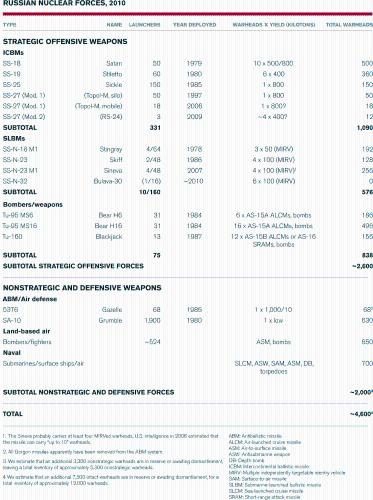
The Sineva probably carries at least four MIRVed warheads. U.S. intelligence in 2006 estimated that the missile can carry “up to 10” warheads.
All Gorgon missiles apparently have been removed from the ABM system.
We estimate that an additional 3,300 nonstrategic warheads are in reserve or awaiting dismantlement, leaving a total inventory of approximately 5,300 nonstrategic warheads.
We estimate that an additional 7,300 intact warheads are in reserve or awaiting dismantlement, for a total inventory of approximately 12,000 warheads.
ABM: Antiballistic missile
ALCM: Air-launched cruise missile
ASM: Air-to-surface missile
ASW: Antisubmarine weapon
DB: Depth bomb
ICBM: Intercontinental ballistic missile
MIRV: Multiple independently targetable reentry vehicle
SAM: Surface-to-air missile
SLBM: Submarine-launched ballistic missile
SLCM: Sea-launched cruise missile
SRAM: Short-range attack missile
As part of its naval modernization plans, Moscow is upgrading the Delta IVs by equipping them to carry the Sineva SLBM, an improved version of the SS-N-23 missile. Three submarines (the Bryansk, Tula, and Yekaterinburg) have completed their upgrades; a fourth (Karelia) is nearing completion, and a fifth (Novomoskovsk) began its modernization in 2009.
Russia conducted seven SLBM test-launches in 2009, culminating with the failure of the Bulava SLBM on December 9–the missile's second malfunction of the year. Depending on the criteria of success, only one out of a total of 12 tests may have been fully successful. Given this performance, the future of the Bulava seems to be in doubt. The Sineva SLBM, which was test-launched from the Bryansk on July 13 and 14, was more successful. 7 From a position near the North Pole, the first missile was test-launched with the Kura test range on the Kamchatka Peninsula as its target, while the second test had a compressed trajectory and hit the Chizha test range in northeastern Russia. A task force of several nuclear-powered attack submarines apparently accompanied the Bryansk for protection, and a source within the Russian Navy said the operation “proves that the Russian Navy has retained the capability of moving under Arctic ice and striking targets while undetected.” 8 A third Sineva was test-launched from the Bryansk on November 1, and two SS-N-18 SLBMs were test-launched from two Pacific-based Delta IIIs–Sv. Georgiy Pobedonosets and Ryazan, on October 6 and 7, respectively.
After we reported that Russian SSBNs conducted 10 patrols in 2008, a source in the Russian Navy General Staff told RIA Novosti, “Up to 10 submarines are conducting various missions around the globe, including training and combat patrol missions with nuclear weapons onboard.” 9 Two Russian Akula-class attack submarines conducted a rare patrol off the U.S. Eastern Seaboard in August 2009. Even though these submarines are very quiet–similar to U.S. Los Angeles-class attack boats–the U.S. antisubmarine forces apparently had no problem monitoring them.
Strategic bombers.
Russia deploys 75 strategic bombers–13 Tu-160 Blackjacks, 31 Tu-95 MS6 Bear H6s, and 31 Tu-95 MS16 Bear H16s–although not all of them are fully operational. Over the last year, Russia has withdrawn one Tu-160 and one Tu-95 MS6. A small number of Tu-160 and Tu-95 aircraft are receiving major modernizations to their targeting and navigation systems, perhaps aimed at adding conventional capabilities to expand their military utility. 10 Russian strategic bombers are equipped to carry an assortment of nuclear bombs as well as the nuclear AS-15A (Kh-55) air-launched cruise missile. Russia has been developing an advanced nuclear cruise missile (Kh-102) for more than a decade, but it still is not deployed. Moscow is converting some nuclear AS-15As to conventional missiles, similar to the U.S. conversion of nuclear air-launched cruise missiles to conventional cruise missiles. The Russian conventional missile is designated as Kh-555.
In 2009, Moscow kept busy with long-range strategic bomber operations, which it increased two years earlier. Shortly before President Barack Obama's visit to Canada in February, Canadian F-18 aircraft intercepted a russian long-range bomber over the Beaufort Sea (in the Arctic Ocean north of Alaska and Canada), about 125 miles from Canadian territory.
In 2009, Moscow kept busy with long-range strategic bomber operations, which it increased two years earlier. Shortly before President Barack Obama's visit to Canada in February, Canadian F-18 aircraft intercepted a Russian long-range bomber over the Beaufort Sea (in the Arctic Ocean north of Alaska and Canada), about 125 miles from Canadian territory. On August 5, two Tu-95s flew southwest between Iceland and the Faroe Islands over the North Atlantic Ocean. In November, two Tu-95 aircraft departed from Engels Air Force Base in eastern Russia and flew north along the Arctic Ocean toward the Aleutian Islands off Alaska, where two U.S. F-22s from Elmendorf Air Force Base intercepted them. Also in November, according to one report, two Tu-160 aircraft from Engels apparently flew along the northern border of Russia and then over the Pacific Ocean before returning to their base along Russia's southern border. 11
Following the deployment of two nuclear-capable long-range bombers to Venezuela in September 2008, the Russian news media speculated that Russia might build base facilities there, something Venezuelan President Hugo Chavez has denied. 12
Nonstrategic weapons.
The Russian government, like the U.S. government, provides very little information about its inventory of nonstrategic nuclear warheads, which only encourages rumors and distrust. Moscow has been reducing its nonstrategic warheads since 1992 when then President Boris Yeltsin pledged that production of warheads for ground-launched tactical missiles, artillery shells, and mines had stopped and that all of those warheads would be eliminated. He also pledged that Russia would dispose of one-half of its tactical airborne and surface-to-air warheads, as well as one-third of its tactical naval warheads. The Russian Defense Ministry said in 2007 that ground-force tactical nuclear warheads had been eliminated; air-defense tactical warheads reduced by 60 percent (10 percent more than Yeltsin pledged); air force tactical warheads reduced by 50 percent; and naval tactical warheads reduced by 30 percent. 13 Many of the Russian nonstrategic weapons are old and will probably be retired in the near future.
We estimate that Moscow retains approximately 5,390 tactical warheads, including 1,120 missile- and air-defense tactical warheads; 2,000 tactical warheads for its air force; and 2,270 naval tactical warheads. Doubts have been raised that not all ground-launched tactical warheads have been destroyed. More than one-third of these warheads probably have some level of operational status; the remaining weapons are in reserve or awaiting dismantlement.
Russia maintains a relatively large inventory of operational non-strategic naval nuclear warheads–nearly 700 warheads that can arm cruise missiles, antisubmarine weapons, anti-air missiles, or torpedoes–for delivery by 280 submarines, surface ships, and naval aircraft. (We believe that surface ships are no longer assigned nuclear torpedoes and that all tactical naval nuclear weapons are stored on land.) The new Severodvinsk-class nuclear-powered attack submarine is probably nuclear capable, and Vice Adm. Oleg Burtsev, deputy chief of the Russian Navy General Staff, told RIA Novosti in 2009, “Tactical nuclear weapons [on submarines probably] will play a key role in the future.” 14 He also said that increased accuracy reduced the need for powerful warheads, so that Russia “can install low-yield warheads on existing cruise missiles.”
Nearly 650 nonstrategic air-delivery warheads (AS-4 air-to-surface missiles and a variety of bombs) are estimated to be operational. Tu-22M Backfire bombers, which Russia considers as strategic aircraft, can deliver both AS-4 missiles and bombs; Su-24 Fencer fighter-bombers, which are being replaced by Su-34 Fullback fighter-bombers, can deliver only bombs. Some Tu-22M and Su-24 bombers are being equipped with precision-guided conventional weapons.
Moscow is updating its SA-10 Grumble (S-300) air-defense system to the SA-12 Growler (S-400) system, which reportedly has some capability against ballistic missiles. Approximately 600 to 700 warheads are believed to be operational for use in the air-defense system and the A-135 antiballistic missile system that surrounds Moscow. At least one SA-12 regiment, which includes about eight launchers and 32 missiles, is deployed around Moscow; a second was expected to become operational in 2008. Russia plans to deploy at least 18 systems by 2015 that will form the core of its air and missile defenses through at least 2020. 15 Test-launches of the short-range Gazelle antiballistic missile interceptors, which are part of the A-135 system, were conducted in 2006, 2007, and 2009, partly as part of an upgrade of the Pill Box (Don-2N) radar north of Moscow.
Footnotes
1.
Medvedev provided no details, but he was probably referring to Russia's Sineva and Bulava SLBMs, remaining Topol-M ICBMs, and new RS-24 ICBMs; the submarines probably include the first Borey-class SSBN, a refitted Delta IV SSBN, and a new attack submarine. Dmitry Medvedev, “Presidential Address to the Federation Assembly of the Russian Federation,” November 12, 2009. Available online at eng.kremlin.ru/text/speeches/2009/11/12/1321_type70029type82912_222702.shtml.
2.
Timofey Borisov, “Nikolay Patrushev: The Draft of the New Document, which Defines the Country's Defense Capability, Has Been Prepared,” Rossiyskaya Gazeta, November 20, 2009.
3.
Essential references for following Russian strategic nuclear forces include the
START Memorandum of Understanding released by the U.S. and Russian governments
twice a year; the Open Source Center; Pavel Podvig's website
“Russian Strategic Nuclear Forces,” available online at
www.russianforces.org; and the database “Russia:
General Nuclear Weapons Developments,” maintained by the James Martin
Center for Nonproliferation Studies, available online at  .
.
4.
Dmitry Medvedev, “Speech at Meeting of Commission for Modernization and Technological Development of Russia's Economy,” Sarov, July 22, 2009.
5.
“Russia to Keep SS-18 Ballistic Missiles in Service until 2019,” RIA Novosti, April 10, 2009.
6.
Dmitry Solovyov, “Russia Plans New Carriers, Subs to Boost Navy,” Reuters, July 27, 2008.
7.
Some uncertainty exists as to whether the launches on July 13 and 14 were from one or two submarines and whether it involved two Sineva or two different missiles.
8.
“Russia Proves Effectiveness of Its Naval Nuclear Forces–Navy,” RIA Novosti, July 15, 2009.
9.
“Up to 10 Russian Subs at Sea Around the World–Navy Source,” RIA Novosti, March 20, 2009.
10.
“Russia to Upgrade Strategic Bombers in 2009,” RIA Novosti, December 23, 2008.
11.
Roger McDermott, “Russian Strategic Bomber Flights: Long Range Deception,” Jamestown Foundation, Eurasia Daily Monitor, vol. 6, no. 220 (December 1, 2009).
12.
“Venezuela: Russian Bombers OK, But No Base,” Associated Press, March 16, 2009.
13.
“Russia Determined to Keep Tactical Nuclear Arms for Potential Aggressors,” Pravda, October 31, 2007.
14.
“Russia Could Focus on Tactical Nuclear Weapons for Subs,” RIA Novosti, March 23, 2009.
15.
“Russia to Deploy Second S-400 Regiment Near Moscow in 2008,” RIA Novosti, January 21, 2008; “Moscow to Deploy S-400 Air Defense Systems in Northwest Russia,” RIA Novosti, February 7, 2008.