Abstract


Cheering up the doomsday Clock
Despite its ominous name, the Doomsday Clock is meant to inspire hope and action. James DeMonaco, a 22-year-old art and design student at the Art Institute of California, San Francisco, got the message loud and clear. A course about the history of war introduced DeMonaco to the Bulletin, and he became fascinated with the Clock. In contrast to the horror of the subject he was studying, the Clock had the potential to present a more optimistic outlook.
As part of the final exam for his class, he decided to interpret the Clock along these lines and solicited his friends on campus to serve as models. The final illustration (above) shows how the Clock can spur action, which was precisely DeMonaco's goal: “I hope to encourage people to do more, to stand up for what they believe in. Your planet needs it, your children need it, we all really need it.”
PROGRAMS
Kennette Benedict to interview Richard Rhodes
The Bulletin's executive director,
Ruth Adams Award-winner to report on Sino-Indian rivalry for water
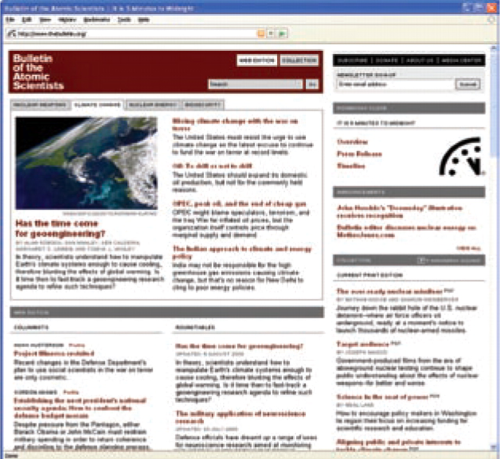
Are there lessons the United States and the rest of the world can learn about international security from the current financial meltdown?
The United States must resist the urge to use climate change as the latest excuse to continue to fund the war on terror at record levels.
Unless the United States solves its nursing shortage, the people most likely to care for the sick and dying during an influenza pandemic would be family and friends.
While China continues to rely predominantly on coal-generated power, Beijing has made impressive gains in alternative energy and efficiency.
Whether it's superbugs, asteroid impact, or nuclear attack, the potential for human extinction makes thinking about the end of the world more than an academic exercise.
The United States should expand its domestic oil production, but not for the commonly held reasons.
Much to Tokyo's dismay, in the last few years, IAEA inspectors have discovered components from Japanese companies at nuclear facilities in Libya and North Korea.
The investigation of the 2001 anthrax mailings demonstrates that the United States has a long way to go before it's capable of preventing a bioterrorist attack.
The most expensive cleanup in IAEA history is under way in Serbia. Yet funding is still required to remove poorly stored spent fuel and a mothballed research reactor.
Past 10 years of Bulletin content available soon online
Bulletin magazine articles going back 10 years will soon be available in fully searchable, digital format at www.thebulletin.org, along with supporting source documents to aid researchers and enhance the value of this historic archive. Thanks to a successful fundraising initiative that included a $100,000 challenge gift from the Scorpio Rising Fund, the campaign raised another $130,000 from the students and colleagues of University of Chicago physics professor
Future of nuclear energy Conference produces recommendations for next administration
Conference organizers
PEOPLE
Lederman honored for science service