




Abstract
Thinking of starting a nuclear power program? Good luck. A review of the capabilities and infrastructure of three Mideast efforts reveals what governments are up against.
Several countries in the Middle East have recently announced either new or renewed interest in the development of nuclear power. The most notable include Egypt, the Gulf Cooperation Council (GCC) states (Bahrain, Kuwait, Oman, Qatar, Saudi Arabia, and United Arab Emirates), and Turkey. All of these nuclear programs have been officially described as peaceful in nature and focused on electricity production and in some instances desalination. 1
Desiring a nuclear program is one thing, building and operating nuclear power reactors is another. As the International Atomic Energy Agency (IAEA), which supports and regulates nuclear power operations around the world, noted in a 2007 report, “[Launching a nuclear power program] is a major undertaking requiring careful planning, preparation, and investment in a sustainable infrastructure that provides legal, regulatory, technological, human, and industrial support to ensure that the nuclear material is used exclusively for peaceful purposes and in a safe and secure manner.” 2
Past efforts to develop domestic nuclear programs in Egypt and Turkey give these countries a head start. The GCC's, and particularly Saudi Arabia's, lack of experience with nuclear technology leaves them with much more work to do. An analysis of available sources sheds light on the challenges confronting key Mideast states as they look to develop nuclear power plants.
Gamal Mubarak, the general secretary of Egypt's Policy Committee and son of President Hosni Mubarak, announced the reinitiation of Egypt's nuclear power program, after some 20 largely dormant years, in September 2006. 3 The decision was motivated, in part, by a number of power shortages and by a strong increase in electricity demand. Indeed, Egypt has planned to increase its installed capacity by more than 8 percent every 12 months. 4 Several months later, Egyptian Energy and Electricity Minister Hassan Younis said Egypt's plan was to construct “10 nuclear-powered electricity-generating stations across the country.” 5 The first 1,000-megawatt-electric plant is planned for El Dabba, a site on the Mediterranean coast about 160 kilometers (100 miles) from Alexandria. 6
Egypt first attempted to build a nuclear power capability in the 1960s, but its dealings with nuclear power behemoths Siemens and Westinghouse failed. It tried and failed on a number of occasions in the mid-1970s and the 1980s. Egypt was also reportedly interested in acquiring nuclear technology from a number of states including China in the early 1990s, but again nothing bore fruit. 7
The Egyptian government may well have opted for a policy of diversification in its current efforts to push forward its nuclear ambitions so as not to rely too heavily on a single supplier. Egypt has received pledges from numerous countries–including China, Canada, France, Germany, Russia, South Korea, and the United States–to participate in its civil nuclear sector since it announced the restart of the program.
Officials announced the joint GCC nuclear power initiative at the group's 27th summit in December 2006. According to GCC officials, the hope is to begin building an initial power plant by 2009. Many observers see Saudi Arabia as the driving force behind the council's nuclear plans. It first showed interest in nuclear power in the 1970s, in part because of potential desalination applications. More recently, the Saudi government's concern with Iran's nuclear program appears to be a motivating factor.
REVIVING AN EXISTING NUCLEAR INDUSTRY
The dark blue billboard hawked its message without subtlety in large yellow letters and an accompanying atom symbol: “nuclear Tech Careers.” It's placement on a rural stretch of interstate outside of Sheboygan, Wisconsin, made perfect sense to locals. The Point Beach nuclear Plant resides about an hour's drive north. And the billboard's sponsor, Lakeshore Technical College, stands just 35 miles from the plant.
Its attendant website (www.nucleartechcareers.com) pressed the case even harder, promising great professional bounty for individuals who decide to enter the nuclear power industry: “Unlimited career opportunities are available in the nuclear technology field. The increasing use of radiation and radioactive materials in today's world has created a demand for nuclear technicians–in Wisconsin and throughout the nation.”
As the United States considers expanding its nuclear power capacity, it's confronting some of the same challenges as aspiring nuclear power states. The talk of a nuclear energy revival has helped revitalize once-moribund nuclear engineering curricula at U.S. universities, with about a fourfold increase in the number of undergraduates pursuing nuclear engineering degrees in the last few years. But nuclear engineers represent only one of many disciplines–engineering and otherwise–that nuclear plants need–hence, the roadside call for support staff. Is the U.S. pipeline for these positions strong enough? What about the tradespeople who construct the plants? Do they exist in the numbers necessary to build the new plants imagined in a domestic nuclear renaissance? And how will the national laboratories that conduct basic nuclear energy research and development–a mandate that requires advanced degrees–remain adequately staffed if the utilities prove to be the more alluring employer for undergraduates?
If someone asked, “Can you build 12 nuclear power plants simultaneously?” The answer would be no. We probably can't build 12 of anything simultaneously in this country–whether it's an oil refinery, coal plant, or nuclear plant–because the skilled labor force isn't sufficient.
To answer these questions, the Bulletin spoke individually with Michael Corradini, a distinguished professor in the University of Wisconsin's Department of Engineering Physics; Thomas Mundy, Exelon Corporation's director of new plant development; Beata Weiss, Exelon's manager of recruiting programs; and Mark T. Peters, Argonne national Laboratory's deputy associate laboratory director.
Right now, the nuclear energy research and development programs haven't grown to the level we and the Energy Department would like. I wouldn't say that we're in crisis mode, but I would certainly be worried if the funding for these programs doubled, which isn't out of the realm of possibility over the next decade. We, in part, push for long-term research in the nuclear field because that will attract the best and brightest.
But we've factored incentives and certain work schedules into the overall project scope to attract the necessary workforce. We're also assuming that a lot of the workers who come to work at the facility are going to need additional levels of training because the qualified skill set isn't there. It's definitely an issue we're looking at closely, and we think we can mitigate the impacts.
JOSH SCHOLLMEYER
The GCC effort has received many offers of assistance. The IAEA agreed to help with a preliminary study, to determine the necessary infrastructure, and to assure the appropriate training of GCC nuclear personnel. Russia offered assistance, and in May 2008, the United States and Saudi Arabia concluded a “U.S.-Saudi Memorandum of Understanding on Civil Nuclear Energy Cooperation.” France is another major nuclear supplier that is likely to contribute to the GCC project. Indeed, the UAE reached a separate agreement with France in January 2008 to develop nuclear power, although it was quick to reassure its GCC partners that this does not invalidate the joint project announced in 2006. 8
After years of indecision, Turkey now appears to be fully committed to developing nuclear power to reduce its dependence on imported energy resources. Turkey is a net energy importer, and its goal is to ensure greater security of supply at a time of increasing energy consumption. In October 2007, Turkish Energy Minister Hilmi Guler stated, “Nuclear energy is not an option. It is a necessity. Turkey is a strong state and has to be strong in nuclear energy as well.” 9
Turkey conducted early feasibility studies for the development of nuclear power in the late 1960s and again in the 1970s. It also negotiated with Sweden, Canada, and Argentina over nuclear power development in the 1980s and with Germany, the United States, and Canada in the 1990s, although nothing came of any of these talks. Previous commitments to pursue nuclear energy in Turkey have failed primarily because of costs and environmental, safety, and nonproliferation concerns.
In 2007, however, Turkey adopted the Law Regarding the Construction and Operation of Nuclear Power Plants and Selling of Electricity No. 5654, which provides for the construction of nuclear power plants. 10 This development was followed in March 2008 by Turkey's request for bids to construct the country's first nuclear power plant at Akkuyu near Mersin on the Mediterranean coast. Potential nuclear technology suppliers include South Korea, Canada, Germany, and the United States.
Given the history of failed attempts to acquire nuclear power, especially in Egypt and Turkey, are these ongoing efforts likely to succeed? By comparing current Egyptian, Saudi, and Turkish capabilities to what would be required to operate an approximately 1-gigawatt-electric nuclear power plant with the requisite “rigor, culture, ethics, and discipline” and “with due regard to the associated safety, security, and nonproliferation considerations” we are able to explore this question. 11
There is more than one way to develop a nuclear power program. At one extreme, a state could try to acquire the complete fuel cycle from mining to spent fuel disposal without any kind of external assistance. At the other extreme, almost everything from the construction and operation of a reactor to fuel management could be outsourced. To make this discussion more concrete, we focus on the challenges with a strategy closer to the “easy” end of this spectrum. Accordingly, we assume that an external supplier is responsible for constructing the reactor on a turnkey basis (i.e., it will be handed over finished and ready to be “switched on”), for providing fresh fuel, and for taking back spent fuel. The host state has four responsibilities. First, it provides the staff for operating the plant. Second, it is responsible for all aspects of regulation from the initial invitation of bids to overseeing safety, security, and safeguards at the plant once it is operating. Third, it must possess an electricity grid that is capable of safely handling a commercial nuclear reactor. And finally, the host state has to deal with decommissioning and the low-level waste that inevitably results from reactor operation.
The most daunting of these challenges is staffing. A typical nuclear power plant requires between 200 and 1,000 staff. 12 These workers fill a range of functions from plant operators to safety officers. The state, therefore, needs a correspondingly broad range of skilled personnel to draw upon. This in turn requires a university sector capable of producing graduates in suitable numbers. Nuclear power plant personnel are also typically expected to have “three or more years of specialized training and experience prior to the initial fuel loading.” 13 In the first instance, this experience could be provided by the external supplier as part of a technology transfer clause written into the contract. However, the state will also need to develop its own specialized training programs so that, over time, it can train new personnel and develop the skills of existing ones.
Research reactors are particularly useful for developing personnel, although these staff would still require suitable additional training. Egypt has two research reactors: the ETRR-1 (a 2-megawatt Soviet-designed tank-type reactor) and the ETRR-2 (an Argentinean 22-megawatt pool-type reactor). According to the IAEA, these two reactors have 22 operators within a total staff of 60. These personnel would provide a modest but nonetheless useful contribution toward the total of 200-1,000 required for a commercial-scale power plant. The challenge is even greater for Turkey, which appears to have just one operational research reactor (a U.S.-supplied, 250-kilowatt TRIGA Mark II reactor) employing two operators and four additional staff. Moreover, its low power makes it less useful for training staff for a nuclear power plant. A second, older research reactor (the TR-2) might still be operational, but available information on this point is contradictory. Saudi Arabia, which does not have a research reactor, starts from the weakest position of any of the three states under consideration.
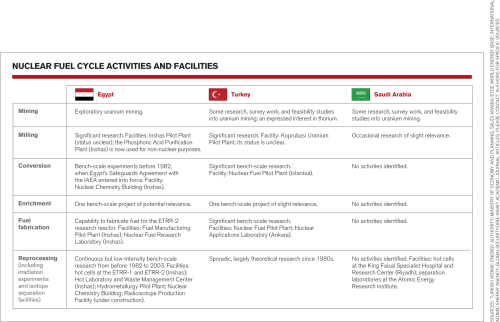
Other nuclear activities, apart from research reactor operation, provide another possible source of skilled personnel. For instance, although we assume that an external supplier will provide fresh fuel for these nuclear power plants, a state with the capability to fabricate fuel for research reactors, say, has personnel with knowledge of chemistry or radiation protection who could be retrained for a nuclear power program (see, “Nuclear Fuel Cycle Activities and Facilities,” below).
Egypt and Turkey have undertaken a broad range of nuclear activities, suggesting that both have a reasonably large pool of skilled personnel on which to draw. In contrast, Saudi Arabia has significant research and development experience only in the area of mining and milling–the least useful part of the fuel cycle from the perspective of developing a nuclear power program. In addition to those activities listed on the table, Saudi academics have undertaken a number of theoretical studies into particular aspects of reactor design such as the performance of types of concrete shielding. Saudi Arabia will, therefore, have to make a very significant investment in skills if it is to acquire the hands-on expertise to build a viable nuclear power program. According to a 2001 interview with the general inspector of the principal Saudi institute for nuclear energy research, the Atomic Energy Research Institute (AERI), only 15 Saudi nationals at work in the AERI hold PhDs in subjects relevant to nuclear power production (although a number of highly trained foreign workers also work there). 14
States with a strong national infrastructure of universities and state-sponsored research institutions are in a good position to make up for expected personnel shortcomings. Turkey is an excellent example. It has about 11 universities that have significant, relevant experience in teaching and research, and a further eight national research institutions of potential significance. The Turkish Atomic Energy Authority (TAEK) is well connected to many, if not all, of these institutions. In particular, the Çekmece Nuclear Research and Training Center (Turkey's premier nuclear research institute), located in Istanbul, coordinates its work with TAEK in support of “the national economy, and focuses on nuclear technology, applications, and training.” 15 This structure should enable TAEK to develop and then implement a coherent national strategy to develop the skills base necessary for a nuclear power program.
Egypt's national infrastructure is similar to, if somewhat less extensive than, Turkey's. Again, there are strong connections between Egypt's Atomic Energy Authority (AEA) and many of the seven universities and six state-sponsored research institutions that could be of relevance to a nuclear energy program. Of these research institutions, the most notable is the Nuclear Research Center at Inshas (northeast of Cairo), where many of Egypt's key nuclear facilities are located. Egypt is also engaged with the IAEA to enhance the ability of its National Information and Documentation Center to act as a central repository for nuclear knowledge. 16 This suggests that Egypt is thinking about the practicalities of how to develop a comprehensive skills base.
By contrast, Saudi Arabia has a much weaker nuclear infrastructure. Only one university, King Abdulaziz University, is known to teach relevant subjects. Based on an analysis of research output from additional universities, it seems probable that at least two more, and possibly as many as six more, do too. Of Saudi Arabia's three relevant state-sponsored research institutions, the most significant is the AERI; the other two largely focus on the use of radioisotopes in medicine, industry, and agriculture. Although the AERI has a research program on nuclear power and reactors, the majority of its published output focuses on managing radioactive waste and environmental monitoring. In general, Saudi Arabia's research appears to lack the coherence of Egypt's and Turkey's efforts.
The second challenge to a state acquiring a nuclear reactor is regulation. The state needs comprehensive legislation covering all aspects of nuclear power, from safety and safeguards to liability. In the initial stages of the project, the state must select a site, request bids, review the bids, oversee the construction and commissioning of the plant, and license it, in addition to developing emergency response plans and procedures. Depending on its legislation, the state may also need to conduct its own safety assessment of the reactor design. Once the plant is operating, the regulator must ensure that safety standards are met and that IAEA safeguards are properly applied. To this end, the regulator needs a skilled inspectorate and the authority to enforce its decisions. For its rules to be credible, the regulator must have a high degree of independence. In practice, implementing all of this requires considerable human resources.
Turkey's history of failed nuclear power projects has ironically left it with a comparatively well-developed regulatory structure. Turkey has a number of statutes that cover licensing, safety, reactor construction, and inspections. Regulation is largely the responsibility of TAEK. Its tasks include defining safety measures, issuing licenses, conducting inspections to check compliance, and, in the event of noncompliance, revoking licenses. 17 Under the terms of the March 2008 tender for the prospective nuclear power plant at Akkuyu, the facility is to be constructed and operated by a private company. However, the state-owned Electricity Generation Company is also permitted to commission and operate power plants, including nuclear ones, if the market is unable to meet demand. 18
The IAEA has been working with Turkey to enhance TAEK's capabilities. Two recent technical cooperation projects focused on improving its regulatory structure; a third task involved training in nuclear law. 19 TAEK has also been working with the IAEA to improve its inspection and enforcement functions–but not very actively. 20
Egypt also gained relevant experience from previous attempts to develop nuclear power, and it has a regulatory structure split between the Nuclear Power Plants Authority (NPPA), which is responsible for proposing and implementing projects, and the Center for Nuclear Safety and Radiation Control (CNSRC), which is part of the AEA and is responsible for licensing and regulation. The CNSRC, which regulates Egypt's two research reactors, is split into the Regulatory Inspection and Enforcement Unit (RIEU) and the Review, Assessment, and Licensing Unit. 21
States with a strong national infrastructure of universities and state-sponsored research institutions are in a good position to make up for expected personnel shortcomings. Turkey is an excellent example.
The IAEA has been very active in helping Egypt develop its regulatory structure. Much of this work has been concentrated on the NPPA. In particular, four technical cooperation projects since 2000 have been focused on building the skills required to manage the initial phases of a nuclear power program, such as site assessment and preparing a bid invitation specification. 22 More recently, however, the focus of technical cooperation seems to have shifted to inspection and enforcement. The IAEA has completed one project with the RIEU, and two more projects are underway, although very little information on them is available. 23 In addition, a 2003 CNSRC study stated that it had rectified some weaknesses previously identified with respect to emergency planning. 24 From all of this, it would appear that Egypt has identified weaknesses in its regulatory structure and is now working systematically to resolve them. Egypt is currently formulating a basic law to cover nuclear power, which is expected to be in force by the end of 2008.
The Saudi national nuclear authority is the King Abdulaziz City for Science and Technology. To date, Saudi Arabia has only needed a relatively simple regulatory structure focused on the use of radioisotopes for medicine, industry, and agriculture and appears to have limited its exploration of the practicalities of setting up a nuclear power reactor to academic research. 25
Saudi Arabia has no experience regulating a research reactor or facilitating international safeguards. Indeed, its IAEA Safeguards Agreement is not yet in force. Most significantly, perhaps, existing safety standards do not seem to be enforced. For instance, researchers at King Abdulaziz University who were studying safety standards in hospitals using radioisotopes found that, “In many, if not most, establishments the level of radiation protection needs to be increased to meet safety requirements. The absence of emergency plans and the lack of proper training on the use of measuring instruments became apparent. It was also observed that interest in radiation protection improvement was low.” 26 Facilitating an appropriate safety culture among Saudi nuclear workers would seem to be a priority.
The final two requirements to build an indigenous nuclear power industry are a viable electricity grid and sufficient waste management and decommissioning capacity. States seeking nuclear power require an electricity grid that is both sufficiently large and reliable. The IAEA recommends that any single nuclear power plant should represent less than 5-10 percent of a nation's installed capacity. 27 This would be the case for Egypt, Saudi Arabia, and Turkey if they each were to bring online a 1-gigawatt-electric nuclear power plant. The same is not true for most other states in the region. For these states, the interconnection of electricity grids between the Middle East, the Caucasus, and Southeast Europe is a potentially important development, as this may make it possible for states that individually use too little electricity for a nuclear power plant to acquire one on a collective basis. Very little information is available on the reliability and stability of the electricity grids in Egypt, Saudi Arabia, or Turkey.
Given our assumption that an external entity will supply nuclear fuel to these countries and will be responsible for disposing of spent fuel, the only type of waste that each will have to manage is low-level waste. The volume of low-level waste produced by a reactor depends on how the waste is treated. In the United States in 1997, for instance, the average volume of low-level waste was 55 cubic meters per reactor. 28 By contrast, Russian-supplied VVER reactors typically produce around 1,000 cubic meters each. 29 To handle this waste, a state needs a repository and suitable regulations for ensuring safe disposal.
Both Turkey and Egypt possess relatively sophisticated waste management infrastructures for dealing with the waste from research reactors and the civilian use of radioisotopes. Their respective treatment and disposal facilities are the Radioactive Waste Processing and Storage Facility of the Çekmece Nuclear Research and Training Center, and the Hot Laboratory and Waste Management Center at Inshas. From operating these facilities, Turkey and Egypt appear to have gained experience relevant to managing low-level reactor waste. Although no detailed information on either set of facilities is available, it is likely that both states will have to increase their storage capacity to handle the waste produced by nuclear power reactors. This is unlikely to prove a significant challenge, however.
Saudi Arabia's waste disposal capacity is inadequate. Its only disposal facility, the Temporary Radioactive Waste Storage Facility at the AERI, consists of one room with a volume of 40 cubic meters–less than the quantity of waste produced annually by one well-run reactor. Moreover, there is evidence that Saudi Arabia lacks both the appropriate safety culture and skills for handling waste. A 1997 study, for instance, found that considerable amounts of radioactive iodine were being disposed of in the local sewage system. 30
Neither Egypt, Saudi Arabia, nor Turkey has seriously planned for decommissioning their as-yet unbuilt reactors, though planning for this part of the process should be integral to a reactor's development. For instance, advance planning enables a state to collect and set aside a small fraction of all nuclear electricity sales to cover later decommissioning costs.
It would be fair to conclude from this analysis that both Egypt and Turkey start their pursuit of nuclear power from a relatively strong position. Both states' previous attempts to acquire nuclear power plants have left them with reasonably well-developed regulatory systems, universities capable of training a sufficient number of skilled graduates, and a strong central authority capable of implementing a national strategy. Even from this starting position, however, the road to developing a nuclear power plant will be a long one–not least because of the need to train sufficient personnel and create regulators that are effective in practice as well as on paper. For Saudi Arabia, the technical and regulatory challenges are truly daunting. With the possible exception of its electricity grid, current Saudi capabilities fall far short of what is required for each of the criteria.
Yet even these assessments understate the difficulties of acquiring a nuclear power plant, because they include only the technical and regulatory considerations. They ignore both the financial considerations and the political will that is required to drive forward such a complex project over many years, particularly if strong domestic opposition exists. The successful completion of these projects could also bring serious security implications if the reactors are not managed to reduce their inherent proliferation risks. This is a particular concern given the broad-based international anxiety that the motivations of Egypt, Saudi Arabia, Turkey, and other nuclear aspirants may encompass more than electricity production and desalination.
All of the potential suppliers of nuclear technology and materials to Egypt, the GCC, and Turkey are unlikely to commit to any deals that do not involve provisions for the external supply of nuclear fuel, thereby limiting the proliferation potential of the projects. Despite this emphasis on nonproliferation, each supplier state must also identify how to make its packages more attractive than other options. This may be a challenge for states such as the United States that are likely to insist upon particularly strict nonproliferation promises. Nevertheless, this technical analysis presents some interesting implications.
Although Turkey and Egypt face important technical and regulatory hurdles in acquiring and operating a nuclear power plant, these challenges may not turn out to be the limiting factors. Rather, the bottleneck could be financing (especially in the case of Egypt, which has a poor sovereign credit rating) or long delays caused by suppliers having more customers than they can handle. 31 This suggests that the most effective way to persuade Egypt and Turkey to accept packages with stronger guarantees of nonproliferation is not through technical cooperation but by favorable financing or preferential supply terms. In contrast, for Saudi Arabia, technical expertise, rather than financial or other considerations, is likely to be the limiting factor. The provision of basic technical assistance (such as a research reactor and appropriate training in how to use it) is likely to make a supplier attractive to Saudi Arabia.
An appreciation of the technical challenges that accompany nuclear plant construction may also help suppliers sell the idea of a multinational approach. Because of their proliferation dangers, enrichment and reprocessing plants are generally considered the most attractive candidates for multinational cooperation. However, power reactors can also be developed by more than one country. Indeed, Brazil and Argentina recently agreed to develop a nuclear reactor together to meet their joint electrical power requirements. They already cooperate on several projects, including a joint company for enriching uranium. 32
It could well be in the interest of Mideast countries to develop nuclear power plants on a multinational basis. States that acquire nuclear reactors individually need to develop a broad range of expertise, which is both expensive and time consuming. In contrast, developing a nuclear power plant cooperatively would allow states to pool their expertise, permitting individual countries to focus their limited resources on mastering certain specific skills. In addition, many Mideast states have power grids that are too small to accommodate even one reactor. One solution may be for a state to build a single reactor and then sell electricity to its neighbors. However, this option would be unattractive to states that do not wish to rely on electricity imported from abroad. A better solution might be for these clusters to develop a jointly owned and operated facility. When trying to promote the idea of a multinational power reactor, supplier states should stress its economic benefits even if their interest in the idea is primarily motivated by nonproliferation. This is likely to prove a more compelling argument for states in the Middle East contemplating the nuclear power option.
All of the potential suppliers of nuclear technology and materials to Egypt, the GCC, and Turkey are unlikely to commit to any deals that do not involve provisions for the external supply of nuclear fuel, thereby limiting the proliferation potential of the projects.
Similar considerations apply to the promotion of nuclear fuel assurances. President George W. Bush proposed in February 2004 that the “world's leading nuclear exporters should ensure that states have reliable access at reasonable cost to fuel for civilian reactors, so long as those states renounce enrichment and reprocessing.” 33 Potential recipients received this proposal unenthusiastically, given the imposition of additional restrictions on their rights. In contrast, an April 2007 proposal by the German government would not require such a renunciation (although it would still have other conditions attached). 34 The German approach is sensible because the costs to a state of developing its first nuclear power plant are so large that they already provide a strong disincentive to developing enrichment or reprocessing technology at the same time. Under these circumstances it is logical to make fuel supply guarantees more attractive by dropping the requirement that states cede sovereignty vis-à-vis certain elements of the fuel cycle. If states accept a guarantee under these terms and receive a continuous supply of fuel at commercial rates, they will see that the nuclear fuel market works and will be less tempted to develop other, more sensitive elements of the fuel cycle. A fuel supply arrangement involving the repatriation of spent fuel would also spare recipient states one of the most expensive and controversial aspects of nuclear power: disposal of spent fuel. In this way fuel supply arrangements can be in the interests of recipient states–even if they involve the imposition of additional obligations.
For all the talk of a global “nuclear renaissance,” the reality is that nuclear power is likely to spread around the globe slowly. The hurdles facing a state developing its first nuclear power plant are considerable. Even Egypt and Turkey, which are relatively well placed to begin their nuclear power projects, are unlikely to see their first reactors go online within a decade. For Saudi Arabia the timescale will be much longer. These challenges present an opportunity for nonproliferation. So far, only a few potential recipients have shown serious interest in nonproliferation assurances, such as multinational facilities or fuel supply guarantees. In part, this is because they are marketed and viewed as additional obligations. Yet, if crafted carefully, they could make it easier for states to develop nuclear power programs. If supplier states would acknowledge the very real technical and regulatory challenges of developing a nuclear power program, they could more easily demonstrate the economic benefits of nonproliferation assurances. This would help hardwire nonproliferation into a global expansion of nuclear power.
Footnotes
1.
This article is based on a project the authors are working on for the Nonproliferation Policy Education Center, Washington, D.C.
2.
IAEA, “Considerations to Launch a Nuclear Power Programme,” 2007, GOV/INF/2007/2/Colour, pp. 1, 3.
3.
Middle East News Agency (MENA), “Egyptian Ruling Party Meeting Discusses Peaceful Usage of Nuclear Energy,” Cairo, September 21, 2006; MENA, “Egypt: Gamal Mubarak Comments on Peaceful Use of Nuclear Energy,” September 21, 2006.
4.
Energy Department, Energy Information Administration, “Country Analysis Briefs: Egypt,” August 2006.
5.
MENA, “Minister: Egypt Peaceful Nuclear Programme Receives World-Wide Acclaim,” March 15, 2007.
6.
“Egypt Unveils Nuclear Power Plan,” BBC News Online, September 25, 2006.
7.
“China Tells of Possible Nuclear Plant Sales,” Washington Times, July 31, 1992, p. A9.
8.
Khalid Hilal and Adam P. Williams, “New French Nuclear Deals in the Middle East Generate Proliferation Concerns,” WMD Insights, April 2008.
9.
Dorian Jones, “Turkey's Rising Nuclear Ambitions,” ISN Security Watch, October 15, 2007.
10.
Ivan Starodubtsev, “Reform of the Turkish Electrical Energy Sector: Basic Principles and Interim Results,” Centre for Energy, Petroleum and Mineral Law and Policy Journal, vol. 17, article 13 (2007).
11.
IAEA, “Considerations to Launch a Nuclear Power Programme,” pp. 7-8.
12.
Ibid.
13.
Ibid.
14.
“Interview with the General Inspector of the Atomic Energy Research Institute at the King Abdulaziz City for Science and Technology, Saudi Arabia,” Al-Jazirah Newspaper (Arabic), March 17, 2001.
15.
“Nuclear Legislation in OECD Countries: Regulatory and Institutional Framework for Nuclear Activities: Turkey,” OECD, 1999, p. 13.

17.
“Nuclear Legislation in OECD Countries: Regulatory and Institutional Framework for Nuclear Activities: Turkey,” OECD, p. 11.
19.
See project numbers TUR/9/015, TUR/9/016, TUR/0/006 in the IAEA national projects database.
20.
See project number TUR/0/009 in the IAEA national projects database. It was also a small element of project number TUR/9/015.
21.
M. A. Salama, “Nuclear Activities in Egypt,” Applied Energy, vol. 75, pp. 71-78 (2003); see project number EGY/9/035 in the IAEA national projects database.
22.
See project numbers EGY/4/045, EGY/4/04, EGY/4/049, and EGY/4/053 in the IAEA national projects database.
23.
See project numbers EGY/9/035, EGY/9/036, EGY/9/037 in the IAEA national projects database.
24.
M. A. Salama, “Nuclear Activities in Egypt.”
25.
Ibrahim Ismail Kutbi, “A Pragmatic Pairwise Group-Decision Method for Selection of Sites for Nuclear Power Plants,” Nuclear Engineering and Design, vol. 100, pp. 49-63 (1987); F. M. Husein, M. A. Obeid, and K. S. El-Malahy, “Site Selection of a Dual Purpose Nuclear Power Plant in Saudi Arabia,” Nuclear Technology, vol. 79, no. 3, pp. 311-321 (December 1987).
26.
27.
IAEA, “Milestones in the Development of a National Infrastructure for Nuclear Power,” IAEA Nuclear Energy Series, NG-G-3.1, 2007, pp. 39-41.
28.
Ronald L. Fuchs, “1997 State-by-State Assessment of Low-Level Radioactive Wastes Received at Commercial Disposal Sites,” National Low-Level Waste Management Program, Energy Department/LLW-247.
29.
IAEA, “Improvements of Radioactive Waste Management at WWER Nuclear Power Plants,” TECDOC-1492, IAEA, 2006.
30.
Rasheed Al-Owain and Yousef Aldorwish, “Medical Radioactive Waste Management in Saudi Arabia,” (lecture, Waste Management Conference 2001, February 25-March 1, 2001).
31.
Sharon Squassoni, “The Realities of Nuclear Expansion,” prepared statement before the U.S. House of Representatives Select Committee for Energy Independence and Global Warming, March 12, 2008, p. 8.
32.
Jessica Lasky-Fink, “Brazil, Argentina Pursue Nuclear Cooperation,” Arms Control Today, April 2008.
33.
George W. Bush, “Remarks by the President on Weapons of Mass Destruction Proliferation,” Fort Lesley J. McNair, National Defense University, Washington, D.C., February 11, 2004.
34.
“Multilateralizing the Fuel Cycle,” German Proposal Discussion Paper, April 26, 2007, in IAEA, “Communication Received from the Resident Representative of Germany to the IAEA with Regard to the German proposal on the Multilateralization of the Nuclear Fuel Cycle,” INFCIRC/704, May 4, 2007.