




Abstract
Government-produced films from the era of aboveground nuclear testing continue to shape public understanding about the effects of nuclear weapons–for better and worse.
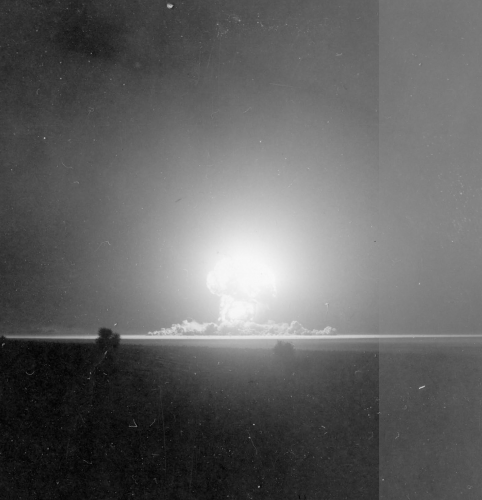
Few Americans have witnessed firsthand the explosive power of a nuclear weapon. Nonetheless, most have some idea of the shape and power of a nuclear explosion. How is this possible? More importantly, how have policy makers come to understand the power of the nuclear arsenal at their disposal and the visceral consequences of nuclear war–especially considering that no U.S. president personally observed any of the 1,054 nuclear tests of the Cold War weapons program? 1 The answer is simple: They watched films.
After World War II, the cinematic atomic bomb became the crucial way in which the government communicated the weapon's power to soldiers, civilians, and policy makers alike. It achieved two main purposes: First, it documented the effects of the exploding bomb; second, it shaped and controlled the meaning of the technology for each of these domestic audiences. This makes the visual record of the aboveground test era, which began in 1945 with the Trinity Test and ceased in 1963 with the landmark Limited Test Ban Treaty, a curious archive of scientific fact, speculation, and outright propaganda. It constitutes a detailed visual record of U.S. efforts to develop a state-of-the-art nuclear arsenal, along with a larger political effort to militarize American society through nuclear fear. This record is crucial to assess today. For in an age of terrorism, preemptive war, and renewed political mobilization of the term “weapon of mass destruction” at home and abroad, U.S. understanding of nuclear technologies has never been more important or more blurred.
Because atmospheric testing of nuclear weapons stopped in the early 1960s, it has been more than three generations since the explosive power of a U.S. nuclear weapon has been visible to the world and subject to detailed sensory assessment and understanding. Nuclear weapons science was conducted underground from 1963 until the current test moratorium began in 1992. Since then, programmatic efforts within the U.S. national laboratories have established a nuclear weapons complex capable of producing new nuclear weapons without conducting nuclear explosions at all–underground or otherwise. 2 As a result, while the weapons themselves have become more sophisticated and embedded within U.S. geostrategic military policy, they have also become more invisible to the American public. Consequently, Americans are increasingly reliant on films, graphics, and computer programs to convey the bomb's destructive power. 3
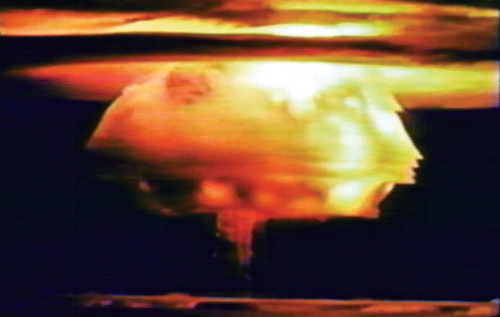
The filmic record in particular is prolific. Each of the aboveground U.S. nuclear test series was extensively photographed, and the footage edited into a variety of films aimed at specific audiences–from classified documentaries shown to policy makers to more general descriptions of test activities delivered to the public. The air force relied upon a Hollywood studio, Lookout Mountain Laboratory, to produce classified technical films on weapons science, in addition to overviews of the major test series in the Marshall Islands and Nevada. 4 Concurrently, the Defense Department made films to indoctrinate soldiers to fight on an atomic battlefield, and the Federal Civil Defense Agency produced films to prepare citizens for life in the atomic age.
Thanks to recent declassification efforts, we now have the ability to publicly assess the films used to craft the country's first official nuclear narratives. Three documentaries in particular (Exercise Desert Rock, Operation Cue, and Special Weapons Orientation) calculate the nuclear danger differently for specific sectors of U.S. society–soldiers, civilians, and policy makers. The two films directed at soldiers and civilians (Exercise Desert Rock and Operation Cue) help establish nuclear weapons as the new normative reality in the United States, grounded in the minute-to-minute possibility of nuclear war. This early effort to mobilize Americans as Cold Warriors was aimed directly at emotions rather than intellect, as soldiers and citizens viewing these films are presented with a highly politicized portrait of nuclear war. Special Weapons Orientation, aimed exclusively at policy makers, offers a different emotional appeal–possession of an absolute destructive power.
In each of these films, a new kind of governance grounded in nuclear fear, and mediated by secrecy, is taking shape. After Hiroshima and Nagasaki, the atomic bomb became a powerful psychological weapon in the United States–policy makers soon discovered that the political uses of nuclear fear worked as well domestically as they did abroad. Controlling the bomb's image–and thus, the nuclear danger itself–became a multi-faceted political tool.
Today, U.S. culture still relies on many of the images and political logics of self-discipline and nuclear fear first articulated in the government test films of the early 1950s, which we now read as propaganda or atomic kitsch. These films also dare today's public to interrogate a “war on terror”–not only for its technical arguments about terrorism, dirty bombs, and WMD, but also for the political strategy of its emotional appeal.
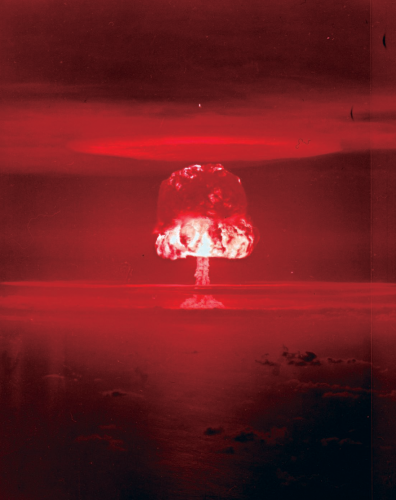
PRIMARY AUDIENCE: Soldiers
FILM: Exercise Desert Rock (1951)
PRODUCED BY: Defense Department
RUNNING TIME: 27 minutes
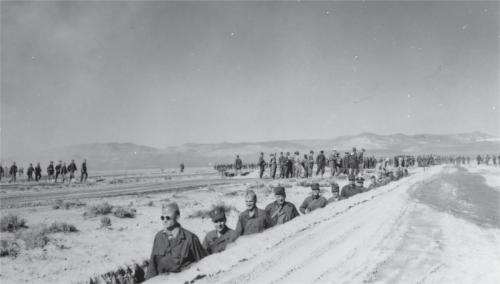
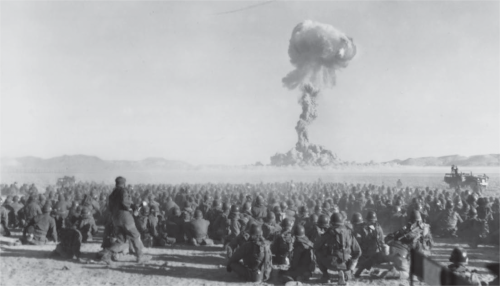
From 1951 to I957 at the Nevada Test Site, Defense ran Exercise Desert Rock, a series of military training operations designed to psychologically prepare troops for fighting on an atomic battlefield. Each of the exercises consisted of a war game that involved the United States using tactical nuclear weapons against an imaginary invading army, followed by a march on ground zero by U.S. troops. First and foremost, the exercises were experiments, designed to test the psychological responses of soldiers to atomic warfare. They also studied the effects of the exploding bomb on military equipment and war-fighting strategy.
Exercise Desert Rock presents an overview of the first Desert Rock experiment in 1951. The film provides interviews with soldiers before and after the explosion and tracks their progress to ground zero. It was circulated within the military as a training film and became part of the indoctrination of U.S. military personnel for nuclear conflict.
Early in the film, the narrator informs viewers that the exercise intends to test the tactical field uses of nuclear weapons. But soon that message is refined, placing the focus on the psychological effects of nuclear fear on soldiers: “An understandable concern is usually expressed by troops about the dangers of entering an atom-blasted zone. In airbursts, like the one the men will see and the type which would normally be used against troop concentrations, no serious amount of radioactivity remains on the ground.”
Promising that troops can be kept physically safe on a nuclear battlefield with careful planning, the problem ultimately becomes how to overcome and internally manage nuclear fear: “It is believed they will experience less fear during the blast because they have learned that radioactive elements from airbursts are carried into the stratosphere in a cloud, where they mix rapidly with the upper air currents. The bomb will be detonated only if all predetermined requirements are met, including weather conditions.”
The test also exposed military equipment (tanks, artillery, bridges, planes, ammunition, communication systems) to the exploding bomb. Foxholes dug at various distances from ground zero were populated with dummies or soldiers. Sheep were also placed in trenches or in aboveground pens at various distances from ground zero. Radiation exposure badges were given to soldiers, placed on the dummies, and located throughout the test range. More than 5,000 personnel participated in this nuclear war-fighting exercise. Taught that “radiation is the least of one's worries” on an atomic battlefield, the soldiers watch the detonation from 7 miles away. They turn away from the exploding bomb during the flash; seconds later, they experience a shock wave that covers them in dust. An interview with one solider elicits the following discussion about the emotional costs of nuclear war:
INTERVIEWER: Can you tell us whether you think the orientation you had for this weapon prepared you for what you saw out here?
SOLDIER: Yes sir, it did.
INTERVIEWER: What about the fear that you felt? Did they prepare you against that?
SOLDIER: Yes sir, they did. They told us enough so that our fear was cut so much more than what it was before the orientation that we hardly had any fear at all.
NTERVIEWER: Do you have confidence that you would be able to go right in there now and carry out your tactical mission after the blast?
SOLDIER: Yes sir.
INTERVIEWER: How close, now that you've seen it, would you be willing to be?
SOLDIER: Well sir, I'll tell you that after I see them positions up there.
The staged nature of such interviews is apparent; the soldier knows exactly what he is supposed to say. But the startling confidence in his statements is undercut by nerves and a controlled hesitation about engaging the frontline of a nuclear war.
The film then follows the troops as they march on ground zero and encounter a carefully prepared course of objects and animals exposed to the blast at different distances. Two miles from ground zero, little damage is visible, but after that, heat and blast have scorched military equipment and dummies. The sheep left in trenches are declared untouched by the bomb, but those situated aboveground suffered burns that the troops carefully observe. The lesson: Foxholes and good military planning can protect soldiers on the atomic battlefield, and nuclear fear is a greater danger than the bomb itself. The film ends with a radiation check of soldiers, a quick “decontamination” with brooms, and a voiceover that declares tactical field weapons can be used safely.
This scripting of danger and stage-managing of nuclear effects became increasingly sophisticated at the Nevada Test Site in the 1950s, eventually including parallel civil defense material aimed at civilians. Again, panic, not nuclear destruction, was positioned as the real danger in nuclear warfare. This argument was made with careful crafting of the images of nuclear warfare, censoring of nuclear effects such as fire and radiation, and focusing on atomic bombs rather than the much larger thermonuclear weapons already in the U.S. arsenal.
The inaugural head of the Federal Civil Defense Agency, Val Peterson, argued in an August 1953 issue of Collier's that emotional self-control was the primary goal of civil defense training, providing a detailed plan for how to become a “panic stopper.” In his book, The Imaginary War: Civil Defense and American Cold War Culture, Guy Oakes documents how the ultimate goal of civil defense was to emotionally manage U.S. citizens through nuclear fear. Mobilizing psychological studies of bombed communities during World War II, defense intellectuals sought to calibrate nuclear fear at a national level, producing a new kind of society for a new kind of “cold” war. Within this scheme, terror was imagined as a paralyzing emotion, but fear could be managed, controlled, and directed. Therefore, defense planners sought to instill in soldiers and civilians a specific idea of nuclear war that would harden them to the difficult realities of a post-nuclear environment, while also focusing them on emotional self-discipline during the ongoing nuclear crisis.
PRIMARY AUDIENCE: Civilians
FILM: Operation Cue (1955)
PRODUCED BY: Federal Civil Defense Agency
RUNNIN G TIME: 16 minutes
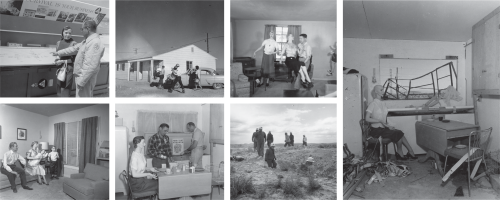
Operation Cue was the largest civil defense exercise conducted at the Nevada Test Site. It involved the construction of a model U.S. city, complete with mannequins representing “Mr. and Mrs. America,” which was then incinerated on live television for 100 million viewers. The exercise promised to reveal what a post-nuclear U.S. city would look like, and the Federal Civil Defense Agency went to extraordinary lengths to make the test city look real. Declaring “survival is your business,” Operation Cue was part of a larger campaign to make Americans responsible for their own safety during a nuclear war. Contemporary-styled homes were stocked with the latest furnishings donated by 150 industry associations. An elaborate food testing program placed packaged and frozen food throughout the test site. The food that survived the explosion was later used as ingredients in dishes served during a post-blast feeding exercise.
Following the script developed in Exercise Desert Rock, the film takes viewers through test preparations, the detonation, and a post-test assessment of the ruins. But in Operation Cue, a female narrator introduces viewers to this “program to test the effects of an atomic blast on the things we use in everyday life.” The mannequin families were posed in moments of domestic normalcy–eating at the kitchen table, napping in bed, or watching television. In other words, viewers were invited to think of themselves as mannequins caught in an unannounced nuclear attack and to watch Operation Cue for signs of what their post-nuclear environment would be like.
Much as the soldiers did in Exercise Desert Rock, a group of civilian volunteers populated a forward trench to test their reactions to the nuclear blast. Testing the cognitive effects of a nuclear blast on civilians was part of Operation Cue's psychological experiment. The film ultimately promised viewers that nuclear war could be incorporated into typical emergencies and treated alongside natural disasters such as hurricanes, earthquakes, and floods. The overt message is that emotional self-discipline and preparation are the key to surviving a crisis–whether that crisis is a Soviet nuclear attack, fire, or bad weather.
In Operation Cue, there is no discussion about radioactive fallout or the extensive fires that the atomic bombings of Hiroshima and Nagasaki produced. Instead, the film provides a detailed portrait of a functioning post-nuclear state. Rescue personnel pull damaged mannequins from the rubble, flying several to off-site hospitals; meanwhile, the mass feeding takes place alongside standing homes and power lines. Later, the mannequins scorched by Operation Cue went on a national tour of J. C. Pen-ney department stores, which had provided the clothing used in the test, offering an explicit portrait of nuclear survival to the U.S. public.
A closer reading of Operation Cue reveals a more complicated message: The film is training citizens to accept nuclear war as a normative threat, employing nuclear fear to craft a militarized society organized around preparing for nuclear war every minute of every day. To accomplish this, the portrait of nuclear danger presented in Operation Cue is partial, a carefully edited version of nuclear science that the day's prevailing experts had already disproved via the test programs in Nevada and the South Pacific. In actuality, the fallout produced by nuclear tests such as Operation Cue traversed the continental United States, creating negative health effects for soldiers and civilians that continue to this day–a much starker reality than Operation Cue promises viewers. 5
PRIMARY AUDIENCE: Policy makers
FILM: Special Weapons Orientation: The Thermonuclear Weapon Part VI (1956)
PRODUCED BY: U.S. Air Force
RUNNING TIME: 29 minutes
A classified film made by the Lookout Mountain Laboratory, Special Weapons Orientation provides a cumulative overview of the U.S. thermonuclear weapons program from 1950 to 1955. It begins with a discussion of the basic science of atomic (fission) and hydrogen (fusion) weapons, noting the potentially unlimited explosive power of hydrogen bombs. It then explains the results of the Pacific test program, documenting that “Mike,” the first thermonuclear event, vaporized the island of Elugelab on November 2, 1952, leaving behind a i-mile crater. The film informs viewers that because of its size (21 feet high and 80 tons) and reliance on massive amounts of cryogenically controlled fuel, “Mike” was not a “deliverable” nuclear device.
But technological breakthroughs soon enabled weapons scientists to miniaturize and “weaponize” hydrogen bombs–moving from 41,000-pound weapons in 1953 to easily delivered 3,000-pound devices by the mid-1950s. This remarkable ability to increase the power of thermonuclear explosives while rapidly decreasing their size reveals the intensity of nuclear weapons science during this period. These atomic secrets remain powerful today, evident in Special Weapons Orientation when the declassified soundtrack drops out as certain issues pertaining to the intricacies of nuclear science arise. The abrupt silences underscore the strategic military relevance of nuclear weapons science, informing both the escalating arms race of the 1950s and official fears of nuclear terrorism today.
Unlike Exercise Desert Rock or Operation Cue, the effects of atmospheric fallout are a central concern of this film, indicating that there was an interest in the military uses of fallout and fire. Noting that “millions of tons of earth” are elevated into a cloud that rises above 70,000 feet in a high-yield explosion, the film reveals that fallout can traverse an enormous territorial range, delivering deadly levels of contamination for hours and days after detonation. The narrator explains that the widespread contamination produced by the first detonation of the 1954 Castle test series created an opportunity for biological research: “Wind factors caused contamination of distant populated atolls, providing a completely new source of study on these effects and showing graphically the tremendous area contamination from a high-yield surface burst. Two hundred and twenty-nine natives and 29 American personnel received doses from 12 to 200 roentgens.”
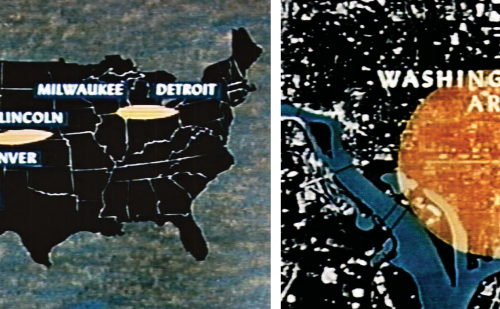
After displaying images of Pacific Islanders with skin bleached by fallout, the narrator states that none of the exposure rates appears to be of “immediate combat significance,” referencing official concern about how such exposures would affect soldiers (ours and theirs) on the atomic battlefield. Next, a graphic illustrating a zone of lethality in the Pacific covering some “7,000 statute square miles” for high-yield explosions is presented, changing the concept of nuclear war entirely. To drive the point home, a map of the United States is offered, with three comparable zones of fallout in California, Colorado, and Wisconsin. Here, emotional management is subverted, and the hydrogen bomb's unprecedented destructive power is celebrated.
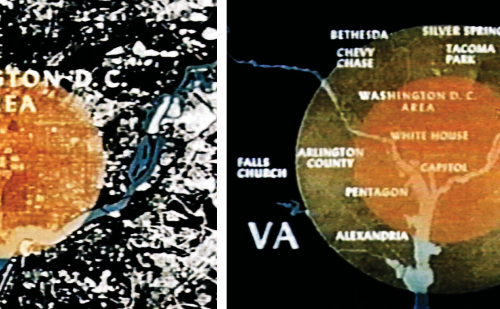
Special Weapons Orientation presents policy makers with a new range of weapons both capable of annihilating another country and offering little hope of a post-nuclear society. The film concludes by assessing the effects of thermonuclear weapons on exposed troops and cities, using Washington as a reference point: “The real military importance of high-yield blast effects lies not in their type or quality but in their enormous range compared to kiloton weapons. A 100-kiloton weapon at optimum height will cause severe damage over an area of 5 square miles and moderate damage over 12 square miles. Contrast this–5 and 12–with 80 square miles of severe damage and 240 square miles of moderate damage from a 15-megaton surface burst like Castle Shot I. Two hundred and forty square miles, more than 20 Hiroshimas in a group, more than 10 Manhattans, in which blast compounded with fire would bring almost total destruction. The big bonus from multimegaton weapons is the longer, positive phase, producing blast damage far beyond that of kiloton weapons.”
In other words, the hydrogen bomb enables a new kind of total war–offering the capacity to annihilate whole civilizations–even as it installs new possibilities for domestic emotional management at home. Special Weapons Orientation ultimately documents the arrival of a new form of governance, as nuclear fear becomes the basis for both a new concept of global order and a new kind of American society–simultaneously militarized, normalized, and terrified.
Supplementary Material
United States Nuclear Tests: July 1945 through September 1992
Footnotes
1.
Energy Department, United States Nuclear Tests July 1945-September 1992 (Washington: Government Printing Office, 2000). The U.S. test program involved 1,149 detonations, including joint tests with Britain and not including the military uses of atomic weapons at Hiroshima and Nagasaki. The United States conducted 210 atmospheric tests, 5 underwater tests, and 839 underground tests between 1945 and 1992.
2.
For further discussion, see Joseph Masco, The Nuclear Borderlands: The Manhattan Project in Post-Cold War New Mexico (Princeton: Princeton University Press, 2006).
3.
Lynn Eden, Whole World on Fire: Organization, Knowledge, and Nuclear Weapons Devastation (Ithaca: Cornell University Press, 2004). Eden has shown that the extensive effects of fire after a nuclear detonation in an urban area were eliminated from nuclear war planning calculations in the United States during the Cold War, leaving policy makers today with models that can radically underestimate the power of urban nuclear warfare.
4.
Peter Kuran, How to Photograph an Atomic Bomb (Santa Clara: VCE, 2006); Hollywood's Top Secret Film Studio, produced and directed by Peter Kuran, VCE Productions, 2003.
5.
Richard L. Miller, Under the Cloud: The Decades of Nuclear Testing (New York: The Free Press, 1986).