




Abstract
Journey down the rabbit hole of the U.S. nuclear deterrent–where air force officers sit underground, ready at a moment's notice to launch thousands of nuclear-armed missiles.
No job is quite like that of a modern nuclear missileer–an air force officer whose sole purpose is to sit underground and wait for orders from the president to turn the key. Although the job requires mastering an exhaustive series of checks and procedures, the mission of the missileer is simple. “The primary duty of the ICBM [intercontinental ballistic missile] crew members is to be prepared to launch their missiles toward enemy targets when directed by the president of the United States,” a 1988 handbook states, adding with obvious understatement, “a task not to be taken lightly.”
Nearly two decades after the guidebook was written, this job description remains the same–even if the world itself has changed. Two decades is a political lifetime, and the intervening years have seen the collapse of the Soviet Union, a drastic reduction in the size of the nuclear arsenal, and the advent of highly accurate conventional armaments that can, in some cases, destroy targets once penetrable only by nuclear weapons. With the threat evaporated, we wanted to see what kept missileers underground today.
We came to F. E. Warren Air Force Base in Cheyenne, Wyoming, home of the 90th Space Wing, to watch the demonstration of a launch. Since rehearsing a launch in an active capsule is–for obvious reasons–not done, missileers must practice the procedures leading up to the key turn in a mock-up facility called a Missile Procedures Trainer. A few lucky missileers will get to turn the key on a real ICBM at Vandenberg Air Force Base in California, where the air force fires off a missile a few times a year to make sure they work–though of course, in those tests, the ICBMs do not carry nuclear warheads. But for most missileers, the simulator is the closest they will ever get to the real thing. We came here for an answer to one question: How do missileers feel about the pivotal key turn, the one task they will perform only once, if at all?
There was a moment of silence, and then Lt. Melanie Stricklan and Capt. Shawn Lee casually unhooked their chair restraints and turned around.
“The first several months, you get all excited, nervous, but then you get used to it,” Lee told us. Stricklan disagreed.
“I've been doing this for two years,” she said cheerfully, “and it makes me anxious every time.”
With her shoulder-length blond hair pulled back in a businesslike pony-tail, Stricklan looked more like a college student than a military officer. It was hard to believe the attractive, all-American lieutenant spent much of her time some 65 feet underground, living in a 162-square-foot missile launch capsule. Her fellow missileer, Lee, had a shaved head and an Air Force Academy ring, a serious look that contrasted sharply with his boyish features. They both looked terribly young.
We chatted with the two officers for a few minutes about their careers, their families, and their future plans. They struck us as serious but levelheaded–exactly the type of people you would want in control of those keys. Unlike the weapons designers at Lawrence Livermore or Los Alamos national laboratories, known for dark humor and mindful of their morbid power, the missileers tended not to joke about their duties in front of outsiders.
Each piece of the nuclear complex plays its role, from the design laboratories that drew up the bombs to the production complex that built and maintains them. In that sense, the missileers are the last link in a very long chain that connects the development of nuclear weapons to their final–hypothetical–use. That the missileers would look at their job very differently than other members of the nuclear world is not such a surprise. But that they look at it the same way missileers looked at it 20 years ago is somewhat shocking. The world has changed; the world of the missileers has not.
So without an enemy like the Soviet Union, we were curious how young air force officers could still justify sitting underground waiting for Armageddon. “I understand we have rogue nations that can do anything,” Stricklan said. “The Soviet Union may not be the highest threat, but deterrence applies to rogue nations.”
Lee agreed, with some qualifications. “The nature of the enemy has changed,” he said. “We know that deterrence doesn't work with everyone.”
Other small, yet not insignificant, changes have taken place in the world of the missileer. Some missileers–though not all–now have access to the internet in the capsule, which provides them with an instant look at world events. We wondered if that might change how a missileer would react to launch orders. In the old days, the missile crews–at least in the moments leading up to a launch order–would have little or no independent, “real world” information about the situation. The launch codes would come to them in an information vacuum. Access to the web would certainly arm missileers with a lot more information in the event of a missile attack. Suppose the crews were following every update on CNN.com and had reason to doubt the validity of their orders or question the response?
Lee disagreed. The missileers had access to classified intelligence, he noted–not just what was seen on CNN. Despite the global reach of media, he said, he would feel comfortable executing a lawful order. “America is not going to be an aggressive nation,” he said. “We would not just nuke someone.”
That the missileers would look at their job very differently than other members ot the nuclear world is not such a surprise. But that they look at it the same way missileers did 20 years ago is somewhat shocking. The world has changed; the world otthe missileers has not.
Bruce Blair, a former missileer who helped jump-start informal talks with Russian counterparts about standing down the continued hair-trigger posture of the two sides, was far more cynical when we interviewed him, calling the missileers “lost in the twilight zone.” He has periodically returned to the bases, including Warren, to interview the young missileers. “You go out in the field, nothing has changed. The same kind of rationale is instilled in the crews about deterrence.”
Yet both Lee and Stricklan seemed to acknowledge that deterrence–the promise of a swift counterattack against a nuclear first strike–did not have quite the unquestionable logic that it did during the Cold War and, arguably, was not such a great personal justification for sitting underground every day. “You do need some sort of personal reason,” Stricklan acknowledged. “Something that is tangible.”
Sixteen years after the fall of the Soviet Union, young missileers are still going to work every day, rehearsing the end of the world. What is, at least in their minds, that “tangible thing”?
It doesn't take much of a lesson in strategic politics to figure out why Cheyenne was selected to house ICBMs. Wyoming is far enough north to shorten the trip for missiles flying to Russia, yet far enough away from the coasts to ensure that a Soviet submarine wouldn't pop up and launch a devastating first strike. But there was another reason: Cheyenne is at home with the military. The town was established by–and grew up with–the military, and its heritage as a nineteenth-century frontier outpost was intimately linked with its modern incarnation as home to the 90th Space Wing. The community sees the base as a natural extension of the town.
Cheyenne, for those not from the community, seems to inspire either a great sense of belonging or an almost unbearable feeling of isolation. Its high winds and endless winters clearly aren't for everyone. “You can only play tennis for two weeks a year,” joked one of our escorts at the base. But for those who enjoy the outdoors, the friendly community, and Cheyenne's particular brand of western authenticity, it is a good place. The revitalized downtown has the picturesque quality of a Hollywood movie set–a frontier city dotted with steak houses, western apparel shops, and quaint storefronts. The town's annual big event is Frontier Days, when thousands of people descend on Cheyenne for what is billed as the largest “rodeo and western celebration” in the country. During Frontier Days, the tiny town temporarily swells to ten times its normal population of 43,000.
The nuclear mission doesn't so much blend into the Wyoming landscape as consume it. Our stop at the base's Warren ICBM and Heritage Museum underscored just how closely the worlds of pioneer kitsch and nuclear weaponry coexist. The museum is an eclectic mix of Indian handicrafts, frontier knickknacks, and ICBM memorabilia. But here, the missileers were the real heroes of the display. The museum even provided cards reminiscent of baseball cards or Star Wars collectibles, with different ones for “orbital analyst,” “convoy commander,” and “missile warning crew member” (who must “within 60 seconds of detecting a missile launch… determine the direction is valid or due to computer, mechanical, or personnel error”).
The museum's curator, a soft-spoken woman named Paula Taylor, grew up in Cheyenne. Her sweet smile and gracious manner made it hard to believe that much of what she was talking about related to nuclear weapons. But for her, the history of the base is an inseparable part of the history of Cheyenne. The first ICBMs had been emplaced the year before she was born, and nuclear weapons, as she reminded us more than once, were a part of her life. Cheyenne's evolution from frontier outpost to nuclear missile base was complete. “We have always been in the business of protecting people, which is what our mission is today,” she said with a smile. “We've come completely full circle in deterrence–it's kind of cool that we're still maintaining it.”
The first ICBM to come to Warren Air Force Base was the Atlas in 1958, making the base home to the first operational ICBM squadron. The Atlas brought other changes to the landscape. The military closed local roads when moving the massive missiles; Taylor recalled having to make a 25-mile detour to get to high school when the missiles were on the move. Eventually, the military paved the roads the Atlas missiles traveled, protecting them from gravel that would shred their thin skin. The pavement ended right where the missiles were emplaced.
Warren was home to 24 Atlas missile silos, giving birth to the first generation of missileers. They dressed in white overalls, which made them look more like lab technicians than warriors. The “white bags,” as they were called, weren't worn for fashion, Taylor explained, but because the highly volatile liquid rocket fuel used in the Atlas made even the tiniest smudge of the chemical a cause for concern. The white bags may have been for safety, not looks, but missileers also traditionally donned colorful ascots. The missileer uniform went through a few more variations before the air force adopted standard one-piece flight suits, the modern “green bags.”
Missileering in the early days was a far cry from today's hair-trigger alert. It took an hour from the time the missileers got the launch order to actually send the missile on its way. Atlas, the “grandfather of ICBMs,” stood 75 feet tall and weighed a massive 260,000 pounds. Called the “steel balloon,” the Atlas could not initially be launched from underground. It was stored in an aboveground “coffin” whose doors would slide open as the missile prepared to launch. A gantry would then be used to pull the missile upright, like hoisting up a stiffened corpse from its grave. One of those old gantries now decorates a bar in downtown Cheyenne.
The Atlas may have been a marvel of technological engineering, but it was also incredibly fragile. The pressurized tanks were less than a few millimeters thick, packed with a volatile liquid fuel that made minor defects potentially fatal. And even in those days, the military was already looking for ways to place the ICBMs into hardened bunkers to ensure their survivability in the event of a Soviet first strike.
The Titan, a more sophisticated version of the Atlas, went operational in 1962 but was never deployed to Warren. Sometimes called “huge flying sewer pipes” owing to their volatile liquid fuel, the Titan and the Atlas were eventually replaced with solid-fueled Minute-man missiles. As the Cold War went on, Warren again rose to prominence, this time for a “rail garrison” system for the MX Peacekeeper. At the end of our tour, Taylor sat us down to watch a video, whose 1980s production value gave it a definite VHi Classic feel. The video featured a young air force captain speaking about the rail system in a rehearsed monotone, barely blinking. We sat entranced, watching the video, a piece of Cold War nostalgia for an ICBM system that never was–mobile launchers that would camouflage themselves by riding on the civilian railway system.
The Peacekeeper could carry up to 10 W87 warheads, each with a 300-kiloton yield. Advocates of the system argued that the Peacekeeper demonstrated the U.S. commitment to winning the arms race and thus helped drive the Soviet Union to its end. The rail garrison would have made anywhere and everywhere a target, but for the nuclear planners, it was a sensible way of ensuring the Soviets couldn't launch a debilitating first strike. The first train was expected to be operational in December 1991, but the Berlin Wall fell in 1989, and by 1991 the country that the system was meant to counter didn't even exist.
“A lot of people think the missile business is Sleepy Hollow,” boomed Col. Michael Fortney, 90th Operations Group commander. “This is a hopping place.”
We were sitting that morning in the back row of an austere auditorium, listening to the briefing that the 319th Missile Squadron receives every day. A nearly identical briefing takes place at Minot Air Force Base in North Dakota and Malmstrom Air Force Base in Montana. This is the same briefing missileers get every single morning before they head off for what could, on any day, be the day they launch their missiles.
It all starts with a weather report.
Winds were gusting up to 39 miles per hour (typical for the fall season). It was partly cloudy, but slightly warmer than average–snow that had fallen the week before had melted before our arrival. Most of the morning briefing covered the minutiae of maintenance that included notes on wrong bolts, vehicle incidents, reminders on security, and “duress words” (code words in the event of capture) that we weren't privy to.
Another topic for the day was the newly introduced three-day alert. Under the old system, a two-person crew would go out for 24 hours–spending a full shift underground in the capsule. Now three crew members go to the facility together for three days, rotating periodically to allow one person to go “topside”–aboveground–to rest. Three-day alerts are largely a cost-saving measure, sparing the base multiple trips to change out crews. They also come with drawbacks; some missileers complain about the extended time spent at the alert facility. There was some acknowledgment in the briefing that the three-day alerts were proving–like almost all changes in workplace routine–to be a bit unpopular.
Following the 15-minute introduction, which covered unclassified issues, we were asked to leave the room so that the squadron could go into a classified session. We then piled into a government SUV with our traveling companions: two local television journalists, two public affairs officers–Staff Sgt. Kurt Arkenberg and Capt. Nora Eyle–and another air force escort, Maj. Jared Granstrom. We headed east on Interstate 80 toward Echo One, a Missile Alert Facility (MAF).
It was approximately 100 miles from the base to Echo One–missileers cumulatively drive millions of miles each year to get from base to launch facilities–and for most of the journey we traveled on I-80, until we approached the Wyoming state line. At one point, we trailed a military convoy–an armored Hum-vee with flashing lights driving behind a nondescript tractor trailer marked only with the sign “wide load.” (Though we had no way of knowing for sure what the convoy was transporting, nuclear materials couriers driving specially outfitted tractor trailers are used to transport warheads and drive along the regular interstate system. According to news reports, however, they typically drive at night.)
We exited I-80 at Pine Bluffs, a town right on the eastern edge of Wyoming. We turned right at a Subway sandwich shop and drove through the main drag, inevitably called Main Street. Someone more inclined toward conspiracy theory might have thought the town had been built there as a sort of Potemkin village, the main purpose of which was to look so ordinary as to conceal the exit to Echo One. In fact, our final turnoff was so easy to miss that the first time around we drove right past it and had to circle back down Main Street. We drove a few miles, turning on and off numbered county roads until we finally approached a long gravel roadway.
The SUV slowed to 10 miles per hour, gravel popping under the tires as we approached what appeared to be an ordinary ranch house, save for what looked like the Satellite Dish of the Gods sticking out of the top.
“Echo control, this is eight dash nine one alpha,” our driver said into the radio.
In 2008, the need to keep missileers sitting deep underground manning nuclear-tipped missiles on hair-trigger alert is becoming increasingly anachronistic. Sitting inside their capsules, the missileers have to find ways to imagine deterrence works and that it's justitied.
Total silence.
“Is there someone I could try to call?” Eyle asked.
“If I have to pass dispatch from the phone at the gate, no big deal,” Gran-strom said. “It sounded like somebody heard me.”
“Would they otherwise know we were approaching?” one of the television journalists asked.
“If we were just in your car, no,” Eyle answered. “Obviously, they know we're here.”
Security, as we soon learned, started at the gate. Though we had driven down public roads to the very end, the land surrounding the facilities belonged to private ranchers, and the government's domain didn't begin until 25 feet outside the gate.
“What would be their response if I just pulled up in my car?” one of the television journalists inquired. “Would security just turn me around?”
“Yeah, just turn you around,” Arken-berg replied.
“It's really a judgment call,” Eyle interrupted. “If you looked a little lost, obviously, this is a public road. But if you're speeding…”
Even though the roads are public access, local ranchers who own the adjacent land are on the lookout for those who don't belong. They are often the first, we were told, to alert security if a stranger was driving down one of the roads leading to either a missile silo or a MAF. In fact, when we stopped along the way to allow the broadcast journalists to film outside the perimeter of an actual missile silo, we could see there was just a fence protecting it from the surrounding ranch land. When doing maintenance, the military at times has to shoo away horses or cows. The proximity of the ranches to the missiles lends itself to an eerie image of what the start of a nuclear war might actually look like. Perhaps the first living thing to see the missiles flying would be a cow grazing impassively near the silo fence.
A guard finally appeared and stuck his head in the window to ask for identification; for the second time that day, we handed over our documents. We entered the MAF, beginning with a tour topside to get a sense of how the crew spent its time. From the inside, the building looks something akin to a college dormitory with all the usual trappings, meaning the largest and most modern item is a large-screen television in the common room. A dining area adjacent to the living quarters offers cafeteria-style seating; farther down, a narrow hall leads to a series of bedrooms where the security staff and others sleep in shifts, along with a cramped office for the facility manager, a sort of superintendent of the missile world. The facility manager on duty at Echo One that day was Greg Hansen, a friendly, ruddy-faced tech sergeant who seemed to know every bolt, knob, and wire that filled the MAF.
War, as the saying has it, is hours of boredom punctuated by moments of sheer terror; sitting topside in a MAF is an exercise in the former. The focus here is clearly on finding diversions. The closet is filled with standard-issue games like Yahtzee and a special edition of Monopoly dedicated to U.S. Air Force Space Command. Not surprisingly, we also spotted Risk (“the game of strategy”). Videos, magazines, and books are all in high demand. There are few personal effects. Since the crews swap out every three days, the troops never stick around long enough to get comfortable.
Security duty at the silos and launch facilities is generally an uneventful job. Protesters, when they come, are usually peaceful. One notable exception was in 2006, when a trio of antinuke protesters dressed as clowns spawned such cute headlines as “Krusty Versus Minuteman III.” The clown attack was spearheaded by a Roman Catholic priest in his 70s; he and two veterans cut their way through the chain-link fence and managed, at least according to their claims, to smash the lock to the entry hatch using a “sledgehammer and household hammers.”
For a third time that day, security checked our identification, and after they keyed in a code to a yellow authen-ticator–a portable keyboard that looked more Cold War than high-tech–we were allowed to enter the underground part of the facilities. As the elevator descended, we were given rules to follow: Keep your hands off the equipment; don't touch switches or valves; stay away from high-pressure hoses; and watch your heads. With those words of wisdom, we entered the subterranean world of the missileers.
We arrived at the bottom–not at the capsule but inside a sepulchral cavern that housed a cluster of pipes, machinery, and tanks. An aging environmental system keeps cool, fresh air flowing into the capsule, and diesel generators–tested once a month–allow the capsule to operate off the power grid if necessary. The industrial equipment, like everything else in the MAF, dates back to the Cold War. Hansen, the facilities manager, noted that the companies that produced the environmental control system had long been out of business, making it all the more important that the system be maintained.
To our right out of the elevator was the missile capsule, separated by a set of 12-ton blast doors. The capsule is often compared to a yolk suspended in an egg, an apt analogy. Four 1,200-pound cylindrical shock absorbers sit under the capsule, which is also suspended from the ceiling. In the event of a nuclear blast, the capsule might shake up and down like a yolk in an egg, but the shell will remain intact. Or so goes the theory.
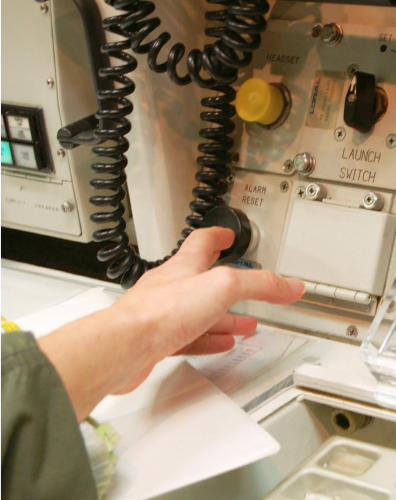
As we stepped inside the capsule, there was something strangely familiar about the scene. It was the image of the iconic Cold War-era thriller WarGames. The movie opens with two missileers being given the order to launch the missiles; one of them hesitates, the other pulls a gun. The scene is pure Hollywood. The idea of officers casually tossing the launch keys to the incoming shift, or shooting a rogue pacifist, is fantasy. The officers on duty wear no holstered sidearms. But the set is nearly identical–perhaps because the capsules have not been updated since the 1980s. Manuals marked “secret” are stored neatly on upper shelves, and above that is the gray metal box that holds the keys. Most people imagine the world of the missileer only in the moment of the key turn–a flurry of intense activity. In fact, quarters are cramped and the day-to-day routine is pretty boring. The toilet makes airplane lavatories look spacious, and there is only one small bed–one missileer can nap while the other keeps watch.
Once inside, we were introduced to Capt. Joseph Reveteriano and Capt. Jason Martin, the missileers on alert that day at Echo One. They were seated in front of a console with an array of incomprehensible push buttons, hardwired telephones, and flickering computer screens. A collection of black and red binders–some marked “secret,” others “top secret,” and yet others “FOUO” (for official use only)–was parked atop the console. Perhaps the most prominent reminder of what the missileers were doing was not even the simple lockbox that held the keys, but the digital clock lit up in red against a black background and flashing Zulu time (the military designation for Greenwich mean time)–a seeming miniature version of a doomsday clock.
We listened politely as the captains ran down a list of their responsibilities, which include endless procedural checklists. The missileers are constantly on watch for anything that trips the sensors around the facility or silo. Even innocuous visits like ours take place only through a series of carefully orchestrated checks.
Each MAF is connected to 10 Min-uteman III missiles. Multiple MAFs are linked to the same missile field–part of a redundant system meant to protect against a disabling first strike. Launching a missile requires the consent of two MAFs, or “votes,” in missileer parlance. Essentially, each missile capsule has a vote that is cast when the two missileers simultaneously turn their keys. It requires two votes–i.e., four people in two separate capsules–to initiate a missile launch. The missileers do not know which of their colleagues in the MAFs are set to cast the second vote. Everything in the nuclear world goes in pairs: two people to vote, two capsules to launch a missile, and so forth.
“What if me and Captain Martin joined the dark side?” Captain Reveteriano asked us rhetorically. The answer, he explained, was obvious. That wouldn't be enough–they would have to conspire with another missile crew, but they wouldn't know which one to conspire with. Even that wouldn't be enough: The missileers can only launch the missiles with the correct codes–codes that come directly from the president. The testament to the success of this system, they told us, was that in more than four decades, there had never been an incident that could have led to an illicit launch.
Inside the capsule, we chatted with the captains about their lives and jobs. Reveteriano became a missileer because it was part of U.S. Air Force Space Command. Before going into the air force, he, like most Americans, didn't realize there were people sitting underground manning the country's nuclear forces. Nor did he know anything about the life or work of the missileers when he signed up for the career. But space and missiles, he surmised, were the “way of the future.” That, plus he was working on his master's degree at night.
Space may indeed be the way of the future, but there is no getting around the fact that the missileer corps is shrinking in size–and arguably, importance–at least in the eyes of senior military officials, who have deferred funding upgrades and replacement systems. When we asked the missileers about their thoughts on pulling alert duty in the post-Cold War era, we suddenly got a jumble of explanations.
“The reason we're doing what we're doing is because of deterrence,” Reveteriano told us. “Are we doing anything different? No.”
Did they feel, we asked, that their job was any less important or urgent?
“You know, we could get a message at any time,” Reveteriano answered. “Look at 9/11, just when you think things are going smoothly, well…”
Reveteriano continued, talking a bit about history, World War II, and how the United States was in a very different, perhaps more frightening world of rogue nations and terrorist threats. “It's different, yes, the threat is different,” he agreed, offering no explanation of why or how 9/11 would lead to a full-scale nuclear attack (or even the seemingly inverse logic–that terrorism perhaps now poses a bigger threat to the United States than nuclear annihilation).
We realized that at least for the two missileers at Echo One that day, thinking about the job didn't extend very much beyond the day-to-day duties. And those duties, over the years since the end of the Cold War, have changed very little. Perhaps the biggest change in missileering over the past few decades has been the introduction of women, followed later by coed missileer teams. While such mixed teams are now commonplace, there were a few bumps along the way. The dimensions of the launch capsule, which measures just 6-feet wide and 27-feet long, make for extremely close–and isolated–quarters. The addition of a door to the toilet is a relative novelty; in years past, just a curtain separated it from the rest of the capsule. On our visit, we noticed that the missileers had piled up their personal belongings, mostly backpacks and magazines, on the single cot for lack of storage space.
Women began training to serve as missileers starting in the late 1970s. In 1988, they were allowed to serve with men, a decision that didn't prove particularly controversial until 1998, when 25-year-old Lt. Ryan Berry, a devout Roman Catholic, asked for a religious exemption to avoid coed duties, in order, as one religious publication described it, “to protect his family from the vagaries of his own heart.”
Its easy to consider the missileers mindless robots who simply follow orders. But the missileers we spoke with were striving for a way to make sense of their job. What is it that would make them turn the key?
Initially, the young lieutenant was granted an exemption from a mixed-sex alert duty, but when he switched squadrons and attempted to renew the exemption, the air force balked and Berry was given a poor review. Berry sued and the air force later agreed to remove his poor performance review from his record. And for the first time, perhaps, the missileers' dirty laundry was aired in public. Editorials described a debauched missileer force that spent its time perusing contraband pornography; mixed missileer teams were fraternizing off duty (with the presumption being that a little hanky-panky might be taking place on duty as well). Suddenly, the concern was not just the lustful heart of one Catholic officer, but rather, the safety of the nuclear deterrent being compromised by missileer teams hooking up underground.
Nowadays, however, Berry's concerns sound anachronistic. Not only are coed teams common at Warren, but we were told there were currently seven or eight married couples pulling alert together.
In 2008, the need to keep missileers sitting deep underground manning nuclear-tipped missiles on hair-trigger alert is becoming increasingly anachronistic as well. And without the ICBMs there would be no missileers–and no Warren Air Force Base. Over 100 years of history would disappear, likely leaving just Paula Taylor and the museum. Sitting inside their capsules, the missileers had to find ways to imagine that deterrence worked, and that it was justified; otherwise, not only wouldn't they be there, but quite sanely, the country wouldn't want them there. The military is not set up to wish itself away, and though we heard missileers say they hoped they would never have to turn the key, none of them expressed the desire to have their jobs go away. Quite the opposite, the stated presumption was that their jobs would always be necessary, because there was always someone who needed to be deterred.
The hair-trigger alert, of course, is the main reason for having missileers. In the fall of 1991, as the Soviet Union slid into chaos, the United States wanted to make a show of goodwill. Among the steps the U.S. government took was to de-alert all the Minuteman II missiles, Blair, the former missileer, told us. “That's almost half our Minuteman [missiles] de-alerted overnight,” he said. “The step they took included taking the launch keys away from the crews.” The missileers, minus their keys, still had to pull alert in the capsule. “They were very upset,” Blair acknowledged. “They felt, what's the word? Emasculated.”
Back in 2005, Gen. Lance Lord, then the head of U.S. Air Force Space Command, boasted that there were 9,000 air force personnel who were safeguarding an ever-shrinking stockpile of nuclear weapons. “As the wing commander at F. E. Warren,” he said, “routinely I was asked, ‘How does winning the Cold War change your mission?’ It doesn't.” As Fred Kaplan, author of The Wizards of Armageddon, points out, “It may well be that the air force missile men are simply, desperately, looking for something to do.”
It is hard to imagine that keeping young and highly trained air force personnel locked underground is really the best use of resources. If nothing else, it strikes us as terribly unimaginative. Nuclear deterrence did not always exist, and it seems somehow odd to think that it always will.
On our second day at Warren, we met with Col. Michael Morgan, the squadron's wing commander. We asked him what life was like for the missileers compared with during the Cold War. Morgan recalled life as a missileer during that period in Minot, North Dakota. His memories were of a beach party. He described how he and his friends hauled sand to a fellow missileer's basement and set up beach umbrellas and drank mai tais in the middle of winter.
“Nobody wanted to clean up the sand, so we left it until next year, then we had ‘son of beach party,’ and then we had ‘grandson of beach party’ the following year,” he said.
Life was different at Warren, he noted, but perhaps not so much because of the era, but because the community is not as isolated. Denver, after all, is less than two hours away. However, time has changed at least how the public thinks–or more to the point, doesn't think–about the silent community of missi-leers. According to at least one poll, most Americans now believe the chances of an all-out nuclear war are remote.
But for Morgan, the fact that the mis-sileers are not really at the forefront of most Americans' minds is, if anything, a good thing. “These are strategic nuclear weapons,” he said. “I think it's absolutely imperative that our citizens, our nation, doesn't worry about us. They are not concerned about our ability to respond; they are not concerned about the safety and security of our weapons systems. The message that we have is not for the American people; the message that we have is for our potential adversaries. And what we do speaks loud and clear to the folks overseas, if you will. And I think, by and large, the missile community, the strategic nuclear community, is just fine with being in the background and not out in front in the minds of the American public.”
For Morgan, as for the missileers, deterrence is a philosophical question best left to Washington and the politicians. “It's our job as professional military officers to salute smartly and carry out the desires of our duly elected civilian officials,” he told us.
Superficially, it would be easy to consider the missileers mindless robots who simply follow orders to turn the switch. But the missileers we spoke with were striving for a way to make sense of their job–that “tangible thing” that Lieutenant Stricklan had expressed to us in the mock-up capsule. What is it that would make a missileer turn the key?
It was clear to us that the missileers were all trying to hang on to deterrence as the rationale to do their jobs. It is no wonder the focus of their training is on mastering the rote procedures that leads to the key turn–the idea, after all, is to make sure that they don't need or want to grope for abstract ideas or questions. In the training capsule, we asked Lee and Stricklan what would happen after the missiles launched. That, after all, is something that couldn't really be rehearsed.
“After?” Lee replied, looking a bit perplexed.
The MAFs are meant to survive a nuclear attack–at least long enough for the missileers to turn the key. They are not intended for any sort of long-term survival. There is just a few days' worth of food at the MAF and no medical care, let alone long-term life support. As Bruce Blair recalled of his days as a missileer, the post-Armageddon plan was for him and his fellow missileers to report to a local National Guard bureau. “Our instructions were you hang out till you've launched the last missile. Then you dig yourself out and you walk to Helena, Montana,” he told us. Blair was stationed some 200 miles away from Helena. In other words, he was ordered to walk “through smoking, irradiated ruins of a state, where you would basically die of radiation poisoning within an hour after leaving the silo.”
Those were his post-launch orders. It was, as he put it, “a joke.”
Yet the missileers belowground had at least a better chance than the crew topside. So what, we asked, would the crew do? The facilities were built to withstand a nuclear blast (though even that was somewhat doubtful); so, presuming they survived the initial thermonuclear onslaught, what would come next? Very little thought had been given to that. Like the bomber pilots who were presumed to be flying their nuclear payloads to a certain death over the Soviet Union, few had really thought about the “day after” for a missileer. Their duties ended with the key turn.
Lee's answer, perhaps not surprisingly, was not really about himself, it was about the men and women topside, who would be completely unprotected in the event of a nuclear strike. “As an officer, I would make the choice to bring my men down,” he said solemnly.
But Granstrom, who had escorted us and was standing behind Lee, frowned slightly and shook his head. The cook and the facility manager could come down, but not the security crew, he insisted. “Security forces would stay up to the bitter end,” he said, “to protect any unlaunched missiles.”
That is the paradox of deterrence. For deterrence to work, the missileer must be able to follow orders that seem absurd. What sort of officer, knowing the end was near, would leave the men and women under his command above ground, condemned to a certain death in the name of a principle–deterrence–that hadn't worked? The logic of Gran-strom's answer was clear; it was the same logic that guided deterrence, which meant following the prescribed steps to the very end, however pointless they might be at the moment of execution.
Our gaze shifted back to Lee for his response. A simple calculation would support Granstrom's view. If you were willing to turn the key after deterrence had failed, why concern yourself with enlisted military personnel who had signed up to sacrifice their lives in the name of deterrence?
It was quiet, and for a moment, as we waited for Lee to concur with his senior officer, we forgot that we were in a training capsule and not the real thing. Lee merely shifted uncomfortably in his seat and stared straight ahead, neither contradicting nor affirming the major's position.
It occurred to us that perhaps the reason Lee would bring his people down was that “tangible thing” that would lead him to turn the key. It wasn't abstract notions of deterrence or a warped sense of patriotism–or even avenging his possibly dead family. It was simply a sense of duty and loyalty to the people with whom he served.
In that instant, we knew that if the missiles were flying, and Armageddon was on its way, Captain Lee, without doubt, would bring his people down.