




Abstract
The United States plans to protect itself from emerging missile threats by building a Europe-based missile defense system. Like its predecessors, the system has serious technological deficiencies.

During 2007, the Bush administration began an aggressive sales campaign aimed at convincing its European allies to accept a U.S. deployment of missile defense components on their continent. The administration's stated objective for a European missile defense system is “to provide a defense of Europe against a limited intermediate and long-range ballistic missile attack from the Middle East and provide additional capability to the current missile defense system located in Alaska and California to defend the United States.” The more specific postulated scenario is a missile attack by Iran. Under this scenario, the administration claims that its European missile defense components will provide coverage of northern and western Europe, and as stated, it would also increase the overall probability of successfully intercepting an Iranian ballistic missile launched toward the continental United States.
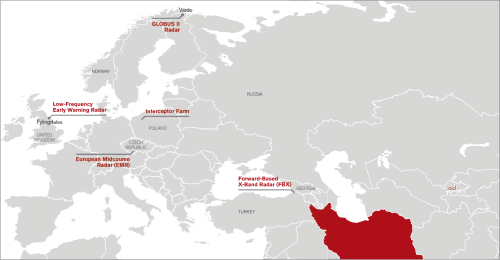
The Missile Defense Agency (MDA) | has described the proposed structure 3 and operation of the system in a series of briefings to European allies. A large X-band radar called the European mid-course radar (EMR) would be deployed in the Czech Republic; a forward-based X-band (FBX) radar would be deployed at an unspecified location near Iran, possibly in eastern Turkey or Georgia; and a launch site with 10 ground-based interceptors would be located in Poland. These new components would be aided by an existing, upgraded early warning radar at the Fylingdales Air Force Base in Britain. (For a detailed breakdown of these radars and interceptors, see “The System's Components,” pp. 34-35.)
If the postulated attack were to occur, MDA maintains these radars would work together as follows: U.S. early warning satellites would initially observe the launch and powered flight of the ballistic missile before providing information on its approximate trajectory to the FBX radar so that radar could begin tracking the missile with much greater precision. Next, the FBX would pass its precision tracking information to the EMR, which would now track the warhead and use its high-range resolution to measure a warhead's target details, along with the details of any decoys or other counter-measures. As currently articulated, the FBX radar and EMR are the only radars within the European missile defense system potentially capable of differentiating warheads from countermeasures.
Almost simultaneously, the Fylingdales radar would also begin to track the complex of targets. Unlike the EMR, the Fylingdales radar is powerful enough to search Europe's sky for low-visibility warhead targets at long ranges. Since the EMR is incapable of searching large areas of sky for low-visibility, cone-shaped warheads, all of this highly accurate “cuing” information from the FBX radar, the Fylingdales radar, and the early warning satellites is essential if the defense is to work as intended.
If the EMR succeeds in identifying objects that might be warheads, the interceptors in Poland would be fired toward predicted intercept points. Once the rocket motors of the interceptor burn out, the kill vehicle would be released to select, home in on, and destroy warheads in high-speed collisions. If the interceptors don't successfully engage the warheads, the Fylingdales radar could continue to track them long after they've flown out of the EMR's coverage–information that could support additional interceptors launched from Alaska and California. (For an in-depth description of how the system will operate, see “A Specific Scenario,” pp. 36-37.)
But when MDA's description of how the system functions is subjected to a detailed technical analysis, it becomes clear that none of the system's components can work as MDA claims. Specifically, our technical findings conclude:
A September 1999 National Intelligence Estimate (NIE) entitled, “Foreign Missile Developments and the Ballistic Missile Threat to the United States Through 2015,” provided a list of countermeasures that the intelligence community concluded would be available to any country that had developed the science, technology, and industrial capacity to build ICBMs. It concluded, “Many countries, such as North Korea, Iran, and Iraq probably would rely initially on readily available technology … to develop penetration aids and countermeasures.” It added, “These countries could develop counter-measures based on these technologies by the time they flight test their missiles.”
Although reported in the 1999 NIE, there was never an attempt to explain the significance of these findings to the non-specialist audience they were intended to address–particularly Congress. After September 2000, these critically important statements about countermeasures are inexplicably missing from unclassified NIEs. Their omission is troubling and raises questions about the possibility of political tampering with intelligence findings similar to those experienced in the run-up to the Iraq War. In this case, the omissions would be aimed at protecting the missile defense program from valid questions about its efficacy. The opacity of the 1999 NIE on the significance of these counter-measures for the missile defense program also raises questions about whether the intelligence community did its job by stating conclusions without pointing out their significance to decision makers.
The System's Components
The version of the EMR to be placed in the Czech Republic is considerably less capable than its imposing physical appearance suggests, mainly because its antenna will contain a much smaller number of transmit/receive (T/R) modules than an antenna of its size can normally contain. These T/R modules both send out and receive the radar energy necessary to perform the required detection, tracking, and discrimination functions. The radar has been designed so that the number of T/R modules could be increased from the current 16,896 modules to as many as 78,848 modules. 2 Moreover, such an upgrade would certainly use more advanced T/R modules, each of which would be two to three times more powerful than the first-generation modules used in the GBR-P.
While public statements indicate that such an expensive upgrade isn't planned, if pursued, it could increase the radar's track-ng capability by a factor of about 40-70, depending on the new modules' power. This would transform the inadequate planned version into a more powerful system that could at least attempt to provide some discrimination services (telling warheads apart from decoys, pieces of wire, and other debris and countermeasures) for Iranian warheads aimed at the eastern portion of the continental United States. The upgraded EMR would also be able to provide critical early detection and tracking services for interceptors based in Poland against Russian ntercontinental ballistic missiles (ICBMs) launched at the United States from sites west of the Ural Mountains.
Because of its close proximity to the anticipated missile launch site (under the postulated threat, somewhere in Iran), the FBX radar would be the first radar to detect the missile and would assist the EMR in detecting the missile warhead. However, the FBX radar can't be relied on to discriminate between warheads and decoys. In many cases, these warheads and decoys will be too far from the FBX radar, resulting in signals too weak to collect the essential high-precision data on both warheads and decoys for any attempts at discrimination.
However, the use of such lower radio frequencies by the Fylingdales radar results in a much lower reso-ution, making it impossible for the radar to discriminate between warheads, decoys, and other objects. Despite this limitation, the initial version of the national missile defense system proposed by the Clinton administration would have relied entirely on the Fylingdales radar and similar radars at Thule, Greenland, and Cape Cod, Massachusetts, to defend the continental United States against an attack from the Middle East. The Fylingdales radar has already been upgraded to support the interceptors currently deployed in Alaska and California.
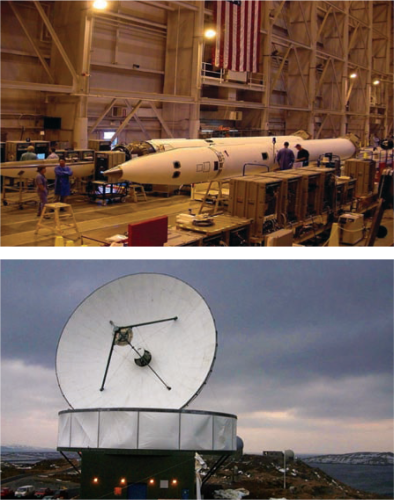
Although not a declared element of the proposed European missile defense system, the GLOBUS II radar in Vardo, Norway (bottom), could perform some of the tracking and discrimination functions the Missile Defense Agency envisions for the system. If all goes as planned, a two-stage rocket (top) launched from Poland would carry an infrared-homing kill vehicle tasked with intercepting the target—a warhead.
Russia has voiced alarm about the two-stage interceptors–in part because the Russians believe that these fast interceptors, supported by detection and tracking data from an upgraded EMR, could be used to intercept Russian ICBMs aunched from sites west of the Ural Mountains. Obering and Keith Englander, his chief scientist, have countered by making a technically mplausible claim that the two-stage interceptors based in Poland can achieve a burnout speed of only 6.3 kilometers per second–too slow a speed to engage Russian ICBMs. But data on stage performance provided to the press by the MDA and performance data from publicly available manuals on the performance of the Pegasus-derived rocket stages indicates that the MDA claim of a 6.3-kilometers-per-second interceptor cannot be correct. 4
GEORGEN. LEWIS and THEODORE A. POSTOL
The EMR is designed to be upgradable, which raises questions about whether the Bush administration is pushing to deploy a lesser EMR in the Czech Republic now as a strategy to commit the country to a course that will be difficult to reverse.
A Specific Scenario
Let's assume that Iran has obtained or produced an intercontinental ballistic missile (ICBM) capable of de-ivering a nuclear warhead to the continental United States, and in an irrational act of probable national suicide, launches this ICBM at Washington, D.C.
Roughly 60 seconds after Tehran aunched such a missile, U.S. early warn-ng satellites would observe the hot exhaust plume from the missile's rocket motor. The United States typically stations several of these satellites at orbital locations that allow them to simultaneously view the Middle East from multiple directions. By using two or more satellites to observe the accelerating missile from different angles, the missile's location–within a volume of about 1 square kilometer–would be obtained.
Within roughly three minutes of the missile's launch, it would be high enough that the curvature of Earth would no longer block it from the view of the forward-based X-band (FBX) radar, which the Missile Defense Agency (MDA) wants to place in southeastern Europe, possibly eastern Turkey or Georgia. Based on information from the early warning satellites, the FBX radar would point its radar beam in the target's expected direction–similar to a giant searchlight. But unlike a powerful searchlight, the radar illuminates targets by radio signals nstead of visible light, pulsing its beam to measure range. If the beam is pointed in the correct direction, a portion of the radio waves from the radar antenna will reflect off the target back to the radar. The size of the reflected signal is determined by the target's radar cross section–an effective reflecting area typically designated in square meters.
After early warning satellites detect the launch of an iranian ballistic missile, the forwardbased X-band radar would begin tracking the missile's speed and range. This information would be relayed to either the European midcourse radar or the GLOBUS ii, which would try to discriminate between warheads and decoys. if potentially threatening targets are identified, data from these radars could then be used to support the launch of interceptors.
Each time a radar beam is pointed at a specific area of the sky, it must “dwell” long enough to collect a suitable number of reflected pulses to detect the target. If the target's location isn't precisely known, the radar will need to search a larger area by dwelling on many discrete areas of sky. If it takes too long to search the potential target area, the target may move out of the search volume and go undetected. Therefore, target acquisition requires that the radar beam be powerful enough to search at sufficient range with sufficient speed to detect the target. If a target's radar cross section is small and its location unknown, the radar will not be able to acquire it, and there will be no way to determine the location of intercept points needed to support the launch of interceptors.
The FBX radar beam would be roughly 10 kilometers (6 miles) across at a range of 1,000 kilometers (620 miles), making it possible for the FBX radar to acquire the accelerating ICBM simply by pointing its beam directly at the volume within which the early warning satellites indicate the missile resides. So, if the reflected signal from the ICBM is large enough, the early warning satellites allow the FBX radar to avoid the difficult task of searching a large area of sky for the missile. Once the target is acquired, a rough estimate of its speed, range, and direction can be determined. With this information, it's straightforward for the radar to repeatedly measure the target's location. As this process of tracking proceeds, the FBX radar can provide increasingly precise measurements of the target's location, speed, and direction. The target's future locations can then be projected forward, giving an interceptor equipped with a homing kill vehicle enough information to look for and acquire the target with its imaging infrared sensors.
After the ICBM finishes its powered flight, the missile's cone-shaped warhead would be deployed. Since the warhead is likely to have a relatively low radar cross section, it poses a challenging detection problem. But because the final stage of the missile booster and the warhead would travel at about the same velocity (unless the attacker took steps to prevent this), they would stay relatively close together as they coast toward the United States. So, even if the FBX radar is unable to detect the warhead, by tracking the final rocket stage, the radar may be able to establish the warhead's approximate location with enough accuracy to support detection by more powerful radars such as the GLOBUS II X-band radar in Vardo, Norway, or an upgraded European midcourse radar (EMR) in the Czech Republic. The initial version of the EMR possesses such limited range that it won't play any useful role in the operation of European missile defense.
As the warhead travels past the FBX radar, it will be high enough for the EMR to attempt to observe it. Several minutes later, it will be high enough for the low-frequency radar at Fylingdales Air Force Base in Britain to detect it, and shortly thereafter, by the GLOBUS II. The task of an upgraded EMR or GLOBUS II is to collect the high-resolution precision data needed to try to determine whether objects are warheads, decoys, or debris. This tracking and discrimination data could then be used to support the launch of homing interceptors–or provide further information to interceptors already launched on the basis of FBX radar data. The data from all three radars could also support the launch of interceptors in Alaska if the European interceptors fail to destroy the target. As the kill vehicle approaches the target, it uses its infrared sensor to home on the complex of warheads, decoys, and other objects associated with the missile's payload. Ideally, the kill vehicle would then pick out the warhead and destroy it in a high-speed collision.
But the above scenario depends on two critical assumptions: The radars will have sufficient ranges to detect the warhead; and the defense will be able to find the warhead among a collection of decoys and other countermeasures. Neither of these assumptions is valid.
The MDA apparently assumes that the warhead's radar cross section will be large–about 1 square meter–making it easy for the EMR to detect it at the expected ranges of the Iran scenario. However, at the short radio wavelengths used by X-band radars (slightly larger than 2.5 centimeters [1 inch]), the radio signals reflect off the warhead much like light reflects off of a mirror. Since the warhead is cone shaped, almost all of the radio energy that falls on the target is reflected in directions away from the illuminating radar. Therefore, over the large majority of viewing angles, the warhead's radar cross section will be miniscule, about one one-hundredth of a square meter or less, relative to that assumed by the MDA.
Given such a stealthy target, at no point in the trajectory of a missile fired from central ran toward the United States could the EMR detect the warhead. (To the Fylingdales radar, the warhead will likely appear 1 0 or more times larger; but again, the Fylingdales radar cannot discriminate the warhead from decoys and other countermeasures–only an upgraded EMR could complete this task.) The same holds true for many potential targets in Europe. Further, for European trajectories where the EMR can eventually detect warheads, the detection ranges will often be so short that there would be insufficient time for interceptors to fly to locations where they could hit attacking warheads.
GEORGEN. LEWIS and THEODORE A. POSTOL
So whether intended or not, the U.S. proposal has the appearance of a missile defense system that's aimed at Russian ICBMs, many of which are already vulnerable to a preemptive U.S. nuclear attack. This creates significant military and political uncertainties for Moscow's leadership, especially if U.S. missile defense capabilities in Europe continue to grow larger and more sophisticated. These factual observations explain the fierce negative reaction in Russia to the proposed Czech and Polish sites. If Russia were deploying such missile defense installations in Canada, it's almost certain that the United States would feel similarly threatened.
The U.S. vow to deploy only 10 interceptors in Poland is inconsistent with the logic Washington has put forward to justify the system's deployment. By definition, a postulated Iranian threat would include an infrastructure, production facilities, and industrial base to build more than 10 ICBMs. Therefore, the 10 proposed interceptors should be regarded as an initial deployment, leaving Russian leaders to contemplate the possibility of a vast expansion in the number of interceptors at the Polish site, and the rest of the world to wonder about the rationality of U.S. leadership that appears to want the unachievable–nuclear supremacy.
Why Countermeasures Will Defeat National Missile Defense
The most fundamental and unsolvable problem with national missile defense–whether deployed in Europe or domestically–is its inability to circumvent relatively simple countermeasures. The reason for this extreme vulnerability can be traced to a surprisingly simple physical fact: The national missile defense operates against targets at high altitudes in the near vacuum of space, where there is no measurable aerodynamic drag to cause light objects to slow down relative to a heavy warhead. Under these conditions, a wispy feather and 900-kilogram (2,000-pound) warhead will travel along together, meaning any object large enough to contain a nuclear warhead must be regarded as potentially containing such a devastating weapon-even if the object is actually a lightweight balloon serving as a decoy.
To understand why decoys create such fundamental problems for national missile defense, consider the problem Transportation Security Administration inspectors face when trying to determine which suitcases at an airport contain explosives. Since missile defense is restricted to using radars and infrared sensors to view objects at long range, this analogy can be further adapted by assuming that the inspectors at the airport are limited to measuring only the externally observable features of each suitcase (color, size, shape) by visual inspection. As such, they cannot open the suitcases, physically shake them, use dogs to sniff them, or employ X-ray machines to inspect their contents. Of course, unless someone tells the inspectors what features to look for (i.e., yellow suitcases), visually inspecting the suitcases is a useless endeavor.
In missile defense, the process of discrimination is similar. Warheads and decoys can only be identified if the distant radar or the kill vehicle's infrared sensor knows exactly what it's looking for and the enemy takes no measures (either accidental or intentional) to change the objects expected appearance–an unlikely scenario. Adversaries can easily modify a warhead's appearance, enclosing it in a balloon and surrounding it with more balloons of different shapes, sizes, and exterior coatings–all of which travel along with the warhead in the near vacuum of space, creating considerably more potential targets than the missile defense's relatively small supply of interceptors could possibly engage.
In addition to needing detailed prior knowledge of the special features that distinguish a warhead from other objects, the missile defense radar and infrared sensors must be able to measure these features with sufficient precision. This requires high-precision data for each target of concern. Such precision measurements require a considerably stronger signal than is required for detection. As a target gets closer to a radar, the strength of its signal ncreases; thus, the range at which a sensor can attempt to discriminate between warheads and decoys must be shorter than the range at which the sensor can detect that target. The Missile Defense Agency (MDA) could upgrade the European midcourse radar (EMR) so that its signal strength would allow it to both detect and attempt to discriminate such a warhead target, but even with this upgrade, the EMR is unlikely to be able to successfully discriminate warheads from decoys.
Worse still, decoys aren't the only coun-termeasure an attacker might use to defeat the missile defense system. Others nclude:
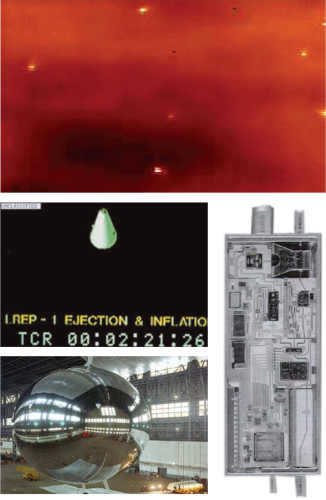
To both national and European missile defense systems, countermeasures such as large balloons with reflective coating (bottom left) and light, rigid replica decoys (middle) can appear similar to nuclear warheads. Likewise, missile attackers can employ low-power jammers (right), pieces of hardware not much larger than a dime, to generate tens of thousands of false targets to mask a warheads presence or location. The infrared view from an interceptor kill vehicle (top) shows how warheads and decoys can appear similar when inspected from a 200-kilometer (124-mile) distance.
Other countermeasures can also prevent an interceptor's kill vehicle from performing discrimination functions. When the kill vehicle tries to identify and home in on the complex of warheads, decoys, and other objects, each are observed as points of light against the dark infrared background of space. Even in the unlikely case where the X-band radars have somehow discriminated between the warheads, decoys, and other objects, the radar will often not be able to provide the kill vehicle with sufficiently precise location information for it to identify the warhead. Because of this “association” problem, the interceptor must be able to select the right target by conducting its own discrimination. The kill vehicle attempts to do this by examining the brightness and fluctuating brightness of the many points of light in front of it. However, even a minimally capable adversary could easily manipulate the brightness and brightness fluctuations of simple objects. For example, the temperature of different sections of a sunlit spherical balloon in space can be drastically altered by painting it with stripes of different colors. By using different patterns of paint colors, the infrared brightness and fluctuation in brightness of any balloon could be easily altered to make it look more like, or less like, a distant warhead. Warheads could also be placed in balloons that do, or do not, look like warheads, and balloons that each have their own infrared signals could be deployed along with balloon-shrouded warheads.
In these circumstances, each object would look different from all other objects, and it would be fundamentally impossible for the kill vehicle to identify balloons containing warheads from those that are empty.
GEORGEN. LEWIS and THEODORE A. POSTOL
Supplementary Material
Long-Range Ballistic Missile Defense in Europe
Supplementary Material
National Missile Defense: Prospects and Problems
Supplementary Material
Reducing Risk in Ballistic Missile Defense Flight Test Programs
Supplementary Material
Why U.S. National Intelligence Estimates Predict that the European Missile Defense System Will Fail: Technological Issues Relevant to Policy
Supplementary Material
Foreign Missile Developments and the Ballistic Missile Threat to the United States Through 2015
Footnotes
1.
Bettina Haymann Chavanne, “Ballistic Missile Defense Elements Modified for Europe,” Aerospace Daily and Defense Report, October 4, 2007.
2.
Military Electronics Briefing, “BMD X-Band Radars and BMD C4I,” Teal Group Corporation, July 2007. Another source describes its upgrade potential as being “greater than 50,000 elements.” J. F. Crawford, E. Reed, J. J. Hines, and D. R. Schmidt, “Ground Based Radar-Prototype Antenna,” National Conference on Antennas and Propagation, IEE Conference Publication, no. 469,1999.
3.
The European midcourse radar would suffer from a similar limitation if targets are separated by angles greater than 50 degrees.
4.
George N. Lewis and Theodore A. Postol, “European Missile Defense: The Technological Basis of Russian Concerns,” Arms Control Today, October 2007, pp. 13-18.