



Abstract
How is global warming affecting existing competition for resources and changing international security priorities? A survey of recent research shows how complex the picture could become.
Disasters are often used to illustrate the range of potential effects of global warming. Hurricane Katrina and the devastation it caused in the Gulf region in 2005 and the 2003 European heat wave that caused 35,000 deaths and $15 billion in agricultural damage are two of the more commonly cited examples. Yet the impact of climate change on human and global security could extend far beyond the limited scope the world has seen thus far.
The Intergovernmental Panel on Climate Change (IPCC) examined the impacts of climate change on natural and social systems in Working Group II of its 2007 assessment report and concluded that climate change will affect species and ecosystems in all parts of the world–such as rainforests, coral reefs, and Arctic ecosystems–and that some already show stress symptoms. 1 Due to climate change, the total area stricken with drought will likely increase, and water supplies stored in glaciers and snow cover in major mountain ranges such as the Andes and Himalayas will likely decline, jeopardizing access to water in large regions. Where natural resources are already in a critical stage, global warming will tend to further degrade the environment as a source or sink of these resources.
By degrading the natural resource base, climate change will increase the environmental stress on the world's population. A combination of these stress factors could lead to cascading effects. Some of the environmental changes may directly threaten human health and life, such as floods, storms, droughts, and heat waves. Others, such as food and water scarcity, disease, and weakened economic and ecological systems, could gradually undermine human well-being.
Environmental changes caused by global warming will not only affect human living conditions but may also generate larger societal effects, by threatening the infrastructures of society or by inducing social responses that aggravate the problem. The associated socio-economic and political stress can undermine the functioning of communities, the effectiveness of institutions, and the stability of societal structures. These degraded conditions could contribute to civil strife and, worse, armed conflict. According to the IPCC, confining the impacts will be difficult: “Where extreme weather events become more intense and/or more frequent, the economic and social costs of those events will increase.”
Whether societies are able to cope with the impacts and restrain the risks depends on their vulnerability, which the IPCC defines as a function of the “character, magnitude, and rate of climate change and variation to which a system is exposed, its sensitivity, and its adaptive capacity.” Societies that depend more on an ecosystem's services and agriculture tend to be more vulnerable to climate stress. Some regions such as Bangladesh and the African Sahel are more vulnerable due to their geographic and socioeconomic conditions and lack of adaptive capacities. Countries and communities that are not affected initially may become vulnerable later. Due to nonlinear effects, an increase in global mean temperature above a certain threshold, say 2 degrees Celsius, may result in disproportionate impacts. 2 The stronger the impact and the larger the affected region, the more challenging it becomes for societies to absorb the consequences. Large-scale and abrupt changes in the Earth system, beyond so-called “tipping points,” could have incalculable consequences on a continental and global scale. 3
The societal implications of climate change crucially depend on how human beings, social systems, and political institutions respond. Some measures facilitate adaptation and minimize the risks, others may cause more problems. For instance, populations could respond to environmental hardships by migrating, which would spread potential hotspots of social unrest. 4 These developments could turn into security problems, as the 2006 Stern Review on the Economics of Climate Change acknowledges: “Climate-related shocks have sparked violent conflict in the past, and conflict is a serious risk in areas such as West Africa, the Nile Basin, and Central Asia.”
While much of the research on climate change is aimed at predicting the future, historical records may provide clues to better understand the interaction between climate and security, much as paleoclimatic records help scientists understand the climate system's physical processes. Human existence depends on certain climatic conditions, defined by a window of tolerable atmospheric temperatures. Outside of this window, human life is hard to sustain.
Researchers believe a changing environment and a lack of adaptation was a factor in the decline or collapse of a number of civilizations, including Bronze Age cultures from the Mediterranean to the Indus Valley, Mayan civilization, the Khmer Empire in Southeast Asia, Easter Island, and Anasazi culture. In modern times, the cooling period between the thirteenth and eighteenth centuries challenged societies in the Northern Hemisphere, contributing to social and political upheaval and revolutions. As Brian Fagan vividly records in The Little Ice Age: How Climate Made History, populations experienced severe hardship when average temperatures in the Northern Hemisphere dropped by not more than 1 degree Celsius. Between 1740 and 1741, “the year of the slaughter,” an unusually long spell of cold weather destroyed both grain and potato crops and killed livestock in parts of Europe. In Ireland alone, the population decreased by 2.5 million people: About 1 million emigrated, and the remainder died of famine and associated disease. In 1816, the “year without a summer,” social unrest, pillaging, rioting, and criminal violence erupted across Europe. In Dundee, Scotland, a crowd of 2,000 plundered more than 100 food shops. The militia had to restore order, and the government intervened aggressively, prohibiting grain exports and deploying the army to provide famine relief. The widespread hunger brought a surge in religious devotion, mysticism, and prophecies of the imminent demise of the world.
Beyond historical narratives, a December 2007 quantitative study by researchers in China, the United States, and Britain highlighted the historical link between temperature fluctuations, reduced agricultural production, and the frequency of warfare in Europe, China, and the rest of the Northern Hemisphere over the last millennium. 5 The researchers show that “long-term fluctuations of war frequency and population changes followed the cycles of temperature change.” In particular, “cooling impeded agricultural production, which brought about a series of serious social problems, including price inflation, then successively war outbreak, famine, and population decline.” The study proposes that a “shortage of food resources in populated areas increases the likelihood of armed conflicts, famines, and epidemics, events that thus reduce population size.”

The temperature fluctuations associated with these periods, however, pale in comparison with the climate change expected within the coming decades and centuries. Humanity's experiment of using Earth's atmosphere as a carbon depot is historically unprecedented. The security implications may be as well.
In the parts of the world where climate change could cause the erosion of social order, state failure and violence may go hand in hand. In the worst-affected regions, climate change could contribute to the proliferation of risk. Food insecurity in one country may increase the competition for resources and force migration, drawing neighboring states into crises. Such spillover effects can destabilize regions and overstretch global and regional response capabilities. 6
In less wealthy regions, climate change adds to already stressed conditions–high population growth, inadequate freshwater supplies, strained agricultural resources, poor health services, economic decline, and weak political institutions–and becomes an additional obstacle to economic growth, development, and political stability. 7 In societies on the edge of instability, the marginal impact of climate change can make a big difference. Failing states with weak structures often cannot guarantee the core functions of government, including law, public order, and the monopoly on the use of force, all of which are pillars of security and stability.
The meaning of security has continuously evolved since the Cold War, when the bilateral East-West conflict dominated and national and international security were reduced to military force assessments. In the world's emerging security system, a large number of actors and interconnected factors shape the security discourse, including environmental dimensions. The concept of ecological security seeks to minimize the dangers from ecosystem change or loss, recasting environmental problems as security threats. “Human security” focuses on “shielding people from critical and pervasive threats and empowering them to take charge of their lives.” 8 Some scientists criticize these extended security concepts as too broad because they would allow the military to expand into environmental policy. 9
In 1991, Thomas Homer-Dixon of the University of Toronto identified four interrelated effects of environmental degradation–reduced agricultural production, economic decline, population displacement, and disruption of social relations–all of which may contribute to conflict. 10 Studies over the last two decades empirically affirmed that environmental degradation and resource competition may indeed cause violence and conflict, when combined with other conflict-amplifying factors. 11 The research literature does not provide sufficient evidence, however, to support a clear causal relationship between security, conflict, and climate impacts. 12 The interaction is complex with a number of contributing factors and feedbacks that are dependent on case-specific circumstances. While the climate signal has been weak in the recent past, the consequences may become more visible in the future when it is too late to prevent them.
In 2007, the German Advisory Council on Global Change published the most comprehensive assessment of the security risks of climate change to date, further defining the range of contributing factors. Its report focused on four particular trends that are likely to result from global climate change and impact security: degradation of freshwater resources, food insecurity, natural disasters, and environmental migration.
In the world's emerging security system, a large number ot actors and interconnected factors shape the security discourse, including environmental dimensions. Ecological security seeks to minimize the dangers from ecosystem change or loss, recasting environmental problems as security threats.
The IPCC has high confidence that the amount of water in rivers, lakes, and reservoirs will decline in many semi-arid areas, for example in the western United States, northeastern Brazil, the Mediterranean Basin, and southern Africa. The German Advisory Council projects that in Africa alone between 75 million and 250 million people could be exposed to climate-induced water stress by 2020. Shrinking glaciers and thinning snow cover will also reduce freshwater availability and hydropower potential near major mountain ranges, such as the Hindu Kush, Himalayas, and Andes, where more than one-sixth of the world's population lives.
Researchers continue to debate whether water scarcity will lead to conflict within or between nations. 14 Individual case studies suggest that water scarcity undermines human security and heightens competition for water and land, inducing migration. A statistical analysis of precipitation patterns suggests that regions whose amount of rainfall varies widely from year to year are more prone to conflict than others. 15 A comprehensive Oregon State University study, based on the Transboundary Freshwater Dispute Database, finds that the likelihood and intensity of conflict rise as the change in water levels of a basin exceeds the capacity to absorb that change. However, skeptics claim that historical cases of “water wars” are extremely rare. 16
Strong cooperation is also relatively frequent in regions vulnerable to water conflict. Transboundary water agreements and institutions have withstood changing political conditions, as demonstrated by the relationship between Israel and Jordan, the Mekong Committee, and the Indus River Commission, and even improved ties. For example, discussions between India and Pakistan over the Indus River led to the resumption of talks over other bilateral concerns.
Most vulnerable from such conditions are coastal and riverine areas and regions whose economies depend on climate-sensitive resources. In many cases, increasingly hot and dry climates will force migration to more temperate locations. Environmental migration will predominantly occur within national borders of developing countries, but industrialized regions should also expect a substantial increase in external migratory pressure. Europe could see an increase in migration from sub-Saharan Africa and the Arab world, and North America from the Caribbean, and Central and South America. China's potential need to resettle large populations from flooded coastal regions or dry areas may pressure Russia, which has a declining population and a huge energy-and mineral-rich territory that may become more agriculturally productive in a warming climate. This scenario may create potential conflict between these two nuclear powers, according to a recent report by a Center for Strategic and International Studies (CSIS) panel. 18
The likelihood of migration-induced conflict increases if environmental migrants have to compete with residents for scarce resources such as farmland, housing, water, employment, and basic social services, or if they are perceived to upset the “ethnic balance” in a region. In general, though, different types of migration involve different security risks. A sudden mass exodus after an extreme weather event would differ in effect from a planned migration in response to gradual environmental degradation. How well local and national governments function also influences the likelihood of conflict. In countries without weather warning systems or evacuation plans, extreme weather causes relatively greater damage and compels more people to flee than in countries whose governments are well prepared for emergencies. The same applies to gradual environmental degradation. For example, continuing soil degradation can be avoided through efficient land-use technologies and land-use systems.
Experts predict that the most se-rious climate risks and conflicts will impact countries that have less money to invest in adapting to these effects, but more wealthy countries are not immune. The impacts on some developed countries may be initially moderate or even positive with limited warming (increasing temperatures could lead to greater agricultural productivity, reduced winter heating bills, and fewer winter deaths), but they will become more damaging at the higher temperatures predicted for the end of this century. The costs of climate change for developed countries “could reach several percent of GDP as higher temperatures lead to a sharp increase in extreme weather events and large-scale changes,” according to the Stern review.
Abrupt and large-scale changes in the climate system–for example, the melting of the ice sheets in Greenland or West Antarctica, or the collapse of the North Atlantic thermohaline circulation (a part of Earth's global water flow)–could directly impact developed economies, forcing population movements and disrupting global trade and financial markets. Governments' reduced ability to prevent and cope with climate-related damages and their economic effects, including high unemployment, may become a task too big for many societies whose social stability may suffer.
The larger question at hand for both developing and developed countries is whether the effects of climate change will exacerbate existing risks and conflicts or will lead to new ones. While much of the early research literature remains undecided on this question, several recent policy-oriented studies take a more pronounced position. In April 2007, the CNA Corporation, a U.S.-based think tank, and the Military Advisory Board, a blue-ribbon panel of retired admirals and generals, published a report on the connection between climate change and national security. The report resolutely identifies climate change as a “threat multiplier of instability” that “will seriously exacerbate already marginal living standards in many Asian, African, and Middle Eastern nations, causing widespread political instability and the likelihood of failed states.” 19 Already fragile regions are susceptible to large-scale migrations, increased border tensions, the spread of disease, and conflicts over food and water, and could become breeding grounds for extremism and terrorism, the report finds. The threat could affect Americans at home, impact U.S. military operations, and heighten global tensions. The report recommends integrating climate change into U.S. national security strategy “to help stabilize climate change at levels that will avoid significant disruption to global security and stability.”
The findings of the CSIS panel, which included former CIA director James Woolsey and Nobel laureate Thomas Schelling, similarly concluded that global warming could “destabilize virtually every aspect of modern life” and would likely breed new conflicts and magnify existing problems, from the desertification of Darfur and competition for water in the Middle East to the disruptive monsoons in Asia, all of which increase the pressure for land. 20
As temperatures increase, so may the potential for conflict. A temperature rise of 1.3 degrees Celsius, which scientists expect by 2040, would heighten internal and cross-border tensions caused by large-scale migrations; spark conflict over resource scarcity; increase the spread of diseases; and reorder geopolitics as nations adjust to shifts in resources and prevalence of disease, according to the panel's findings. Severe climate change, a temperature rise of 2.6 degrees Celsius by 2040, could induce massive nonlinear societal events, including a dramatic rise in migration; changes in agricultural patterns and water availability; the emergence of pandemic diseases; and the flooding of coastal communities around the world. Armed conflict between nations over resources is likely, and nuclear war is possible, according to the CSIS panel's findings. An even higher temperature change “would pose almost inconceivable challenges for human society.”
The German Advisory Council's findings mirror many of the dire conclusions of the CSIS and the Military Advisory Board reports but also predict that the potential security impacts of climate change could unite the international community to avoid dangerous anthropogenic interference with the climate system by adopting a dynamic and globally coordinated climate policy. 21 For this to happen, nations must elevate concerns about climate change to the highest level.
The response to recent natural disasters, such as Hurricane Katrina, prompted U.S. officials to question national security preparations for a range of major disasters, whether caused by nature or by enemies. “What we found out with Katrina is that the country is still unable to deal with disaster,” said former New Hampshire Republican Sen. Warren Rudman, who together with former Colorado Democratic Sen. Gary Hart chaired a commission that warned of the dangers of terrorism prior to the September 11, 2001 attacks. “This country is big enough and strong enough to prepare for both,” he added. 22
The likelihood of migration-induced conflict increases if environmental migrants have to compete with residents for scarce resources such as farmland, housing, water, employment, and basic social services.
In an effort to better prepare the country for the security implications of climate change, in March 2007, Democratic Sen. Richard Durbin of Illinois, Republican Sen. Chuck Hagel of Nebraska, and seven cosponsors introduced the Global Climate Change Security Oversight Act, requesting a National Intelligence Estimate to assess whether and how climate change might pose a national security threat. 23
In The Seventh Decade, Jonathan Schell asks why the threat of nuclear war receives much less public attention today than global warming, when both hold the possibility of global security disasters: “The two perils have a great deal in common. Both are the fruit of swollen human power–in the one case, the destructive power of war; in the other, the productive power of fossil-fuel energy. Both put stakes on the table of a magnitude never present before in human decision making. Both threaten life on a planetary scale. Both require a fully global response. Anyone concerned by the one should be concerned with the other. It would be a shame to save the Earth from slowly warming only to burn it up in an instant in a nuclear war.”
Despite their similarities, these threats are quite different. Nuclear war results from the short-term decisions of a small group of actors and eradicates select targets within seconds. Global warming is not caused by a particular enemy, but
by the emissions of all human beings, although humans across the globe are affected asymmetrically by its impacts over longer timescales. It is certain that climate change is occurring, despite large uncertainties about the magnitude, frequency, and distribution of risk. The likelihood of nuclear war increases with nuclear proliferation and hawkish doctrines, but can hardly be quantified.
Each threat may interfere with the other in the future. Conflicts induced by climate change could contribute to global insecurity and create more incentives for states to rely on military means of security, including nuclear weapons. Increased reliance on nuclear energy to reduce carbon emissions could contribute to nuclear proliferation. A renewed nuclear arms race would consume considerable resources and undermine the conditions for tackling the problem of climate change in a cooperative manner. Nuclear war itself would severely destabilize human societies and the environment, not to speak of the possibility of a nuclear winter.
Instead of these worst-case scenarios, scientists and policy makers could promote an alternative development. The challenge to avoid dangerous climate change could foster the readiness for cooperation, on local and global levels. And a push toward nuclear disarmament could help transform the international security landscape into a more peaceful and sustainable world order. The Bali climate summit in December 2007 was a hopeful sign that the international community can act together against climate change. Over two weeks, more than 10,000 representatives from governmental and nongovernmental organizations gathered in a public global forum where some actors were more welcomed than others. In the end, all states agreed to a road map which, though weak in some ways, could be a stepping stone to a genuine global coalition.
This will require cooperation across the North-South divide and the balancing of trade-offs–economic growth, emission reduction, and equity, among them. 24 In the face of global disaster, all of humanity is sitting in the same boat.
Global Hot Spots
Since the 1970s, a series of droughts in Northern Africa have aggravated the situation. The predicted loss of agricultural land in the region due to climate change would lead to an additional decline in food production of about 20 percent with potentially serious implications. For example, the drought and desertification in the Sahara region increased migration of nomadic groups into the more fertile areas of Sudan's Darfur region. Arabic herders migrated south in the dry season in search of water, and their grazing cattle trampled the fields of farmers, leading to clashes and tensions.
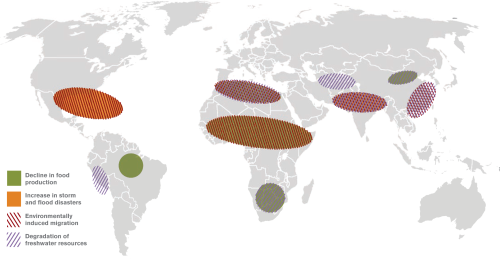
Agricultural factors also became a key driver in the 1994 Rwandan genocide. Soi degradation, population growth, and unequal land distribution transformed the environmental crisis in Rwanda into a nationwide crisis. 3
Many Pacific coastal cities were founded on the estuaries of large rivers. As a consequence, at least eight of the twenty-one argest cities on the Pacific Rim have experienced marked subsidence in the twentieth century, including Tianjin, Shanghai, Osaka, Tokyo, Manila, Jakarta, and Los Angeles. Worldwide, more than 1 50 regions are at risk from flooding, and in China S alone the estimated number of affected cities and districts is 45, accordinq to the German Advisory Council.
Extreme weather events affect millions of Bangladeshis each year, and since 1960, about 600,000 people have died due to cyclones, storm surges, and floods. 5 Even without natural disasters, Bangladesh has a lot to worry about. The impacts of projected sea-level rise could threaten the entire economy and exacerbate insecurity. A 1-meter increase in sea-level could inundate about 1 7 percent of Bangladesh and displace some 40 million people. The intrusion of salty seawater would destroy large amounts of agricultural land and decrease agricultural productivity, forcing populations to higher, flood-protected lands.
On several occasions, large-scale migrations have caused violent clashes within Bangladesh and between emigrating Bangladeshi and tribal people in Northern India. 6 The effects of climate change are only likely to increase human insecurity and conflict in Bangladesh, challenging internal social and political stability and undermin-ng young democratic institutions.
Competition for land and water is increas-ng in the Canary Islands and the south of Italy, Spain, Greece, and Turkey. Climate change may further endanger these resources and threaten the tourism sector, the main economic driver in these areas. In Southern Europe, a temperature rise of 2 degrees Celsius might decrease summer water availability by 20-30 percent; a rise of 4 degrees Celsius would decrease availability by 40-50 percent, according to the Stern Review.
As a consequence of these changes, governments may find it increasingly difficult to sustain living standards and provide development opportunities for residents, and compliance toward foreigners may decrease. It is unlikely, however, that climate change alone could cause severe problems; rather it would interact with other forces, such as unemployment, economic recession, and unstable political regimes to cause widespread dissatisfaction and, eventually, human insecurity and social instability.
FOR NOTES, PLEASE SEE P. 60.
JÜRGEN SCHEFFRAN
Supplementary Material
Climate Change 2007: Impacts, Adaptation, and Vulnerability
Supplementary Material
Stern Review: The Economics of Climate Change
Supplementary Material
U.N. Framework Convention on Climate Change: The Bali Action Plan
Footnotes
1.
Climate Change 2007: Summary for Policy Makers. Contribution of Working Group II to the Fourth Assessment Report of the Intergovernmental Panel on Climate Change.
2.
See H. J. Schellnhuber, W. Cramer, N. Naki-cenovic, T. M. L. Wigley, and G. Yohe, eds., Avoiding Dangerous Climate Change (Cambridge: Cambridge University Press, 2006).
3.
Timothy M. Lenton, Hermann Held, Elmar Kriegler, Jim W. Hall, Wolfgang Lucht, Stefan Rahmstorf, Hans Joachim Schellnhuber, “Tipping Elements in the Earth's Climate System,” Proceedings of the National Academy of Sciences, vol. 105, no. 6, pp. 1,786-93 (2008).
4.
R. Schubert et al., Climate Change as a Security Risk (Berlin: German Advisory Council on Global Change WBGU, 2007).
5.
David D. Zhang, Peter Brecke, Harry F. Lee, Yuan-Qing He, Jane Zhang, “Global Climate Change, War, and Population Decline in Recent Human History,” Proceedings of the National Academy of Sciences, vol. 104,19,214-19.
6.
Schubert et al., Climate Change as a Security Risk.
7.
U.N. Development Program, “Fighting Climate Change: Human Solidarity in a Divided World,” 2007.
8.
Commission on Human Security, “Human Security Now,” 2003.
9.
Daniel Deudney, “Environment and Security: Muddled Thinking,” Bulletin of the Atomic Scientists, May/June 1991, pp. 23-28; Lothar Brock, “The Environment and Security: Conceptual and Theoretical Issues,” in Nils Petter Gleditsch, ed., Conflict and the Environment (Dordrecht, The Netherlands: Kluwer Academic Publishers, 1997).
10.
Thomas Homer-Dixon, “On the Threshold: Environmental Changes as Causes of Acute Conflict,” International Security, vol. 16, no. 2, pp. 76-116 (1991).
11.
Seventy-three cases are described in A. Carius, D. Tänzler, and J. Winterstein, World Map of Environmental Conflicts [in German] (Berlin: Adelphi Consult GmbH, 2006).
12.
Partial aspects of the causal relationship between security, conflict, and climate impacts were discussed in the earlier research literature: N. Brown, “Climate, Ecology and International Security,” Survival, vol. 31, no. 6, pp. 519-32 (1989); R. Swart, “Security Risks of Global Environmental Changes,” Global Environmental Change, vol. 6, no. 3, pp. 187-92 (1999); Jürgen Scheffran, “Conflict Potential of Energy-Related Environmental Changes: The Case of Global Warming,” [in German] in Wolfgang Bender, ed., Verantwortbare Energieversorgung für die Zukunft (Darmstadt: Technische Universität Darmstadt, 1997), pp. 179-218; A. Rahman, “Climate Change and Violent Conflicts,” in Mohamed Suliman, ed., Ecology, Politics and Violent Conflict (London: Zed Books, 1999) pp. 181-210; J. Barnett, “Security and Climate Change,” Global Environmental Change, vol. 13, no. 1, pp. 7-17, (2003).
13.
W. Arnell, “Climate Change and Water Resources: A Global Perspective,” in H. J. Schellnhuber et al., Avoiding Dangerous Climate Change, pp. 167-170.
14.
Peter Gleick, “Effects of Climate Change on Shared Fresh Water Resources,” in Irving Mintzer, ed., Confronting Climate Change (Cambridge: Cambridge University Press, 1993) pp. 127-40; Kent Butts, “The Strategic Importance of Water,” Parameters, vol. 27, no. 1, pp. 65-83 (1997); Manas Chatterji, Saul Arlosoroff, Gauri Guha, eds., Conflict Management of Water Resources (Burlington, Vermont: Ashgate Publishing, 2002); Sandra L. Postel, Aaron T. Wolf, “Dehydrating Conflict,” Foreign Policy, September/October 2001, pp. 60-67.
15.
Marc Levy, Catherine Thorkelson et al., “Freshwater Availability Anomalies and Outbreak of Internal War: Results from a Global Spatial Time Series Analysis,” in the proceedings of international workshop “Human Security and Climate Change,” held in Oslo, Norway, June 21-23,2005.
16.
J. Barnett, “Destabilising the Environment-Conflict Thesis,” Review of International Studies, vol. 26, no. 2, pp. 271-88 (2000).
17.
Norman Myers, “Environmental Refugees: A Growing Phenomenon of the 21st Century,” Philosophical Transactions of the Royal Society of London Series B-Biological Sciences, vol. 357, no. 1,420, pp. 609-13.
18.
Kurt M. Campbell et al., The Age of Consequences: The Foreign Policy and National Security Implications of Global Climate Change (Washington, D.C.: Center for Strategic and International Studies, 2007).

20.
Campbell et al., The Age of Consequences.
21.
Schubert et al., Climate Change as a Security Risk.
22.
Mark Sandlow, “The Quest for National Security,” San Francisco Chronicle, September 11, 2005.
23.
Global Climate Change Security Oversight Act, Congressional Record, March 28, 2007 (Senate), pp. S4059-S4061; related is H. R. 1961, sponsored by Massachusetts Democratic Cong. Edward Markey. To date both bills are in the first step of the legislative process.
24.
Dirk Ipsen, Roland Rösch, and Jürgen Scheffran, “Cooperation in Global Climate Policy: Potentialities and Limitations,” Energy Policy, vol. 29, no. 4, pp. 315-26 (2001).