




Abstract
Trapped by a political stalemate, Burma's Rohingya minority live in horrific conditions that are both an indictment of the international community's inability to protect refugees and a recruiting ground for terrorists.
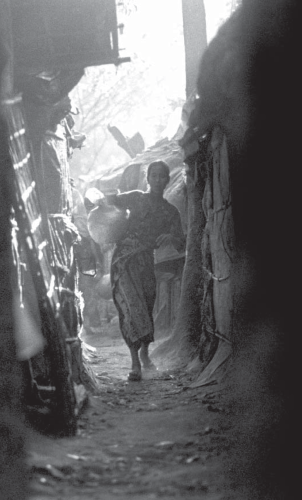
All over Bangladesh, road-side buildings are being razed and pavement shacks cleared away. At the beginning of 2007, the government I began reclaiming land from illegal encroachers who had built too close to the road. By early March, this official order hit hard in the southern end of the country, where a group of unrecognized Burmese refugees, whose huts line the main highway, have been given 24 hours to move. The problem is they have nowhere to go.
As I watch the refugees dismantle their shelters, a woman starts yelling at me: “My house is being torn down! What should I do?”
“I'm sorry,” I say. “You're sorry?” she screams, her face close-up against mine. “I have nothing to feed my children today. I have nowhere to sleep tonight, and you're sorry …?” She glares at me for a moment and then strides away toward the tangled debris that once housed her family.
Ask any aid worker in Bangladesh about the Rohingya refugee camps, and they will all agree on one point: These are the worst camps they have ever seen, temporary home to some 36,000 Muslims who have fled human-rights abuses and religious persecution in military-ruled Burma (Myanmar). Trapped by a political stalemate over their future, the Rohingya live in conditions that are both a powerful indictment of the international community's inability to protect refugees and a potential recruiting ground for global terrorists.
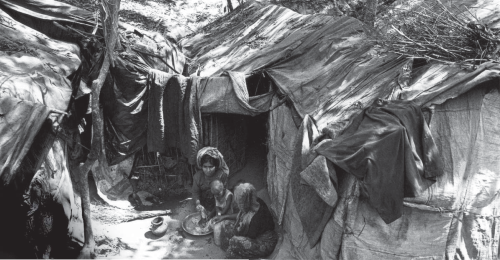
A group of as many as 10,000 Rohingya has been herded into a makeshift, unofficial camp on a 30-meterwide plot of land between a busy highway and the muddy banks of the Naf River, which divides Bangladesh and Burma. It is a fetid hovel of shacks built so close together that the spaces between them are barely wide enough to walk through. Hoards of ragged children stampede along the dirt pathways playing with bits of rubbish–an empty cigarette packet, a condom blown up like a balloon. The refugees living here survive hand-to-mouth. Some men find day-labor jobs at the river's port. Others risk beatings and jail sentences to forage for firewood in the forest. Women go to the nearby town of Teknaf to beg.
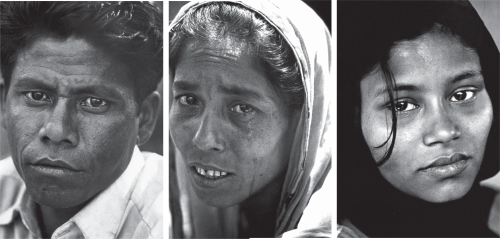
Profiles in despair: Rohingya refugees at Dum Dum Meah, an unofficial camp in Bangladesh. In early March 2007, government authorities ordered the refugees to destroy homes that were too close to the road. There are an estimated 26,000 Rohingya refugees in camps in Bangladesh
Now, because of the latest government decree, the shacks nearest to the road must be torn down; some 200 households are forced to move. Weary-looking families sit by the roadside guarding their measly belongings–a blackened cooking pot or two, a sack of rags (clothes or blankets, it's hard to tell), and the folded scraps of tarpaulin with which they built their shelters. As I walk along the edge of the road, I hear the same words spoken over and over again: Where will we go? There is nowhere left for us to go.
The story of the Rohingya's seemingly endless search for a home has an epic, almost biblical quality to it. The Rohingya live mostly in Arakan (Rakhine) State in northwestern Burma and trace their ancestry back to ninth-century Arab traders who settled there. The current regime in Burma, however, does not recognize the Rohingya as one of the country's 135 indigenous races. In 1978, some 200,000 Rohingya arrived in Bangladesh, fleeing a military crackdown. They were repatriated only to return to Bangladesh again, in even larger numbers, in the 1990s. By mid-1992, more than 250,000 Rohingya refugees had arrived, bringing with them accounts of forced labor, rape, torture, and summary executions at the hands of the Burmese army.
The Rohingya were not allowed to stay long in Bangladesh. By 1996, the majority of refugees had again been repatriated to Burma. Today, only two official camps remain, housing some 26,000 refugees. The additional 10,000 living in the makeshift camp are Rohingya who arrived after the government's cutoff date for refugee registration in 1992 and are therefore not eligible for refugee status or any kind of protection.
Though refugees in the official camps are entitled to assistance from the United Nations and nongovernmental organizations, their existence is still precarious. “The conditions are absolutely atrocious,” a program officer for the World Food Program told me. “I've spent a lot of time in camps in Africa, and if a camp had been there for 15 years it would be functioning as a village, with its own economy and community. The people in these camps have been here 15 years, but it looks like they just arrived.”
Wary of bad press, the Bangladeshi authorities do not often allow foreign journalists into the official camps. A contact in the Rohingya community arranged for a camp resident to sneak out and meet with me. Ibrahim (not his real name) is 33 years old and has been living in the camps since he fled Burma at the age of 18. He describes a prison-like atmosphere where corrupt authorities withhold food rations and require bribes for basic services, such as access to medical care. It is his three children that Ibrahim worries for most. Camp schools provide only a rudimentary version of primary education. “It is very hard for us to keep our children occupied and happy,” he says. “What can they do? There is nowhere for them to play and nothing for them to learn. They have no future.”
Without access to formal education, many disenfranchised young Rohingya are turning to the local madrassas mushrooming throughout the region, raising concerns that they may become easy recruits for militant Islamist groups. During the early 1990s, Jamaat-e-Islami, a powerful fundamentalist Islamist political party, developed a strong support base among the refugees. And Thailand-based Burma expert Bertil Lintner has cataloged how Rohingya men were sent to fight for Al Qaeda in Afghanistan after being recruited by Harkat-ul-Jihad-al-Islami, a militant group allied with Jamaat-e-Islami that dubs itself the “Bangladeshi Taliban” and was formed with financial support from Osama bin Laden.
In the context of global terrorism, the deprivations of these people may not be as remote and faraway as they seem. I met an 18-year-old Rohingya refugee in the makeshift camp who told me his dream was to become a driver for the commuter buses he sees barreling along the highway each day. It is an impossible dream; to get a license he would need a Bangladeshi identity card. Despite his illiteracy, he has a poetic way of describing his predicament: “We Rohingya are like orchids,” he explains. “We are not able to grow any roots in the ground, so we are left with only one way to stay alive, and that is to cling on to others.”
Bangladesh is not a signatory to the 1951 Refugee Convention Relating to the Status of Refugees, which severely curtails the ability of the U.N. High Commissioner for Refugees (UNHCR) to ameliorate the situation. “UNHCR is often viewed as an omnipotent force that can make things happen, but we are not,” says Pia Prytz Phiri, the UNHCR representative in Bangladesh. “The government has not wanted to provide any standard within the camps that would make it look like the refugees should stay in Bangladesh.” In recent months, the government belatedly has begun cooperating on several projects, including improved medical care, building shelters, and providing literacy training–although UNHCR says the camps are still not up to international standards.
Work for hire: Outside the Dum Dum Meah camp, Rohingya refugees wait to be taken to work. Many of the men are exploited as cheap (and illegal) labor by local contractors.
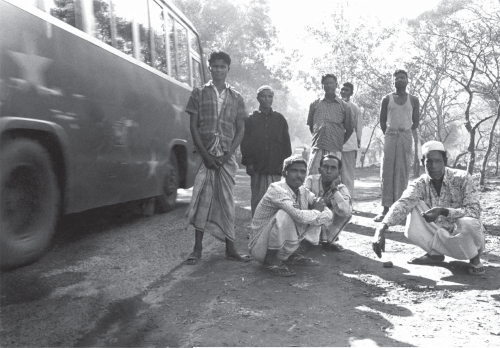
Surviving in squalor: In the Dum Dum Meah camp, some 6,000 Rohingya refugees squat beside the road in some of the worst conditions of any refugees in the world. The situation only deteriorates during the monsoon season when the Naff River floods its banks—and the shacks that lie between the road and the river.
From the Bangladeshi government's point of view, the refugees are occupying space and consuming resources in an already overcrowded and very poor area of the country. The government would like to see the remaining refugees repatriated to Burma, but past efforts have a checkered history. According to a Medecins Sans Frontieres survey, 63 percent of refugees repatriated during the 1990s did not want to return. One Rohingya man I spoke with told me he had been repatriated at gunpoint. After he arrived in Burma he was imprisoned and tortured and, inevitably, he fled back to Bangladesh, where he now lives in the makeshift camp.
The Bangladeshi government has also called for Western countries to offer the refugees resettlement in a third country. So far, only Canada has stepped forward, accepting 22 refugees last year and a further 80 this year. Tun Nyo, a UNHCR community services assistant, already sees a ripple effect throughout the camps as the refugees strive to tailor themselves to be the type of people they think Canada wants. The Rohingya have “started to learn English, even the adults started going to school,” she tells the UNHCR news service. “Domestic violence has been reduced, as have early marriages.” Still, resettlement is happening in such small numbers that it is not a viable solution, says Francis Teoh, UNHCR's deputy representative in Bangladesh: “While resettlement is a tool of protection, it is not a right of the refugees, and the prerogative lies with the generosity of resettlement countries.”
Nurul Islam, the London-based president of the Arakan Rohingya National Organization, believes that the only long-term answer lies in Burma. “Unless the root of this problem is solved it will continue to be a cyclical matter, and it will happen again and again,” he says. “The Rohingya must be accepted as indigenous people of Arakan and their rights and freedom must be assured.”
Largely ignored by the international community, denied a home in Burma and a refuge in Bangladesh, the Rohingya refugees are, for the moment, utterly helpless. Nurul Islam sums up their plight with a sad laugh: “We have no friends,” he says, “no friends at all.”
Supplementary Material
WFP/UNHCR: Report of the Joint Assessment Mission
Supplementary Material
Bangladesh: Analysis of Gaps in the Protection of Rohingya Refugees
Supplementary Material
Refugee Consultations: Bangladesh