




Abstract
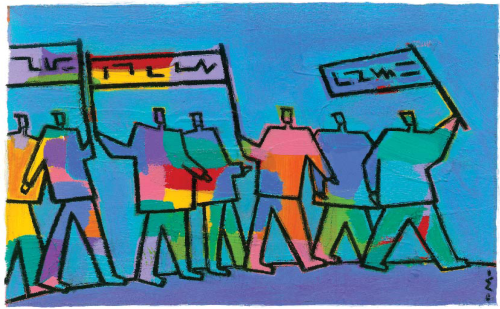
During the 1980s, a grass roots movement against nuclear weapons filled city streets worldwide with protesters. Today, the drumbeat for disarmament is growing loud again. Our experts debate whether we are witnessing a reemergence of the anti-nuclear weapons movement.
STRUGGLE THAT NEVER CEASED
Although the nuclear disarmament movement has been in the doldrums since the end of the Cold War, in recent years there have been signs of a modest revival.
Of course, even in the intervening period, the struggle against the Bomb never disappeared. Around the world, peace and disarmament organizations continued to assail nuclear weapons; however, such efforts failed to spark broad-based antinuclear activism.
But thanks to the recent erosion of the global nuclear arms control regime and to the Bush administration's undisguised contempt for arms control and disarmament treaties, popular participation in disarmament ventures has begun to grow.
On May 1, 2005, the day before the Nuclear Non-Proliferation Treaty Review Conference began at the United Nations, thousands of demonstrators marched through Manhattan, demanding a nuclear-weapon-free world. Less dramatically, U.S. peace groups such as Peace Action, Physicians for Social Responsibility, Women's Action for New Directions, the Council for a Livable World, and the Friends Committee on National Legislation mobilized substantial grass roots pressure against the Bush administration's proposals for nuclear “bunker-busters” and “mini-nukes,” playing a key role in their congressional defeat.
Student antinuclear activism also appears to be undergoing a renaissance. In May 2007, student hunger strikes and demonstrations broke out on three campuses of the University of California in protest against the university's involvement in U.S. nuclear weapons programs. Pressing the issue, students disrupted the university's board of regents meeting on May 18, departing only when tied up and removed by police.
Admittedly, none of this agitation is comparable to the outpouring of antinuclear protest during the 1980s. But it does indicate the possibility for a dramatic upswing in antinuclear weapon activism, especially if there is a breakdown of the nuclear arms control and disarmament regime or a heightened prospect of nuclear war.
A NEW CONSENSUS
The most significant gain in 2007 for antinuclear work took place days after the New Year, when a Wall Street Journal oped, entitled “A World Free of Nuclear Weapons,” surprised the nation. Endorsed by eminent national security experts, including former secretaries of state George Shultz and Henry Kissinger, former Georgia Democratic Sen. Sam Nunn, and former Defense Secretary William Perry, the statement grew out of a consultation commemorating the twentieth anniversary of the 1986 Reykjavik summit, in which Ronald Reagan and Mikhail Gorbachev nearly agreed to eliminate their nuclear arsenals.
Increased support for a nuclear-weapon-free world changed the dynamics on Capitol Hill this year, where the Bush administration has been hard-pressed to find support for the Reliable Replacement Warhead Program. The House zeroed out all funding for the production of new warheads, calling instead for the creation of a yearlong, bipartisan commission to reevaluate the U.S. strategic nuclear posture.
With such politically diverse people and groups working toward the shared goal of a nuclear-weapon-free world, we have a new opportunity to reach out to conservative Americans eager to embrace Reagan's legacy.
ROAD TO VICTORY
There has been a fierce antinuclear uprising in Britain over the past year. Campaign for Nuclear Disarmament (CND), together with other peace organizations, has built Britain's broadest ever alliance against nuclear weapons. We built this alliance in opposition to our government's plans to pursue a replacement for Britain's Trident nuclear weapons system.
But this parliamentary opposition is just the tip of the iceberg of wider public opposition. Last summer, CND commissioned a public opinion poll showing that 59 percent were opposed to replacing Trident, knowing how much it will cost. Just days before the parliamentary vote, a further poll commissioned by a major TV channel found that 72 percent didn't think the government should go ahead with this decision now.
Today, many believe that possessing nuclear weapons puts us in more danger, not less. They agree with former U.N. Secretary-General Kofi Annan who said that if we maintain that we need nuclear weapons for our security then others will come to the same conclusion.
Just three weeks before the Trident vote, nearly 100,000 people demonstrated in the streets of London. On the day of the vote, there were protests in London and around the country, which utilized all the creativity of the peace movement. This is a real and growing protest about legality and morality, about Britain's resources, its double standards, and its role in the world. The movement is pushing forward, and we see the opposition it inspired as a step on the road to eventual victory.
ROOT CAUSES
There is a resurgence of nuclear disarmament activity. In recent years we have also seen a movement to establish a Department of Peace, which offers a new approach to ending the possibility of nuclear war. It would address violence at its roots, strengthening practical and effective means of nonviolent foreign relations at a federal level. The U.S. Department of Peace has been proposed by legislation in the House (H.R. 808) that is cosponsored by 67 members of Congress. As currently outlined in H.R. 808, the Department of Peace will feature an Office of Arms Control and Disarmament.
The U.S. Department of Peace campaign is active across the country and spans generations. The youth campaign formed in March 2006 is active on 30 campuses, and the Student Peace Alliance will host its first national conference in October. The legislation has been endorsed by 20 city councils across the country, including Detroit, Atlanta, San Francisco, and Chicago.
This effort is focused on creating the infrastructure necessary to encourage and support the growth of peaceful cultures. Nowhere in the U.S. government is there a platform from which to launch such a focused, strategic approach to reducing and preventing violence. The time has come for a fresh approach, and a movement has been born to make this vision a reality.
THE ONGOING ROUNDTABLE DISCUSSION FROM WHICH THIS BRIEFING WAS DRAWN IS AVAILABLE AT THE BULLETIN ONLINE (THEBULLETIN.ORG).
Supplementary Material
2005 Review Conference of the Parties to the Treaty on the Non-Proliferation of Nuclear Weapons: Final Document
Supplementary Material
House Resolution 808: To Establish a Department of Peace and Nonviolence