




Abstract

Congress is weighing several significant questions related to nuclear weapons that could emerge during the 2008 presidential campaign. These questions include the current and future size of the U.S. nuclear arsenal; the status of the Stockpile Stewardship Program; and whether there is a need for new warheads and a production complex to manufacture them. Although secrecy shrouds details on these issues, some pertinent facts and estimates can contribute to an informed discussion.
The stockpile's total firepower peaked in 1960 at just over 20,491 megatons, according to the Energy Department, equivalent to 20 billion tons of TNT, or enough for 1.36 million detonations the size of the one exploded over Hiroshima. From the late 1940s to the mid-1960s, the predominant strategic weapon delivery system was the heavy bomber, with more than 1,600 B-47, B-58, and B-52 aircraft allocated some 3,000 bombs, most of them with multimegaton yields. But as intercontinental ballistic missiles (ICBMs) and submarine-launched ballistic missiles (SLBMs) were deployed, the number of bombers and bombs declined, with a corresponding drop in megatonnage. As missile accuracy increased, lower-yield warheads replaced higher-yield versions, contributing to the downward trend.
We estimate that from 1945 to 1990 the United States produced approximately 70,000 nuclear weapons of some 75 types for more than 120 weapon systems. Today's stockpile contains about 2,400 megatons, a little more than one-tenth the 1960 level, but still equivalent to 159,000 Hiroshimas.
There are three categories of stockpiled warheads: active deployed, responsive, and inactive. Active deployed warheads are those on or associated with fielded systems such as ICBMs, SLBMs, bombers, and fighter-bombers. The responsive category includes spares and what have been referred to as “active non-deployed” warheads, which can be deployed quickly. All active and responsive warheads contain limited-life components such as tritium and are maintained through regular surveillance schedules. Inactive warheads are intact but have had limited-life components removed, thus making it harder to return them to service.
THE U.S. NUCLEAR ARSENAL, 2007 AND 2012
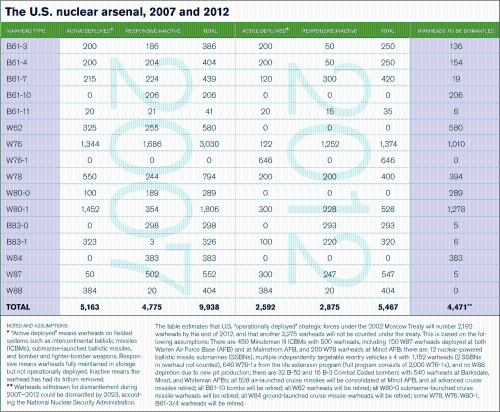
NOTES AND ASSUMPTIONS
“Active deployed” means warheads on fi elded systems such as intercontinental ballistic missiles (ICBMs), submarine-launched ballistic missiles, and bomber and fi ghter-bomber weapons. Responsive means warheads fully maintained in storage but not operationally deployed. Inactive means the warhead has had its tritium removed.
Warheads withdrawn for dismantlement during 20072012 could be dismantled by 2023, according the National Nuclear Security Administration.
The table estimates that U.S. “operationally deployed” strategic forces under the 2002 Moscow Treaty will number 2,192 warheads by the end of 2012, and that another 3,275 warheads will not be counted under the treaty. This is based on the following assumptions: There are 450 Minuteman III ICBMs with 500 warheads, including 150 W87 warheads deployed at both Warren Air Force Base (AFB) and at Malmstrom AFB, and 200 W78 warheads at Minot AFB; there are 12 nuclear-powered ballistic missile submarines (SSBNs), multiple independently targetable reentry vehicles 4 with 1,152 warheads (2 SSBNs in overhaul not counted), 646 W76-1s from the life extension program (full program consists of 2,000 W76-1s), and no W88 depletion due to new pit production; there are 32 B-52 and 16 B-2 Combat Coded bombers with 540 warheads at Barksdale, Minot, and Whiteman AFBs; all 528 air-launched cruise missiles will be consolidated at Minot AFB, and all advanced cruise missiles retired; all B61-10 bombs will be retired; all W62 warheads will be retired; all W80-0 submarine-launched cruise missile warheads will be retired; all W84 ground-launched cruise missile warheads will be retired; some W78, W76, W80-1, B61-3/4 warheads will be retired.
The warheads removed from the stockpile are retired and eventually dismantled. Retired warheads stored in weapons bunkers at military bases are under Defense Department custody until they are handed over to Energy and sent to the Pantex Plant outside of Amarillo, Texas, for dismantlement. (Thermonuclear secondaries are sent from Pantex to the Y-12 plant in Oak Ridge, Tennessee, for storage or dismantlement.) Approximately 4,500 warheads are scheduled to be retired by 2012.
In March 2006, Energy's National Nuclear Security Administration (NNSA) sent Congress its plan for accelerating the dismantlement rate. From a baseline figure, the goal was to increase the rate by 25 percent per year. While we do not know the baseline figure, it is probably in the 100-200 per year range, given the last known projections. In June 2007, the NNSA announced that it was speeding up warhead dismantlements by more than 50 percent for fiscal 2007, that it had met that goal four months early, and that by the end of the year it might be double. 1 By our calculations, this could mean that as many as 200-400 warheads will be dismantled by September 30, 2007, the end of the fiscal year.
These are encouraging figures especially if they can be sustained in tackling the 4,500 warheads scheduled for retirement. To better gauge whether this acceleration serves Energy's avowed purpose of “ensuring that the weapons can no longer be used,” and to show that “this country is serious about nonproliferation,” as Energy has proclaimed, the department should return to its policy of transparency, announcing annual dismantlement figures as it did in the past. 2
Dismantlement has not been Pan-tex's top priority. As Energy has acknowledged, it considered extending the lives of active warheads and the ongoing surveillance of the stockpile more important. The resources at Pantex are limited, and it will be interesting to see if the accelerated dismantlement rates can be sustained once W76 and B61 life extension programs (LEPs) get fully under way. The House Armed Services Committee has demanded a report with current plans and schedules as well as an assessment of the capacity of the Pantex and Y-12 plants to accommodate accelerated dismantlement. 3
Determining the age of each warhead type is tricky. Manufacturing hundreds or thousands of a new warhead type normally took place over a span of years. It took almost 10 years, 1978-1987, to produce 3,250 W76 warheads for the Trident missile system. Current plans call for retaining about 2,000 W76s, modifying them, extending their service lives, and improving their military capabilities. Sometimes older weapons are modified by adding new components, as when about 48 B61-7 bombs were converted into B61-11 earth-penetrating bombs by adding, among other elements, 450 pounds of steel to the front end. The thermonuclear secondaries, manufactured from 1969 to 1971, were retained. The B61-7 itself is a modified B61-1 that was converted between 1985 and 1990. How old thenistheB61-ll?
These extensive and expensive LEPs address the problems of warhead aging by replacing certain components, often enhancing the weapons' military capabilities; LEPs have been implemented or are scheduled for every warhead type that will be retained in the stockpile. As to the issue of plutonium and pit aging, the independent Jason group recently concluded that “primaries of most weapons system types in the stockpile have credible minimum lifetimes in excess of 100 years and that the intrinsic lifetime of [plutonium] in the pits is greater than a century.” 4 In other words, existing long-lived nuclear components can be recycled and “new” weapons built around them.
Throughout the fiscal 2008 budget process, Congress was skeptical of the Reliable Replacement Warhead (RRW) Program, which the Bush administration has promoted as a more reliable, proliferation-proof option, and some committees cut funding for RRW dramatically. 6 They felt that it is premature to rush forward with a new warhead design and a production complex before basic questions are answered. Such questions include how many bombs will be built, and more fundamentally, what the role of nuclear weapons in U.S. security policy is to be. In part to address these issues, the Senate Armed Services Committee directed Defense and Energy to submit a new Nuclear Posture Review (NPR) to Congress in December 2009. The committee advised: “The new NPR would include a review of policy objectives with respect to nuclear forces and weapons and include the relationship among United States nuclear deterrence policy, targeting strategy, and arms control objectives.” 7
The House Armed Services Committee also took action after declaring that “clear policy objectives should be established before Congress commits to ambitious new programs.” 8 The committee demanded a report from a Commission on the Strategic Posture of the United States, which will be created to deal with basic policy questions. The congressionally appointed bipartisan commission will examine the role of deterrence in the twenty-first century, assess the role of nuclear weapons in U.S. national security policy, and make recommendations on the most appropriate U.S. strategic posture.
Supplementary Material
Pit Lifetime
Footnotes
1.
National Nuclear Security Administration, Energy Department, “Dismantlements of Nuclear Weapons Jump 50 Percent,” Press Release, June 7, 2007.
2.
Ibid.
3.
House Armed Services Committee (HASC), “National Defense Authorization Act for Fiscal Year 2008 to Accompany H.R. 1585,” Report 110-146, 110th Cong., 1st sess., May 11, 2007, p. 539 (Section 3113).

5.
6.
For a discussion of the Reliable Replacement Warhead, see July/August 2007 Bulletin, pp. 30^19; Nuclear Weapons Complex Assessment Committee, The United States Nuclear Weapons Program: The Role of the Reliable Replacement Warhead (Washington, D.C.: AAAS, 2007); Jonathan Medalia, “The Reliable Replacement Warhead Program: Background and Current Developments,” Congressional Research Service Issue Brief RL 32929, May 11, 2007.
7.
Senate Armed Services Committee, “National Defense Authorization Act for Fiscal Year 2008,” Report 110-77, 110th Cong., 1st sess., June 5, 2007, p. 395 (Section 1061).
8.
HASC, Report 110-146, p. 390 (Section 1046).