




Abstract
“Atmospheric Effects and Societal Consequences of Regional Scale Nuclear Conflicts and Acts of Individual Nuclear Terrorism,” by Owen B. Toon, Richard P. Turco, Alan Robock, Charles Bardeen, Luke Oman, and Georgiy L. Stenchikov. Atmospheric Chemistry and Physics Discussions, November 22, 2006.
“Climatic Consequences of Regional Nuclear Conflicts,” by Alan Robock, Luke Oman, Georgiy L Stenchikov, Owen B. Toon, Charles Bardeen, and Richard P. Turco. Atmospheric Chemistry and Physics Discussions, November 22, 2006.
Physicist Brian Toon's recent work on the global effects of regional nuclear wars began a few years ago, when a reporter asked him about the consequences of a nuclear exchange between India and Pakistan. “My answer was that a lot of people would die in India and Pakistan, there would be radiation falling on China and Vietnam, but we in the West wouldn't feel any effects because I expected all the radiation would be gone by the time it got to us,” says Toon, director of the Department of Atmospheric and Oceanic Sciences at the University of Colorado at Boulder. “And I didn't expect any climate impact.”
But that answer, based on intuition rather than analysis, started grating on him. He found that little work had been done on the effects of a nuclear war in South Asia except for casualty estimates. He talked about the issue with his UCLA colleague Richard Turco, one of several scientists with whom he participated in 1983 (and again in 1990) on the groundbreaking “nuclear winter” study that postulated the catastrophic climatic effects that would accompany the enormous quantities of smoke generated by a full-scale war between the United States and Soviet Union. The scenario of a world cut off from sunlight–prompting a severe temperature drop on Earth's surface–galvanized the attention of both the general public and policy makers. As an article in the Summer 1985 edition of the Washington Quarterly noted, “The climatic consequences of such a conflict would appear to afford no sanctuary…. A superpower could not isolate itself from the effects of its own weapons.” So when Toon broached the subject of studying the effects of a regional nuclear war, which is more likely to occur in this political climate, Turco was intrigued.
Then, about two years ago, Toon “did some crude estimates of the casualties by using a very low-resolution population database and looked at the smoke that would be generated and decided these are pretty big numbers,” he recalls. Toon prepared a rough draft that he shared with Turco and asked a third colleague, Alan Robock, a professor of meteorology at Rutgers University, to model the climate response.
Their efforts resulted in two dramatic companion studies published last November that deserve, at the very least, to stimulate serious debate and add to the discussion about the implications of nuclear proliferation. One of the studies' major conclusions is that, due to the growth of “megacities” in developing countries, a regional nuclear war involving the explosion of 100 15-kiloton, or Hiroshima-sized, bombs “could produce direct fatalities comparable to all of those worldwide in World War II [about 62 million] or to those once estimated for a ‘counterforce’ nuclear war between the superpowers.”
The researchers also concluded that the urban firestorms caused by a 100-weapon regional nuclear war would cause smoke to rise into the upper troposphere, the region of the atmosphere extending from Earth's surface up to 8-16 kilometers (5-10 miles), depending on location. “The smoke would subsequently rise deep into the stratosphere [up to 50 kilometers, or 31 miles] due to atmospheric heating, and then might induce significant climatic anomalies on global scales,” they found. Some smoke could remain in the stratosphere for 10 years and affect agricultural production worldwide.
Interestingly, that significant, long-lasting cooling effect on the climate was found by Robock and his associates by running the same state-of-the-art general circulation model–ModelE from the NASA Goddard Institute for Space Studies–used in some calculations of global warming by the Intergovernmental Panel on Climate Change. Using this model, Robock and his associates took smoke estimates calculated by Toon and Turco using various scenarios of the number of nuclear weapons fired and targets hit and plugged an estimate into the computer model.
“We took 5 teragrams [5 million metric tons] of smoke, put it over India and Pakistan, and calculated the climate response,” Robock says, noting that the new model is vastly more sophisticated than the ones used in the 1980s to calculate the “nuclear winter” effects. For one thing, ModelE is an atmospheric and ocean general circulation model, so that the oceans–with their huge heat capacity that can moderate the climate–were examined on a prolonged timescale. For another, the model goes up to 80 kilometers (50 miles) and, thus, includes effects in the entire stratosphere and meso-sphere. “Previous models went up to 20 or 30 kilometers [12 or 19 miles]. So smoke would be heated and locked in there–it would hit the lid of the model and not go anywhere,” Robock says, adding that fast modern computers allowed the researchers to do 10-year simulations. “What was really new from our results is that the smoke would get heated and lofted into the upper stratosphere and last much longer than anyone thought before.”
The smoke particles and what happens to them is the key to the global cooling that would be caused by a regional nuclear war. And Toon acknowledges the uncertainties in any prediction. One issue involves how high the smoke plume from the urban fires will rise. Another question is how much will get rained out. Toon says that his group's best guess is that 20 percent will be washed away and that current models can't provide more precision. Another critical issue is how much fuel would be burned in cities hit with nuclear weapons. “In my mind the biggest uncertainty, however, is what kind of war would be fought,” Toon says. “How many weapons would be used, how big would they be? That's unanswerable.”
That issue was highlighted in a critique from an anonymous reviewer at the online discussion site of Atmospheric Chemistry and Physics Discussions, where the two papers were published. “Assessing the impact of a ‘generic’ nuclear war–or of a random terrorist strike–is practically impossible, given the range of conditions under which it might arise (even more so factoring in the uncertain meteorological conditions),” the reviewer wrote. “This paper attempts to do it anyway, and the result is numerous ad hoc assumptions which are unlikely to be realized in any particular situation.”
Asked about this critique, Toon says, “Since we don't know what would happen, there are things that are possible and one should assess what the consequences of those things are. Just because somebody wants to argue about how nuclear weapons might be used, doesn't mean that they won't be used in this particular choice of ways, which is a perfectly rational way to use them.”
A major goal of Toon and his coauthors is to raise awareness. “My hope is that the worldwide science community will renew its studies in this area and will debate the consequences of regional wars and will tell their politicians what the consequences of nuclear proliferation are,” Toon says. Their message today resonates as much as it did during the Cold War: No nation can hope to isolate itself from the consequences of using nuclear weapons.
JOURNAL ROUND-UP
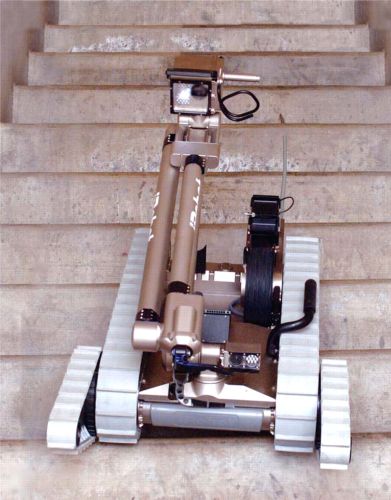
Made to order: A prototype military robot.
Ghosts in the machine
If a robot commits a war crime, who would be put on trial? That ethical dilemma might come sooner than we think, given the military's growing interest in autonomous weapons systems and artificial intelligence. In the
Who should be held responsible? Not the computer programmers, since the very nature of an autonomous system absolves them of personal responsibility, much in the same way parents cannot be held culpable for the actions of children no longer under their care. Then, what about the commanding officer who ordered the deployment of the weapon? Again, the answer is no, since “the autonomy of the machine implies that its orders do not determine … its actions.”
A necessary condition for fighting a just war is that someone can be held responsible for unjust deaths that occur during conflict. As such, Sparrow concludes it would be completely unethical to deploy autonomous weapons systems in warfare. To contemplate otherwise would be inhuman.