




Abstract
Armed with new leadership, the storied Nevada Test Site is ready for a host of new challenges-even a resumption of nuclear testing.
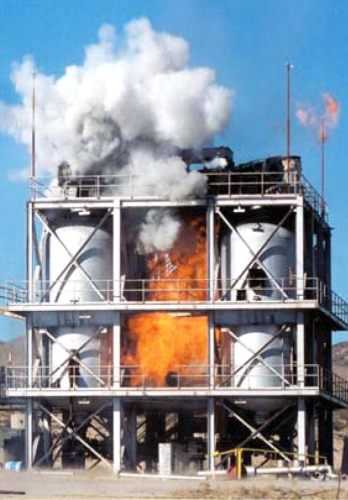
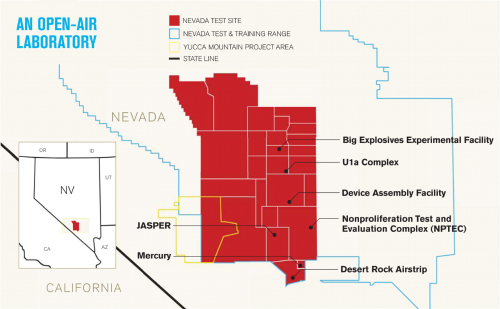
Stephen Younger spends most of his days in the desolate, rugged landscape of southern Nevada, far removed from the political hubbub of Washington and the scrutiny he experienced while directing nuclear weapons work at Los Alamos National Laboratory. In the summer of 2006, Younger and a team of contractors won the five-year, $2.5-billion contract to manage the Nevada Test Site, a 1,375-square-mile, open-air laboratory set aside for nuclear weapons testing more than 50 years ago. “We've all had bigger jobs,” he humbly says of his new position as operations manager.
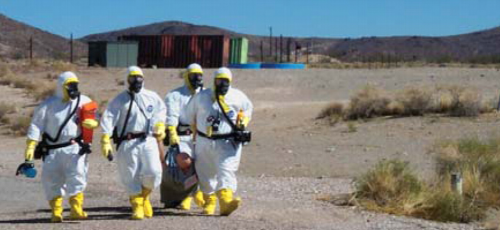
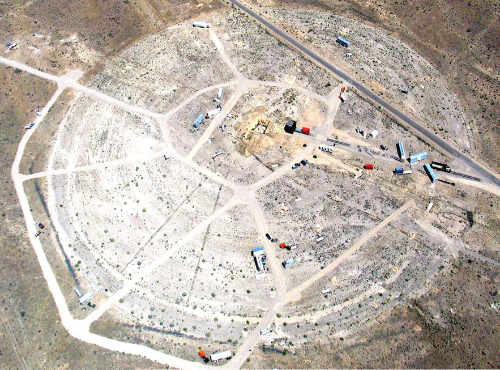
Bomb-scape: Test site officials transformed the location of several atmospheric nuclear tests (above) into a counterterrorism training ground. The unique backdrop allows responders to train in a “radiologically contaminated environment,” according to Energy. Counterterrorism exercises (opposite) constitute a significant part of the test site's current activity
Younger's long career in the upper echelons of the U.S. national security establishment would seem to over-qualify him to manage the test site, once a hotbed of scientific activity that took on a significantly smaller profile during the 1990s under an administration that was “not enamored of the nuclear mission,” according to Younger. The son of a working-class Baltimore family, he studied theoretical physics at The Catholic University of America and the University of Maryland and took a job in 1982 at Lawrence Livermore National Laboratory to design nuclear weapons. He rose to direct the nuclear weapons program at Livermore's sister lab, Los Alamos, and then in 2001 moved to Washington to direct the Defense Threat Reduction Agency (DTRA).
Yet Younger's successful professional career reveals a mere sliver of the self-described “restless intellect” that brought him to Nevada. When he wanted to read 5,000-year-old documents, he learned Sumerian cuneiform to study them without the filter of translation. His everyday reading list favors twentieth-century Georgian poetry, the fiction of Graham Greene, and modern Australian literature. In his spare time, he studies computational anthropology, creating simulations of small societies and analyzing what drives the appearance of conflict. “[Humans] have a propensity for violence,” he explains.
The Nevada Test Site lured him with both its vastness and its potential for scientific research, he says.
“We view the test site as a national resource. We can do stuff you can't do anyplace else.” And “we think [the site] can do more,” he says. It's forward thinking from a man who has steered the progress of the nuclear weapons complex and U.S. nuclear strategy–and that's precisely why so many arms-control advocates are worried.
A boom in the desert
U.S. officials began searching for a continental site for nuclear weapons testing in 1948, after conducting a series of nuclear tests at the remote Bikini and Enewetak atolls. They wanted a secure, easily accessible location where they could perform tests more cheaply than in the Pacific Islands. A large tract of remote, U.S. Air Force-owned land 65 miles north of Las Vegas provided the solution. In late 1950, President Harry Truman officially approved the moonscape now known as the Nevada Test Site. During the next 42 years, 100 atmospheric and 828 underground nuclear test explosions shook the Nevada desert.
A large community of scientists, miners, meteorologists, construction workers, and government officials flocked to the growing site in a shroud of secrecy and with a sense of lofty purpose. Each nuclear test was designed to reveal a new mystery. Thousands of people worked for months to retrieve a split second of data before a blast vaporized cables. If all went as planned, the next test could be tweaked accordingly.
Joe Behne, a retired test director who worked at the site for 30 years, remembers how the entire landscape was festooned with drill rigs during periods of testing, a valley of lights stretching from Frenchman Flat to the Yucca Valley. Like many scientists, managers, and policy makers who worked at the site, Behne flew to work on the Lawrence Livermore lab plane on Mondays and returned home on Friday. The town of Mercury was his makeshift haven in the desert, a bustling hub of activity where as many as 10,000 workers found food, water, camaraderie, and a bunk to sleep.
During these years, in addition to weapons testing, the test site hosted a range of scientific experiments, from studies on the health effects of radiation to the geological effects of nuclear explosions. Behne spent his first years at the site working on Project Pluto, an 8-square-mile proving ground on Jackass Flats designed to develop and test nuclear ramjet engines for longdistance missiles. (The engine worked in ground-level tests but never flew or went into production.)
Among the desert sage and Joshua trees, other test-site experiments touched a more human scale. Weapons tests blew apart suburban homes, cars, buses, and forests constructed to test blast and radiation effects. Civil Defense Administration experiments used mannequins to demonstrate the effects of successful and unsuccessful basement bomb shelters. And from 1965 to 1981, in the far northwest corner of the site, the Environmental Protection Agency ran a 36-acre experimental farm to study the effects of radioactive fallout on the food chain. Scientists milked a Holstein cow dairy herd; farmed vegetables; and raised horses, pigs, goats, chickens, and a herd of 100 free-range Hereford beef cattle–four of which had surgical openings on their sides so digested forage from around the Nevada Test Site could be sampled. The experiments and weapons tests at the site exposed participating populations and the public at large to elevated levels of radiation. (For more on the test site's legacy, see “The Damage Done,” p. 62.)
This was the Nevada Test Site's go-go era. The Cold War raged, and funding for nuclear weapons experiments seemed limitless. Physicists and mechanical engineers used the exotic materials that flowed freely at the Nevada Test Site to help build their projects. “We knew what we had to do, and we went out and did it. And we did our job well,” Behne says.
Activity peaked at the Nevada Test Site in 1988, with nearly 10,000 workers on-site. For Nick Aquilina, then Energy's Nevada operations manager, heady times were punctuated that year by joint verification experiments between the United States and the Soviet Union. Aquilina reminisces fondly about the good-natured exchanges with longtime enemies, when Soviets visited the Nevada Test Site to monitor the American Kearsage test shot in August, and Americans visited Kazakhstan's Semipalatinsk Test Site in September to measure the Soviet Shagan test shot. The shared smiles, flag exchanges, and commemorative T-shirts were a preview of warming international relations to come.
That same year, more than 8,000 activists, including movie stars, “downwinders,” atomic veterans, Japanese bombing survivors, religious groups, Native Americans, and Pacific Islanders would come to Peace Camp, the long-standing protest site across the highway from the test site, to demand the end of testing. They would wait four more years to see the fruits of their work.
The Nevada Test Site's primary purpose had always been to test nuclear weapons. “There was pure understanding of the number one priority–the testing. Nothing interfered with that,” explains Aquilina, who retired in 1994. But testing ended on September 23, 1992, with a shot ironically called Divider. President Bill Clinton imposed a moratorium on future nuclear testing, and an evolution at the Nevada Test Site began.
In the following years, Energy began several environmental and alternative-energy research projects at the site and designated 865,000 acres as a National Environmental Research Park. Since 9/11, the test site has also taken on new homeland security missions, serving as a nuclear-response training ground for police and firefighters and as a hazardous-materials spill training center. Although nuclear testing never resumed, the site continues to conduct other experiments and explosives testing. Most recently, DTRA, Younger's former employer, planned to conduct a large, $23-million conventional weapons test, code named Divine Strake, at the site. Divine Strake was officially canceled on February 22 in response to concerns that the massive explosion of 700 tons of fertilizer and fuel would be a precursor to developing low-yield nuclear weapons and, furthermore, would kick up a second-generation mushroom cloud of radioactive debris deposited on the site over the last 50 years.
Complex role
Coming out of the Cold War, the U.S. government reduced the number of warheads in the operational nuclear arsenal. The cessation of nuclear testing meant that Energy had to find a new way to ensure the reliability of the remaining weapons. The Nevada Test Site's role in the Stockpile Stewardship and Management Program, as this caretaker effort was termed, was to maintain the capability to conduct underground nuclear tests and non-nuclear experiments.
These were the test site's dormant years. The national laboratories started testing the fitness of nuclear weapons components using simulations and other means, including a series of “subcritical” plutonium experiments to study the physics of plutonium, the first of which was conducted at the test site in 1997. These complex experiments use laser-driven diagnostics in tunnels deep underground to test radioactive materials, always stopping short of initiating a nuclear chain reaction–all in an effort to ensure that the various parts of the aging nuclear arsenal are viable. Throughout this period, the site maintained the capability to test nuclear weapons within a period of years, should it be asked to do so. “We went into readiness mode,” Aquilina, the former operations manager, says. “Readiness to resume testing.”
Beliefs about the role of the U.S. nuclear stockpile began to shift in 2000, due to the work of the then head of Los Alamos's nuclear weapons program, Stephen Younger. The emergence of new security threats–including the potential proliferation of nuclear weapons in such countries as North Korea and Iran–and advances in precision delivery technology required a wholesale rethinking of the U.S. nuclear posture, Younger reasoned. He laid out his ideas in a paper, “Nuclear Weapons in the Twenty-First Century,” which articulated a set of strategic principles that would begin to appear more frequently in the mainstream.
In the paper, Younger envisioned a larger role for conventional weapons in strategic planning, even fitting them on ballistic missiles, and an increased reliance on precision-guided, low-yield nuclear weapons that could theoretically be tailored to destroy some hardened targets. He also anticipated the advantages of a smaller nuclear complex and “simple, rugged [nuclear weapons] designs that might be maintained with high confidence without testing,” a concept that is making headway today as part of the Reliable Replacement Warhead (RRW) Program. Younger brings “a huge body of experience in nuclear weapons programs, in management with DTRA, and very solid technical abilities” to the test site, according to John Harvey, director of policy planning at the National Nuclear Security Administration, which oversees the nuclear weapons complex.
The release of the 2001 Nuclear Posture Review (NPR) reinforced many of the concepts articulated in “Nuclear Weapons in the Twenty-First Century.” The NPR envisioned a “new triad” of offensive weapons, defensive weapons, and “a defense infrastructure that will provide new capabilities in a timely fashion to meet emerging threats.” This realignment of the U.S. nuclear posture included plans to shorten the period of time it would take officials at the Nevada Test Site to prepare for a nuclear test. The 2002 report of the Panel to Assess the Reliability, Safety, and Security of the United States Nuclear Stockpile reinforced this need, recommending that test readiness take “no more than three months to a year, depending on the type of test.” Congress repeatedly refused to fund this shortened deadline, but arms-control advocates could plainly see the appetite for a renewal of testing. The test site is currently required to be prepared for a full-scale test within 24 months.
THE DAMAGE DONE
Some experiments conducted at the Nevada Test Site have left a dark stain on its legacy. During the early 1950s, Camp Desert Rock was home to the test site's large-scale human experiments. U.S. soldiers stood as close as 2,500 yards from nuclear detonations on Yucca Flat, wearing as little protection as steel helmets and safety goggles, to gauge the effects of radiation and to test the viability of conducting military operations during and after a nuclear exchange.
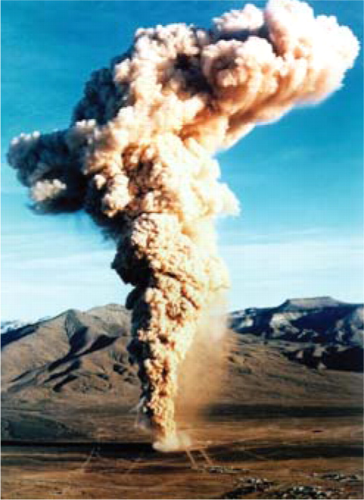
The Baneberry nuclear test.
The exercises exposed personnel to dangerous doses of radiation. At just one of several such tests, more than 300 individuals received doses larger than 3 rem, and 16 people received doses between 3.9 and 6 rem, significantly more exposure than the one-third of a rem the average person receives per year, according to Defense Threat Reduction Agency reports.
The 1970 Baneberry nuclear operation is the underground test that most spectacularly failed to contain its radioactive production. The blast vented 80 kilocuries of radioactive iodine 131 into the atmosphere from the underground test cavern. Wind blew the cloud of highly radioactive dust to an altitude of 10,000 feet, carrying the radionuclides far beyond the test site's boundaries. Although this constituted one of the worst radiation releases from an underground test, the cumulative effect of frequent, atmospheric nuclear tests during the 1950s and 1960s exposed the U.S. public to elevated levels of iodine 131–beyond the average 0.1 rad per year of naturally occurring iodine 131 dosage–with states closer to the test site experiencing greater exposure, according to the National Cancer Institute. Radionuclides released from nuclear tests also contaminated the test site's water supply, though the Energy Department maintains that human-made radionuclides from testing have never been detected in off-site groundwater.
In order to limit the liability of the federal government for the long-term consequences of radiation exposure, Congress passed the Radiation Exposure Compensation Act in 1990. Through the program, the government has paid out over a billion dollars in damages to uranium miners and millers, and those both on- and off-site downwind of atmospheric tests. The exact human toll may never be known.
Some scientists and policy makers continue to reason that nuclear testing may be the only way to ensure the reliability of the current stockpile, not to mention any new nuclear weapons that are developed, such as the RRW. Younger says that he has “100 percent confidence in the stockpile today” but reasons that there's always a concern that you've missed something: “No one has ever tried to maintain such complex instruments in perpetuity without exercising them.” Harvey insists that the RRW Program will not require testing (”if we can't do that, we're not going to field it”) but equivocates in regard to the current arsenal. “We have a huge stockpile out there of legacy warheads that could develop a problem. “We can't rule [testing] out.”
Critics meet such reasoning with skepticism. “ [The RRW] is not going to be reliable without testing, and it's not a replacement,” contends Robert Civiak, a physicist and former policy researcher. He argues that the broad range of new capabilities the weapons labs have proposed for the RRW Program means that there's no way to tell what they can really do. The ultimate decision on whether to test or not before deployment will come six or eight years down the road, he says, when there's no telling who will be making the call. “You're going to have a president with a dilemma,” Civiak explains. “There will be at least some discussion whether to test or not.”
“Testing is a technical decision and a political one,” notes Robert Nelson, a senior scientist with the Union of Concerned Scientists. Nuclear weapons lab scientists don't want to lose their projects or their jobs, and Energy doesn't want to lose its budget, Nelson argues. Younger's leadership of the site only intensifies concerns. Nelson points out that although Younger's title changed when he came to the site, he's still working on a lot of the same projects he did in other labs and agencies. “He's a true Cold “Warrior. He's a believer,” he says.
Younger, for his part, is convinced that the United States could do with a significantly smaller nuclear arsenal, of say 1,700 nuclear weapons, but he doesn't question the conviction that they–and the test site–are essential. “Nuclear for us is a matter of national survival,” he adds. But satisfying the missions currently set out for the U.S. nuclear arsenal or any future configuration might require Energy to test again at the site, arms-control advocates fear. “It's less about what's happening right now,” Nelson says, “than what could happen five or ten years down the road.”
Supplementary Material
Project Nutmeg: The Birth of the Nevada Test Site