



Abstract

SPACE: Out to launch
Kazakhstan hopes to capitalize on its illustrious, fortuitous space history.
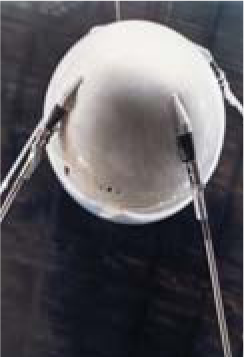
A “Russian-made moon” is how the U.S. media characterized Sputnik in 1957. But the world's first satellite was launched far from Moscow, in the steppes of Kazakhstan. The Central Asian nation of 15 million has a long association with space exploration–hosting the Baikonur cosmodrome that launched legions of space vehicles–but possesses little of the fame and fortune attributed to the Soviet program.
That could soon change.
Kazakhstan hopes to develop its own national space industry and plans to build new launch and tracking facilities at Baikonur and a constellation of Kazakh communication satellites. The motivation is part financial: Improved satellite systems would support economic growth, and as Russia has found, the capability to launch commercial satellites generates income.

There are environmental factors, too. For years, the lower stages of Russian Proton rockets launched from Baikonur have fallen to earth, spilling toxic fuels. To avoid this, Kazakh officials plan to configure the new Baiterek launch complex to launch only Russian-made Angara rockets, whose fuel is more environmentally friendly.
Despite Baikonur's history, Kazakhstan's space play won't have a large effect on the global space industry, which has numerous alternative launch options, according to Jeff Foust, a launch industry analyst at Futron Corporation. That's not stopping Kazakhstan. “Prestige plays a role in a lot of these matters,” Foust says. “That is certainly the case here.”
BAIKONUR SPACE MILESTONES
Cosmonaut
An Indian satellite becomes
The Zarya module,
Kazakh officials plan to build the
JONAS SIEGEL
RE: CONFLICT: A deadly inheritance
Long after the fighting stops, landmines continue to leave a dangerous legacy. Although Angola, Afghanistan, and Cambodia are usually cited as the countries most afflicted by these remnants of war, the fierce, often barbaric fighting between the Russian military and Chechen guerillas has elevated Chechnya to the top of the list. “In the past decade, Chechen rates, especially at the beginning of the second Chech en war, far exceed those of other coun tries,” notes Oleg Bilukha, a medical epidemiologist with the International Emergency and Refugee Health Branch of the Centers for Disease Control and Prevention. Amid the nearly constant warfare, mineclearing and educational programs that work to reduce landmine fatalities have been unable to make an impact. And sadly, landmines usually kill or maim children instead of combatants, the intended target. DANIEL KIMERLING

LANDMINE INJURIES PER 10,000 PEOPLE (2000)

Q+A BARBARA G. GREEN
Reverend Barbara G. Green is the executive director of the Churches' Center for Theology and Public Policy and a senior adviser to the National Religious Partnership on the Nuclear Weapons Danger (Faithful Security). She is coauthor of Lines in the Sand: Justice and the Gulf War (1992).
“Faith is stronger when the other side is there too.”
JOHN REZEK
IN BRIEF
Amid concerns that destroying the remaining known stocks of the smallpox virus could keep scientists from developing defensive measures against bioterrorism, the World Health Organization decided in February to move the actual destruction date back until at least 2010.
EMERGING TECHNOLOGY: The nanosance
Umberto Baldini, the noted Italian art restorer, would usually visit the chemists at the University of Florence in the morning, each time describing a classic Florentine wall painting that needed mending. For instance, smoke from a seventeenth century fire blackened much of Masaccio's frescoes in Florence's Brancacci Chapel and melted the wax from nearby candles, which permeated the wall and threatened the paintings. “Can you remove this wax from the wall?” Baldini would ask.

Such challenges intrigue Piero Baglioni and his colleagues at the university's Center for Colloid and Surface Science (CSGI). Long at the forefront of using chemistry and physics to better preserve cultural artifacts, in recent years they've added a new tool to their restoration processes–nanotechnology.
“Nano is better than classical chemistry because you have complete control over the chemical reactivity of the particle you inject into the works of art or in the system you use to clean a work of art,” says Baglioni, CSGI's director. “It's like you go back in time four centuries and reproduce something very similar to what the artist originally painted.”
Over time, the wall's chemical composition changes–and with it, the way the paint adheres, causing the paint to flake and powder. Using nanoparticles, the scientists recreate the chemical bonds that originally existed between the wall and the paint, which reinforces the painting's pigment. (The cleaning of Masaccio's frescoes in the late 1980s marked the first time nanoparticles were used in conservation science.) “In Florence, you're in an environment where it's difficult not to be interested in art,” Baglioni says. “My official position is in a different field–I mainly work on neutron scattering. But I do these restorations because it's fun.”
JOSH SCHOLLMEYER
POVERTY: Map quest
Hunger is a high-profile issue, but locating the hungry can prove challenging–particularly when influencing factors vary from country to country. To better target resources to alleviate human suffering, Columbia University's Center for International Earth Science Information Network (CIESIN) assembled Where the Poor Are: An Atlas of Poverty, a compendium of detailed maps of impoverished areas around the globe.


For years, global poverty maps lacked subnational data. Researchers were “stuck assigning a single color to an entire country” to denote poverty, says Marc Levy, head of the science applications group at CIESIN. Using survey data from the U.N. Development Programme's Human Development Report Office and high-resolution maps, CIESIN researchers created 21 regional and global maps that correlate poverty to a range of factors, including such variables as topography and proximity to cities.
By presenting their data in intuitive, colorful maps, CIESIN hopes the atlas will help governments and nongovernmental organizations understand the relationship between geography and hunger, which according to Levy will “transform the way people respond to poverty.” CHARLOTTE TOOLAN