




Abstract
“Independent Working Group on Missile Defense, the Space Relationship, and the Twenty-First Century,” Institute for Foreign Policy Analysis, July 2006.
Light show: An artist's conception showing a spacebased laser destroying a target.
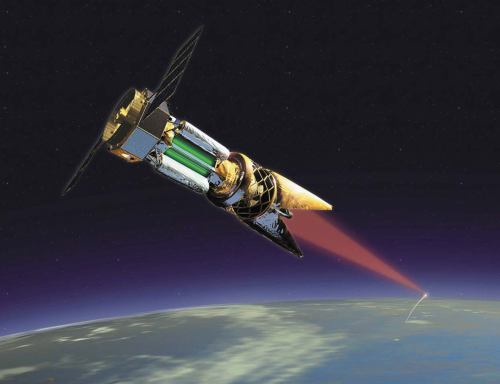
They're baaaack! The crowd that brought us President Ronald Reagan's “Star Wars” fantasy is at it again, with the recent release of a 200-pluspage manifesto advocating an Apollo-style program to deploy legions of missile interceptors in space.
This time, the group is billing itself as the “Independent Working Group on Missile Defense, the Space Relationship, and the Twenty-First Century.” Members include longtime, hard-line Star Warriors such as Lawrence Livermore National Laboratory physicist Lowell Wood, former champion of the infamous orbiting X-ray laser that he claimed could “win” a nuclear conflict by destroying Soviet missiles; William Van Cleave, formerly of the Committee on the Present Danger, which opposed Cold War-era arms control; Henry Cooper, chairman of the missile defense advocacy group High Frontier and former director of the Strategic Defense Initiative Organization under President George H. W. Bush; William Graham, Reagan science adviser and member of the so-called Space Commission, which warned of a potential “space Pearl Harbor”; and Keith Payne, president of the National Institute for Public Policy and an architect of the current Bush administration's doctrine advocating the preemptive use of nuclear weapons.
The report was published by the Institute for Foreign Policy Analysis, and official sponsors include, among others, such well-known conservative think tanks as the Heritage Foundation, High Frontier, the Claremont Institute, and the George C. Marshall Institute.
“Independent Working Group” is, therefore, a bit of a misnomer.
The bulk of the report consists of a call to arms for supporters of space-based interceptors (SBIs), with recommendations on how to massage a political message to gather others to the cause. Written in language so incendiary it should be banned from carry-on luggage, the report lashes out against opponents of the weaponization of space, branding them as a cabal of “arms control extremists, pacifists, realpolitik practitioners, [and] anti-Americanists” bent on “unilateral disarmament” of the United States.
The authors assert that political, rather than technological, reasons are to blame for the fact that the United States does not have a working missile defense network more than two decades (and $100 billion of research and development) after Reagan's 1983 Star Wars speech. They attribute this “failure” to the ghost of the Anti-Ballistic Missile Treaty and lingering support–including within the Missile Defense Agency (MDA)–for the doctrine of mutual assured destruction, which was “shaped by pacifist impulses” and held the American people “hostage” to Soviet missiles during the Cold War. The Clinton administration, the report argues, not only canceled programs that were proving the feasibility of SBI technology, but also conducted a “systematic eradication of space-based technologies” and scientific know-how.
These themes are repeated relentlessly throughout the study. In doing so, the authors distort a complex strategic and technical debate about space-based missile defenses into an ideological battle–much as the Republican Party successfully did with the overarching missile defense debate in the 1990s. The authors leave no room for nuanced argument; it's the Light Side of the Force (the authors and their supporters) against the Dark Side (everyone else).
Written in a language so incendiary it should be banned from carry-on luggage, the report lashes out against opponents of the weaponization of space.
Beneath all the bombast, one of the report's key recommendations is a crash program to revive the Reagan-era “Brilliant Pebbles” program. The study group calls for a test program consisting of 40-120 Brilliant Pebbles–tiny, orbiting missile interceptors–to be built and launched within three years at a purported cost of between $3 billion and $5 billion, and the deployment of 1,000 Brilliant Pebbles by 2010 at a purported cost of $16.4 billion.
The report's technical “analysis” revives the original, spandex-era architecture for the wee interceptors. Each Pebble–“about the size of a traditional South Carolina watermelon” (too risky to use a hefty California watermelon, no doubt) and weighing between 3.1 and 5.1 pounds (1.4 and 2.3 kilograms)–would be housed in a “life jacket” that provides autonomous operations, for a total weight of 99 pounds (45 kilograms), and would orbit at an altitude of about 180 miles (290 kilometers). The report claims that the Pebbles would provide global coverage, be on constant alert, and launch on warning.
Unfortunately, it is impossible to adequately review the feasibility of the study group's proposal, since the report does not provide sufficient details of its technical and cost assumptions. (It is interesting to note, for instance, that the original Brilliant Pebbles concept called for a constellation size of 100,000, was later reduced to 7,000, and now–at a time when supporters claim a growing threat–has been chopped to 1,000.) There isn't even an appendix (in a report boasting a whopping nine appendices) that lays out the supporting technical analysis. Instead, the authors repeatedly assert that the technology has been available since the 1990s, despite the fact that MDA, not exactly famous for a cautious approach to fielding technology, continues to insist that the technology for SBI “is not there.” The authors' commit a high crime of science: They fail to document their work in a manner that would allow for peer review.
Meanwhile, the study group has no compunction against faulting two previous, truly independent reviews of SBI feasibility conducted by the American Physical Society (APS) in 2003 and the Congressional Budget Office (CBO) in 2004. The group accuses both studies of being based on improper assumptions, although the authors again provide no details of what might be mistaken.
That's hardly a trivial oversight, since both the APS and CBO studies arrived at radically different conclusions than those of the study group. The APS review panel, relying on what it admitted were extremely optimistic parameters, estimated that, in a best-case scenario, 1,600 interceptors would be required to protect the continental United States from a single missile launched from Iraq, Iran, or North Korea. Likewise, the CBO put the best-case cost range for development, deployment, and 20-year operations of an SBI constellation capable of defending the continental United States against a single, liquid-fuel missile from North Korea or Iran at anywhere from $27 billion to $78 billion, and from $57 billion to $224 billion for a constellation capable of defending against newer model solid-fuel missiles launched from the same countries. Both reports noted that many additional interceptors would be required, and thus more costs incurred, if the attacking country launched two or more missiles simultaneously.
JOURNAL ROUNDUP
Science is fundamentally flawed, argues Eric Cohen, the editor of the
conservative-leaning science journal New Atlantis, in his essay
“The Ends of Science,” published in the November 2006
His arguments boil down to a set of threatening observations: “The knowledge acquired by scientific methods cannot always justify the particular experiments used to acquire it…. Divine salvation may be an illusion, but so is believing that science can tell us how to live in the world it dissects and describes…. The modern scientific project will always be a failure: Its powers do not satisfy our deepest longings; its victories are always temporary and its losses always final.”
However, Cohen wouldn't obviate scientific institutions or the steady churn of scientific exploration. Rather, he embraces the limitations of the scientific project and the “equanimity that faith often inspires.” “In our hunger for still waters,” he combatively concludes, “nature offers no proof that man's redemptive hopes are justified, but also no proof that everything is hopeless.” Take that, science.
In 2000, World Watch (Worldwatch Institute) touted Iceland as a
hydrogen pioneer with plans to kick its relatively small fossil fuel habit by 2030
or 2040 in favor of clean-burning hydrogen. In the November/December 2006
Securing the world's shipping containers is proving to be a similarly
challenging task, according to a statistical analysis, “Preventing the
Importation of Illicit Nuclear Materials in Shipping Containers,” in the
October 2006
Robert G. O'Hanneson lived through the Cuban Missile Crisis with his
19-year-old finger on the nuclear button. Holed up in missile control facilities on
Okinawa, O'Hanneson received a barrage of teletypes during those
tension-filled days of October 1962, as the U.S. defense posture escalated to Defcon
3 and then Defcon 2. “I moved to the desk where my counterpart had placed
a .45 caliber weapon, [its] magazine, and launch messages,”
O'Hanneson writes in the November 2006
APS and CBO each provided detailed technical information about their assumptions and methods for fellow scientists and experts to review and openly discuss. No such opportunity exists for the report of the “Independent Working Group.” This is one Star Wars sequel we could have done without.