




Abstract
A Cold War mind-set still dominates the United States and Russia, aggravating the risk of nuclear theft–or accidental nuclear war.
American and Russian political rhetoric attaches the highest priority to imposing ironclad control over their nuclear arsenals. The two nations cooperate extensively and devote substantial resources to achieving this aim, particularly to preventing terrorists from stealing or buying Russian nuclear weapons or raw materials.
But both nations are shooting themselves in the foot by allowing hoary Cold War priorities to take precedence. The anachronistic mind-set of the Cold Warrior still dominates their nuclear establishments, their agendas, and their relationship in ways that deeply undermine their efforts to contain “loose nukes.” They spend 25 times more money to preserve their Cold War nuclear deterrent postures than they spend on shoring up security against theft. Moreover, their deterrent operations not only undercut theft prevention, but also aggravate a wider range of nuclear dangers, including unauthorized, accidental, and mistaken launch.
Since the inception of the Cooperative Threat Reduction program (more commonly known as the Nunn-Lugar program) 15 years ago, the United States has invested roughly $1 billion each year toward preventing the theft of Russian nuclear weapons and materials. The money goes toward improving security at hundreds of nuclear sites; deactivating nuclear warheads; destroying nuclear submarines, missiles, and bombers; converting bomb-grade uranium into civilian nuclear reactor fuel; and enabling nuclear weapons scientists to pursue civilian careers.
Nuclear arsenals
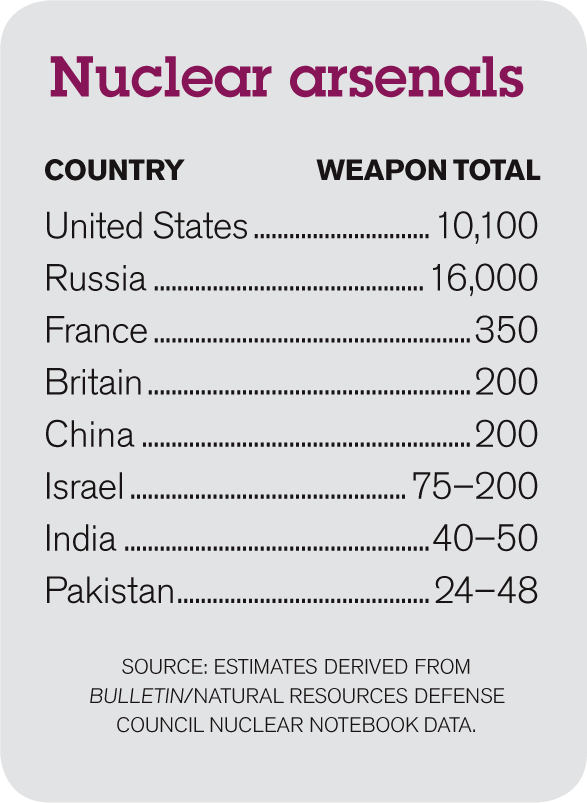
SOURCE: ESTIMATES DERIVED FROM BULLETIN/NATURAL RESOURCES DEFENSE COUNCIL NUCLEAR NOTEBOOK DATA.
This is money wisely spent. I remember well the state of the Russian nuclear establishment during the bleak decade of the 1990s. Fears of loose nukes were fully justified after the breakup of the Soviet Union, as were other specters: unauthorized seizure, coups d'état, nuclear diffusion among the former Soviet states, and launch on false warning issued by deteriorating early warning networks.
Nuclear safeguards were malfunctioning for want of spare parts and maintenance. The military was disintegrating, and nuclear scientists were struggling to feed their families. Nuclear security guards were desperately underpaid. At one point, about 80 percent of the families of the Russian strategic rocket troops were living below the official poverty line. For several years, everyone I met in the nuclear forces in Moscow was moonlighting driving a taxi or performing some menial job on one shift, and on the next shift standing nuclear duties or manning early warning sites all blinky-eyed from lack of sleep. They were receiving too little training to operate nuclear weapons safely. The nuclear bomber pilots, for instance, were getting about 10 hours of airborne flight training per year, barely enough to land a plane safely, much less fly them with nuclear bombs onboard, as compared to 200 hours for U.S. strategic bomber crews. In short, Russia's nuclear arsenal was an accident, theft, or inadvertent launch waiting to happen.
In terms of preventing theft, the Nunn-Lugar effort has made considerable progress. More than half of the Russian weapons and materials facilities (some experts say 80 percent) are now under more stringent safeguards. Military morale and well-being in the Russian nuclear sector are also being steadily restored, thanks to oil profits filling the government coffers and Russian President Vladimir Putin's increases in military spending.
But a large portion of Russia's nuclear stockpile remains insecure and will remain so for many years. The deterioration of nuclear forces and command-and control systems has been arrested but not reversed. As long as the United States and Russia continue to operate their nuclear forces on a Cold War footing, their cooperative efforts to secure the Russian stockpile from theft or unauthorized use will fail.
There are two competing priorities here. One is the Nunn-Lugar effort to “lockdown” the Russian stockpile at fixed, secure locations. The other, in both Russia and the United States, is to maintain standard deterrent postures in which each side's nuclear forces stand ready at all times to fight a large-scale nuclear war with the other. Contrary to popular belief, the two sides still aim thousands of nuclear weapons at each other to satisfy nuclear guidance from both the Kremlin and the White House.
Nuclear aftermath
The more than 26,000 nuclear weapons spread across the globe have the potential to devastate the world's population and make vast areas of land uninhabitable. A summary of some of the effects of nuclear weapons, by the numbers:
SOURCES: OFFICE OF TECHNOLOGY ASSESSMENT, “THE EFFECTS OF NUCLEAR WAR,” 1979; NATURAL RESOURCES DEFENSE COUNCIL (NRDC), “THE U.S. NUCLEAR WAR PLAN: A TIME FOR CHANGE,” 2001; MATTHEW MCKENZIE ET AL., “THE RISKS AND CONSEQUENCES OF NUCLEAR WAR IN SOUTH ASIA,” IN OUT OF THE NUCLEAR SHADOW (2001); CARNEGIE ENDOWMENT FOR INTERNATIONAL PEACE; DEPARTMENT OF MILITARY AFFAIRS, STATE OF MONTANA; NRDC.
To understand how these priorities work at cross-purposes, it helps to be familiar with how nuclear forces are operated today. First, portions of both nations' strategic missile arsenals are kept on hair-trigger alert. If both sides sent the launch order right now, out of the blue, without any warning or preparation, thousands of nuclear weapons–the equivalent in explosive firepower of about 70,000 Hiroshima bombs–could be unleashed within a few minutes.
Second, if early warning satellites or ground radar detected missiles in flight, both sides would attempt to assess whether a real nuclear attack was under way within a strict and short deadline. Under Cold War procedures that are still in practice today, early warning crews manning their consoles 24/7 have only three minutes to reach a preliminary conclusion. Many people imagine that such occurrences never happen, or only rarely. But in reality, it happens practically on a daily basis, sometimes more than once per day, because there are many events involving apparent missile launches that require evaluation. I was visiting the North American Aerospace Defense Command in Colorado on New Year's Eve in 1999 when an event occurred that demanded such a threat assessment. At the conclusion of the incident, the early warning team emerged to report that the Russians had just launched a Scud missile into Chechnya. Other almost daily events include situations such as Japan launching a missile to put a satellite in orbit or a North Korean missile test.
Third, if an apparent nuclear missile threat is perceived, then an emergency teleconference would be convened between the president and his top nuclear advisers. On the U.S. side, the top officer on duty at Strategic Command in Omaha, Nebraska, would brief the president on his nuclear options and their consequences. That officer is allowed all of 30 seconds to deliver the briefing.
Then the U.S. or Russian president would have to decide whether to retaliate, and since the command systems on both sides have long been geared for launch-on-warning, the presidents would have little spare time if they desired to get retaliatory nuclear missiles off the ground before they–and possibly the presidents themselves–were vaporized. On the U.S. side, the time allowed to decide would range between zero and 12 minutes, depending on the scenario. Russia operates under even tighter deadlines because of the short flight time of U.S. Trident submarine missiles on forward patrol in the North Atlantic.
It is surprising to many people that so much firepower, representing such an apocalyptic threat, remains cocked on a hair trigger. Such rapid implementation of war plans would amount to going to war by checklist, enacting a prepared script of launch-on-warning that leaves no room for real deliberation, rational thought, or national leadership. Even in today's post-Cold War political environment with relatively good relations between Russia and the United States, there is inherent risk of human or technical error that results in a mistaken or unauthorized launch.
CLOSE CALLS: Political imbroglios
CLOSE CALLS: False alarms
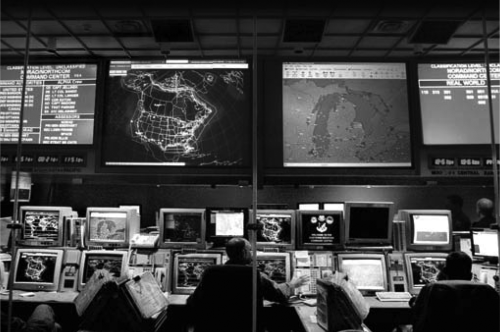
Watching and waiting: Inside NORAD.
What is less well understood is that this nuclear dynamic absolutely precludes “locking down” Russia's nuclear arsenal in the way envisioned by the Nunn-Lugar program. Russia's warfighting nuclear posture keeps many hundreds of weapons in transit or temporary storage at any time. Far-flung mobile combat forces are in constant motion, and nuclear bombs are being constantly shuttled back and forth between their combat field locations and bomb remanufacturing facilities thousands of miles away. By truck, train, helicopter, and van the Russian bombs are constantly moving across 10 time zones.
And transportation is the phase in a nuclear bomb's life cycle in which it is most susceptible to capture or theft. That is the Achilles' heel of Russian nuclear security. Nunn-Lugar focuses on stationary weapons, in storage, and does not alleviate this risk at all. How long before a weapon in transit is stolen? If scores of heavily armed Chechens can travel to Moscow and seize a theater, could they also travel comparable distances to missile fields, seize a mobile intercontinental ballistic missile (ICBM) on patrol, circumvent the launch safeguards, and then fire it? Or could they hijack a truck or train car loaded with nuclear bombs being shipped over long distances to refurbishing plants? In pondering these questions, it is worth reflecting upon the fact that all nuclear safeguards are rated for their effectiveness in thwarting circumvention only for a temporary period of time. No safeguard can foil circumvention forever if the weapon remains under terrorist control.
Keeping hundreds of missiles on hair-trigger alert–armed, fueled, targeted, and poised to launch as soon as they receive two or three short, coded computer commands–also raises the question of whether they could be fired by unauthorized actors who manage to hack into the nuclear communications networks or even the actual launch circuits. It may not be as farfetched as many think.
Let me offer some food for thought: During the 1990s, an in-depth investigation of U.S. nuclear weapons safeguards conducted by the Federal Advisory Committee on Nuclear Failsafe and Risk Reduction found several deficiencies that terrorists could exploit to gain some control over the weapons. For instance, the committee found an electronic backdoor to the naval communications network used to transmit launch orders to U.S. Trident missile submarines. Unauthorized individuals, including terrorists, could have hacked into the network, seized control over land-based naval transmitters, and sent a nuclear launch order over the airwaves to the subs. This deficiency was deemed so serious that Trident crews were given radically new instructions on how to ensure that a launch order is valid.
Today, military computers are constantly under assault by hackers, and the vulnerability of nuclear command, control, early warning, and communications systems to unauthorized electronic intrusion is worthy of serious concern and analysis. In my experience, the deficiencies in these networks defy comprehensive discovery, and evaluating their danger is highly complex, particularly when assumptions about the nature of “insider” collusion are varied.
Why take these real risks for unnecessary, anachronistic deterrent purposes? The United States and Russia could greatly strengthen their nuclear security and safeguards (and demonstrate their commitment to honoring their pledges to pursue nuclear disarmament as required by treaties in force) by standing down their nuclear missiles, taking them off of hair-trigger alert, and extending the time needed to launch them from the current period of seconds to a much longer period of days, weeks, and eventually years. By physically de-alerting their forces, the two nuclear rivals would buy a large margin of safety against a host of dangers and risks of an apocalyptic magnitude. De-alerting would also allow nuclear weapons to be locked down and secured through Nunn-Lugar and would virtually eliminate risks of theft and unauthorized or inadvertent missile launch.
Russia and the United States need to deepen their cooperation beyond Nunn-Lugar and realign their nuclear postures to fit with the current political reality, for the sake of nuclear security on both sides. This has become clear to me in personal terms through hundreds of conversations with Russian nuclear experts over the past two decades. It was driven home most vividly on New Year's Eve, 1999, when I joined up with a group of Russian and U.S. military officers in Colorado.
Readers may remember that our countries set up a joint center there to monitor the rollover from 1999 to 2000, in order to prevent an accidental nuclear war from being triggered by the computer bug dubbed Y2K. Despite spending billions of dollars to rid their military and intelligence computer networks of this so-called millennium bug, the two countries took the additional precaution of bringing their early warning officers together to jointly interpret the near real-time data from U.S. satellite and ground radars used to detect enemy missile launches. These officers' job was to diagnose any missile launch reports coming from these sensors during the rollover period, to ensure that they were not caused by Y2K bugs. I was allowed to watch this joint operation as the clock ticked down to midnight around the world. We were, of course, all jubilant as the rollover proceeded without a hitch from one time zone to another, moving from Russia west through Europe and the United States. I was there at the moment of truth for U.S. nuclear control, when the clock struck midnight Greenwich mean time without any false alarms from our missile attack warning sensors or any computer-induced accidental launches of strategic missiles.
This joint center was actually a prototype for a permanent joint center that was to be built in a Moscow suburb. Its purpose was not only to prevent false alarms of nuclear missile attacks from triggering World War III, but also to share intelligence and real-time data on ballistic missiles being developed and tested by proliferant states such as Iraq, Iran, North Korea, and many others. If we had finished building this joint center, today both the United States and Russia would be closely monitoring the test of North Korea's Taepodong II ICBM, which is being designed to loft a nuclear bomb to targets many thousands of miles away. We would be jointly tracking nuclear missile proliferation around the world. We could have invited China and other interested parties to become partners in the venture.
The center unfortunately was not built, stalled over a minor dispute about who would assume liability for construction accidents. This is one small but telling indicator of the level of priority actually accorded nuclear safety and proliferation by the White House and the Kremlin. It is lower than most people realize. If we were really serious about it, and wise, we would end the nuclear hairtrigger status quo, de-alert, cut the liability knot, and open this joint center in Moscow.