




Abstract
Disposing of U.S. chemical weapons has been a slow, contentious operation.
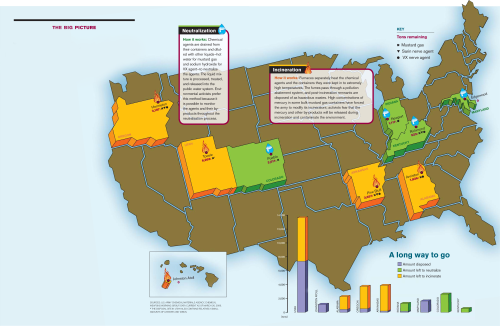
By ratifying the Chemical Weapons Convention in 1997, the United States outlawed its own stockpile of more than 30,000 tons of weapons material, including sarin nerve agent, VX nerve agent, and mustard gas. To destroy the vast U.S. arsenal and come into compliance with the treaty, the army uses two techniques: incineration and neutralization (see right for descriptions). Because some community activists who live near the stockpile sites believe that incineration is potentially hazardous to the environment, the manner of destruction has been contentious. The army initially planned to incinerate the entire stockpile, but in the mid-1990s, it agreed to use neutralization at some sites, as it proved to be a feasible alternative.
Though there have been delays in the disposal process-the U.S. stockpile won't be completely destroyed until 2017, at the earliest, five years after the treaty deadline-there also have been notable successes. In February, the army decontaminated the last agent containers at the Aberdeen, Maryland, disposal facility, where 1,600 tons of mustard gas were destroyed using neutralization. Aberdeen became the second U.S. site to destroy all its chemical weapons holdings; the first was an incineration facility at Johnston Atoll in the Pacific Ocean. Aberdeen's success has buoyed activists who hope to convince the army to adopt neutralization to destroy remaining stocks of other sites' bulk mustard gas, which is the largest remaining part of the stockpile.
At present, transporting the remaining bulk stocks to neutralization sites seems unlikely, not least because U.S. law prohibits the movement of chemical weapons across state lines. And the Defense Department is reluctant to build new facilities at the four incineration sites. New neutralization facilities would be too costly, especially when the army feels incineration is safe, according to Greg Mahall, spokesman for the army's Chemical Materials Agency (CMA). “It is safe to say that the CMA is going to continue to use both technologies but keep the technologies specific to the present locations,” Mahall says.
Craig Williams, director of the Chemical Weapons Working Group, a Kentucky-based activist organization, argues that the army could dispose of all the bulk mustard gas faster, cheaper, and safer with neutralization. “The completion of the mission in Maryland validates our contention … that there are non-emissive, much more controllable disposal technologies available for treating this material,” Williams says.
Neutralization
Incineration
Supplementary Material
Convention on the Prohibition of the Development, Production, Stockpiling, and Use of Chemical Weapons and on Their Destruction