Abstract
Who stands in harm's way during a chemical, biological, or radiological release? It depends, in part, on the weather.
EMERGENCY RESPONSE: Where the plume blows
No matter which direction the chemical plume headed, people stood in its path. But Cincinnati officials knew just who to call when they responded to an August 2005 railcar leak of styrene, a mildly toxic chemical used in rubber and plastic manufacturing. Since 2003, local officials had been working with the National Atmospheric Release Advisory Center (NARAC), at Lawrence Livermore National Laboratory, to integrate its plume-modeling capabilities into local emergency response. Within minutes of answering a simple web questionnaire about the conditions of the release, officials received the first of several computer-generated, color-coded models showing the likely path and concentration of the chemical plume.
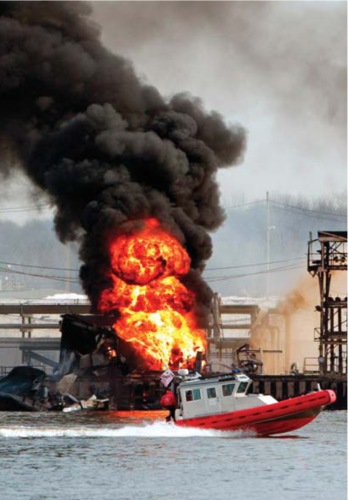
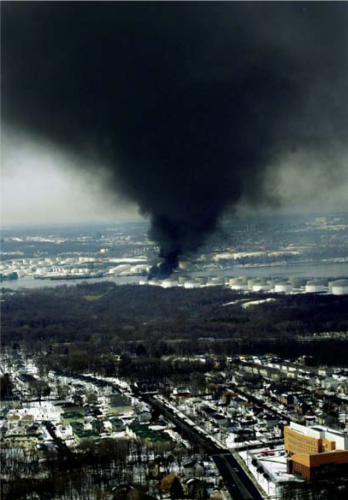
Responders, the media, and the public want to know if they are in harm's way, says Ed Dadosky, a district chief at the Cincinnati Fire Department, who responded to the styrene leak. “To be able to show a picture is much more helpful than telling people,” he says. The NARAC models proved their worth. Despite some public anxiety, the leak resulted in no injuries.
The rising specter of an accidental or terrorist release of chemical, biological, or radioactive material situates weather prediction and modeling technology at the center of emergency response. Meteorological tools have been an important part of responding to both natural disasters and man-made emergencies, but in the past, local responders have calculated their own rudimentary plume models or fed limited, locally collected weather data into computer models. The 2003 NARAC pilot program, which also included coordination with Albuquerque, Seattle, Fort Worth, and New York City, provided direct access to a robust modeling capability.
NARAC can develop complex models of wind fields using real-time National Weather Service data and constantly adjust the models as new data and locally collected dispersion measurements are gathered. Quickly distributing this information ensures that local officials can communicate with neighboring municipalities, decide who needs to be evacuated, and plan safe evacuation routes–among other things. “A tool like NARAC puts me on equal footing with somebody who is much better trained and more knowledgeable about this particular part of emergency response,” Dadosky says.
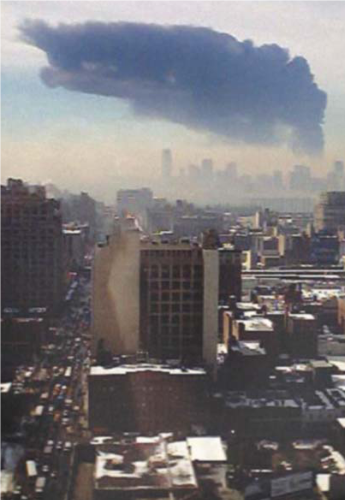
New York City officials bought into the NARAC program after the models helped track a thick plume of smoke from a February 2003 Staten Island oil barge fire. Since then, officials have begun deploying 10 new weather stations around the city, which will eventually feed back into NARAC models. Together with other research aimed at improving dispersion modeling in the city's urban canyons, New York officials are placing considerable stock in their meteorological assets. “If you improve the distribution of weather stations and get more weather data, you have a better ability to predict local dispersion patterns,” says Kevin Clark, a preparedness specialist in the city's Office of Emergency Management.
Working with local officials to track fires and chemical releases–and participating in Department of Homeland Security exercises–also enables NARAC to improve its capabilities. The center is developing an “event reconstruction modeling” capability, which uses dispersion and weather data to more accurately reconstruct releases. NARAC hopes to completely automate the process which will be particularly helpful when officials don't know the source of a release, according to John Nasstrom, NARAC's associate program leader, as in the event of a terrorist chemical attack.
Similarly, Homeland Security is placing considerable emphasis on these types of capabilities, having established the Interagency Modeling and Atmospheric Assessment Center in May 2004 to corral the expertise of federal agencies in the event of an “incident of national significance.” The more substantive modeling infrastructure can only be beneficial, says Kay Goss, a former associate director of the Federal Emergency Management Agency and a preparedness consultant. By making the decision process transparent, Goss says, “The public knows that we are planning and preparing to keep them safe and secure.”
Q+A Jennifer Ouellette
The author of the forthcoming Physics of the Buffyverse and associate editor of APS News, the American Physical Society's magazine, offers her views on how best to explain physics to the public.

THREAT ASSESSMENT: Garbage in, garbage out
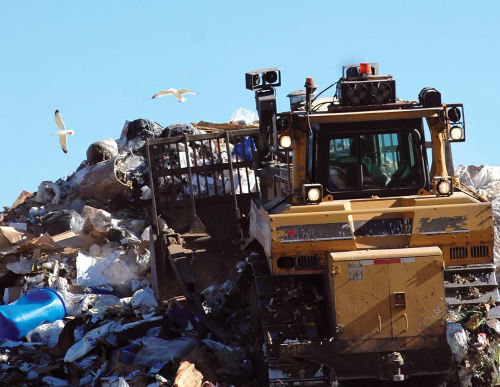
Every day, Canadian garbage trucks brimming with refuse cross the border between the United States and Canada unencumbered on their way to Michigan landfills. This practice poses a legitimate national security hazard, according to a recent report compiled by the bipartisan Senate Committee on Homeland Security and Governmental Affairs. The report calls for a moratorium on such trash imports, claiming that terrorists could smuggle “weapons or nuclear material” in the densely compacted trash, which X-rays and other security measures cannot penetrate.
A terrorism and border security expert at the Council on Foreign Relations and the author of America the Vulnerable (2004).
If the overall goal is to create economic disruption, a terrorist won't freeze the way we do business by blowing up a garbage truck with a dirty bomb. It would be a bad day for Canadian trash collectors. If a terrorist hopes to smuggle a dirty bomb from Canada into the United States by hiding it in garbage, the issue then becomes wading through mountains of trash unnoticed to dig it out.
“This particular story line features a healthy mix of local politics and serves as a perfect example of hitching your wagon to the threat of the moment. The bottom line: Detroiters don't like Canadians dumping trash in their landfills.”
GENDER: Political glass ceiling
Forget political maneuvering, women aspiring to become the first female U.S. president face another more formidable campaign roadblock: war.
Breaking with a steadily climbing, 70-year trend, a survey published in March 2006 shows a decline in the number of people who would vote for a female presidential candidate. This dip coincides with respondents' views that the most important issues facing the country are the Iraq War, homeland security, and terrorism.
According to Erika Falk, a researcher at Johns Hopkins University who coauthored the study, voters are looking for decisive, experienced leaders. “In this country, our notion of leadership tends to be defined by stereotypically masculine qualities,” she says.
Then again, when researchers match up specific female candidates (say Hillary Clinton or Elizabeth Dole) against men from the ‘ opposite political party, gender stereotypes become less important. As Falk says, “Partisanship actually trumps sexism.”
JONAS SIEGEL
RE: NUCLEAR HISTORY: Fermi on display
What special recognition, if any, have you received for excellence in academics, such as honors, prizes, scholarships?” the application for a room at the University of Chicago's International House asked. Enrico Fermi went for brevity. “Nobel prize for physics 1938,” he scrawled.

The housing application constitutes one of many professional documents, family photos, and private letters on display in the exhibit, Enrico Fermi: The Life of a Scientist, at the university's John Crerar Library. (The exhibit runs until September 8; portions of it are available online at fermi.lib.uchicago.edu.) Among the most interesting: A handwritten missive in which Fermi calls his dissertation “rubbish” and a hastily assembled baptismal record for Laura Fermi, his Jewish wife, to avoid persecution in fascist Italy.
“Fermi's professional contributions are well known,” says James Pilcher, director of the Enrico Fermi Institute, “but this display adds a human dimension.”
JOSH SCHOLLMEYER
NUCLEAR POWER: Russia's sea change
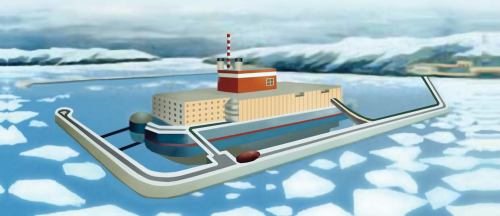
The Sevmash Shipyard in Severodvinsk, once the proud home of the Soviet Union's fleet of ballistic-missile submarines, has found a new raison d'être. According to local media reports, Sevmash has begun preparations to construct the first floating reactor, a nuclear power plant mounted on a barge. Russia hopes to complete construction before year's end with Rosenergoatom (a Russian nuclear power conglomerate) bankrolling the $200 million cost.
The floating reactor has been an on-again, off-again project since the early 1990s when Russia began promoting it as a cheap way to power the country's Arctic regions. While the latest plans still call for the reactors to power remote coastal areas, Russia hopes to export them to countries such as Indonesia and India as part of an effort to capture a larger slice of the world's nuclear power market.
POWER BOAT
The schematic of a proposed floating nuclear power plant featuring two VBER-300 reactors.
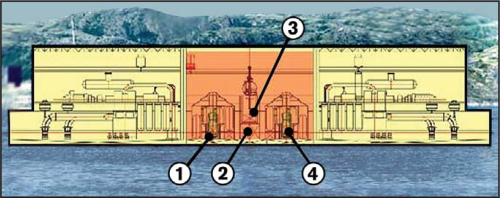
1) Reactor unit #1
2) Radioactive waste storage
3) Fresh and spent fuel storage
4) Reactor unit #2
Since the original designs were heavily criticized fortheir reliance on highly enriched uranium (HEU)–a clear proliferation concern–Russian scientists have been studying the possibility of running the reactors on low-enriched uranium (LEU) fuel. Despite these efforts, Cristina Chuen of the Monterey Institute of International Studies questions the reactors'feasibility: “If the [new reactor] turns out to be inefficient when fueled with LEU, will Russia be tempted to use HEU fuels? Or will it really fund construction of a completely new reactor type so that LEU can be used?”
Even if LEU reactors are developed, there are concerns about radioactive waste. The plan calls for temporarily storing waste on the barges until they return to the shipyard for cleanup every 12 years. Some experts remain skeptical. Notes Chuen, “Russian environmentalists like to say that there's nothing more permanent than a temporary facility.”
MICHAEL FLYNN
An artist's rendering of a Russian floating nuclear power plant.