




Abstract
Quadrennial Defense Review, U.S. Defense Department, February 2006.
The Bush administration's 2006 Quadrennial Defense Review (QDR) bears both good and bad news for those concerned about the U.S. nuclear posture. The good news is that 111 pages of the 113-page report–the fifth in a series of periodic Pentagon reviews since the waning days of the Cold War–stress the importance of a robust conventional military capability to confront terrorists, rogue regimes, and other threats. In this respect, the QDR implies that U.S. nuclear weapons have a limited role. The bad news is that the 2006 QDR features a mere two pages on U.S. nuclear strategy. “Nuclear weapons,” according to the report, “will be accurate, safe, and reliable, and tailored to meet modern deterrence requirements.” The report also calls for reductions of Minuteman III ballistic missiles from 500 to 450 and for the replacement of some nuclear warheads deployed on long-range Trident submarine-launched ballistic missiles with conventional precision-guided warheads–both reasonable, if modest, proposals. It also noted that the Defense Department would work with the Energy Department “to assess the feasibility and cost of the Reliable Replacement Warhead [RRW],” an ambiguously defined initiative to study simplified warhead designs.
But that's it. The 2006 QDR is otherwise a terse endorsement of the pre-9/11 strategic posture outlined in the intensely controversial 2001 Nuclear Posture Review (NPR). The lack of in-depth analysis is troubling because the strategic environment has changed a lot since then. The 9/11 terrorist attacks highlighted the threat posed by extremists bent on causing mass destruction, especially if they acquired nuclear weapons. North Korea has a nuclear weapons program and shows no sign of giving it up. Iran is headed toward having a turnkey nuclear weapons capability under the guise of a civilian energy program. China, which drove much of the incoming Bush administration's threat perceptions in 2001, has in fact become more globally integrated with its entry into the World Trade Organization and has even shown increased willingness to work with the United States on issues of shared strategic concern, such as North Korea's nuclear program. And with U.S. military forces severely overstretched in Iraq and Afghanistan, most adversaries are unlikely to view threats of regime change as credible.
The failure of the 2006 QDR to even acknowledge how these critical developments relate to U.S. strategic forces policy gives the impression of a strategy in limbo. The report merely reaffirms the Defense Department's “shift from a ‘one size fits all’ notion of deterrence toward more tailorable [sic] approaches … consistent with the New Triad priorities developed during the 2001 Nuclear Posture Review.” This “New Triad” was a phrase invented by the authors of the 2001 NPR. Under this formulation–a play on the Cold War triad of silo-based ballistic missiles, submarine-launched ballistic missiles, and strategic bombers–nuclear weapons are part of a broader strategic posture that includes non-nuclear weapons, a ballistic missile defense system, and a nuclear weapons manufacturing infrastructure that would enable the United States to respond nimbly to changes in the security environment.
In the name of tailored deterrence, the 2001 NPR called for two new tactical nuclear weapons–a high-yield nuclear “bunker-buster” and a low-yield “mini-nuke”–to collapse hardened enemy bunkers and destroy mobile and relocatable targets, such as mobile missile launchers. The proposals were intensely controversial and sparked a heated and generally productive debate over the role of nuclear weapons in U.S. strategy. Five years later, the 2001 NPR's controversial proposals for a bunker-buster and mini-nuke are dead (for now) after Congress refused to support them. And yet, the 2006 QDR references them only obliquely by saying merely that “capabilities will be available to attack … fixed, hard and deeply buried, mobile, and relocatable targets.” If the capabilities were really as critical to the U.S. strategic posture as the 2001 NPR suggested, it is odd that the 2006 QDR failed to really engage the debate. Perhaps upon further reflection, the Defense Department came around to agreeing with Congress that these capabilities aren't so critical after all.
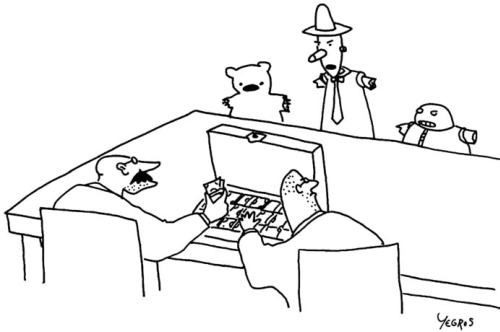
“The money's there. Now, where are the arms?”
The 2006 QDR also falls short on a much more fundamental level. Strategic policy is more than just deterrence policy; it is creating the right political and, if necessary, military conditions to prevent terrorists, extremist regimes, and even allies from desiring and acquiring nuclear and other catastrophic capabilities. Like the 2001 NPR before it, the 2006 QDR trumpets the putative benefits of various strategic capabilities without a clear analysis of the opportunity costs, particularly with respect to U.S. nonproliferation objectives.
U.S. nuclear forces are the ultimate insurance policy against existential threats. Nuclear weapons should and will continue to have some role in maintaining the national defense as long as there is some possibility, however remote, that an existential threat will someday reemerge.
But in the here-and-now, the United States faces a diverse range of grave but not existential threats. Extremist regimes such as Iran and North Korea pursue nuclear weapons in significant part as a deterrent against U.S.-led regime change and other interference. A bunker-buster or mini-nuke might in theory help nullify some of a regime's strategic capabilities, but the practical circumstances in which using a nuclear weapon instead of conventional means would advance U.S. security interests are severely limited and highly improbable. The Pentagon itself seemed to recognize this when it pulled back from proposals in a recent draft Doctrine for Joint Nuclear Operations to use nuclear weapons preemptively to destroy an enemy's chemical, biological, or nuclear weapons.
A far more practical, proactive, and therefore effective strategic course is preventing terrorists and extremist regimes from acquiring catastrophic capabilities in the first place, and isolating or containing the regimes that do acquire nuclear weapons. The United States cannot do this without a global commitment to the effort. There is an inherent tension between the twin U.S. goals of preventing the spread of nuclear weapons and sustaining a robust nuclear arsenal. Doing so obstructs the ability of the United States to marshal greater international support for its nonproliferation objectives. It is common, even clichéd, for countries to vigorously assert their opposition to nuclear proliferation, but the reality is that the intensity of their commitment varies widely. For instance, many countries at the May 2005 Nuclear Non-Proliferation Treaty (NPT) Review Conference scoffed at U.S. proposals to strengthen nonproliferation norms in the face of North Korea's withdrawal from the treaty and Iran's questionable nuclear activities, citing U.S. pursuit of the nuclear bunker-buster as running counter to its NPT obligations to reduce the role of nuclear weapons in its defense strategy. The conference ended in failure.
Now, the Bush administration wants to study the feasibility of a Reliable Replacement Warhead, and “if warranted, begin development of that system.” Yet, the QDR fails to clearly articulate why an RRW may be necessary, given that the Energy Department already certifies the current nuclear arsenal as safe and reliable.
That's unfortunate, because there may be sound national security reasons for an RRW. If concerns about reliability are what drove opposition to the Comprehensive Test Ban Treaty, then an RRW should eliminate them and lead to ratification. The increased reliability could also enable the United States to keep a much smaller number of weapons in reserve. And since replacement means “substitution,” not “augmentation,” it implies that the RRW should not create new missions for nuclear weapons.
The QDR should have elaborated on these points. Instead, by being ambiguous, the report's endorsement of the RRW program will only raise concerns abroad about whether the ultimate goal is to increase the military utility of U.S. nuclear weapons. Given the enormous stakes of preventing potential adversaries from acquiring nuclear weapons, the United States cannot afford to waste precious political capital (or, for that matter, exorbitant economic resources) on nuclear capabilities that, as a practical matter, offer marginal security returns at best. In light of the severely limited role that nuclear weapons play against twenty-first century threats, doesn't it make sense to ask whether the potential benefits of RRW outweigh the costs to nonproliferation efforts? Carrying out this calculation requires the senior leadership from the Defense, Energy, and State departments to take a hard, comprehensive look at all U.S. strategic capabilities, from military, to political, to economic, in order to comprehensively assess the real-world tradeoffs. The 2006 QDR falls short on such assessments, both for the proposed RRW and the U.S. nuclear arsenal more broadly. Instead, it continues to endorse a pre-9/11 nuclear posture customized to a geopolitical climate that even its authors concede no longer exists.
Supplementary Material
Quadrennial Defense Review Report