




Abstract

The nightly border-closing ceremony at Wagah-Attari routinely draws a huge, boisterous crowd to both sides of the Pakistan-India divide. And on January 26, India's Republic Day, the spectators in At-tari are more raucous than usual. A sound system blasts bhangra beats that catapult grown men out of their seats to dance. Ecstatic boys run up and down the high-security Attari Road, waving bedsheet-sized Indian flags. An emcee revs up the capacity crowd with call-and-response chants of “Long live India!”
The scene is medium-heat mayhem, which the immaculately mustachioed Indian border guards in their martial plumage only half-heartedly try to control.
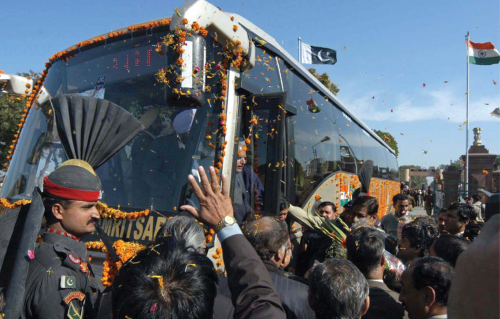
All aboard: The AmritsarLahore bus pulled into Wagah on January 24, 2006.
When the Indian troops high step toward their Pakistani counterparts, preparing to lower their nations' flags and close the border, onlookers on both sides strain to glimpse the moment of theater that brings the two countries, quite literally, nose to nose. After the ceremony, Indian and Pakistani bystanders rush the closed gate to snap pictures of the other side, as if the lands beyond the border were alien planets and not East and West Punjab, topographic and genetic twins.
This mutual gawking may soon become history. For perhaps the first time since the Indo-Pak line cooled into one of the hardest borders on Earth after the 1947 partition, it is possible to imagine a day when Indian day-trippers will watch the border-closing ceremony from Pakistan, and vice versa. Four years after Indian and Pakistani forces last clashed over the disputed territory of Kashmir, the Indo-Pak border, including the Line of Control, is undergoing a marked softening.
“There has been a sea change in the last year,” says Ershad Mahmud, research associate with the Institute of Policy Studies in Islamabad. “The forward movement on trade and people-to-people contacts is historic.”
Since the latest round of Indo-Pak detente began in early 2004, Indian and Pakistani officials have met more than 100 times. In lieu of a final settlement on Kashmir, a vital part of the peace process has been instituting confidence-building measures, also known as “track-two diplomacy.” Such measures, which have been credited with reducing the nuclear tension between the two rivals, have included everything from recent cross-border cricket matches to the October 2005 pre-notification agreement between New Delhi and Islamabad regarding ballistic missile flight-tests. Increased transport and trade links, also seen as confidence-building measures, have led many observers to sound surprising notes of not-so-cautious optimism. Nowhere is this truer than in the Indo-Pak business communities, which have been at the forefront of the border-softening initiatives.
“This is the era of trade, not politics,” says Maher Alam Khan, secretary of the Federation of Pakistan Chambers of Commerce and Industry. “If you have good trade relations, everything else will follow.”
Khan's Indian counterparts share his mix of optimism and impatience. “Things are finally going in the right direction,” says Manesh Mohan of the Federation of Indian Chambers of Commerce and Industry. Mohan estimates that official Indo-Pak trade, currently estimated at $500 million a year, could easily reach $10 billion once the border opens completely and trade barriers are lowered. “Trade between India and Pakistan should be the engine of South Asia,” he says.
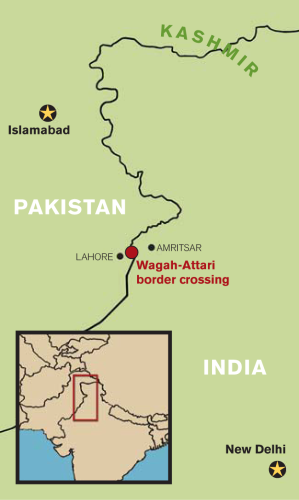
That dream could be facilitated by revitalized transportation links, making the flow of people and products easier–and greasing the wheels of the peace process. In January, two new bus lines opened, directly linking Amritsar, an Indian city about 30 kilometers (19 miles) east of Wagah, to the Pakistani cities of Lahore and Nankana Sahib. The maiden voyage of the Dosti (“Friendship”) Express launched amid flower petals, music, and proclamations of a new day dawning.
“The period of separation is over,” declared the Pakistani folk singer Resh-ma, who rode the first Lahore-Amritsar bus. The following week, an Indian delegation returned from its inaugural cross-border trip, where Pakistanis reportedly lined the streets in greeting. The mayor of Amritsar announced he would visit his counterpart in Lahore later in the year to explore further ties between the two cities, and discussions are under way to add bus lines between Amritsar and the Pakistani towns of Katasraj and Punja Sahib.
“Measures like the bus service between Amritsar and Lahore … not only promote people-to-people contact, but also mark the beginning of a cycle of trust and mutual confidence,” Saroj Kumar Poddar, president of the Federation of Indian Chambers of Commerce and Industry, told the Indian Express in late January.
Further indication of the degree to which tensions have eased can be found in Kashmir, where last April a bus line opened, linking India and Pakistan across Kashmir's Line of Control; another line is set to open this April. (Three other routes across the Line of Control remain open following October's devastating earthquake in Pakistani-controlled Kashmir.) The newly revitalized links are not limited to bus services; a rail line opened in 2004, and another is set to enter service this year; even maritime travel could be affected–there are tentative plans to reinstate the Mumbai-Karachi ferry.
If there was any doubt as to what's behind the mood shift, it was put to rest last May, when an Indian trade delegation spent a week touring Pakistan. Like January's bus voyagers, the representatives were received with garlands and rose petals. On the final night of the visit, the delegation attended a banquet hosted by Pakistan's President Pervez Musharraf, who told his guests, “Geopolitics has given way to geo-economics.”
But the culture of hostility and distrust between the two countries runs deep, and the Kashmir dispute remains central. “The last year has led to some deserved euphoria,” says Mahmud, in Islamabad. “But unless there's more impact and movement in the Kashmir Valley, these trade and travel breakthroughs won't be enough.”
Speaking this year at the World Economic Forum in Davos, Switzerland, Musharraf himself seemed to backtrack on earlier comments, warning of the limits of an approach that focused on confidence-building measures at the expense of a Kashmir settlement. “We ought to look at conflict resolution because there cannot be a permanent peace if we don't,” he said.
Some are hopeful that the growing trade and transit links can gain momentum parallel to power politics, eventually overtaking them. Yet there are stumbling blocks. When it comes to transit, an anachronistic visa regime will have to be modernized. Currently, lone consulates in Islamabad and New Delhi dole out single-entry, city-specific visas that require all visitors, including frequent business travelers, to check in with the police upon arrival. In the trade realm, tariffs present a serious obstacle to budding economic integration. Since 2002, official trade between India and Pakistan has roughly doubled. Unofficial trade, meanwhile, is booming, spurred by exorbitant tariff costs. The Indian Chamber of Commerce and Industry estimates the value of Indian-made goods pouring into Pakistan from third countries at $2 billion, most of it funneled first through Europe and the Persian Gulf.
Current Indo-Pak trade is riddled with peculiarities. Take, for example, tea. Pakistan is the world's second largest consumer of tea. It also shares a border with the world's second largest producer of tea. Yet because of a 49 percent import duty levied on Indian tea (on top of a basic 20 percent tax), Pakistan imports most of its tea from Kenya and Rwanda. Similar examples can be found down the line of industries and products.
Officials on both sides are hopeful that the tariff issues will be resolved through the South Asian Free Trade Agreement, which came into effect in January 2006 and requires that Indian and Pakistani tariffs be drastically reduced by 2013. But the Chambers of Commerce in New Delhi and Islamabad are pushing for a bilateral deal to accomplish this much earlier. While India has granted Pakistan “most favored nation” status, Pakistan has not reciprocated, tying the issue to movement on Kashmir.
Although India and Pakistan have yet to solve a number of issues, that hasn't scared off investors in Amritsar, where local land prices are 10 times what they were a few years ago, according to the Amritsar Development Corporation. As investors anticipate a further softening of the border, they are scrambling to gobble up choice plots in potential border boomtowns like Amritsar. During a recent land auction, local officials were stunned when a plot sold for nearly eight times the asking price. The Mumbai-based buyer then turned around and flipped the property to a Dubai sheik.
“The uncertainty is lifting,” says K. S. Kang, commissioner of the development corporation. “People are starting to see that things are moving and gaining speed. You don't overcome 50 years of history overnight, but I don't think there's any going back. Investors would not be buying land at these prices unless they believed we were moving toward some kind of lasting integration.”
“It's a question of breaking the ice,” Kang says. “Once it starts melting, it flows like water.”
Supplementary Material
Agreement Between the Republic of India and the Islamic Republic of Pakistan on Pre-Notification of Flight Testing of Ballistic Missiles