




Abstract
The war on terror and the Osama bin Laden manhunt have brought an age-old debate about self-censorship to the geosciences.
TERRORISM: A shifting landscape
The camera angle was tight, neatly framing Osama bin Laden, his second in command Ayman al-Zawahiri, and their two cohorts, sitting in an indistinguishable ravine, perhaps somewhere along the Afghanistan-Pakistan border. The tape, which aired first on Aljazeera a month after 9/11 and featured bin Laden praising the attacks, contained no clues of the terrorists' location–until its final few throw-away frames.
Hidden clues: A computer-enhanced video clip revealed geologic evidence of Osama bin Ladens location.

As he watched the tape's concluding moments on CNN, Jack Shroder, a geo-scientist at the University of Nebraska at Omaha (UNO), noticed something–the camera had been filming when it was wrestled from its tripod. The tight frame around bin Laden now swung suddenly upward, providing a split-second glance of sheared crystalline rocks. “I know where that is!” exclaimed Shroder, who mapped Afghanistan in the 1970s and cofounded the Afghanistan Studies Center at UNO. “That's the Spin Ghar range.”
The rest happened quickly. After Shroder told a reporter where he believed the tape was shot, U.S. government officials visited him in Omaha and asked him to keep his expert opinion quiet–they also enlisted him in the bin Laden manhunt. Meanwhile, at the University of Cincinnati, geography researcher Richard Beck was inspired by Shroder's deduction. Familiar with the Pakistan side of the border from doing exploratory fieldwork there for Amoco, Beck began formulating his own guess as to bin Laden's whereabouts. Within a few weeks, he was forwarding possible search targets, such as Afghanistan's Zhawar Kili cave complex, to the U.S. military, officially ushering the geosciences (geography and geology) into the war on terror.
That two academics would work so closely with the government at first gave no one in the geoscience community pause. The U.S. government and geoscientists have been intertwined for decades; a large number of geoscientists are either employees of offices such as the National Geospatial-Intelligence Agency, or they work on outsourced projects that are bankrolled by federal dollars. Nor were Beck and Shroder alone. A number of other geoscientists rapidly realized their expertise could be applied to combating terrorism. In January 2002, the Association of American Geographers (AAG) held a workshop to discuss how its members could aid in areas as disparate as emergency response and biosecurity.
Beck, too, wanted to collaborate with his colleagues. In the May 2003 issue of the AAG journal Professional Geographer, he detailed his successes and frustrations in the bin Laden search–with one caveat: “Some information sources used in this study, some details of the method, and some conclusions have been omitted” for the safety of U.S. personnel in Afghanistan.
This proviso raised some hackles. “We're in the business of fairness, openness, and transparency,” says John O'Loughlin, a geography professor at the University of Colorado and editor of the non-AAG affiliated journal Political Geography. “Anything that violates that doesn't belong in an academic journal.”
O'Loughlin contends that the gold standard for academic publication is that research be replicable and that Beck's work didn't meet that standard. Beck disagrees, arguing that Shroder did exactly that when he commented on Beck's work (and revealed much of his own) in a November 2005 Professional Geographer article. “There's a certain segment of academia that's rabid, and you're never going to satisfy them,” Beck says.
“Self-censorship is a completely legitimate thing to do,” adds Shroder, who, at the government's request, removed many sensitive items from the Afghanistan Studies Center web site after 9/11.
Troubled by such sentiment, O'Loughlin is taking the matter to the AAG Publications Committee in hopes of persuading it to devise more rigid replication standards that would prevent publication without, as he terms it, “the full Monty”–complete openness–regarding methods and funding.
As for Beck and Shroder, they've long relinquished their search for bin Laden. Despite the criticism and the fact that bin Laden's still at large, they believe they made an important contribution to both geoscience and the war on terror. Especially, Shroder says, considering bin Laden's new preferred means of communication–audiotape. “They sure got the message that we can tell where they are.”
Viral marketing: A recent FBI Cyber Crime Survey found that small businesses are reluctant to report cyber attacks, such as computer viruses, because they fear bad publicity, among other things.
How Jack Shroder guessed

RE: TECHNOLOGY: Rolling to the rescue
When it comes to finding earthquake victims trapped inside collapsed buildings, a new type of search robot has a leg up on its competitors by not having any legs at all.

Eschewing bulky motors, Osaka University robotics researcher Kenji Inoue and colleagues devised “search balls”–durable, spherical robots–that instead use gravity. When dropped into a flattened building, the search balls roll through the rubble as far as the terrain lets them, searching for victims.
Fitted with small lights, cameras, and perhaps one day microphones, the balls, which are still under development, are made to gather information and transmit it to a command center. Lack of propulsion limits the devices' range, Inoue admits, and collecting every last bot–hundreds could be used in a search operation–would be difficult. “Some search balls can be collected by rescuers, but some will be lost,” Inoue says, “which is why it is important to make them cheap.”
BIOWEAPONS: Past lessons
Bioweapons programs are tricky things. By nature, defensive programs, which often create and study bioweapons in order to better protect against them, can be difficult to distinguish from their offensive counterparts.
Man on a mission: Samuel Goudsmit (at right), scientific head of the Alsos Mission.
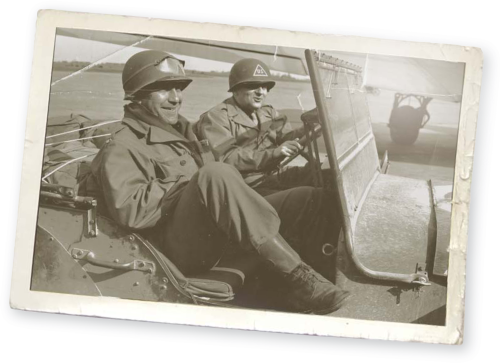
To find ways to better ascertain the nature of hostile bioweapons programs, Stockholm International Peace Research Institute researcher John Hart recently reviewed declassified documents from the Manhattan Project's Alsos Mission, the secret U.S. intelligence operation tasked with determining the intent of Nazi weapons programs, including bioweapons, during World War II. Hart discovered many lessons (a few at right) that could aid intelligence experts and might be applied to helping the Biological and Toxin Weapons Convention establish an effective inspection protocol, which doesn't yet exist.
The Allies expected Adolf Hitler to pursue a sophisticated, offensive bioweapons program just as they were doing. But Alsos operatives discovered that Hitler ordered the German program to remain defensive, illustrating that even bellicose regimes that have the capability to create offensive programs might not want to.
Alsos was a secret scientific intel mission; its agents were specially trained. “Nothing replaces experience,” Hart explains. “A weapon scientist or technical expert will understand what he's looking at better than someone who has only read about weapon development.”
For every action, there is a reaction–especially when secrets are hard to keep. “The discoveries made in France [about French bioweapons development] by German occupation forces resulted in renewed and focused German bioweapons threat assessments and related activities,” Hart argues, “which probably wouldn't have occurred otherwise.”
WEB WATCH PHYSICS.UCSD.EDU/PETITION
THE MOTIVATION IS ELEMENTARY: Physicists created the atomic bomb, so they have a responsibility to guard the world from it. This rationale (which the Bulletin can thank in part for its existence) resurfaced late last year in the form of a petition started by physicists at the University of California-San Diego in protest of the draft U.S. Doctrine for Joint Nuclear Operations, which outlined potential new uses of nuclear weapons. Although the Pentagon canceled the draft doctrine, the petition persists.
“[This policy] is really a question that will affect everybody, yet it is not in the public view,” says Jorge Hirsch, a physicist who has been promoting the petition. “If tomorrow the United States used small nuclear weapons against Iran's underground facilities, this is going to have major consequences that will be widely discussed after the fact, and possibly regretted.”
Hirsch says the petition, supported by more than 1,750 people by early February, additionally seeks to pressure the American Physical Society to take a position on new U.S. nuclear weapons policies-which it has yet to do. Available online, the petition can also be signed by the general public.
Q+A Lt Gen. Roméo Dallaire
The Canadian commander of the U.N. peacekeeping mission to Rwanda during the 1994 genocide discusses how to prevent such atrocities in the future, his battle with depression, and the debate over the definition of genocide.

AN EXTENDED VERSION OF THIS INTERVIEW ISAVAILABLE0NLINEATTHEBULLETIN.ORG.
ESPIONAGE: Spy-wear
When might a feather in a hat be more than a fashion statement? When the wearer is a CIA agent looking to signal a sit-down. Agents rendezvousing with an unknown person have a variety of subtle gestures at their disposal, according to “Recognition Signals,” a formerly secret reference guide now available in the CIAs electronic reading room (www.foia.cia.gov). See right for a glimpse at the guide's surprisingly pedestrian spy-signal tricks.

Carrying such an object as a signal has the advantage of being recognizable from a distance–especially if the rubber band is fluorescent.
CULTURE: Super beings in tough times
Things that make the Incredible Hulk angry: fear, stress, and, apparently, a sluggish economy. After comparing comic books from periods rife with national tumult (such as during the L.A. riots in 1992 and the Soviet invasion of Afghanistan) to times of relative calm, Smith College psychology professor Bill Peterson found that Marvel Comics' superheroes, including the Hulk, Spider-Man, and the X-Men, feel the strain of war, recession, and domestic unrest just as keenly as mere mortals. The result? Spidey and friends become more aggressive, emotionally unavailable, and self-righteous:

Comic book heroes rarely stage six-party talks with their archenemies, but the fisticuffs markedly increase during political mbroglios, such as the Iran hostage crisis. “If you look at comics from the late 1970s, 50-60 percent of the comic is a slugfest between hero and villain,” Peterson says. “During low-threat years, comics were much less focused on fighting.”
No national tranquility? No reflection-filled thought bubbles. “A good percentage of one Spider-Man comic we studied [from a peacefu year] involved a conversation between Peter Parker and Mary Jane about their relationship,” Peterson explains. “This contrasts with a [high-threat year] comic that begins with Spider-Man in a death trap and ends with the villain defeating him.”
When times get tough, the tough get preachy–and patriotic. According to Peterson, “Comics in the high-threat years featured more moralizing about the negative effects of drugs, sex, and alcohol and contained fewer story lines featuring government wrongdoing.”
RE: ART AND SCIENCE: Into the fold
A new way to advance technology has unfolded–applying origami. Take for example, the 100-meter space telescope that scientists at Lawrence Livermore National Laboratory wanted to design, which to get into space would need to be folded down. Enter physicist and leading origami practitioner Robert Lang. Intrigued by his papers on origami's underlying mathematical theory and design algorithms, the Liver-more scientists contacted Lang; their collaboration resulted in a collapsible 5-meter prototype lens.
The art of origami has been around for centuries, but the science of it has exploded in the past 20 years, due in part to Lang, a lifelong origami enthusiast. (Other origami-inspired applications now under development include medical stents for opening blood vessels and solar sails that expand in one motion.) In the 1990s, trying to devise a better way to design folding patterns, Lang merged his work with his pastime. “I'm a physicist; a lot of my science has been developing the mathematical theory of lasers,” he says. “It was natural to try to apply that tool kit to origami.”
One result was TreeMaker, an origami design software program that Lang wrote and continues to update. An accomplished artist, Lang sells his creations online at langorigami.com. Currently, he's interested in the mathematical theory behind geometric shapes with curved folds. “There's a range of structures that could be manufactured if you could figure out how to make them from one sheet of paper with just folding,” Lang says. “Manufacturers would love to be able to design things that use curves from a single sheet.”
Origami hermit crab