




Abstract
The Doomsday Clock–tracking the course of global security since 1947.
The ever-changing global security outlook–whether it be the apprehension that followed the first thermonuclear tests or the optimism accompanying the fall of the Berlin Wall–has guided the movement of the Doomsday Clock. When the Clock was introduced in 1947, Bulletin co-founder Eugene Rabinowitch defined it as a “symbol of urgency” representing the “state of mind” of those aware of nuclear peril. Later Clock changes often referred to “turning points,” “retreats,” “hopeful trends,” and “fateful junctures” to characterize not only events, but also the broad course of international security.
Nearly 60 years later, the Clock is still ticking, performing its task, in the words of Rabi-' nowitch, “to reflect basic changes in the level of continuous danger in which mankind lives … and will continue living, until society adjusts its basic attitudes and institutions.”
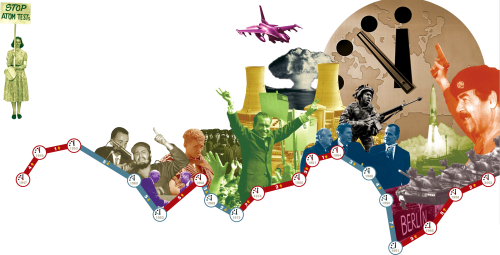
1947-1953
A foreboding feeling ushered in the Clock's inaugural appearance in the June 1947 Bulletin. After the U.S. atomic bombings of Hiroshima and Nagasaki, the question was when–not if–the Soviet Union would acquire its own nuclear weapons. Because of the “slow progress” of negotiations on the international control of atomic energy and the surprisingly quick development of U.S. and Soviet thermonuclear weapons, by 1953 the Clock had moved from seven minutes all the way to two minutes to midnight.

1954-1963
Though careful to avoid “facile optimism,” the Bulletins editors believed that by 1960 they had “lived through a turning point in the affairs of mankind.” The establishment of international bodies, the growing global acceptance of a cooperative mindset, and the entry into force of the 1963 Limited Test Ban Treaty gave the Bulletin enough hope to move the Clock back from the brink, despite ongoing conflicts and continued disparities between rich and poor nations.
1964-1968
Whatever optimism had accrued during the late 1950s had disappeared by early 1968. Following a trend of “international anarchy,” both France and China began building their nuclear arsenals in earnest, war raged on the Indian subcontinent, in the Middle East, and in Vietnam. Sounding a dour note, Rabinowitch questioned the priorities of global powers when announcing the Clocks move toward midnight
1969-1972
A series of arms control agreements in 1969 and 1972, which would lay the groundwork for nonproliferation efforts for decades to come, brought new hope and a renewed commitment to international cooperation. But some saw immediately that this progress left significant room for countries–specifically the United States and the Soviet Union–to expand their nuclear arsenals.
1973-1984
India developed the Bomb, and the number of nuclear weapon states continued to grow–as did the number of warheads worldwide. While political instability in Europe and the growing influence of Islamic extremism contributed to the longest period of pessimism in Clock history, the breakdown in relations between the United States and the Soviet Union was the overwhelming factor. In 1984, the Bulletin described the decision to move the Clock to three minutes to midnight, saying that it was “a time when the blunt simplicities of force threaten to displace any other form of discourse between the superpowers.”
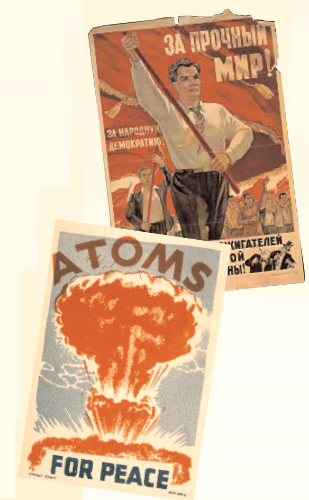
OPPOSITE: CORBIS/BETTMANN (PROTESTOR); ENERGY DEPARTMENT (AEC PIN); COURTESY OF JOHN KRYGIER (ATOMS FOR PEACE ENVELOPE); LIBRARYOFCONGRESS (SOVIET POSTER); CORBIS/BETTMANN (CASTRO); NARA (KRUSHCHEV AND KENNEDY); NARA (SOLDIER); NARA (CHINESE SOLDIERS).
THIS PAGE: NARA (NIXON); DEFENSE DEPARTMENT (F-16 FIGHTING FALCON); ENERGY (“IVY MIKE'TEST); NARA (THREE MILE ISLAND); FILE PHOTO (DOOMSDAYCLOCK);
1985-1991
Passage of the Intermediate-Range Nuclear Forces Treaty sparked hopes that Soviet and U.S. leaders were moving in a positive direction, and the collapse of the Iron Curtain ensured a relatively peaceful end to the Cold War. The U.S. withdrawal of thousands of tactical nuclear weapons from Europe and the completion of a nuclear arms reduction treaty further reduced the specter of nuclear annihilation. The Bulletin proclaimed “a new era,” exhorting citizens throughout the world to challenge “bankrupt paradigms of militarism.” Yet enthusiasm was tempered by the challenge of securing and dismantling the thousands of nuclear weapons stored in former Soviet republics and of reducing further global nuclear stockpiles.
1992-2005
It didn't take long for post-Cold War euphoria to evaporate. Announcing the resetting of the Clock closer to midnight in 1995, then-Bulletin editor Mike Moore lamented that “vision has been in particularly short supply.” Despite unprecedented opportunities to disarm, no nuclear weapon state made significant moves in that direction. The risk of fissile material finding its way into the wrong hands, the abandonment of international arms control agreements, and the failure to effectively stem nuclear proliferation reflected a disturbing attitude of complacency, said the Bulletins Board of Directors in 2002.
