




Abstract
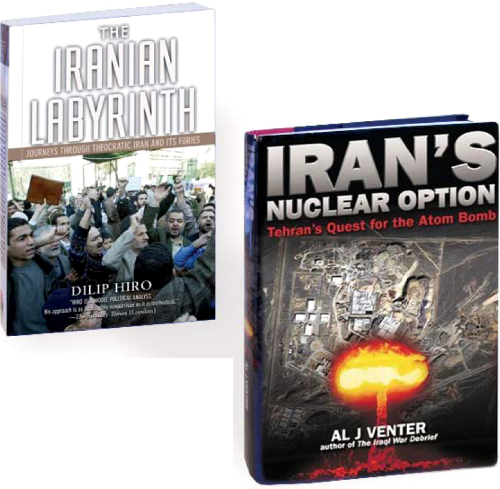
The Iranian Labyrinth: Journeys through Theocratic Iran and Its Furies, by Dilip Hiro. Nation Books, 418 pages, 2005, $16.95.
Iran's Nuclear Option: Tehran's Quest for the Atom Bomb, by Al J. Venter. Casemate Publishers, 451 pages, 2005, $29.95.
Suddenly, it was 1979 all over again. In the United States, the election of Iranian President Mahmoud Ahmadinejad prompted a wave of nostalgia–and not the good kind. In the words of the Chicago Tribune, Ahmadinejad was an “ultraconservative” former mayor of Tehran who “sought to resurrect the fervor” of Iran's Islamic revolution. Grainy photos of Ahmadinejad–or someone resembling him–from more than 20 years ago appeared on television screens like a scene from America's Most Wanted, amid speculation that he was personally involved in the seizure of the U.S. Embassy.
But while America seems unable to get over its feelings of humiliation from the days of the 1979 hostage crisis, many Iranians are eager to move on. A recent New York Times report recounts how the denizens of Tehran have become increasingly embarrassed by the relics of their revolutionary past, such as an American flag painted on the road for cars to drive over. “We don't hate America,” explains a man working in a jewelry store. “We like to have better relations. It's just the governments.”
Yet judging by the “Axis of Evil” rhetoric of the Bush administration, the United States seems determined to squander the benefits it could be reaping from Iran's shifting attitudes. That's too bad, because as historian Dilip Hiro writes in his new book, The Iranian Labyrinth, all it might take to win crucial allies in Iran's younger generation would be a thoughtful U.S. policy toward the country.
For, as Hiro notes, “in 1999, roughly half of Iran's population of 65 million were under 21, and two-thirds were under 25. They had no direct experience or memory of the Shah, and therefore their commitment to the Islamic regime was less than total.” More significantly, these Iranians did not experience America's controversial 1953 intervention in Iran. They had yet to be born when the CIA engineered the coup that overthrew the democratically elected government of Prime Minister Muhammad Mussadiq, and thus, are not seething over it.
The 1953 coup subjected Iranians to 25 years of dictatorial rule by Mohammad Reza Shah Pahlavi, who managed to isolate every sector of society. The first Iranian Revolution toppled the Shah in February 1979. When the U.S. Embassy was overrun and occupied in November, Ayatollah Ruhollah Khomeini called it the “second revolution, greater than the first.” The objective of this second revolution, Hiro says, was to purge the country of all American influence.
Today, Hiro sees scant evidence that the younger members of Iran's population share their parents' fervor for either revolution. Notwithstanding the low esteem Iranians have for Bush, a thoughtful U.S. policy toward Iran could still tap into young Iran's willingness to put the past behind it, he says. Such a policy would be predicated on the diplomatic engagement that Iranian officials have privately sought.
But such a policy must deal with two realities. As Professor Zhand P. Shakibi, a fellow in comparative politics at the London School of Economics, recently observed in a letter to me, “The national card is still powerful. [And] the nuclear issue strikes a positive chord among many Iranians.” Indeed, those two issues have become increasingly intertwined, as the Iranians routinely depict international efforts to limit or control their uranium enrichment program as an assault upon their sovereign right to modernize their country.
Regrettably, anyone searching for insight as to how to defuse this crisis will find little of worth in Al J. Venter's new book, Iran's Nuclear Option. An international war correspondent for nearly 30 years, Venter claims that Iran's pursuit of nuclear weapons is especially ominous because it is “a nation that regards itself in a state of war,” not only with the United States and Israel, “but with any country with whom it has serious differences.”
Venter's book is a maddening mess. It is filled with overheated rhetoric that is often contradictory or unsupported by facts. Consider the traces of highly enriched uranium (HEU) found at one of Iran's locations. Venter incorrectly asserts that “After some careful forensic work, the [International Atomic Energy Agency] afterward belied the Iranian claim the HEU was ‘imported.’” The truth is that there is no evidence that Iran ever produced its own HEU. Venter's provocative assertions are undercut by his subsequent qualifications. Chapters ostensibly devoted to one subject inexplicably shift to another. Some quotations and sources merit endnotes; others do not. Details addressed in one chapter are repeated, almost verbatim, 10 pages later.
Also unconvincing is Venter's breathless account of his 1997 personal conversation with Waldo Stumpf, then head of South Africa's state-controlled Atomic Energy Corporation, in which he says Stumpf told him Iranians went shopping for bomb parts in South Africa. First of all, not long after Venter first made this claim in 1997, Stumpf said that Venter, a fellow South African, “made it all up.” And by trying to strengthen his case with weak arguments–such as the “fact that Tehran admitted in 2003 that it had been trying to build an atom bomb for almost two decades”–Venter, a defense analyst, doesn't do himself any favors. Iran continues to maintain that its nuclear programs are solely for peaceful purposes; despite investigation by the International Atomic Energy Agency, no one has been able to prove otherwise.
Nevertheless, Venter concludes: “That the Persian religious hierarchy is pursuing a robust nuclear weapons option is no longer in doubt. What remains obscure is what the mullahs propose to do with the bomb once they've got it.”
What actually remains obscure is Venter's understanding of the difference between having a nuclear weapons “option” and having actual weapons. At issue is whether Iran is willing to forego its rights to the nuclear fuel cycle under Article 4 of the Nuclear Non-Proliferation Treaty–rights that many believe would give Iran the option to build nuclear weapons. Having that option, however, doesn't necessarily mean Iran will exercise it. From Iran's perspective, the mere capability to develop nuclear weapons might be seen as an adequate deterrent against its adversaries.
Still, preventing Iran from one day doing so remains the crux of the problem. And here the debate–represented by the authors of these two books–boils down to a choice between containment and engagement. Because Hiro has suggested that “One way Washington might turn Iranian minds more toward America is to stop constantly threatening Tehran and start engaging Iran in meaningful dialogue,” Venter excoriates him as “someone who makes no secret of his admiration for those in Tehran who are intent on jeopardizing the security of America.”
Yet, by what measure can Venter claim the current U.S. policy of isolating and threatening Iran to be a success? As George Perkovich, the vice president for studies at the Carnegie Endowment for International Peace, succinctly notes in a recent policy brief (“Changing Iran's Nuclear Interests,” Policy Outlook, May 2005), “U.S. policy toward Iran over the past 26 years has not worked.” Instead, Perkovich suggests the United States should make clear that “if Iran stops pursuing technologies vital to the production of nuclear weapons and threatening its neighbors,” the United States in turn will respect “Iran's security and state sovereignty” and support “Iran's ambitions to be an advanced technological state and suggest possible technological collaborations.” Iran would not be denied a nuclear program but would be expected to modify it, making use of “foreign-fuel services rather than domestic uranium enrichment and plutonium separation.”
Such an approach could offer a way out of the true Iranian labyrinth–the one haphazardly built by vindictive U.S. policy makers in the years since the fall of the Shah. The only other alternative is a dead end.