




Abstract
The latest doomsday threat to emerge from Washington envisions terrorists unleashing an electromagnetic pulse to produce the mother of all blackouts.
But don't be afraid of the dark.

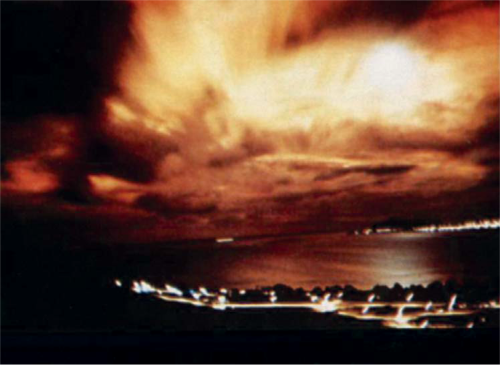
By all accounts, it was a dazzling nuclear explosion. On July 9, 1962, a Thor missile carrying a 1.4-megaton warhead was launched by the U.S. military from Johnston Island in the Pacific. In a test code-named Starfish Prime, the warhead was detonated at an altitude of 250 miles. More than 3,000 miles away, a red aurora with streaks of bright white light illuminated the night sky of New Zealand. Among the thousands who witnessed the unsettling spectacle was 20-year-old David Lange, who would credit the explosion as an inspiration for his staunch antinuclear policies when he became prime minister more than two decades later. 1
But in Hawaii, some 800 miles north of Johnston Island, the mood was decidedly more festive. The local news media spread the word about the test, prompting hotels to schedule special rooftop bomb-watching parties. An electronics engineer named Cecil Coale, stationed nearly 1,500 miles south of Johnston on Kanton Island and tasked with monitoring the detonation with a magnetometer, described what happened that night: “A brilliant white flash erased the darkness like a photoflash. Then the entire sky turned light green for about a second. In several more seconds, a deep red aurora, several moon diameters in size, formed where the blast had been…. This visual display lasted for perhaps 10 minutes before slowly fading. There was no sound at all. The strip chart recorders hummed loudly as soon as the flash occurred. Wow, was there a big change in the Earth's magnetic field! Welcome to the electromagnetic pulse!” 2
Hawaiians didn't need a magnetometer to tell them about the electromagnetic pulse (EMP). The proof was suddenly all around them. Street lamps went dark on the island of Oahu, while telephone service was disrupted on Kauai. In some areas, radio stations stopped broadcasting and cars halted. Tripped circuit breakers triggered burglar alarms. Meanwhile, high above, seven low Earth orbit satellites were crippled. 3
Welcome, indeed, to the electromagnetic pulse. Physicists had speculated about the phenomenon since the 1940s, but Starfish Prime provided tangible evidence of EMP. A nuclear weapon detonated at a high altitude produces an intense burst of gamma rays. The gamma rays, in turn, collide with air molecules, which eject high-energy free electrons in a process known as Compton Scattering. The Earth's magnetic field then traps these high-energy electrons, producing an intense electromagnetic pulse that propagates to the Earth's surface. This energy field is harmless to people, but it can disrupt electronic equipment faster than a lightning bolt. Metallic conductors, such as power cables or even pipes, can channel the shockwave into the electronic systems of cars, airplanes, and computers. A single nuclear warhead of sufficient yield detonated above Kansas could, theoretically, impact the entire continental United States.
Fire in the sky: The Starfish Prime high-altitude nuclear test on July 9, 1962.
The prospect of the Soviet Union utilizing EMP in a crippling first strike against the United States was a perennial concern for Cold War military planners, who undertook efforts to “harden” the electronic systems of critical infrastructure against such a possibility. Such fears largely faded with the end of the Cold War. But in recent months, EMP has returned to the spotlight as one of the hottest new post-9/11 doomsday scenarios making the rounds in Washington.
In the shadow of the 9/11 Commission, a congressionally mandated panel, the Commission to Assess the Threat to the United States from Electromagnetic Pulse Attack, has released a report warning that rogue states, and even terrorist groups could soon acquire the capability to plunge the nation into the pre-industrial Dark Ages. Among the commission's key recommendations is a renewed effort to safeguard the nation's critical infrastructure against EMP, at an estimated cost of $1 billion a year over one or two decades. 4 And advocates of the new EMP threat are quick to note, the United States must push ahead with its efforts to develop ballistic missile defenses.
The EMP report was released in July 2004, and subsequent congressional hearings to publicize the commission's findings have prompted a series of panicky op-eds and articles. “No American would necessarily die in the initial attack, but what comes next is potentially catastrophic,” warned the Wall Street Journal. “Millions could die for want of modern medical care or even of starvation since farmers wouldn't be able to harvest crops and distributors wouldn't be able to get food to supermarkets.” 5 The commission's recommendation is “a regrettable and expensive step,” noted the Omaha World-Herald, “But in today's world, it is a necessary one.” 6 “Imagine the blackout that hit Northeastern states one year ago going coast-to-coast,” opined the San Antonio Express. “And imagine months, or even years, instead of days, to restore basic services.” 7 And Republican Sen. Jon Kyl of Arizona warned in a Washington Post editorial: “No need for the risk and difficulty of trying to smuggle a nuclear weapon over the border or hit a particular city. Just launch a cheap missile from a freighter in international waters–Al Qaeda is believed to own about 80 such vessels–and make sure to get it a few miles in the air.” 8
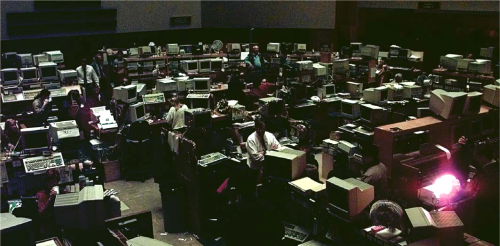
Grinding to a halt: Pacific Stock Exchange traders sit in darkness during a 1998 citywide blackout in San Francisco.
Not everyone, however, is watching the skies and stockpiling food and kerosene heaters. Among the skeptics is Philip Coyle, the former assistant secretary of defense and Pentagon director of operational test and evaluation during the Clinton administration, whose response to the report was that not even the U.S. military knows how to do this today, and that the United States “has no way of demonstrating the capability in the future without returning to nuclear testing.” In his view, the EMP Commission extrapolated “calculations of extreme weapons effects as if they were a proven fact, and further to puff up rogue nations and terrorists with the capabilities of giants.” 9
Indeed, this latest incarnation of the EMP threat endows just about any nation, or even terrorists, with superpower status. In doing so, it offers a convenient list of talking points as a riposte to missile defense's critics: Scud missiles aren't dependable or accurate enough to hit their targets? In the case of EMP they don't have to be. “A terrorist organization might have trouble putting a nuclear warhead ‘on target’ with a Scud,” notes Kyl, “but it would be much easier to simply launch and detonate in the atmosphere.” 10 But if terrorists actually got hold of a nuke, why would they go through the trouble of acquiring a missile when they can smuggle their weapon into a U.S. city using a cargo container? Perhaps, but a high-altitude nuke would do more than wipe out a city–it would bring the entire country to its knees. (“We might be able to do without Los Angeles or New York,” observes Republican Cong. Roscoe Bartlett of Maryland, “but it would be very difficult to live without power, communications, and computers anywhere in America.”) 11
But what about countries like North Korea and Iran? Wouldn't they fear a retaliatory strike? Yes, but deterrence doesn't work in this case. The military might be blinded, unable to retaliate. And besides, those countries wouldn't have directly destroyed any cities, so the United States wouldn't have any clear moral rationale to respond with a retaliatory nuclear strike. Nor do these countries fear an EMP counterattack. Have you seen North Korea? It's so technologically backward, it doesn't have to worry much about EMP.
Sound logic for some; grasping at straws for others. As physicist Richard Garwin notes, “People who argue for missile defense use the most bizarre arguments.”
The EMP strikes back
It began in 1997, when Republican Cong. Curt Weldon of Pennsylvania convened a hearing to address America's growing vulnerability to the EMP threat, noting that no National Intelligence Estimate had addressed the issue since the 1980s. In the hot seat was retired air force Gen. Robert T. Marsh, the chairman of the president's Commission on Critical Infrastructure Protection. Marsh did not challenge the notion that EMP could have “very devastating effects if employed,” but considered the likelihood of it happening to be “very, very remote.” The technological obstacles were too formidable, he said, and if a terrorist group or rogue state were to ever acquire a nuclear weapon, they would more likely use that weapon to obliterate a target on the ground rather than lobbing it into the upper atmosphere with uncertain results. The government, he concluded, would be better off investing its money into efforts to prevent nuclear proliferation and to safeguard nuclear materials. 12
Others at the hearing disagreed. Physicist Lowell Wood of Lawrence Livermore National Laboratory proclaimed that “the de facto national policy of nakedness to all of our potentially EMP-armed enemies takes on ever more the character of national-scale masochism” and chided Defense Department officials for not doing enough. Congressman Bartlett, present at the hearing, lectured the general: “There is not much probability your home will burn tonight, but I bet you have a fire insurance policy on your home. There is not a large probability that we are going to have an EMP laid down over our country, but the probability is certainly not zero. I would submit that, in terms of relative probabilities, we are more likely to have that as a nation than the pulse testing. probability that your home will burn tonight.” 13
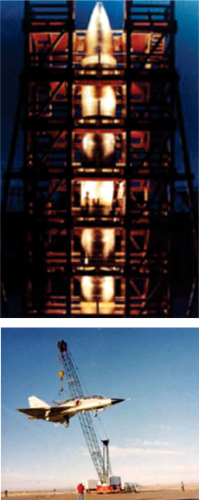
Shock treatment: A Trident missile (top) and an F-106B aircraft undergo electromagnetic pulse testing.
Two years later, Weldon convened another hearing on EMP. Los Alamos National Laboratory physicist Michael P. Bernardin, citing a 1989 Sandia National Laboratories report on the Starfish Prime-induced EMP, noted that “the 30 strings of failed streetlights represented only about 1 percent of the streetlights that existed on Oahu at the time. Thus, the effects were not ubiquitous.” 14
Also, Stanley Jakubiak, the senior civilian for nuclear command and control and EMP policy from the Joint Chiefs of Staff, testified that, in the event of an EMP attack, “our nuclear command and control system would continue to operate properly,” and it would not be “a drastic or catastrophic event that would wipe out the civilian infrastructure.” 15 Citing reports from the National Communications System, Jakubiak noted that phone calls would still get through at a 70 percent rate. Wood, again testifying before the committee, retorted, “This is the same telephone company that can't carry my traffic when I try to call my mother on Mother's Day.” 16
Congress had apparently heard enough. One year later, Bartlett introduced legislation to create a commission to assess the EMP threat. It was an apolitical panel with “impeccable credentials,” enthused Weldon–although some on the commission had a distinct rightward slant. 17 While two of the panel members were appointed by the director of the Federal Emergency Management Agency, seven others were appointed by the secretary of defense. Among the committee members were retired air force Gen. Richard L. Lawson, who is identified by the Center for Security Policy, a conservative think tank, as a member of its military committee, and John S. Foster, a former Livermore director who headed a panel (created by Senator Kyl in 1998) that pushed for new nuclear weapons research. The chairman of the EMP Commission was William Graham, who had served on Donald Rumsfeld's controversial 1998 Commission to Assess the Ballistic Missile Threat, which had chastised the CIA for underestimating the capabilities of rogue states. Also on the panel was the aforementioned Wood, who had twice testified before Weldon on EMP and who liked to refer to EMP attacks as a “giant continental time machine.” 18
Wood's reliance on a science fiction metaphor is unfortunate, given his history. A protégé of Edward Teller's, he infamously overhyped the promise of X-ray laser technology during the Reagan “Star Wars” era. Wood suggested during a 1987 congressional hearing that a single X-ray laser platform could “win” a nuclear conflict by destroying the Soviet missile complement. (He had also sought permission to conduct a test in Nevada, using nuclear-bomb-pumped X-rays to ignite the atmosphere. His briefing was titled: “Pillars of Fire in the Valley of the Giant Mushrooms.”) 19 Ten years and $1 billion dollars later, Congress severely slashed funding of the X-ray laser, demoting it to a small-scale research project.
In his opening remarks to a Senate hearing on the findings of the EMP Commission, Wood stated: “The ‘bottom line’ is that several classes of potential adversaries–including terrorist groupings–have or can acquire the capability to attack the United States with a high-altitude nuclear weapon-generated electromagnetic pulse. A determined adversary can achieve an EMP attack capability without having a high level of either military or nuclear sophistication.” 20 Wood also stressed that the commission sought to avoid a scenario-driven assessment (“sketching the ways … people might choose to do this”), choosing instead to focus on capabilities, because “frankly thinking like a terrorist or thinking like a rogue state leader or whatever is well outside the competences that individual commissioners brought. None of us have been terrorists and very few of us have led rogue states.” 21
But in public statements, members of the EMP Commission have taken ample opportunity to divine intentions, sometimes through arguably circumstantial analyses. In his testimony before the Senate, Peter Pry, an ex-CIA analyst and a senior EMP Commission staff member who advises Weldon on nuclear proliferation issues, theorized that the statement of North Korean defector Hwang Chang-yop that “North Korea would use nuclear weapons ‘to devastate Japan to prevent the United States from participating,’” might mean that North Korea may use EMP to attack Japan. Pry wondered how “North Korea thinks it can somehow ‘devastate’ Japan with its tiny nuclear inventory.” 22 Yet it could just as easily be thought that one nuclear weapon detonated in or over densely populated Tokyo would be devastation enough.
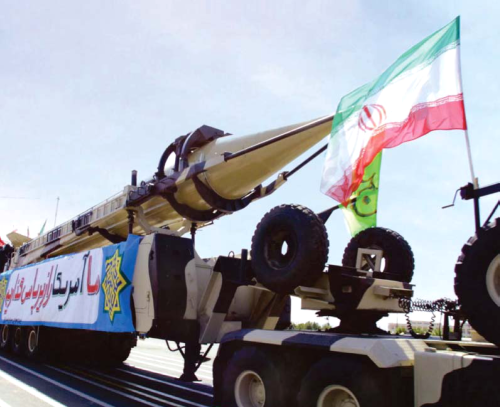
Elsewhere in the Axis of Evil, Pry noted that Iranian flight-tests of the Shahab-3 medium-range missile “have in recent years involved several explosions at high altitude, reportedly triggered by a self-destruct mechanism on the missile. The Western press has described these flight-tests as failures, because the missiles did not complete their ballistic trajectories. Iran has officially described all of these same tests as successful. The flight-tests would be successful, if Iran were practicing the execution of an EMP attack.” 23 Or, put another way, Pry's statement seems to show that he prefers to trust the positive spin of the Islamic Republic of Iran rather than the assessments of Western analysts.
Armed and dangerous? An Iranian Shahab-3 missile on parade in Tehran.
Pry also quoted a passage from an Iranian political-military journal as supporting evidence that Tehran believes the key to defeating the United States is an EMP attack: “‘Advanced information technology equipment exists which has a very high degree of efficiency in warfare. Among these we can refer to communication and information gathering satellites, pilotless planes, and the digital system…. Once you confuse the enemy communication network you can also disrupt the work of the enemy command and decision-making center. Even worse, today when you disable a country's military high command through disruption of communications you will, in effect, disrupt all the affairs of that country…. If the world's industrial countries fail to devise effective ways to defend themselves against dangerous electronic assaults, then they will disintegrate within a few years…. American soldiers would not be able to find food to eat nor would they be able to fire a single shot.’” 24
The EMP Commission, as it turns out, has squeezed much mileage out of this quote. In a PowerPoint presentation delivered in October 2004 at James Madison University, EMP Commission Chairman William Graham also cited the Iranian article to argue that “Potential Adversaries Know About EMP.” 25 Ditto Bartlett, who included a variation of the same quote on a chart that he presented before the House of Representatives in June. 26
“Frankly thinking like a terrorist or a rogue state leader is well outside the competences that individual commissioners brought. None of us have been terrorists and very few of us have led rogue states.”–physicist Lowell Wood
Just one small problem–the article never mentions EMP, or for that matter nuclear weapons. Titled “Electronics to Determine Fate of Future Wars,” the author offers a brief overview of contemporary Western thinking on information warfare, focusing on such issues as internet hacking, computer viruses, and disrupting communications. 27 The article does indeed envision American soldiers unable to find food or fire a single shot–but this is not due to an EMP attack, but rather the result of enemy infiltration of information networks. As it turns out, the EMP Commission didn't need to look all the way to Iran to quote this material. The Iranian author credits the information to the Washington Post.
Some assembly required
John Pike, director of GlobalSecurity.org, doesn't rule out the possibility of nations with nuclear capabilities employing EMP. He could imagine North Korea threatening Japan with an electromagnetic pulse, noting that such an attack would cause a “bizarre amount of economic damage.” But he adds, “If you're talking about terrorists doing [an EMP attack] over the United States, that's in a Batman movie!”
One of the commission's key claims is that the technology to build a Super-EMP weapon–designed to produce the optimum magnitude and kind of gamma radiation for the maximum EMP effect–is within the grasp of both governments and terrorists. Wood said the commission “investigated in detail the assertion of specialists that very small warheads could inflict continental-scale damage and discovered that indeed these assertions have a very substantial basis.” Such a weapon would mean a low-yield warhead (10-20 kilotons)–as opposed to megaton-size yields–could inflict continental damage. “The principal question is: How easy is it to gain the use of a nuclear explosive?” asks Wood.
Even advanced nuclear-armed nations–not to mention terrorists–would confront significant technological hurdles in developing a Super-EMP weapon, especially without resorting to nuclear testing.
“It is difficult enough for terrorists to acquire nuclear weapons or weapons-usable fissile material,” explains Charles Ferguson, a science and technology fellow at the Council on Foreign Relations and a nuclear terrorism expert. “Firing a high-yield nuclear weapon on a ballistic missile adds at least another layer of difficulty for terrorists.” Ferguson believes that “it is far more likely that nuclear terrorists would only be able to build relatively low-yield–at most Hiroshima-sized–improvised nuclear devices and use relatively low-tech delivery vehicles” like a truck, an unmanned aerial vehicle, or a ship. Locks and arming codes built into most Russian and U.S. weapons prevent easy use if they are stolen. And an improvised nuclear device that terrorists could construct–if they had enough weapon-grade uranium–would not be designed for optimal EMP generation.
Similarly, Garwin–who studied the results of the Starfish Prime high-altitude test for President John F. Kennedy's science adviser Jerome Wiesner and who published one of the first theoretical papers on EMP from nuclear explosions in 1954–says the EMP Commission “regards it as a lot easier than it is to produce a high-performance EMP producing bomb.”
He also feels that the EMP Commission doesn't delve “into the differences between an ordinary fission bomb and a thermonuclear weapon.” A thermonuclear weapon, such as the 1.4-megaton Starfish Prime test, will produce “a good deal more EMP simply because the thermonuclear burning is faster.” A smaller, Hiroshima-sized weapon (about 15 kilotons) would have to be optimized to produce large amounts of gamma radiation during fission. Either way, even advanced nuclear-armed nations–not to mention terrorists–would confront significant technological hurdles in developing a Super-EMP weapon, especially without resorting to nuclear testing.
When asked what he thought about the commission's unanimous agreement that a small, 10-kiloton weapon could shut down the critical infrastructure of the United States, he responded, “You can have a unanimous agreement and still have it not right.” Garwin says there is just not enough analysis to say what kind of effect an EMP-maximized fission weapon could produce.
And even if terrorists managed to acquire a nuclear weapon, how would they deliver it? Wood suggests that terrorists could launch an EMP attack even without a state sponsor: “[A] Scud missile launched from a freighter off the Atlantic coast of the United States could constitute a platform that would enable a terrorist group to mount an EMP attack against roughly half of the United States in population terms. Scud missiles can be purchased inexpensively (of the order of $100,000) by anyone, including private collectors, in the world's arms markets.” 28 Pry testified that “some models, the Scud-1, can be purchased for $50,000.” 29
But Steven Zaloga, a missile expert at the Teal Group Corporation, a defense consulting firm, says, “A price of $100,000 for a Scud might refer to a non-working training model, but not to a functional weapon. A price of $50,000 is not realistic, and I don't know what that statement is based upon.” Zaloga said he is unsure what the going rate for a North Korean extended-range Scud would be, but that a baseline Russian-manufactured Scud (which are no longer manufactured) would cost between $1 million and $2 million for the missile alone. The entire Scud system (everything needed to launch the missile, such as the fuel and launch system) would cost significantly more.
And even if terrorists acquired a Scud, could the United States shoot it down? One of the EMP Commission report's suggestions is that the United States should “have vigorous interdiction and interception efforts to thwart delivery.” When asked, Wood said that this included missile defense as well as programs such as the Proliferation Security Initiative and the Nunn-Lugar program to secure nuclear materials in the former Soviet Union. But the problem here, as Garwin notes, is that “the only kind of missile defense the United States is spending a lot of money on now is the National Missile Defense, which would be totally incompetent against the short-range [missile] attacks” the commission lays out as the most devastating EMP attack scenario.
In sum, Garwin says, the U.S. government “needs to do more studies” on EMP and “set a policy for retaliation in response to … any nuclear effect against the United States.”
Others in the international security community feel the same way. Coyle has advocated an independent scientific peer review of the EMP Commission's findings. “The Congress has done this in the past to address controversial nuclear weapons issues. Before this commission's findings become the basis for significant policy and budgetary decisions, we need such an independent scientific review.” 30
It's not a bad idea, especially since the 2006 Defense Authorization Bill includes a provision extending the EMP Commission to ensure that Congress follows through on its recommendations. But before Congress commits itself to spending billions of dollars to safeguard the nation against the EMP threat–and commits potentially billions more to missile defense–it might do well to get a second opinion.
↗
↗
↗
For these articles and more, visit the online Bulletin Archive at www.bulletinarchive.org.
Footnotes
1.
Raymond Richards, “An Unnerving Spectacle: The Starfish Prime Nuclear Test and Antinuclear Sentiment in New Zealand,” Asia Pacific Cultural Studies, December 2004.

3.
Daniel G. Dupont, “Nuclear Explosions in Orbit,” Scientific American, vol. 290, no. 1.
4.
Figure cited by Lowell Wood to author.
5.
Editorial, “Mother of All Blackouts,” Wall Street Journal, August 13, 2004.
6.
Editorial, “Another Type of Threat Homeland Defense Needs Protection Against the ‘EMP’ Threat,” Omaha World-Herald, September 28, 2004.
7.
Editorial, “Commission Notes Yet Another Threat; Last Year's Blackout in the Northeast Demonstrated a Catastrophic Danger to the Nation's Infrastructure,” San Antonio ExpressNews, September 1, 2004.
8.
Jon Kyl, “Unready for This Attack,” Washington Post, April 16, 2005.
9.
Cited in David Ruppe, “Plausibility of EMP Threat Classified,” Global Security Newswire, September 24, 2004.
10.
Kyl, “Unready for This Attack.”
11.
Quoted in Kenneth R. Timmerman, “U.S. Threatened with EMP Attack,” Insight on the News, May 28, 2001.
12.
Military Research and Development Subcommittee of the House Committee on National Security, Threat Posed by Electromagnetic Pulse (EMP) to U.S. Military Systems and Civil Infrastructure, House Hearing 105-18, 105th Cong., 1st. sess., 1997.
13.
Ibid.
14.
Written statement by Michael P. Bernardin. Military Research and Development Subcommittee of the House Committee on Armed Services, Electromagnetic Pulse Threats to U.S. Military and Civilian Infrastructure, House Hearing 106-31, 106th Cong., 1st sess., 1999.
15.
Military Research and Development Subcommittee of the House Committee on Armed Services, Electromagnetic Pulse Threats to U.S. Military and Civilian Infrastructure, House Hearing 106-31, 106th Cong., 1st sess., 1999.
16.
Ibid.
17.
Kathy Gambrell, “Threat from EMPs Needs More Attention, Weldon Says,” Aerospace Daily and Defense Report, July 22, 2004.
18.
Roscoe Bartlett, “The EMP Threat is Real,” UPI, October 28, 2004.
19.
Deborah Blum, “Weird Science: Livermore's X-Ray Laser Flap,” Bulletin of the Atomic Scientists, July/August 1988.
20.
Opening statement of Lowell Wood. Senate Committee on the Judiciary, Subcommittee on Terrorism, Technology, and Homeland Security, Terrorism and the EMP Threat to Homeland Security, Senate Hearing, 109-30, 109th Cong., 1st sess., 2005.
21.
Senate Committee on the Judiciary, Subcommittee on Terrorism, Technology, and Homeland Security, Terrorism and the EMP Threat to Homeland Security, Senate Hearing, 109-30, 109th Cong., 1st sess., 2005.
22.
Statement of Peter Vincent Pry. Senate Committee on the Judiciary, Subcommittee on Terrorism, Technology, and Homeland Security, Terrorism and the EMP Threat to Homeland Security, Senate Hearing, 109-30, 109th Cong., 1st sess., 2005.
23.
Ibid.
24.
Ibid.
26.
Congressional Record, 109th Cong., 1st sess., 2005. Vol. 151, no. 76, pp. H4340-H4345.
27.
28.
Wood, Terrorism and the EMP Threat to Homeland Security.
29.
Terrorism and the EMP Threat to Homeland Security.
30.
Ruppe, “Plausibility of EMP Threat Classified.”