




Abstract
The United States isn't the only country mesmerized by the potential of unmanned aerial vehicles. Is an unmanned arms race in the offing?
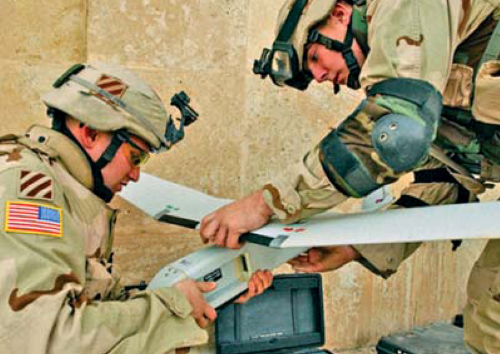
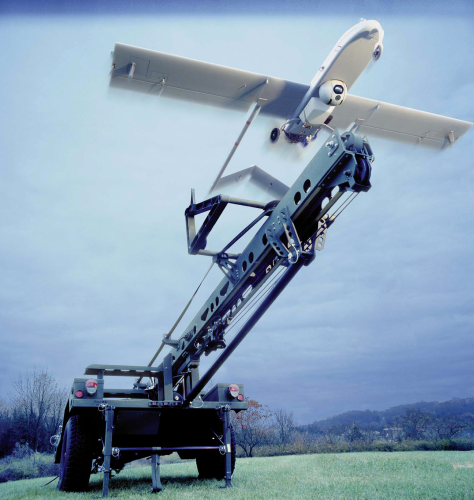
Taking flight: A hydraulic launcher catapults a Shadow UAV into the air; soldiers assemble a Raven UAV for a surveillance flight in Iraq (opposite page).
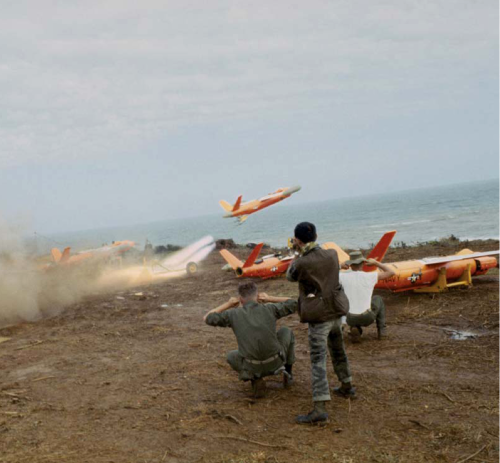
When U.S. military forces charged into Iraq in 1991, they were accompanied by the only unmanned aerial vehicle system in the Defense Department's arsenal.
Dubbed the Pioneer, this small, remotely piloted aircraft with a camera affixed to its belly relayed a soda-straw view of the battlefield to commanders in the army, Marine Corps, and navy curious about what lay beyond the desert horizon–and whether artillery fire had found its target. By the time U.S. forces returned to Iraq in 2003, the inventory of unmanned aerial vehicle (UAV) systems had grown tenfold, and its range of missions had expanded enormously.
Originally designed to provide an overhead pair of eyes for commanders, UAVs are now being armed with missiles and taking on additional roles: counterinsurgency, force protection, infrastructure protection, and strikes against time-sensitive targets. Still more UAV missions, such as supplying troops with everything from beans to bullets, are being considered. (U.S. officials are even considering UAVs for nonmilitary missions, like border patrol and scientific research.) “In 20 years, when we look back, I believe that it will be difficult for us to imagine how we fought without these systems,” says Glenn Lamartin, director of defense systems in the Office of the Undersecretary of Defense for Acquisition, Technology, and Logistics.
Such effusion is driving significant sums into UAV development and acquisition coffers, despite lingering questions about some systems. In 2001, the Pentagon spent $360 million on UAVs; that has climbed to $2.3 billion this year and is projected to reach $3 billion annually by the end of the decade. Worldwide investment in unmanned systems has followed the U.S. trend. Peter van Blyenburgh, head of the Paris-based Unmanned Vehicle Systems International, which advocates on behalf of European UAV manufacturers, told Reuters on the heels of the U.S. military's 2003 arrival in Baghdad that nearly 400 UAV projects were under way around the world, involving 189 manufacturers in 37 countries.
The appeal of UAVs, say military officials, is simple: They are well suited to completing missions that are dull, dirty, and dangerous–from performing sentry duty to examining whether an area has been contaminated by a chemical, biological, or radiological weapon to attacking an adversary's air defenses–all without putting personnel in harm's way.
All of this enthusiasm has a potential downside, too. Despite the allure of unmanned systems, concern is growing that the increasing availability of UAV technology will enable some states or even terrorist and insurgent groups to possess capabilities they wouldn't otherwise have. In this sense, unmanned systems not only have the potential to change the makeup of military forces–they could reshape the future of warfare.
Unmanned promise
The U.S. military's interest in unmanned aerial vehicles had considerably humbler roots. In 1953, Col. Sam Webster, an army intelligence officer at Fort Huachuca in Arizona, installed a camera on a drone typically used for target practice as a way to photograph troop movements, according to air force Col. Thomas Ehrhard, who has analyzed five decades of U.S. UAV experimentation and operation.
Webster's success prompted the army Signal Corps to develop Surveillance Drone-1 (SD-1), a 13-foot-long, propeller-driven craft that parachuted its way to safety after completing missions. Though pilotless aircraft had been used as aerial targets since World War I, the army's SD-1 ushered in a new era of vehicles designed for return and reuse, according to Ehrhard. The vehicle was operationally deployed to many U.S. units around the world but never saw combat.
The next generation of UAVs, including the converted Firebee target drone, conducted more than 3,500 combat sorties during the Vietnam War, collecting valuable intelligence. When U.S. forces withdrew from Southeast Asia, their focus shifted to the Cold War's central front in Europe. Soviet air defenses and electronic jamming capabilities, paired with frequent cloudy days, however, made UAV operations impractical along the Iron Curtain. The Defense Department regained interest in UAVs in the mid-1980s, after observing how Israeli defense forces used them in concert with manned aircraft to devastate the Syrian Air Force during 1982 fighting in Lebanon's Bekaa Valley.
The United States had a number of notable failures in UAV development, but by the time Iraq invaded Kuwait in 1990, the navy, air force, and army had sufficient confidence in the Pioneer system and went on to employ UAVs in support of both combat and peacekeeping operations in the Balkans in 1996 and 1997.
The first of the current wave of UAVs began to come off the drawing boards in the mid-1990s, just as the theory of “network-centric warfare” took hold as a cornerstone of the U.S. military's effort to remold its industrial age forces into a cohesive unit that uses information, speed, and access to prevail. To do this requires a network of sensors, including layers of overhead eyes, to feed information to forces with the goal of reducing the “fog of war.” For many Pentagon leaders, the 2001 operations in Afghanistan and the initial military combat operations in Iraq in 2003 validated the effectiveness of this vision.
Advocates of unmanned technology say more is yet to come. Demand has driven the number of unclassified UAV systems on the Pentagon books to 17, encompassing a fleet of nearly 1,500 air vehicles. By the end of the decade, the Pentagon plans to quadruple its UAV inventory.
The military is eyeing a massive unmanned airship that could act as a temporary satellite, operating in near-space with a host of sensor and communication gear. The promise of nano-technology is giving rise to visions of UAVs the size of insects that might fly through an open window to observe what's happening inside a building. Other advances are driving Pentagon officials to predict that in 25 years unmanned capabilities could be paired with airframes that morph, skins that stretch, and alloys that bend, permitting mid-air maneuvers impossible for today's manned aircraft.
Yet questions linger about some UAVs' basic functions. One of the military's most successful UAV systems, the Predator drone, has also been the most fallible. Because it flies at relatively low altitudes and at relatively slow speeds, the Predator is vulnerable to attack and accident. Although, as an experimental system, its failure rate is consistent with its original design. Defense officials and experts have also been critical of the limitations of the Predator's imagery sensors.
An arsenal of drones
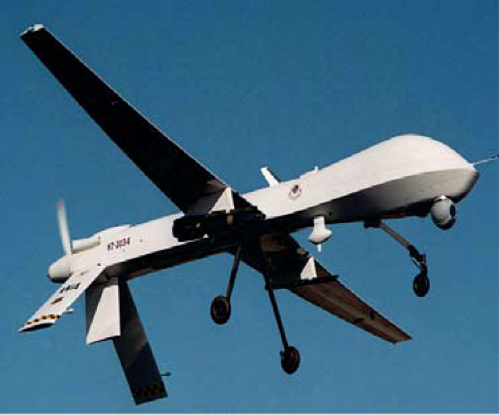
In addition to its intelligence-gathering abilities, the MQ-1 Predator can be armed with Hellfire missiles.
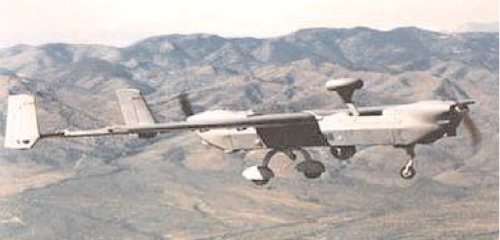
The army used Hunters to relay imagery in support of missions in Bosnia and Iraq, and the Department of Homeland Security has used the craft to patrol the Mexican border.

The Shadow can operate for more than five hours and can carry both electro-optic and infrared imagery payloads.
Soldiers using a laptop in the battlefield control this hand-launched reconnaissance and surveillance drone, which can stay airborne for 30-60 minutes.
SOURCES: GLOBALSECURITY.ORG; ARMY-TECHNOLOGY.COM; AAI CORPORATION; DEFENSE DEPARTMENT.
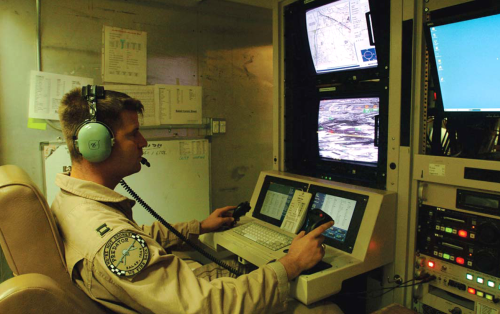
Remote control: An air force pilot maneuvers a Predator drone flying over Iraq from a control station in July 2004.
And while the Defense Department has no plans to fly armed UAVs in domestic airspace, the possibility of this craft, or any UAV, crashing or flying astray might explain why the Federal Aviation Administration (FAA) has been reluctant to approve UAV flights over the 50 states. “We don't have particularly good protocols yet for low-altitude UAVs,” said R. John Hansman, director of the MIT International Center for Air Transportation. Still, the Department of Homeland Security is operating unmanned aircraft to patrol the U.S.-Mexican border, and interest among state and local authorities for UAVs is high. Hansman warns that low-flying UAVs present two risks that experts at FAA and NASA, among other places, are working to address: airborne collision and aircraft failure. Military officials have expressed similar concerns that a lack of coordination between services could lead to mid-air collisions and radio frequency jamming issues.
These questions aside, UAV systems are “one of those asymmetric advantages that a technological nation has,” says Marine Corps Lt. Gen. James Conway, director of operations on the Joint Staff who recently led Marines in two combat tours in Iraq. “We need to exploit it as much as we possibly can.”
Mini me: A prototype micro air vehicle.
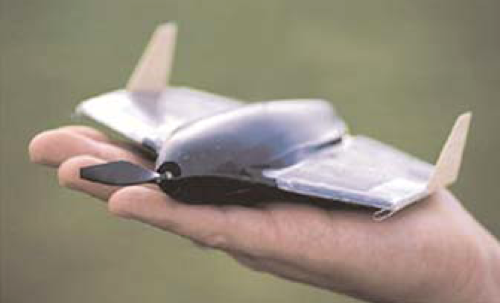
The fastest growing category of U.S.-built UAVs includes devices not much bigger than what one might find on the shelves of toy stores. The nearly 1,300 small UAVs in the U.S. inventory generally weigh less than 10 pounds and have been particularly useful for troops on the ground in Iraq and Afghanistan because of how easily and quickly they can be deployed to gather information. The larger and considerably more expensive UAVs–like the Predator, Global Hawk, Shadow 200, Pioneer, and Hunter–fly much higher and further, covering wider swaths of terrain with sensor packages that can cost millions of dollars apiece (see “An Arsenal of Drones,” p. 31). And unlike the small UAVs, most of these aircraft require airfields for landing and launching, not to mention support teams to maintain, launch, and recover them. Data from these craft go to higher headquarters, where colonels, generals, and admirals direct their movements and assign tasks. Unless a small-unit commander out in the field is on a very high-priority mission, he doesn't have a chance of influencing the direction of these vehicles or accessing their imagery in real time.
Identity crisis
Why one man's UAV is another man's cruise missile
When the Defense Department moved to arm the Predator drone in 2000, it ran into a legal problem. Since the mid-1980s, arming unmanned aerial vehicles (UAVs) had been unacceptable because of concerns that the vehicles–similar in function to cruise missiles–would violate the Intermediate-Range Nuclear Forces (INF) Treaty.
In 2000, a Compliance Review Group determined that both the Predator and the air force's in-development unmanned combat air vehicle (UCAV) would not violate the INF. Able to take off and land on a runway and to be reused, and featuring built-in weapon bays, the Predator and UCAV were determined to be more like aircraft (which are not covered by the treaty) than cruise missiles.
Stuck in the no-man's-land between aircraft and cruise missiles in terms of function and design, UAVs have proved difficult to categorize for arms control purposes. The wide range of types and purposes of vehicles in use and under development make it even harder to keep certain technologies out of the wrong hands, experts say.
“UAVs and cruise missiles play several different roles in security thinking that lead to different approaches to controlling them,” says Michael Levi, a weapons expert at King's College London and coauthor of The Future of Arms Control. “Whether you are thinking of them as strategic assets or things that terrorists would use, that changes what it is you are worried about.”
One concern is that even relatively primitive UAVs could be armed with conventional explosives or, worse, fitted to spread bioweapons agent. The Missile Technology Control Regime (MTCR), an export control agreement that monitors the trade of some UAV systems and components, recently responded to this concern by expanding controls on short-range UAVs and adopting new definitions for cruise missile and UAV range and payload, all in an attempt to close loopholes that permitted the exchange of sensitive UAV systems.
Despite progress, there are still gaping export control holes, according to Dennis Gormley, a senior fellow at the Monterey Institute's Center for Nonproliferation Studies. Gormley believes that the MTCR should also control the trade of countermeasures (such as stealth technology), as well as a specific type of flight management system that would allow an individual to convert a small manned aircraft into an unmanned one–a particularly frightening proposition if that person is a terrorist. “It is simply a matter of looking at the technology closely and describing it in sufficient detail so it could be written in as part of the export control regime,” he says.
On the other end of the UAV spectrum are UCAVs, some of the most advanced UAVs yet conceived, which military planners on both sides of the Atlantic hope will take over some of the duties of existing manned aircraft. But because UCAVs are so similar to some manned aircraft, the number of arms control measures limiting their spread could be low, since historically, Gormley says, there have been no broad measures restricting trade for manned aircraft. “I just don't see a [formal agreement] in the cards. Each country is going to deal with the [UCAVs] consistent with their perception of their national interest,” he says.
Fight or flight? A French drone is launched over Kosovo in 1999.
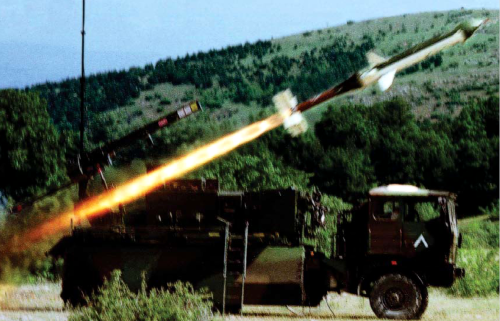
Controlling exports of UAVs intended for surveillance and other nonlethal missions–but which could be used for other purposes–could be just as tough, Levi says, as controlling transfers of other defense-related technology with multiple applications. “It is just important to recognize the diverse set of roles these things play.”
A guiding hand: Chinese soldiers launch an unmanned reconnaissance aircraft as part of a 1999 training exercise. Global development of UAVs has been steadily increasing.
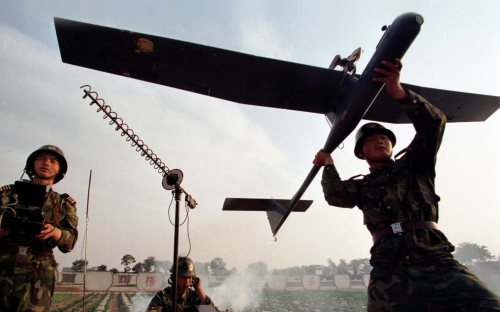
The most expensive and most capable UAV is the Global Hawk, a jet-powered, high-altitude craft that can stay aloft for 36 hours at a time. Flying just 3 percent of the intelligence, surveillance, and reconnaissance missions in Iraq, it generated 55 percent of the time-critical targets against enemy air defenses.
As demand for Global Hawks has risen, so has the cost of producing the newest model of the craft. In this regard, UAV systems–which can consist of the aircraft, ground control stations, sensors and payloads, communication links, and data distribution infrastructure–have proved very similar to their manned counterparts. As with the Pentagon's long roster of big-ticket aircraft programs (such as the F/A-22 fighter, the C-17 cargo plane, the V-22 tilt-rotor Osprey), the price tags for UAV systems have ballooned as a result of mission creep, lack of multi-year contracts, uncertainty about future acquisitions, and overly ambitious test schedules.
Earlier this year, for instance, the air force notified Congress that the average cost of producing a Global Hawk had risen by 18 percent, triggering reporting requirements under the Nunn-McCurdy provision, which is intended to limit cost growth in major weapons programs. In response, the House Armed Services Committee cut some funding for the program and noted that it was “extremely concerned” about the increase.
Aware of the rising cost of acquiring some UAVs, in January, Michael Wynne, then acting undersecretary of defense for acquisition, technology, and logistics, told Aviation Week and Space Technology that UAVs were at risk of losing their attractiveness as low-cost alternatives for certain missions. “I have watched our Global Hawk go from a relatively inexpensive and phenomenally appreciated vehicle … to the point that it is now approaching what we paid for some bombers in the past,” he said.
Initially designed to complement manned assets, UAVs are increasingly being seen as replacements for some aging aircraft systems. The Global Hawk, for instance, is expected to eventually replace the venerable U-2 reconnaissance aircraft. The navy recently decided to replace its fleet of nearly 230 P-3 Orion submarine hunting aircraft in 2013 with a fleet of roughly 100 new, modified Boeing 737 aircraft; the balance of the mission is to be executed by a still-to-be-defined fleet of Broad Area Maritime Surveillance UAVs.
“The idea is not simply to replace people with machines, but to team people with autonomous platforms to create a more capable, agile, and cost-effective force that also lowers the risk of U.S. causalities,” explains Tony Tether, director of the Defense Advanced Research Projects Agency.
Now that Defense has modified some UAVs, such as the Predator, to carry weapons, it won't be long before they begin to usurp some missions traditionally given to manned fighter craft. Though representing a fundamental shift in military capabilities, these vehicles' potential is primitive in comparison to the most ambitious unmanned aircraft program the Pentagon has yet undertaken–the Joint Unmanned Combat Air System (J-UCAS), which aims to develop for the navy and air force by 2010 a prototype stealthy UAV with a bomb bay.
Some analysts believe the J-UCAS program may prove too expensive and that unmanned combat systems will more likely take the form of UAVs currently in the inventory, only armed. “You're likely to see much more fielding of relatively low-tech, unmanned combat air vehicles like Predators, Hunters, or Pioneers that are dropping small bombs well before you're going to see something that is high-tech, high-performance, and expensive like J-UCAS,” says Christopher Bolkcom, an aviation analyst with the Congressional Research Service.
Odd bird out
While UAVs are enjoying an exceptionally high profile, in the view of many Pentagon veterans, they have yet to firmly establish constituencies and leadership to protect them when making difficult resource decisions. When it's time to pick between funds for infantry, aviation, or armor, UAVs may still get short shrift in the politics of Pentagon budget drills.
Of all the services, the air force has taken arguably the most steps in making a permanent place for UAVs. It has established UAV squadrons with all the attendant training and support elements accorded its manned aircraft. The biggest difference being that UAV operators are often stationed a world away–literally. Take, for example, the air force's Predator squadrons that support round-the-clock operations in Afghanistan and Iraq from just outside Las Vegas. A skeleton staff of pilots and maintenance crews launch and recover the UAVs from airfields in Iraq and near Afghanistan. Once airborne, however, control of the UAVs is handed over to pilots and operators in the Nevada desert.
Ensconced in windowless ground control stations that look like trailers from the outside, the operators sit before a set of control devices and monitors–sometimes linked by radio with troops on the ground–looking over distant terrain. When “you put your hands on the controls and your eyes on the screens, you feel as though you're flying over Iraq or flying over Afghanistan. You get yourself into that reality. It's not a video game. It's the real deal,” says Capt. Steven Rolenc, spokesman for Predator operations at Nellis Air Force Base.
Still, there is resistance to UAVs, acknowledges a navy analyst who asked not to be identified. “It's strongest within the [naval] aviation community. It's taking jobs away from [fighter] pilots. And being a pilot of a UAV isn't the same thing as being a pilot of a fighter.” Yet amid that resistance is a growing appreciation for the improving reliability of UAVs, particularly following a handful of successful strikes against Al Qaeda operatives in Yemen and Pakistan.
Attention getter: An Israeli-manufactured UAV on display at the Aero India 2005 air show in Bangalore, India.
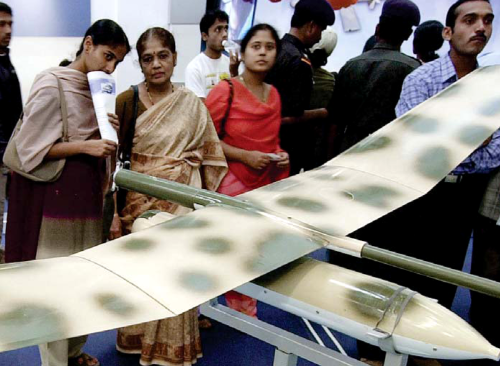
While fighter pilots have been slow to accept the burgeoning role of UAVs, air force officials have been outspoken in support of coordinating the UAV operations of all the services and petitioned for the Defense Department to name the air force its executive agent for UAVs. This proposal met stiff resistance from army, navy, and Marine Corps officials who believed such a move would invest too much power in a single service. Instead, in July, Marine Corps Gen. Peter Pace, vice chairman of the Joint Chiefs of Staff, directed the creation this fall of a Joint UAV Center of Excellence at Creech Air Force Base in Nevada to improve the interoperability and use of UAVs across the services.
New uses, new threats
“The real benefit comes when you can populate a region with a large number of UAVs, because if there are high numbers of UAVs, their sensors can be much weaker,” says navy Cdr. Gregory Glaros, who is investigating the command and control issue in the Pentagon's Office of Force Transformation. With scores of unmanned systems controlled by a single operator, “unique things start to happen,” says Glaros, an F-18 pilot. “If you have a homogeneous sensor on each vehicle, it creates a robustness in the network, greater effectiveness, and clarity.” Fulfilling this potential, he adds, would essentially create “God's view.”
Yet omniscience doesn't come easily–especially in wartime. After Saddam Hussein's Baghdad regime was quickly defeated in 2003, the Defense Department found itself in a low-grade war that it was not equipped to fight, bolstering the sentiments of critics who have argued that the Pentagon's emphasis on information dominance will not necessarily translate into tactical, operational, or strategic advantages in future conflicts.
Grounded for good: Insurgents in Iraq display pieces of a U.S. unmanned aerial vehicle that crashed near Falluja in September 2004.
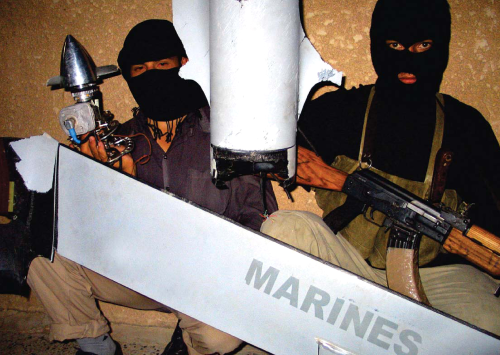
The era in which the United States enjoys an exclusive asymmetric advantage thanks to UAVs may be brief. In the future, the Pentagon could end up squaring off against UAV-armed enemies.
“If you think about the three wars we're in, do we really know who the insurgents are, what their motivations are, or how they're operating?” asks Marine Corps Col. Thomas X. Hammes, a counterinsurgency expert and author of The Sling and the Stone: On War in the 21st Century. “We're fighting in an information deficit in [Iraq, Afghanistan, and the war on terrorism], but we're building a future based on information dominance.”
Talk to other military officials and they will tell you that UAVs have been adept at countering insurgent threats. The Pentagon has employed UAVs to map and regularly survey vulnerable supply routes, pipelines, and power lines; while hunting for insurgents planting roadside bombs, UAVs have observed black marketers salvaging copper from newly repaired power lines. And, for soldiers on the ground, they save lives. “We've been fairly effective in using both the Shadow and the Raven as a means to identify and then eventually target mortar teams and rocket teams that have been killing our soldiers,” says Brig. Gen. Jeffrey Schloesser, head of the Pentagon's Army Aviation Task Force.
Yet, the era when the United States enjoys an exclusive “asymmetric advantage” through UAVs may be brief. Many Pentagon strategists believe that future U.S. adversaries will most likely be subnational actors–such as the Iraqi resistance or Somali clans, and transnational actors, like Al Qaeda or organized criminals–rather than nation-states. Either way, the Pentagon could end up squaring off against an enemy armed with UAV forces.
The number of countries worldwide capable of manufacturing UAVs keeps growing, as does the desire to push UAV capabilities. In May, Indian officials announced plans to begin producing UAVs domestically. A consortium of European companies has also agreed to begin developing an unmanned combat aerial vehicle. Russia recently announced that it had developed a UAV that didn't require a special launcher, but could be fired with an 800-kilogram rocket launched by a Smerch multiple-launch rocket system.
Vision quest: Photos of a Hezbollah UAV flying over northern Israel (left); Israeli drone imagery from above the Gaza Strip.
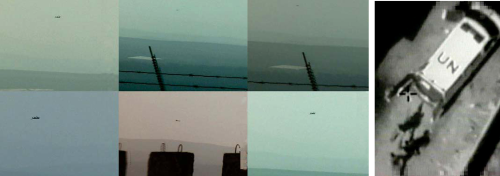
Absent an indigenous production capability, countries looking to add UAVs to their forces have had to look no further than the international arms market. India, China, and Turkey are among the nations reported to have acquired Harpy attack UAVs from Israel. (Harpies can only marginally be considered UAVs; they function more like cruise missiles.) Concerned that Israel was preparing to upgrade the Harpies that it had sold to China, the United States intervened earlier this year to scuttle the plan.
Unlike building an air force, which requires the resources of a state, UAVs are now being acquired and operated by terrorists. Hezbollah has acquired a UAV system, most likely from Iran, which it has dubbed Mirsad-1 and flown on multiple reconnaissance missions from Lebanon into Israeli airspace. “You can load the Mirsad plane with a quantity of explosive ranging from 40 to 50 kilos and send it to its target,” bragged Hezbollah leader Hassan Nasrallah. “Do you want a power plant, water plant, military base? Anything!”
“This fundamentally changes the competition,” said Michael Vickers, director of strategic studies at the Center for Strategic and Budgetary Assessments in Washington. “A competitor that might have difficulty creating a manned air force could potentially get into the air game or undersea game, without having to have a very sophisticated undersea force.”
The increasing availability of technology necessary to build so-called micro air vehicles (MAV), which are typically less than 6 inches long in any direction, is particularly worrisome, according to a recent National Research Council report, “Avoiding Surprise in an Era of Global Technology Advances,” which labeled MAVs “a significant threat” to U.S. air dominance. “Given today's trends in the global commercial marketplace, future adversaries will have low-cost options that could negate the advantage held by today's [friendly] forces,” the report states.
Add to this the fear of some Pentagon officials that the technologies necessary to assemble a UAV and effectively create a poor man's cruise missile are readily available. “The capability to do this is really out there,” says Bolkcom.
Concerned about the vulnerability of U.S. airspace to a low-cost UAV, possibly armed with a weapon of mass destruction, the Senate Armed Services Committee in May directed the Pentagon to establish an executive agent to focus on this and other low-flying threats. Regardless of the agent's findings, it is all too clear that unmanned vehicles have made an indelible impression on U.S. military officials, both as potential capabilities and potential threats.
↗
↗
↗
For these articles and more, visit the online Bulletin Archive at www.bulletinarchive.org.