




Abstract
In the internet age, everything is a tew clicks away–including sensitive satellite imagery.

SATELLITES: A Google's-eye view
“There are A10, AV8B Harriers, AC130s, C17s, and several helo makes (are there some Cobras I spy in the mix?). It appears that there are some leftover MiGs parked next to the AC130s.”–Analysis of a Google Maps satellite image of Bagram Airbase in Afghanistan, from a guy named “Joe,” posted on the blog googlesightseeing.com.
A few months ago it would have cost Joe considerably more time and money to obtain such unique satellite imagery. But thanks to internet vanguard Google, any regular Joe can now locate and look at commercial satellite images of everything from the Bagram Airbase to the Playboy Mansion to the Nevada Test Site.
In early April, Google added the commercial satellite search to its Google Maps function, which pinpoints and displays restaurants, hotels, and other attractions that are near a searched-for address. With this feature, users can spot their homes and take sneak peeks at other locations from high above in space. At first, Google provided only coverage of the United States, but gradually it has released more and more international imagery, including military installations in Iraq and Afghanistan.
Google isn't peddling anything new–commercial satellite providers such as Space Imaging and Digital-Globe began supplying satellite imagery to the in-the-know public and nongovernmental community years ago, albeit much more expensively. Nor are images on Google particularly good; most non-U.S. shots continue to be very low resolution. But it is the first time that the general populace has had this kind of imagery a few keystrokes away. (In late June, Google released Google Earth, free interactive software that allows users to zoom from one location to another, further enhancing the “wow” factor.)
The intelligence analyst's-eye view has proved to be incredibly popular. Numerous blogs and repositories devoted to capturing and cataloging satellite images of famous, offbeat, or “secret” sites throughout the world have cropped up across the internet. “It's compelling because we're seeing the way God looks at things,” says John Pike, who chronicles various nations' nuclear and missile programs via commercial satellite imagery at his web site GlobalSecurity.org. “We are sharing that divine perspective.”
The most highly sought-after images–besides celebrity domiciles, of course–are U.S. military installations, especially air bases. Conceivably, reconnaissance for terrorists or other evil-doers is just a click away; the potential repercussions of this have yet to be determined. But thus far, it doesn't seem as though there's anything to worry about.
“Some of this stuff may be of interest to a variety of people, but it's not necessarily something that provides a new resource that can be exploited by those who want to use it for nefarious purposes,” says Jeffrey Richelson, a satellite expert and senior fellow at the National Security Archive. “It's one more source of news for people,” adds Ted Timmons, who maintains an online Google Maps repository at his personal web site, perljam.net. “It's unbiased. Pictures don't lie.”
But they can be hard to decipher. Those who attempt it could easily embellish or misidentify something–especially if they're a novice or self-trained at reading satellite imagery, a highly skilled discipline. Who will provide the context for work done by people like Joe? Or, at the very least, fact-check it? According to Richelson, such an effort might be unnecessary. “Look at the face on Mars,” he says. “There's a case of photo interpretation that doesn't really hold up. If the analysis isn't very good, it's not going to stand out and become something that people start to worry about.”
Native American groups have asked the Department of Homeland Security for funds to strengthen border security on tribal lands that contain critical infrastructure such as nuclear power plants, dams, and pipelines.
Q+A Kaisha Atakhanova
The director of the Karaganda Ecological Center in Kazakhstan, who is a biologist and winner of a 2005 Goldman Environmental Prize for environmental activism, talks about her country's nuclear legacy and the role of scientists in policy making.

PROLIFERATION: The paper chase
Call him “The Bibliographer.” Since about 1991, 49-year-old Mark Gorwitz has spent his spare time trudging to libraries in the Los Angeles area and beyond, tracking the growth of nuclear experimentation and knowledge across the globe.
Open to the public: Researcher Mark Gorwitz.
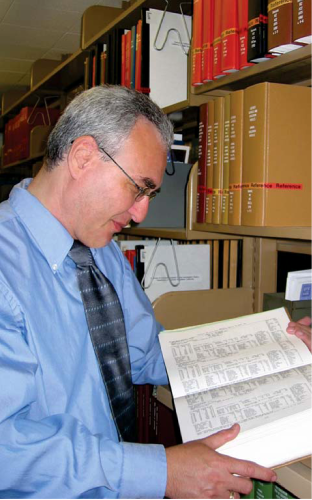
By sifting through the contents of scientific journals, patents, conference proceedings, and other open-source material, the aerospace industry worker has compiled at least nine detailed bibliographies of the nuclear-related work published by scientists from various countries, and numerous additional reports. The gathered information, he says, allows researchers to divine a country's nuclear intentions.
“After awhile you can tell what is civilian-based research, what has military applications, or what has dual-use applications,” he says. “Certain technologies are definitely not civilian in nature.”
In 1996, Gorwitz compiled a report and bibliography on nuclear research in South Korea and identified a surprising pattern of laser isotope separation research. “For a country that imports all of its enriched uranium, as far as I know, you wonder why they were doing this work?” he says. Then last year, South Korean officials acknowledged that scientists at government laboratories had enriched a small quantity of undeclared uranium using laser separation. “It was like a self-fulfilling prophecy,” he says.
While he enjoys peer recognition, Gorwitz ultimately hopes his work inspires others to take advantage of the vast amount of publicly available scientific information and question what they read in the news. “Go out, do your own research, and form your own opinions,” he says. “Don't just take somebody's word for it.”
WEBWATCH: Earth shatterer
HTTP://NED.UCAM.ORG/~SDH31/MISC/DESTROY.HTML
As British college student Sam Hughes astutely and humorously notes on his online guidebook to the various natural and nefarious means of turning the Earth into bits of rubble, the planet is pretty darn sturdy. “It is a 4,550,000,000-year-old, 5,973,600,000,000,000,000,000-tonne ball of iron,” he writes on his aptly named web site, “How to Destroy the Earth.”

Hughes catalogs terrestrial doomsday scenarios–everything from Earth being “gobbled up by strangelets” to being “frazzled by solar plasma”–and rates their feasibility. His only proviso: The method must be scientifically plausible, however improbable or impractical. Of course, no such tutorial could exist without a touch of irreverence. “Addressing such utterly ridiculous subject matter in a straight way makes it funny,” Hughes says.
EMERGENCY RESPONSE: Hive mentality
The answer to better disaster relief might reside in a beehive. Led by civil engineering professor Feniosky Peña-Mora, a research team at the University of Illinois at Urbana-Champaign is attempting to improve the interaction and communication between first responders in disaster situations by studying the behavior of insects such as bees and ants. “There are some commonalities that we can define with insects,” Peña-Mora says. “They know how to survive cataclysm, while humans haven't been doing that well.”
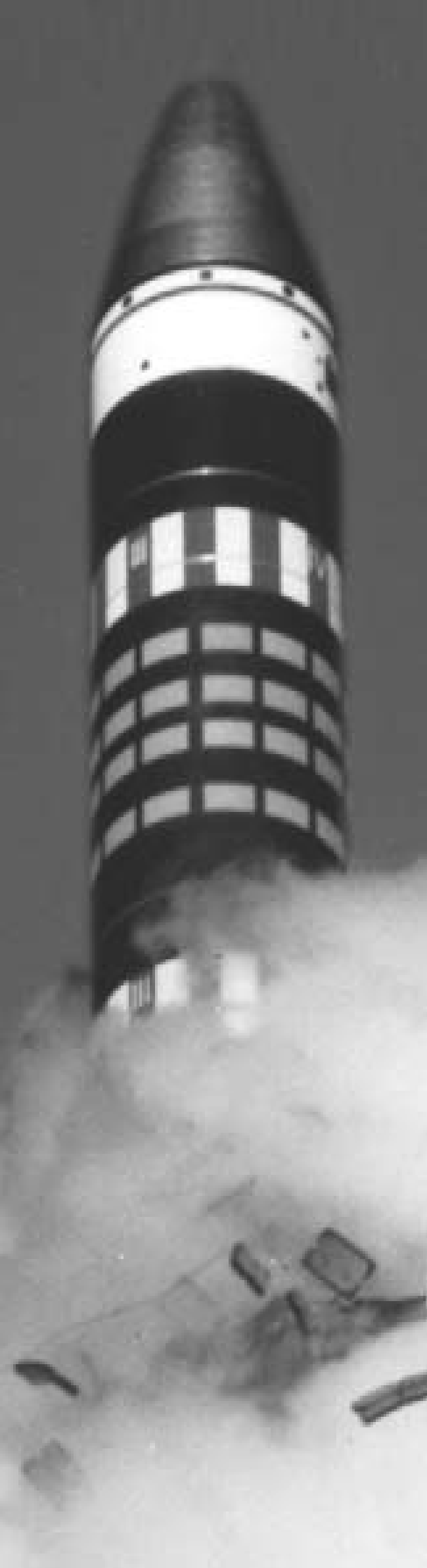
“An insect colony acts as an integrated unit,” adds entomologist Gene Robinson, one of the study's other principal investigators. “It makes decisions. It adapts to changing conditions. And it does these things without having an individual telling the others what to do.”
When disaster strikes, insects rely on instinct. In contrast, humans' reactions in such situations are often undermined by chaos and responders' conflicting priorities. Peña-Mora reasons that this lack of coordination might improve if a more insect-like response enters into human thinking.
Peña-Mora hopes to broaden the first-responder hive by bringing civil engineers into the mix. Having someone on the scene who has crucial information about the endangered physical structure–as a civil engineer would–should facilitate stronger rescue operations, Peña-Mora argues. “Let's make civil engineers one of the first responders. Like the fire department, police department, and EMT services, [let's] have a civil engineering squad in large cities that gets activated depending on the situation.”
CONGRESS: Running numbers
When it comes to politics, mathematician Mason Porter pleads ignorance. So when he and three of his colleagues set out to determine mathematically the partisanship of congressional committees and subcommittees, they let the numbers tell the story.
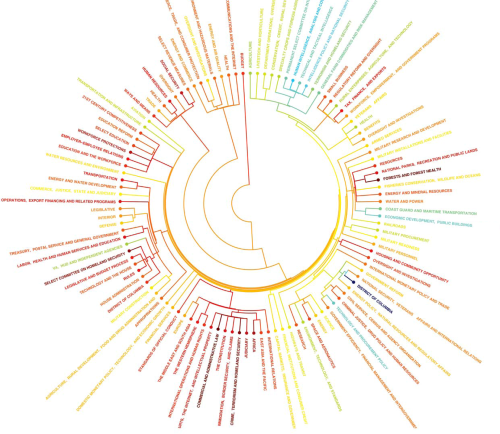
Color-coded: Shades of red represent the most partisan committees in the 107th Congress.

Their study, recently published in Proceedings of the National Academy of Sciences, kept it simple. In cataloging voting records, a ceremonial vote to congratulate Sammy Sosa on his five-hundredth career homerun carried the same weight as a vote on the controversial education bill No Child Left Behind. Yeas, nays, abstentions, and absences were replaced with (what else?) numbers–ensuring that even the tiniest value judgments or biases never figured into the equation. They then plotted the results, to see the extent that members voted along party lines.
What they discovered wasn't exactly shocking–yes, Congress is rife with partisanship and favoritism. But what they showed is how the concept can be derived and illustrated using mathematic tools. (See illustration above.)
According to the study, the Select Committee on Homeland Security was one of the most partisan committees in the 107th Congress, and Illinois Democratic Cong. Jan Schakowsky and Colorado Republican Cong. Tom Tancredo are the most partisan representatives in their respective parties.
Ever the mathematician, Porter will leave interpretation of his data to others. “What we want to do is give a political scientist a good idea of where to look,” he says. “But ultimately, they need to determine whether this reflects something real.”
RE: NUCLEAR WEAPONS: Rest in Peacekeeper
Say goodbye to the MX Peacekeeper missile. After nearly 20 years of service, a symbol of Cold War nuclear excess is retiring–a move the United States agreed to under the now-defunct START II–with the last intercontinental ballistic missile scheduled for withdrawal by October 1.
Of course, as analyst Victoria Samson of the Center for Defense Information notes, the U.S. nuclear arsenal won't take that big of a hit: It will still hold more than 5,300 operational and 5,000 reserve warheads. “If the United States is serious about cutting its nuclear arsenal, it needs to start taking steps to do so now,” she says.
An MX Peacekeeper missile.
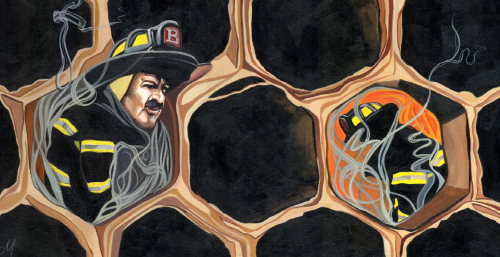
Though the Peacekeeper is being deactivated, its nuclear punch will live on. Some of its 310-kilo-ton W87 warheads will soon replace the warheads in Minute-man III missiles. “This swap will significantly increase the lethality of the Minuteman III force,” says nuclear weapons expert Hans Kristensen.
Other Peacekeeper warheads may someday arm Trident II D5 submarines. It seems that a Peacekeeper's job is never done.
TERRORISM: Weapons of mass digestion
It usually doesn't taste good and may not always be healthy. But could cafeteria food be a terrorist target, too?
Lunch crime: Government officials worry that terrorists might target school cafeteria grub.
The Agriculture Department's Food Safety and Inspection Service (FSIS) is studying whether chicken nuggets and other types of food commonly served in school lunchrooms might be used by terrorists as a kind of biological weapon–and they're not talking about food fights. “The school lunch program is particularly vulnerable,” FSIS administrator Carol Maczka told an audience at the Association of Food and Drug Officials' annual conference in June. The agency has already studied the potential susceptibility of popular cafeteria fare such as spaghetti sauce, egg substitutes, and milk.
Maczka couldn't offer more specific details, noting that these studies are classified. Many security experts, however, stress that while it is important to be vigilant, there is no cause for immediate alarm.
That's probably just as well, since biological weapons expert Milton Leitenberg, a senior research scholar at the University of Maryland, says that a complete checklist of foods that are vulnerable to tampering would encompass “every food” on Earth. “Someone could say that about spinach, dry cereal, or ice cream–anything you want,” he observes.
That said, Leitenberg believes that chicken nuggets, at least, would rank low as a tempting target. Since they're solid, he explains, it would be hard to spread a poison or pathogen over a large quantity of them. When it comes to cafeteria food, it seems, there is safety in numbers.