




Abstract
“All our final decisions are made in a state of mind that is not going to last,” wrote the French novelist Marcel Proust. In 1945, our collective state of mind was despair. World War II touched every inhabitable continent, leaving more than 50 million dead and millions of others as refugees. The conflict had spanned more than half a decade. It would effectively end during an interval of 43 seconds–the time it took for the atomic bomb to explode over Hiroshima after it was released by the Enola Gay on August 6. Three days later, a second bomb was dropped on Nagasaki, followed by Japan's surrender.
Sixty years later, we live in a world where the capacity for mass destruction is no longer limited to superpowers–or, for that matter, to nations. Our collective state of mind is one of vulnerability. The bombings of Hiroshima and Nagasaki are not just historical events but portents of a possible future for any city, anywhere. And it is through that lens that we find ourselves looking back at the decision of President Harry S. Truman and its legacy.
With each passing decade, the anniversary of the atomic bombings provokes a debate over whether the United States made the right choice. But this crucial question is almost always considered in the abstract. A far more difficult task is to assume personal responsibility. With that in mind, the Bulletin sought out noteworthy thinkers with backgrounds in history, theology, physics, and diplomacy and posed a single, provocative question: “If the decision had been yours alone to make, would you have dropped the bomb?”
President Harry S. Truman's chair in the Oval Office of the White Hous
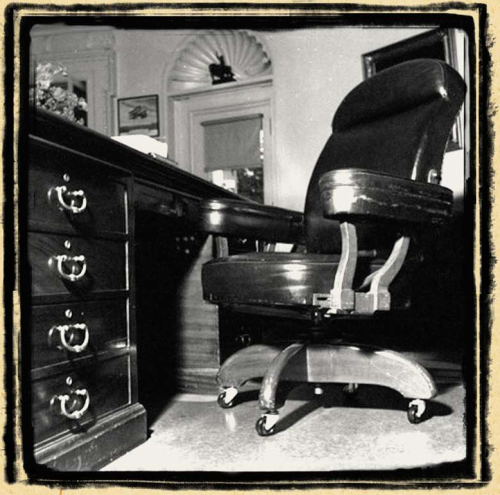
A different kind of weapon
“I am a peace-minded realist who reckons with the occasional necessity of participation in war.”
Fair warning: There will not be and cannot be a satisfactory answer to the question, “If the decision had been yours alone to make, would you have dropped the bomb?”
Still, the answer is: “No.”
That single word suggests that making such a decision might have been simple. Not at all. Taking everything into consideration about what the United States knew in August 1945, it had to be complex.
First, an acknowledgment: Among post-Franklin D. Roosevelt presidents, Harry S. Truman is my favorite. I would not judge him casually.
Second, a handicap: Were I a pure pacifist, that “no” would come more easily. However, I am a peace-minded realist who reckons with the occasional necessity of participation in war. I saw then, and I see now, no way for the United States to have avoided its encounter with and response to Japanese militarism.
And third, a preliminary: I empathize with President Truman and the many, many thousands of G.I.'s (and their families) who were in jeopardy and might have lost their lives had there been an invasion of Japan.
Despite these aforementioned qualifications and assessments, I still believe that using atomic weaponry in this manner was wrong. In 1945, we did not have at hand the sophisticated updating of just-war doctrine that we associate with the judgment of the U.S. Catholic bishops, who wrote in their 1983 pastoral letter, The Challenge of Peace: “Under no circumstances may nuclear weapons or other instruments of mass slaughter be used for the purpose of destroying population centers or other predominantly civilian targets. Retaliatory action, whether nuclear or conventional, which would indiscriminately take many wholly innocent lives, lives of people who are in no. way responsible for reckless actions of their government, must also be condemned.”
Still, the teaching of many religious leaders as of 1945 against bombing civilians gave plenty of warrant to search for alternatives that August. The United States had found desert sites for experimental explosions. It is certainly plausible that the Japanese could have been invited to cross into no-man's-land to observe a demonstration at some other desert location. Had they done so, they might have foreseen the suicide they would bring upon themselves had they continued the savage island warfare into autumn 1945.
Even apart from that, the unleashing of the almost unlimited destructive potential of atomic warfare meant a qualitative leap in mass violence, even for what our nation conceived as a good goal: an earlier end to the war.
This distinction is crucial, as those who grapple with the question of dropping the first bomb on Hiroshima–the second bombing, of Nagasaki, is much further beyond the range of the morally defensible–must also allow that the United States, its allies, and enemies had been bombing civilian centers since 1941. Yet the atomic bomb's fearsomeness, its pandemic effects of radiation, and its capacity to end not only lives but civilizations, made it that much worse than the firebombings that killed hundreds of thousands of civilians in Tokyo and elsewhere. This is what represented the quantum leap in destructive potential and occasioned more reasons for moral opposition.
It was not the use of weapons with more destructive power than before that should have raised moral alarms, but the use of a new kind of weapon, with uncertain and almost unlimited power. In the months and years that followed, President Truman sometimes made his decision to inaugurate this new era sound relatively easy. He cannot have been casual, but his typically abrupt and decisive defenses showed insensitivity to the moral complications, and, in my view, his decision remains unjustified.
That enormous issue apart, he is still a favored president, in my reckoning. I only wish we could roll back the calendar to pre-August 1945. Since we cannot alter the past, it has become more necessary than ever to make our own quantum leap in the use of energies to work for restraint in the present.
A victory without spoils
“Six decades later, even American liberals remain ambivalent about the morality of nuking the two Japanese cities.”
President Harry S. Truman, April 19, 1945.
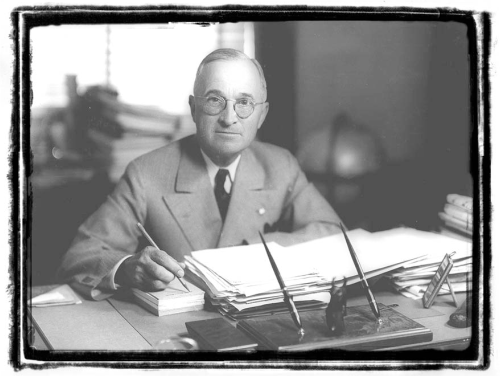
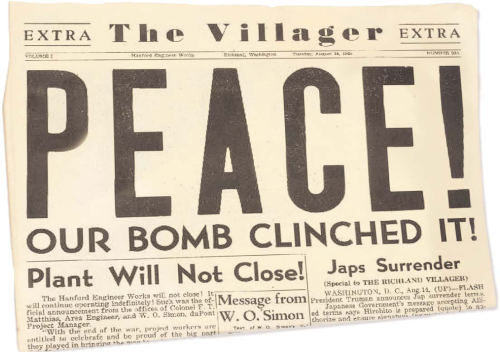
The decision to incinerate Hiroshima and Nagasaki was not taken in anger. White men in grey business suits and military uniforms, after much deliberation, decided it would be cheaper in American lives to release the nuclear genie. Besides, it was such a marvelous thing to show Soviet leader Joseph Stalin. Headlines like “Jap City No More” brought the news to a joyous nation. Crowds gathered in Times Square to celebrate; there was less of the enemy left. The victorious are rarely encumbered by remorse. Not surprisingly, six decades later, even American liberals remain ambivalent about the morality of nuking the two Japanese cities.
Even as the United States dusted off its hands and moved on, elsewhere the radioactive rubble of the dead cities spawned not only a sense of dread, but also an obsessive desire for nuclear weapons. In 1948, while arguing to create India's Department of Atomic Energy, Prime Minister Jawaharlal Nehru told Parliament, “I think we must develop [nuclear science] for peaceful purposes.” But, he added, “Of course, if we are compelled as a nation to use it for other purposes, possibly no pious sentiments of any of us will stop the nation from using it that way.” Just three years after Hiroshima and Nagasaki, those “other purposes” were all too clear.
Days after Pakistan's nuclear tests in May 1998, Japan invited the country's foreign minister to visit Hiroshima's peace museum. The minister was visibly moved after seeing the gruesome evidence of mass devastation. His reaction: We made our nukes precisely so that this could never happen to Pakistan.
Those of us who fight against the Bomb in Pakistan–and are thus branded agents of America and spied upon by our government–recognize that the horror of Hiroshima is a metaphor that cuts both ways. In a recent and widely watched nationally televised debate between myself and Gen. Hameed Gul–a highly influential pro-nuclear Islamist ideologue and former head of Pakistan's powerful intelligence agency–my opponent snarled at me: Your masters (that is, the Americans) will nuke us Muslims just as they nuked Hiroshima; people like you want to denuclearize and disarm us in the face of a savage beast set to devour the world.
I will not burden readers with my reply to this extremist general. But he was making a point that resonates around the globe. The United States has bombed 21 countries since 1948, recently killed thousands of people on the pretext of chasing weapons of mass destruction in Iraq, and claims to be a force for democracy despite a long history of supporting the bloodiest of dictators. Do Americans have even a clue of the anger that seethes in the hearts of people across the globe? Do they care? They now need to, because two nascent fundamentalisms–that of George W. Bush and Osama bin Laden–are heading toward a dreadful collision.
Today, the United States rightly lives in fear of the Bomb it created because the decision to use it–if and when it becomes available–has already been made. But this time around, pious men with beards will decide when and where on American soil atomic weapons are to be used. Shadowy groups, propelled by fanatical hatreds, scour the globe for fissile materials. They are not in a hurry; time is on their side. They are confident they will one day breach Fortress America. And what then? The world shall plunge headlong into a bottomless abyss of reaction and counterreaction whose horror the human mind cannot comprehend.
Such a scenario could have been averted. Had I been the president of the United States in 1945, my first choice would have been to warn the Japanese civil and military leadership of the impending doomsday weapon, and then invited them to see a test demonstration. If that failed to impress, then the bomb could have been used not against civilians but against genuine military targets.
Hiroshima signaled a failure of humankind, not just that of America. The growth of technology has far outstripped our ability to use it wisely. Like a quarrelling group of monkeys on a leaky boat, armed with sticks of dynamite, we are now embarked on an uncertain journey.
Bearing the burden
“The use of atomic weapons did not bring a world without war, but it did bring to an end the most lethal conflict in human history.”
Okinawa, 1945: A U.S. Marine takes aim at a Japanese sniper.
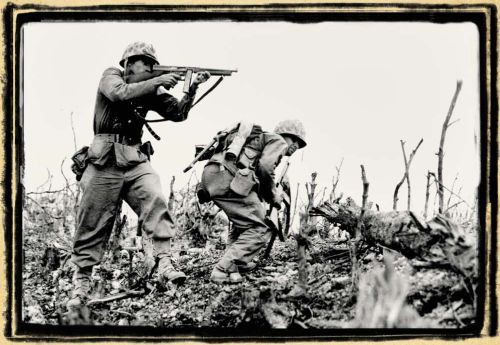
In Goodbye Darkness, his memoir of World War II in the Pacific, historian William Manchester wrote, “After [the campaign on the Indonesian island of] Biak, the enemy withdrew into deep caverns. Rooting them out became a bloody business which reached its ultimate horrors in the last months of the war. You think of the lives which would have been lost in an invasion of Japan's Home Islands–a staggering number of Americans but millions more of Japanese–and you thank God for the atomic bomb.”
To writer and literary critic Paul Fussell, an infantry lieutenant who fought in Germany before being shipped to the Pacific, Manchester's blunt words so obviously and perfectly captured the grunt's-eye view that he took them as the title for his greatest collection of essays. Alas, this rather simple but profound understanding of Harry S. Truman's “decision” to use atomic weapons on Hiroshima and Nagasaki–which wasn't really that agonizing for the president–has been lost with time.
We Americans have also convinced ourselves, as our power and military prowess have grown to the almost absurd point where we talk about “precision warfare,” that war can never again become so desperate or defeat so vivid that we might again consider the nuclear option. War is not meant to be murder, but it does mean killing, and victory requires killing enough of the enemy to make them stop trying to kill us.
In 1945, how much killing would be required remained very much an open question, even after the Nazis surrendered. Japanese propaganda called for “One Hundred Million Souls for the. Emperor,” and there is no debate that an invasion of the Home Islands would have been a ghastly and bloody affair; nor was victory preordained. Indeed, it's hard not to find more than a little moral vanity in our second-guessing of President Truman from the safe distance of several decades. “Having found the bomb,” the president said with typical plainness, “we have used it. We have used it to shorten the agony of young Americans.” No commander-in-chief could have acted otherwise. In the Pacific, E. B. Sledge recorded the reaction of his fellow marines to the news of the bombing; that the war might end was heard “with quiet disbelief coupled with an indescribable sense of relief. We thought the Japanese would never surrender…. Sitting in stunned silence, we remembered our dead. So many dead. So many maimed. So many bright futures consigned to the ashes of the past. So many dreams lost in the madness that had engulfed us. Except for a few widely scattered shouts of joy, the survivors of the abyss sat hollow-eyed and silent, trying to comprehend a world without war.”
Saipan, 1944: A U.S. Marine patrol encounters a Japanese family hiding in a hillside cave.
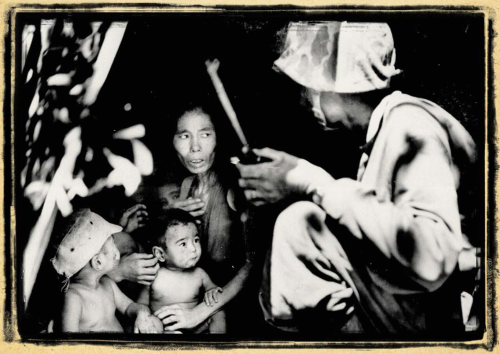
The use of atomic weapons did not bring a world without war, but it did bring to an end the most lethal conflict in human history, during which two fascist regimes employed a variety of ingenious methods to systematically and barbarically destroy tens of millions of their fellow men. Thank God, again, for the atomic bomb–and for Harry Truman's willingness to bear the burden of using it. And if I had been in Truman's place? I hope I would have made the same decision to shorten the agony that was World War II in the Pacific. Having found the bomb, I would have used it.
The promise of retaliation
U.S. strategic bombing survey depicting the extent of fire and blast damage in Hiroshima in the aftermath of the atomic bombing.
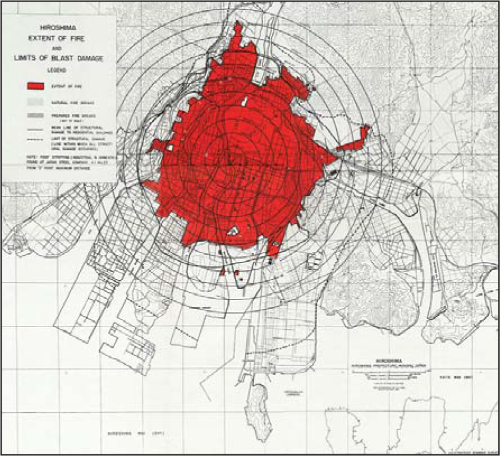
“History cannot be revised, but perhaps our current strategic targeting plan ought to be.”
The issue behind the question of whether or not we should have dropped nuclear weapons on Hiroshima and Nagasaki is whether it was moral or ethical to attack cities with what we now call weapons of mass destruction. Is it acceptable to commit an act that will predictably kill tens of thousands or more civilians, large numbers of whom have no direct connection with the enemy war effort, in order to have some material impact on the enemy's capacity to wage war–and, more importantly, to crush the enemy's will to continue the war? In practice, the United States had, of course, answered that question in the affirmative, by the bombing of Tokyo and Dresden, and in principle by embracing the concept of strategic bombing against Japan and Germany. Although those attacks involved thousands of tons of conventional explosives, and the so-called atomic bombs involved only one bomb for each city, the order of magnitude of the casualties caused was the same: tens of thousands to one hundred thousand or more deaths per city. So what, we may ask, is different about the nuclear attacks?
The answer might be that these weapons have the potential of wiping out entire populations of nations. If one bomb can destroy one city, the United States or any nation can essentially be reduced to a nonfunctioning state by a few tens of nuclear weapons. This would be true if we were speaking of the simple, first-generation fission bombs of 60 years ago. If we consider modern thermonuclear weapons, those produced 30 or 40 years ago, those with two orders of magnitude greater destructive capacity, then we can appreciate how a few weapons could change the course of history and the distribution of power in the international system–indeed, the very structure of the system. That is what makes these weapons different.
But if the issue here is the ethical one, then we should also put President Harry S. Truman's decision to attack Hiroshima and Nagasaki in the context of the plan–the strategy of every president who followed him, including the current one–for defending America from attack with nuclear weapons. The plan is to retaliate against the attacker and destroy perhaps one-half of its population. For Russia, that amounts to not 100,000 innocents, but 100 million. That is the plan. It is called deterrence. That is not only what the United States plans to do, that is what the United States is deeply committed to doing. In this context, the question of whether or not Truman did the right thing in killing Japanese civilians to avoid more American military and naval losses, in a war started by the Japanese, can look a little different, even though he used nuclear weapons to do it. One wants to ask, what were his choices, what were ours all those years during the Cold War with the Soviet Union, and what are they now as we consider our continuing deterrent posture with Russia?
Absent the possibility of an effective classic defense by denial, we are forced to resort to deterrence, the promise of retaliation. But that reality does not relieve us of our responsibility to limit the impact on civilians. Our targets should be military forces and leadership, and ultimately any industry directly connected to the prosecution of the war by the enemy. Beyond that, we get into acts that cannot even be justified by allusions to self-defense. This suggests that President Truman should have looked for targets that were primarily military or genuine war industry–targets that involved fewer, rather than more, civilian casualties. It is unlikely that Hiroshima and Nagasaki could be so described. Breaking the will of the enemy or hoping to put future enemies on notice cannot justify the intentional slaughter of innocent civilians who certainly did not vote for the government that was conducting the war and did not work directly to support the war.
Tokyo Bay, 1945: U.S. Navy carrier planes fly in formation over the U.S.S. Missouri during the official Japanese surrender ceremonies.
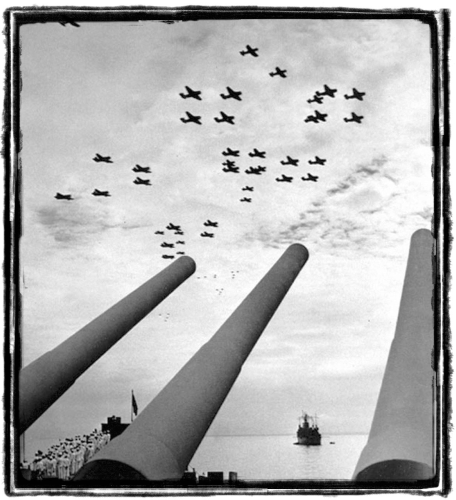
I would not have used nuclear weapons to destroy those cities. History cannot be revised, but perhaps our current strategic targeting plan ought to be.
A dubious advantage
“The bombs were targeted to kill as many workers as possible, with the explicit purpose of creating shock.”
If the decision had been mine to make in 1945, I hope I would have had the good sense to say no, we are not going to use the atomic bomb against a Japanese city.
I certainly would not have been alone in this view. So far as historians can tell from the less-than-perfect records that were kept, top U.S. military leaders felt exactly this way at the time–and well before the August bombings. General (later President) Dwight D. Eisenhower urged that the bomb not be used against an already defeated Japan. The diary of President Harry S. Truman's Chief of Staff–Adm. William D. Leahy, the conservative who presided over both the U.S. Joint Chiefs and the Combined British-American Chiefs of Staff–reveals Leahy believed the war could be ended on acceptable terms in June 1945. Most top U.S. military leaders (including even the famous hawk Gen. Curtis LeMay) strongly condemned the decision as soon as they felt free to speak publicly after the war.
LeMay, for one, is on record as judging the war would likely have ended in two weeks. Japan was essentially defeated by the summer of 1945–her navy sunk, her industries in ruins, her cities undefended against conventional bombardment. U.S. intelligence argued as early as April 1945 that a modification of the unconditional surrender formula plus the shock of the forthcoming Russian declaration of war (expected in early August), would almost certainly end the conflict long before the first landing of troops could occur in November.
Moreover, even if U.S. intelligence advice proved wrong, three full months remained in which the bombs could be used before any troops hit the beachheads. During this period, Gen. George Marshall, chief of staff of the U.S. Army, urged another option. A document dated May 1945 reads: “[Marshall] thought these weapons might first be used against straight military objectives such as a large naval installation and then if no complete result was derived from the effect of that, he thought we ought to designate [a] number of large manufacturing areas from which the people would be warned to leave….”
Many historians now understand that the decision to use the atomic bomb–and the timing–had a great deal to do with diplomacy toward the Russians rather than military defeat of the Japanese. For one thing, the bomb was seen as a great “hammer” (to use President Truman's term) to make the Russians more “manageable” (as Secretary of State James F. Byrnes put it). “Atomic diplomacy” also involved using the weapon to try to stop the fighting very quickly–again for political (not simply military) reasons–before the Red Army and Soviet influence got very far into Manchuria.
Neither Hiroshima nor Nagasaki was a significant military target. The bombs were targeted to kill as many workers as possible, with the explicit purpose of creating shock (i.e. terror). After the war Admiral Leahy framed the moral issue as well as any civilian–indeed better: “[T]he use of this barbarous weapon at Hiroshima and Nagasaki was of no material assistance in our war against Japan…. [I]n being the first to use it, we … adopted an ethical standard common to the barbarians of the Dark Ages.”
There is one other issue: Well before atomic weapons were used, Truman was urged by the Interim Committee (via Secretary of War Henry L. Stimson) to inform the Soviet Union of the new weapon before it was used. To ex-, plode the new weapon without doing so–as a surprise–would clearly make it much more difficult to achieve post-war control of the new force. Stimson, along with many others, believed the Russians had as much interest in controlling nuclear weapons as did the United States. This eminent, conservative Republican leader was dismayed that Truman subsequently rejected his and other proposals for serious negotiations.
Truman's shortsightedness was both immoral and dangerous. Since his time, many presidents, including the current one, have neglected arms control and instead pursued short-term, dubious military advantage. At some point–especially given the thrust of current U.S. foreign policy and the determination of modern terrorists–we Americans in our own era may well experience, directly and tragically, the costs of our massive and continuing nuclear failure.
The best worst option
“I cannot imagine that anyone who could have been president would have failed to use atomic bombs.”
I believe a sober assessment of ends, means, and costs demonstrates that the atomic bombs were the worst way to end the Pacific War–except all the others. Therefore, had the decision been mine to make, I would have authorized the use of atomic bombs.
The U.S. war aim of “unconditional surrender” constituted the essential legal authority to abolish the old order in Japan, thereby transforming military victory into an enduring peace. The Japanese, however, pursued two minimal goals: preservation of the Imperial institution and of the entrenched militaristic order.
Far from regarding their situation as hopeless, Japanese leaders crafted a military-political strategy called Ketsu Go to secure their twin war aims. Ketsu Go rested on the premise that inflicting heavy losses during the initial invasion would shatter brittle American resolve. The Japanese shrewdly anticipated that southern Kyushu (Japan's third largest island) would be the U.S. beachhead and packed it with defenses. Against this backdrop, U.S. diplomatic concessions acted not as a one-way ratchet toward peace, but as concrete vindication for the hardliners' central premise of vulnerable American will.
U.S. leaders confronted an extensive menu of options. Naval and air officers advocated continuation of the ongoing campaign of bombardment and blockade. This strategy contemplated killing Japanese by the tens or hundreds of thousands with bombs and shells, and by the millions through starvation. U.S. decision makers looked to complement bombardment and blockade with an invasion followed by Soviet entry. But the Joint Chiefs of Staff in April 1945 defined the ultimate American nightmare not as the invasion, but the peril that, even if the Japanese government surrendered, Japan's armed forces would not. The prospect of defeating some five million unyielding Japanese in the Home Islands, on the Asian continent, and throughout the Pacific far overshadowed the potential losses in the initial invasion of Japan.
By July and the first days of August 1945, radio intelligence demonstrated that southern Kyushu bristled with Japanese forces that far exceeded prior U.S. estimates. A radio intelligence assessment passed to senior policy makers on July 27 stated that, based on review of both the diplomatic and the military intercepts, it was clear that Japan would never submit to terms acceptable to the United States as long as the Imperial Army remained confident in Ketsu Go. That is the most succinct and accurate assessment of the realities of 1945 as one can find. Given these revelations, I cannot imagine that anyone who could have been president would have failed to use atomic bombs.
The realization that the planned invasion of Kyushu was no longer feasible also undercut any American confidence that Soviet intervention could be decisive, since Gen. George Marshall had tied its impact to the success of the U.S. invasion. More importantly, Japanese military leaders did not regard Soviet entry as the end because the Soviets lacked the sea lift to deliver their massive armies and tactical air forces to the Home Islands. Accordingly, Gen. Yoshijiro Umezu, the chief of staff of the Imperial Army, told the emperor that Soviet entry made no difference for Ketsu Go. More ominously still, the Imperial Army rebounded from news of an imminent Soviet entry with a plan to eliminate any vestige of civilian government and rule from Imperial headquarters. This stroke would have eradicated the legal basis for the emperor's intervention. And absent the emperor's intervention, there was no sure path to peace.
This brings us to costs. The bombs killed between 100,000 and 200,000 Japanese–many from the horrifying effects of radiation that U.S. policy makers were ignorant of in 1945. The alternatives were worse. Beyond the military losses, the Soviet Union's initial intervention in the war against Japan ultimately cost the lives of between 340,000 and 500,000 Japanese, overwhelmingly noncombatants. Had the war not ended when it did, many more would have perished. The blockade would have killed millions.
Finally, we now know that ending the war by August 15 was crucial. By then, a new August 13 targeting directive that sought the destruction of Japan's railroads through strategic bombings would have gone into effect. Coupled to the annihilation of shipping and a desperate food shortage, this directive would have locked Japan inexorably on a course to a massive famine. Ghastly as the bombs were, the grim reality is that no other combination of events would have produced an enduring peace at less cost.
Wrong question
“All I have ever been able to do is talk to people about what physicist Freeman Dyson called ‘a drama too large for a single mind to comprehend.’”
August 1945: Physicist Norman F. Ramsey looks on as Cmdr. A. F. Birch numbers the “Little Boy” atomic bomb as Unit L-11 before loading it onto a trailer.
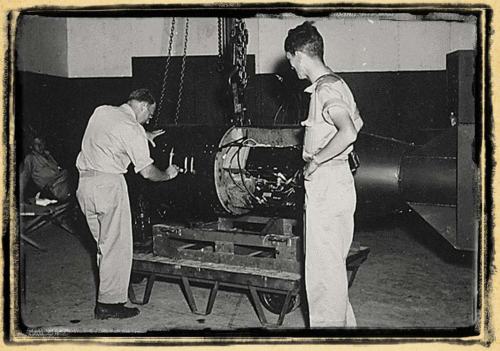
The discovery of nuclear weapons created a crisis in human history. The question posed on the sixtieth anniversary is: Would I have used the atomic bomb? That decision has been extensively debated, most prominently during the fiftieth anniversary of Hiroshima and Nagasaki, when Americans argued passionately about its meaning. Fundamental disagreements were inevitable and appropriate, given the grave subject matter, the availability of new evidence, an aging wartime generation, and the profound legacy of World War II in individual, family, and national psyches. Today, my rendering a judgment would neither add to the empirical data nor settle the matter.
In the face of this crisis, all I have ever been able to do is talk to people about what physicist Freeman Dyson called “a drama too large for a single mind to comprehend.” The process began when I was around seven years old. My father told me that he and my mother, who both worked on the bomb, had hoped that instead of it being used at the end of the war, it would have been demonstrated, compelling the Japanese leaders to surrender, thus saving countless defenseless lives.
On the fiftieth anniversary, five years after my father's death, I moved my dialogue forward by interviewing the Nobel Prize-winning physicist Hans Bethe, head of the theory division at wartime Los Alamos, where the bomb was created. He was among the first to comprehend the precise nature of this new reality. Hans reasoned that the bomb ended the war quickly and definitively, saving untold Japanese and American lives. He asserted that the bomb's development was a foregone conclusion. But the gravity of the crisis meant that the world needed to experience the terrible weapon in actuality, as a warning against the horrors of a future nuclear war: “I think you had to see the center of Hiroshima destroyed, completely leveled…. And so, in a way, the victims of Hiroshima died so that others could live. It is unhappy but that is the way it is.”
Fellow Manhattan Project scientist Philip Morrison commented on Bethe's argument that Hiroshima saved lives: “I don't think we know. I can't say that he is wrong, but I don't agree that it is clear today. I felt that a warning with evidential support would have worked. It would have been much better from the American moral position not to use it as a surprise. And I always spoke for that.”
The Bulletin's longtime editor Ruth Adams learned of nuclear weapons with Hiroshima and Nagasaki. Then she dedicated herself to the crisis. In 2001, she explained to me, “What really struck me then was [that] what begins with killing ends with killing. When you fight a war, you have to prepare for peace. You have to have some understanding and respect for the value of human life. And so to end the war that way, to me, was almost criminal.”
Currently, I am at the University of Nevada, Las Vegas, conducting oral histories of the Nevada Test Site. Here, for good or for ill, the crisis has played out in individual, communal, and cultural consciousness. At the Cold War test site, everyone from warehousemen to weapons designers, from secretaries to science advisers, held top-secret clearances.
Recently, a physicist told me of his deep commitment to saving civilization, during both the Manhattan Project and his work on the Cold War nuclear deterrent. At a meeting of American Indians whose tribal lands lay downwind of atmospheric tests, I was asked how the A-bomb scientists lived with themselves without committing suicide, given the thousands of Japanese they killed. Did I not realize that the science-dominated Western worldview, fed by torrents of cash from Washington, had turned the desert 60 miles north of Las Vegas into a vast experimental laboratory, desecrating traditional lands and raining down illness?
Perhaps our drive to answer the isolated question about “the decision” once and for all reflects our inability to shake an undeniable awareness that the crisis of the bomb in human history is not resolved. What was the probability–given the development of technology and science, the evolution of global political and military institutions, and the state of post-war geopolitics–that the arms race could be avoided even if Hiroshima had never been?
Shortly before his death, the philosopher David Hawkins told me of his friend Robert Oppenheimer's prophecy that nuclear weapons represented a change in the nature of the world: “Here were energies of a magnitude a thousand times greater than anything that had ever been known by human beings before…. Nuclear weapons are simply too great to be used in what human beings have called warfare, which has been an institution in our past for thousands of years, but which has outgrown its own powers. But this is a belief that will come only very slowly and I hope without further tragedy.”
In 1945, a handful of political and scientific elites made the irreversible decision to use the bomb. But the moment the Japanese surrendered, another question arose for the world: “Will nuclear weapons ever be used in warfare again?” This year, Ruth Adams, Hans Bethe, and Philip Morrison, who devoted their lives to avoiding such a tragedy, have died.
Nuclear knowledge is no longer the realm of elites. Ever since Hiroshima, despite scientific complexity and institutionalization of secrecy in our democracy, Americans have borne witness to the bomb. With shared knowledge comes shared responsibility. On the fiftieth anniversary, during the post-Cold War calm, we debated World War II's ending. On the sixtieth, as we face dangers few imagined a decade ago, the question is not, “Would I have?” but “Will we?” Will we be able to prevent future generations from having to ask, for a second time in history, “Should we have used the bomb?”
POSTSCRIPT: THE SURVIVORS
According to Japanese and Chinese tradition, a sixtieth anniversary begins a new cycle of rhythms in the interwoven fabric that binds humankind and nature. To understand what the next cycle will bring, Hiroshima must return to our point of departure and explore the meaning of these 60 years of survival, recovery, and growth. After I took office in 1999, I issued a Peace Declaration highlighting the three primary contributions of the hibakusha (atomic bomb survivors). The first was to transcend their infernal pain and despair. Hovering between life and death in a corpse-strewn sea of rubble, they opted to continue living when none could have blamed them for choosing death. We should never forget the will and courage required for the hibakusha to return to life as decent human beings.
Their second accomplishment has been to effectively prevent a third use of nuclear weapons. From Korea to Vietnam and even Kosovo, strong voices have advocated the use of nuclear weapons. I truly believe the hibakusha's courage in telling their stories, their eloquent argument that nuclear weapons are the ultimate evil, and their determination that such evil never be repeated have helped prevent such madness.
Their third achievement is the new worldview engraved on the Cenotaph for the A-Bomb Victims that stands in the middle of Hiroshima's Peace Memorial Park: “Please rest in peace, for we [the human race] will not repeat the evil.” The survivors make this pledge and totally reject the path of revenge and animosity because they know it leads to extinction.
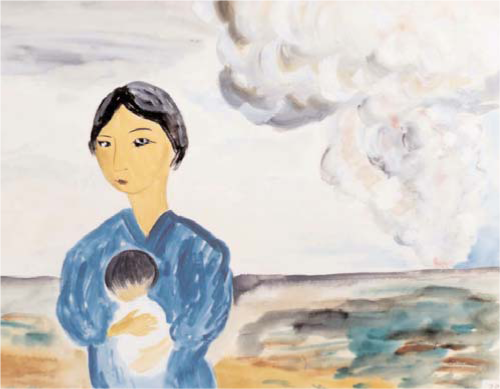
How did the hibakusha, just ordinary people like you and me–except they happened to be in Hiroshima on August 6, 1945–become so determined that “no one else should ever suffer as we did?” Could it be that a mechanism, perhaps encoded in our genes, is triggered when a sufficiently large group of people confronts a threat to our collective survival? Such a mechanism may have shown the hibakusha the truth about nuclear weapons, and they, in turn, are telling us that we must eliminate these weapons if the human race is to endure.
People of faith tend to hear the hibakusha message as a revelation from God. Others react differently, but most of those who study and understand the hibakusha experience come to the same conclusion about nuclear weapons. Perhaps this is why more than 1,000 mayors around the world have responded to the Mayors for Peace 2020 Vision Campaign, which calls for the elimination of all nuclear weapons by the end of the next decade.
The vast majority of people and nations on Earth want to be rid of nuclear weapons. The hibakusha have done more than their share to create a safe and peaceful world for the generations to come. It is now our responsibility to champion the will of the majority and fulfill the hibakusha vision by ensuring their most cherished desire–that no one else ever suffers as they did.
Hiroshima and the decision to use the bomb
↗
↗
↗
↗
For these articles and more, visit the online Bulletin Archive at www.bulletinarchive.org.