




Abstract
Long after the fight over John Bolton's confirmation as U.S. ambassador to the United Nations has ended, the more critical battle over his worldview will continue.

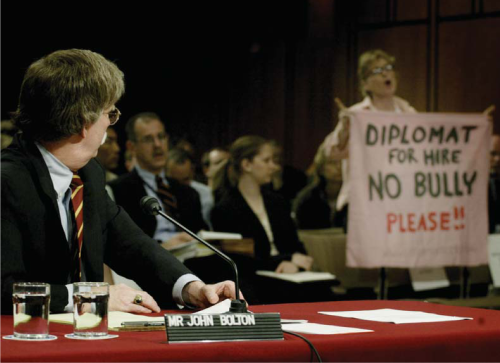
Code Pink struck at 11:15 a.m. Unfurling a banner that read, “No Bolton, Yes U.N.,” activists from the women's peace group staged a protest in the middle of the April 11 confirmation hearing, telling the Senate Foreign Relations Committee precisely what they thought of President George W. Bush's nominee for U.S. ambassador to the United Nations.
No doubt, a few members of the diplomatic community were suppressing grins. During his tenure as undersecretary of state for arms control and international security, John R. Bolton was derided by many State Department colleagues as a neoconservative “mole” who took his orders from Vice President Dick Cheney rather than from the secretary of state. After he was nominated, more than 60 former U.S. ambassadors and diplomats rushed a letter to the Senate Foreign Relations Committee, warning that Bolton “cannot be an effective promoter of the U.S. national interest at the [United Nations].” An activist group called Citizens for Global Solutions launched a web site–stopbolton.org–that featured video of a pugnacious Bolton informing a conference that “there is no such thing as the United Nations.”
On paper, Bolton looked like a shoo-in for the post. The Baltimore native and Yale-educated lawyer has a strong academic background, expertise in international law and policy, and a long history of government service, including several years during the George H. W. Bush administration as assistant secretary of state for international organization affairs–the State Department office that supervises U.S. relations with the United Nations. Yet Bolton's penchant for making outrageous statements, intimidating colleagues, and clashing with intelligence analysts made his confirmation one of the year's nastiest political fights.
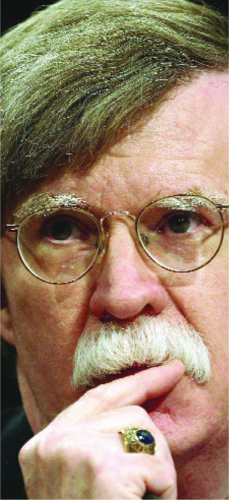
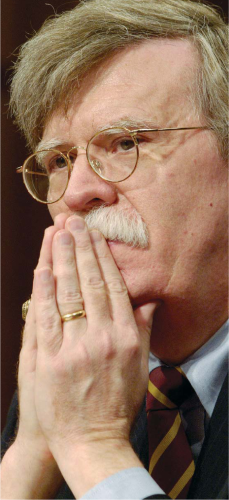
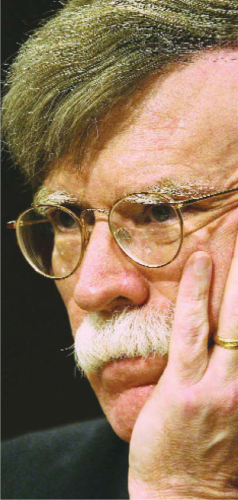
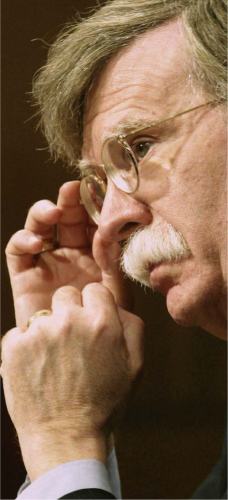
Unfortunately, the furor over Bolton's management skills all but overwhelmed the debate over his views. When Bolton's substance was discussed, the blithe characterizations of him as a neoconservative and the constant repetition of the most egregious “Boltonisms” obscured as much as they illuminated. Bolton may be an unappealing–even abusive–figure, but his amalgam of nationalism and realism are persuasive to many Americans. At the time this article went to press, the Senate had (yet again) delayed the final vote on Bolton's confirmation. But long after the country forgets the congressional brawl, the much more critical battle over his worldview will continue.
The undiplomatic diplomat
There is no getting around John Bolton's personality. Opponents of his nomination often passed only briefly through the realm of policy before arriving at Bolton's undeniable knack for ticking people off. Ask former colleagues their opinion of Bolton and the most frequent response is the adage that those who have nothing good to say shouldn't say anything at all. (Bolton's office did not respond to an interview request.) One senior government official who worked closely with Bolton told me that many State Department employees would have “slit their wrists” if John Bolton had been elevated to the position of deputy secretary–a post he sought before getting the nomination to the United Nations. That official went on to describe Bolton as “a bully” who should be kept “as far away from European diplomats as possible.”
At his confirmation hearings, it was Bolton's run-ins with U.S. officials rather than foreign diplomats that dominated debate. Carl Ford, a former assistant secretary of state for intelligence and research, accused Bolton of harassing an intelligence analyst who challenged his findings on biological weapons in Cuba. In blunt, personal testimony, Ford called Bolton a “classic kiss-up, kick-down kind of guy.” As the hearings continued, other unsettling examples of Bolton's penchant for bureaucratic rough play emerged, including accusations that he blocked information on Iran from reaching Secretary of State Condoleezza Rice and her predecessor Colin Powell.
The stories weren't news to the diplomatic community. Many foreign officials remembered Bolton's performance at a meeting of the Group of Eight (G-8) industrialized countries last October. The European states leading negotiations with Iran over its nuclear program wanted to exchange views on the issue with the United States. After the European presentations, Bolton formally read out a U.S. position paper. In response to a question, he brusquely read another statement. One participant described the performance as “Soviet-style.” Another European diplomat in the meeting remembered, “It wasn't the substance of the message, it was the dynamics–the complete bluntness of the approach shocked people.” Bolton's problem, the diplomat told me, “is that he can't communicate.”
Not all the foreign diplomats with whom Bolton has worked agree that he was ineffective. “There is a lot of respect for him,” one European diplomat told me. “People who demonize him are people who have never met him and have never read anything by him. Much of what they've heard about him is hearsay and fourth hand.”
But hearsay is not usually required. Bolton's long and colorful paper trail ensures that those looking for a reason to dismiss him as an extremist don't have far to go. Many of the choice quotes that emerged during the confirmation fight were penned during the Clinton years, when Bolton took shelter at the conservative American Enterprise Institute (AEI), where he was a senior vice president. There, he poured out tens of thousands of words critiquing the Clinton team's foreign policy.
In Bolton's view, President Bill Clinton's policy on Iraq was “worse than incompetent,” “duplicitous,” and driven by the impeachment process and domestic politics. 1 Clinton's North Korea stance was “egregiously wrong.” 2 Clinton's Libya policy led to a “catastrophic loss of U.S. credibili-ty.” 3 Bolton even challenged human physiology as he derided Clinton's policies as both “flaccid” and “promiscuous.” 4 Just for good measure, U.N. officials were “nabobs.” 5
Reading through stacks of Bolton op-eds, it's tempting to dismiss him as a hopeless partisan, a think-tank thug doing a number on his party's opponent. That would be unfair though, and his critics tacitly acknowledge as much by describing the tenacity with which he has fought for his policies within the Bush administration. If Bolton were merely about getting his party into power and securing high office, he could have played nice, made friends at the State Department while nurturing his ties with Vice President Cheney's office, and probably ended up as deputy secretary of state. “John didn't join government for frequent flyer points or for diplomatic receptions, or for having a chauffeur-driven car,” says Robert Einhorn, who worked under Bolton for eight months as an assistant secretary of state. “He didn't join for the prestige of occupying a senior position. He joined to get something done.” For good or ill, John Bolton is a conviction player.
He fought the law
Few Boltonisms got more play during the confirmation hearings than his assertion that international treaties are not “legally binding.” Delaware Democratic Sen. Joseph Biden told Bolton that “the logical conclusion of your views, in my view, is if the U.S. Embassy is sacked by a foreign state, or a U.S. soldier tortured, then this country and its citizens have no recourse under international law, because in your view there's no such thing as international law.”
At first glance, Bolton's record in the Bush administration appears to confirm Biden's charge that the president's nominee was an international lawyer with little use for international law. One of Bolton's first steps upon taking office was to remove Clinton's final-hour signature from the statute of the International Criminal Court (ICC). Bolton described it as “my happiest moment in government service.” Then, on his watch, the United States negotiated more than 90 bilateral agreements that help place U.S. citizens beyond the court's reach. Congress has endorsed Bolton's campaign and authorized the administration to cut military aid to states that do not sign the agreements. For their part, some State Department officials complained bitterly that Bolton's ICC obsession was threatening relations with important allies–including some, such as Ukraine and Poland, that were contributing to the effort in Iraq.
The ICC is not the only area where Bolton has been able to attack what he sees as a dangerous reliance on treaties and international institutions. He almost gleefully pulled the United States out of negotiations on a protocol to the Biological Weapons Convention in late 2001 and he negotiated the U.S. withdrawal from the Anti-Ballistic Missile (ABM) Treaty with Russia so that the United States could deploy its nascent missile defense system.
This record of treaty killing seems in synch with his stated doubts about the worth of international law. But Bolton's views are more complicated than they first appear. He has indeed stated that “international law, especially customary international law, meets none of the tests we normally impose on ‘law.’” 6 But here, he is actually highlighting an important distinction. When a citizen of the United States breaks the law, that person is subject to coercive measures through the courts and law enforcement agencies. But, if a country ignores or breaks a treaty–say, if North Korea refuses to live up to its nonproliferation obligations or China its human rights undertakings–then what? Because aggrieved nations usually cannot guarantee enforcement, Bolton reasons, most international law isn't law in the sense that term is normally used.
In the world of international legal scholarship, this assertion is more shopworn than shocking. The question of whether law can exist without an enforcing power can be heard in most first-year law school classes. The critical issue is what one does with that insight. And here, Bolton actually leans toward the conventional. Although he questions the formal weight of international law, he adds a major caveat: “This is emphatically not to say that the United States should freely ignore its treaty obligations.” 7 Bolton believes that, in most cases, the United States is morally and politically bound by treaties. He cites, as an example, Article 5 of the North Atlantic Treaty, which states that an “armed attack upon one” shall be deemed “an attack against them all.” The obligations embedded in Article 5, Bolton argues, are weak and vague. Yet, it would have been unthinkable for the United States to have quibbled with the wording had the Soviet Union attacked a NATO ally. The corollary to his view is that the only effective treaties are those whose signatories have a genuine desire to adhere to them.
As such, it's a caricature to say that Bolton doesn't believe in international law. It is precisely because he believes the United States should and will honor its legal obligations in almost all cases that he has been so intent on keeping the United States out of treaties he believes are not in the national interest. After all, he might have recommended that the United States remain a party to the ABM Treaty or the ICC statute and simply ignore their obligations (a tactic not unknown in international politics). And, it is worth recalling, Bolton himself negotiated a raft of bilateral treaties–a strange activity for someone who allegedly places no value on them.
Pretty mad in pink: Protesters disrupt Bolton's confirmation hearing on April 11, 2005.
But Bolton also believes that international law is seductive; that it can blind enthusiasts to the realities of power. Supporters of the ICC, he warns, “make a fundamental error in trying to transform matters of power and force into matters of law.” 8 In his view, the Clinton administration suffered from a “fascination with arms control agreements as a substitute for real nonproliferation of weapons of mass destruction.” 9 One can hear echoes of the classic realists in his concerns. Writing in the late 1930s, as the fascist menace grew, British historian E. H. Carr mocked “the metaphysicians of Geneva” who “found it difficult to believe that an accumulation of ingenious texts prohibiting war was not a barrier against war itself.” 10 Bolton places himself squarely in this tradition, removing blinkers from idealist eyes.
He believes that the same faith in international law that sets up idealists for disaster abroad can be insidious at home. Bolton fears that creeping–and deeply undemocratic–internationalism will undermine American liberties. “To have law in a free society,” he argues, “there must be a framework (a constitution) that defines the government's authority, thereby limiting it and preventing the exercise of arbitrary power.” 11 This is not a trivial point. Today's international law and institutions are often weak on democratic accountability, a flaw that conservatives are not alone in diagnosing. Environmental and labor activists who worry that free trade agreements undermine important national protections often read from a similar script.
Then there is the mushy category of “customary” international law, which develops through the practice of states and the writings of international legal scholars. What happens if there emerges a worldwide consensus, backed up by legal scholars and even U.N. General Assembly resolutions, that the death penalty is repugnant? It is quite possible that the death penalty might then violate customary international law. Is the United States–which has dealt with the issue through its own democratic processes–obliged to ban it? European nations forming their political union have been wrestling with the dilemma of pairing supranational governance and democratic accountability for more than a generation. With its unparalleled power and tradition of fierce independence, the United States has mostly managed to stay aloof. Bolton is anticipating a debate that will almost certainly become more salient as global integration proceeds. His answer to that debate may be crude, but it deserves to be taken seriously.
Holding up the court
In many respects, the new International Criminal Court is the embodiment of Bolton's twin fears about the direction of international law. The Hague-based court, created in 1998, can prosecute genocide, crimes against humanity, and war crimes when national courts aren't up to the task. Where the court's advocates see an important deterrent against atrocities, Bolton sees a collection of unaccountable international functionaries likely to be imbued with a deep hostility to the United States. Because the court claims to sit above national courts, he contends it is “inconsistent with American standards of constitutional order, and is, in fact, a stealth approach to eroding constitutionalism.” 12 In his view, an international court untethered from a legitimate, democratic government cannot pretend to exercise coercive power over U.S. citizens. Bolton bristles particularly over the ICC's claim to exercise jurisdiction over even the nationals of states that have not signed on to the court.
Full court press: U.N. Secretary General Kofi Annan speaks at the inaugural ceremony of the International Criminal Court.
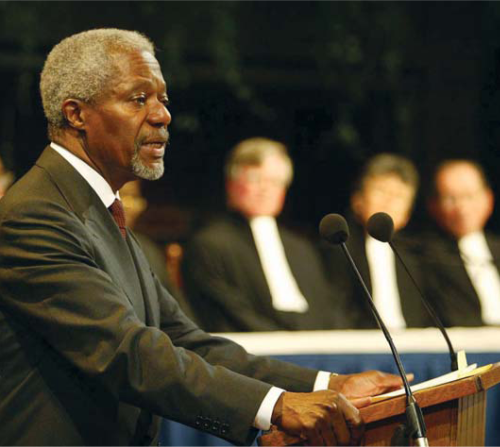
Bolton's suspicion of the ICC was hardened by the controversy surrounding the NATO campaign against Serbia in the late 1990s. NATO acted without the approval of the U.N. Security Council, prompting U.N. Secretary General Kofi Annan to warn that the international community was on a “dangerous path to anarchy.” European and Canadian law professors filed a 1999 complaint with the prosecutor of the International Criminal Tribunal for the former Yugoslavia (ICTY)–established by the United Nations in 1993 to prosecute Balkan war criminals–arguing that NATO had committed aggression and crimes against humanity. The ICTY prosecutor ultimately cleared NATO, but the tribunal's mere consideration of the complaint was a red flag for Bolton. If the ICTY, largely an American creation, could get so out of hand, Bolton shudders to think what the ICC will do, and he does not doubt that its sights are set on Washington. “[T]op leaders in the United States, not just individual soldiers, are the real targets of the ICC,” he warns. 13
In issuing these dire predictions, Bolton intentionally ignores the ICC's procedural safeguards and exaggerates its potential anti-Americanism. One senior Clinton administration official who worked on the ICC calls Bolton's views on the court “hysterical” and says that he “distorts the argument so that the entire court is seen as an assault on the United States.” Three years after it opened its doors, there is no sign that the ICC is bent on pursuing Americans; its first investigations have been in Uganda, the Democratic Republic of Congo, and Sudan.
Bolton's hyperbole about the ICC points to a streak of what can only be called nationalist paranoia. He believes fervently that not just the court but the entire international law movement aims to subdue the United States. “If the American citadel can be breached, advocates of binding international law will be well on the way toward the ultimate elimination of Treaty of Westphalia-style nation states.” 14 Given the stakes in what he sees as an epochal, almost biblical, battle for national sovereignty, it is no wonder that he fights so fiercely against the advance guard of internationalism.
Bolton's view of the court–and of the direction of international law more generally–connects to something powerful in the American psyche, and in American politics. A telling moment came during last year's presidential debates. On two separate occasions, President Bush taunted Massachusetts Democratic Sen. John Kerry for supporting the ICC. “It's the right move,” the president said, “not to join a foreign court that could–where our people could be prosecuted. My opponent is for joining the International Criminal Court.” Kerry never responded. There were no political points to be won in defending the international court.
Passive aggressive
Not far behind Bolton's concern about the direction of international law is a conviction that the United States has the power to alter the world's political landscape, including through the use of force. Speaking to the Chicago Council on Foreign Relations last October, Bolton proudly claimed “the Bush administration is making up for decades of stillborn plans, wishful thinking, and irresponsible passivity. After many years of hand-wringing with the vague hope to find shelter from gathering threats, we are now acting decisively. We will no longer accept being dispirited by difficult problems that have no immediate answer.” 15
His celebration of action puts Bolton partly in line with the neo-conservatives. At a meeting in late 2001 on North Korea policy, one U.S. official made the point that, like it or not, the North Korean regime had to be engaged. “We're in the business of changing regimes,” Bolton retorted. When asked by reporters about whether he favored taking a carrot-and-stick approach toward North Korea, Bolton famously responded, “I don't do carrots.” According to Einhorn, “His view is that you don't deal with dictators–that the only reliable way of disarming tyrannical regimes is to get rid of the regimes. He doesn't believe that good agreements can make bad regimes behave.”
But it would be quite wrong to place Bolton in the neoconservative camp. Generally absent from his rhetoric is the neoconservative idealism that sees U.S. power as a catalyst for spreading liberty around the world. Nor is Bolton enamored of using military force to defend human rights. He has derided the “right of humanitarian intervention” as “even more malleable than most principles of international law,” adding that it sets a dangerous precedent that authoritarian regimes can manipulate to their own ends. 16
At his confirmation hearing, Wisconsin Democratic Sen. Russell Feingold probed Bolton on his commitment to preventing genocide. What more could have been done in Rwanda, Feingold wanted to know. “We don't know if it was logistically possible to do anything different,” Bolton responded, ignoring substantial evidence that an international show of force could have curtailed the killing. The answer left Feingold agape. “Your answer is amazingly passive,” he fumed.
In Bolton's worldview, passivity in the face of genocide is not a vice. He wants to change the world to keep the United States physically secure, not to pursue utopias. It is a nationalist, rather than a neoconservative mindset. American power serves the American national interest, narrowly defined. Bolton wants to avoid foreign entanglements whenever possible, but when nations choose to tangle with the United States, they will find the steel fist of American power waiting for them. Here again, Bolton reflects a formidable strain in U.S. foreign policy thought: He is a “don't tread on me” kind of guy.
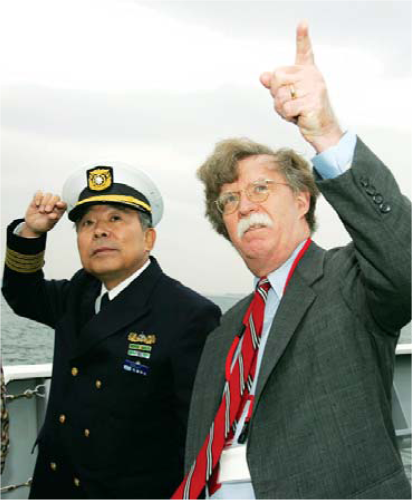
Arms control at sea: Japan is a core participant in Bolton's Proliferation Security Initiative.
Bolton's experience as the State Department's chief arms control official offers a glimpse of this worldview in practice. In addition to the ICC, North Korea and Iran have consumed much of his attention, and the twin nuclear crises have showcased his preference for changing the world, rather than managing its problems through diplomacy. In both cases, Bolton has opposed all but the most constrained negotiations. Yet forcible regime change is out of the question. How does someone who believes in changing the world to safeguard America cope with dangerous regimes that can't be overthrown?
At least in part, it appears, by yelling and screaming. Bolton's dealings with North Korea, in particular, have revealed a moralistic streak that is odd for a diplomat who clearly draws inspiration from foreign policy realists. The dean of modern U.S. realists, George F. Kennan, warned repeatedly against moralism in American foreign policy. “Where measures taken by foreign governments affect adversely American interests rather than just American moral sensibilities, protests and retaliation are obviously in order,” Kennan wrote in 1985, “but then they should be carried forward frankly for what they are, and not allowed to masquerade under the mantle of moral principle.” 17 Bolton himself has often sounded a similar note. In a published debate with a human rights expert in 1999, Bolton lectured, “setting priorities and making choices … is what policy is about, not simply talking about condemning this injustice or righting that wrong.” 18
And yet moral outrage suffuses Bolton's North Korea statements. That anger surfaced most notoriously when Bolton visited the region in July 2003. “While he lives like royalty in Pyongyang,” he said of North Korean leader Kim Jong Il, “he keeps hundreds of thousands of his people locked in prison camps with millions more mired in abject poverty, scrounging the ground for food.” Life in North Korea, Bolton went on, is “a hellish nightmare.” Unsurprisingly, the North responded in kind, calling Bolton “human scum.” The name-calling induced the White House spokesman to publicly defend Bolton, but privately some in the administration expressed frustration at what appeared to be an unnecessary confrontation. Several former officials believe it was a conscious attempt to sabotage negotiations. 19
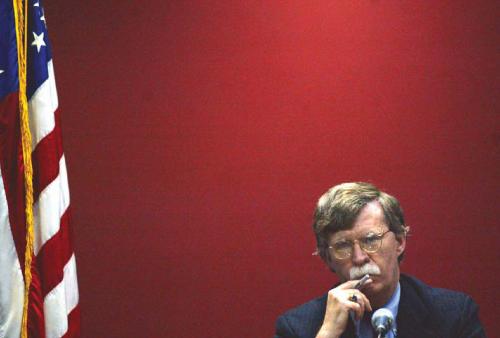
Odd man out: Bolton attends a press conference at the U.S. embassy in Bangkok during a diplomatic tour of Asia.
Unable to change the regimes of Iran and North Korea by force and unwilling to negotiate freely, the administration's policies toward these two countries have meandered painfully. The conviction that negotiations with rogue states are useless has produced odd results when translated into policy. Matthew Bunn, a nonproliferation specialist at Harvard, sees an approach that is inadvertently passive. “In reality, if not in rhetoric, their policy has actually been much softer than the Clinton administration's. The Clinton administration actually communicated a number of red lines. The Bush administration has failed to do that. We've done nothing except to say that it's not a crisis.” A senior official who worked with Bolton on developing North Korea and Iran policy agrees: “The ideological attachment to regime change, made it very difficult to pursue practical policies that would have better served our national interests.”
The proliferation docket is not without its achievements. Bolton often cites Libya's decision to categorically and verifiably reject its WMD program as the only route for Iran and North Korea. Arms control advocates, however, note that Libya's decision was the product of patient, multilateral diplomacy offering a package of incentives–the very approach that Bolton eschews toward Pyongyang and Tehran. And it has been reported that the British government explicitly asked that Bolton not participate in the Libya negotiations, for fear that he might scuttle them. 20 For his part, Bolton has claimed that the turning point for Muammar Qaddafi's regime came when centrifuge parts bound for Libya were seized aboard the cargo ship BBC China in October 2003.
À la carte multilateralism
Bolton's focus on the seizure of the BBC China is no accident. It highlights one of his most prized projects: the Proliferation Security Initiative (PSI). President Bush formally announced the initiative to intercept ships carrying WMD and WMD components in May 2003. Eighteen countries are currently core participants in the initiative, and the Bush administration claims that more than 60 nations support it. The PSI is a potent rejoinder to those who believe that Bolton is incapable of effective negotiations and ideologically averse to multilateralism and international law.
But Bolton has done it his way. He has made sure that the PSI remains “an activity and not an organization.” He has avoided creating new layers of bureaucracy by including only countries that he feels have the desire and ability to participate. He has also firmed up the legal underpinnings of the initiative by signing boarding agreements with states that frequently flag merchant vessels, including Liberia, Panama, and the Marshall Islands. Supporters of Bolton contend that the PSI is not an aberration, but a reflection of Bolton's realistic worldview. AEI scholar James Glassman notes that “the way he structured PSI is in complete accord with his overall views about international agreements–the only agreements that really work are those that a country voluntarily enters into.”
Critics, however, see this voluntary, informal structure as a limitation. The problem with a maritime “coalition of the willing” is that not every country is willing. China, India, and South Korea have refused to join the initiative despite U.S. prodding. And, Bolton's best efforts notwithstanding, the enthusiasm of some participants is suspect. As Andrew Prosser and Herbert Scoville at the Center for Defense Information note, “the fact that the PSI lacks machinery to ensure participant compliance with PSI operations suggests that PSI states such as Russia, which may possess relatively relaxed understandings of what constitutes a proliferation concern, will feel at liberty to support PSI actions only marginally, offering its permission à la carte to use national territory for PSI interdictions, and mobilizing national law enforcement or military assets to combat weapons trafficking only when economic or other interests are not judged superior.” 21 Because the PSI has not been memorialized in a treaty or protocol, a lackadaisical approach would violate no agreement and put Russia under no legal, political, or moral obligation to get with the program.
Beneficial as PSI has been, it is not an approach for all problems. Treaties and formal organizations, such as the Biological Weapons Convention and the Nuclear Non-Proliferation Treaty, are helpful precisely because they can create political and moral costs to departing from their mandates–as the United States knows all too well from the diplomatic damage it incurred in waging war against Iraq without U.N. approval. Bolton is no doubt correct that such strictures are meaningless to outlaw nations. But regimes like North Korea, for all their danger, are anomalous. Most governments respond in some way, however imperfectly and inconsistently, to the pressure of international law and institutions. By disparaging formal treaties and exalting the PSI, Bolton may have damaged tools that are effective with most countries in an effort to craft policy for the exceptional few. Hard cases, as lawyers say, make bad law.
That said, the immediate fears of U.S. internationalists that emerged during Bolton's confirmation hearings are probably exaggerated. How many people, after all, could name the most recent U.N. ambassadors or say anything about their effectiveness? When the United States needed to make its case to the U.N. Security Council on Iraq, Colin Powell–not the U.N. ambassador–was the country's voice. Secretary of State Rice always made clear that Bolton would answer to her; the fact that Rice, rather than the president, announced Bolton's nomination was significant in establishing the chain of command. She has also appointed a separate senior adviser on U.N. reform, whose voice may be as influential as the U.N. ambassador's. Oddly, the prevailing image of Bolton as a foaming-at-the-mouth extremist could be seen as a point in his favor. As the PSI demonstrates, he has shown the capacity–if not always the will–to work effectively with foreign governments. Many foreign delegations in New York would be pleasantly surprised after emerging physically unscathed from a meeting with Bolton.
In a broader sense, however, Bolton's diplomatic career has represented a defeat for internationalism, and Americans who believe in the development of international law and institutions must combat Bolton's worldview. That will be a much more difficult struggle than the confirmation battle. The beliefs that Bolton represents will not always come attached to a bristling mustache and a nasty personality. His challenges to the efficacy of international law and the democratic credentials of international institutions have merit, and considerable public appeal. (Someone will always have to puncture the illusions of idealists who believe that world order can be constructed on paper.)
Bolton's cramped view of U.S. national interests has a strong constituency, particularly in a country tired of conflict. And it will be easy to convince many Americans that global institutions are out to get them, not least because a few international bureaucrats actually do hate the United States. Until American internationalists speak convincingly–yes, even during presidential debates–about the importance of preventing massive crimes against humanity, the possible benefits of ceding some sovereignty, and the need to advance sensible international law and accountable institutions, they will be forced to defend their ground on personality rather than policy. It's not a winning strategy.
International law
↗
↗
↗
For these articles and more, visit the online Bulletin Archive at www.bulletinarchive.org.
Footnotes
1.
John Bolton, “Surrendering to Saddam,” Weekly Standard, September 7, 1998, and “Bombing Before Ramadan,” Weekly Standard, December 28, 1998.
2.
John Bolton, “U.S. Must Stand up to North Korea,” Los Angeles Times, September 22, 1999.
3.
John Bolton, “Clinton's Bluster,” Weekly Standard, March 8, 1999.
4.
See, for example, John Bolton, “Clinton's Intelligence Failures,” Washington Times, May 16, 1999.
5.
John Bolton, “The U.N. Steps out of Line,” Washington Times, May 31, 1998.
6.
John Bolton, “The Global Prosecutors: Hunting War Criminals in the Name of Utopia,” Foreign Affairs, January/February 1999.
7.
John Bolton, “Is There Really ‘Law’ in International Affairs?” Transnational Law & Contemporary Problems, Spring 2000.
8.
John Bolton, “Courting Danger: What's Wrong with the International Criminal Court,” National Interest, Winter 1998/99.
9.
John Bolton, “A Legacy of Betrayal,” Washington Times, May 12, 1999.
10.
E. H. Carr, The Twenty Years' Crisis, 1919-1939, (London: Macmillian, 1981), p. 30.
11.
Bolton, “The Global Prosecutors.”
12.
Bolton, “Courting Danger.”
13.
Bolton, “Is There Really ‘Law’ in International Affairs?”
14.
Bolton, “The Global Prosecutors.”
15.
John Bolton, remarks to the Chicago Council on Foreign Relations, October 19, 2004.
16.
Bolton, “Is There Really ‘Law’ in International Affairs?”
17.
George F. Kennan, “Morality and Foreign Policy,” Foreign Affairs, Winter 1985/1986.
18.
John Bolton and William F. Schulz, “What Price Human Rights? An Exchange,” National Interest, Summer 1999.
19.
Barbara Slavin and Bill Nichols, “Bolton a ‘Guided Missile,’” USA Today, November 30, 2003.
20.
Michael Hirsh and John Barry, “Madmen, Rogues & Nukes,” Newsweek, October 11, 2004.
21.
Andrew Prosser and Herbert Scoville,”Proliferation Security Initiative in Perspective,” Center for Defense Information, June 16, 2004.