




Abstract
Eugene Rabinowitch was a true Renaissance man–a member of the Manhattan Project, an outstanding thinker, scientist, and writer. And 60 years ago he founded the Bulletin.
Eugene rabinowitch, my father, was a world-class scientist and editor, as well as a talented teacher, journalist, and poet. Yet, he was much more than that. His life was forever changed by his service as a senior chemist and section chief on the Manhattan Project. Haunted to his final days by the threat to mankind posed by nuclear weapons, he became a voice of conscience for the atomic age.
Dad was born Evgenii Isaakovich Rabinovich in St. Petersburg, Russia, in 1898, the son of a lawyer and an aspiring concert pianist. His love affair with science began at St. Petersburg University, where a chemistry department was created after the outbreak of World War I alerted the czarist government to Russia's dependence on chemical imports. One of seven students in the department's first class, he excelled in his courses. However, the 1917 Russian revolution interrupted his studies.
Along with most members of Russia's liberal middle class, my father welcomed the revolution. He was confident that Russia would be transformed into a Western-style democracy. In March 1917, he proudly participated in a huge, day-long funeral procession for 180 fallen heroes of the revolution. When a call went out for student volunteers to join a people's militia to replace the discredited old police, he donned an armband and joined. Recalling those heady days, he wrote in notes for an unpublished memoir, “I mostly broke up tavern brawls–goodbye chemistry!”
To help with the Constituent Assebly elections, my father supervised a staff of 70 people–most of them older–in drawing up lists of eligible voters in his electoral precinct. He was most pleased that he designed a system for tabulating votes that enabled him to report his results long before anyone else in the city. “I am still proud of this achievement!” he wrote in his memoir notes, long after his international reputation was firmly established.
But his enthusiasm was quickly squelched. Two weeks before the September 1918 start of the “Red Terror” against class enemies in St. Petersburg (then called Petrograd), my father and extended family fled to Kiev, Ukraine, which had become a temporary haven for thousands of former Russian elites. While my grandparents were confident that the Bolshevik regime would not last, Dad was skeptical.
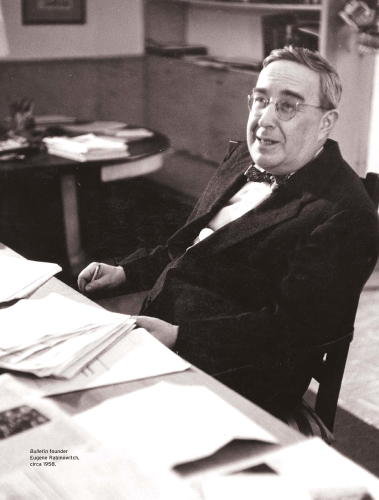
Bulletin founder Eugene Rabinowitch, circa 1958.
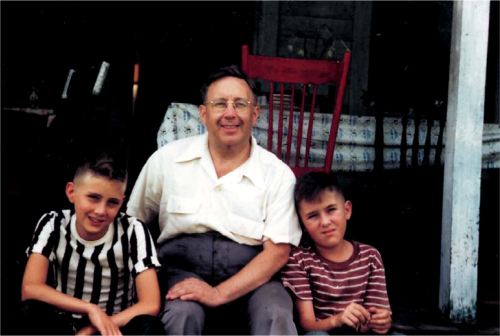
Rabinowitch with twin sons Victor (left) and Alexander at the family's farm, 1946.
His hunch proved correct. In 1919, the Bolsheviks took power in Kiev, forcing my father and extended family to escape to Warsaw. Unable to continue his scientific studies, he began dabbling in journalism. He contributed editorials, short stories, and analysis of the Russian civil war for a Russian-language paper. The changing political and social landscape in his homeland consumed him. To record the war's constantly changing fronts and the dates of significant campaigns, he painstakingly drew, in colored pencil, a detailed map of Russia.
In spring 1921, my father and grandparents, through a ruse concocted by chance contacts in the Danish Embassy, managed to slip into Germany. Soon after, he was admitted to the chemistry department at the University of Berlin. There, he attended Albert Einstein's course on relativity and participated in the physics colloquium at which Max Planck, Max von Laue, and Einstein, all by then Nobel laureates, occupied the front bench.
As usual, he left prolific footprints. Ineligible for an academic position because he was not a German citizen, my father nonetheless contributed many important works to the chemistry discourse at the time.
He accepted an appointment at the University of Göttingen in 1929 as assistant to Nobel laureate James Franck, who would become a seminal figure for his scientific research and his life in public affairs.
At Göttingen
My father's admiration for his new boss was immediate. “What impressed me most in Franck–in addition to his incredibly honest, warmly humane personality,” Dad wrote in his memoirs, “was his capacity to deal with atoms and molecules as if they were familiar objects of everyday life. He saw them within his mind's eye and drew conclusions about their behavior by contemplation; he would leave mathematical checking of his conclusions [to others].”
While working with Franck, in 1930 my father was invited to an international scientific congress in St. Petersburg, which was by then called Leningrad. Although identified as a German national, until the moment he was waved through passport control, he was skeptical that he would be allowed into Soviet Russia. His Russian background was exposed as soon as he appeared at the congress, as several Soviet scientists with whom he had interacted in Berlin were participants. However, to his great relief, his “social status” did not cause him difficulties. Rather, housed in the elegant Hotel Europa, he was feted as a particularly “distinguished foreigner,” and shown sights that ordinary Russians were not allowed to see.
His treatment so astounded him that he continually pinched himself to make certain he wasn't dreaming. But visits with Russian relatives living in difficult straits common to most citizens during the “Stalin revolution” left him deeply dispirited.
“I saw everyone … life is very difficult for all,” he wrote afterward in a letter to a cousin in Paris. “For one, the food shortage is very hard (it is necessary to spend whole days in line) and the situation is even worse with clothing…. Second, the intensification of terror depresses everyone and in the twelfth year of the revolution arouses a mood familiar to us from [1918] and [1919]. At the cost of this terror and impoverishment, a do-or-die, mad drive to industrialize the country is taking place. Dozens of new factories, institutions of higher learning, especially technical ones, research institutes, etc., are being built. Naturally, there are not enough hands to realize all these initiatives, people are in great demand, and everyone has forgotten about unemployment. That is about the only comforting aspect in the daily life of the former intelligentsia and bourgeoisie. Almost everyone firmly believes that this construction will be successful, and even many from ‘our circle’ are enthusiastic about it. That is the only way of avoiding a feeling of complete use-lessness of life and of utter depression. Taken together, all this creates the impression of a profound and tragic process, the outcome of which is terribly difficult to imagine.”
Life with Bohr
When Adolf Hitler became chancellor in 1933, the purge of Jews in Germany began, and my father's modest research stipend at Göttingen was cancelled. One evening soon thereafter, the front windows of his home were smashed, presumably by marauding Nazi students. My grandmother, who slept in the front room, narrowly escaped injury. An invitation from Niels Bohr for a year's research at his Institute for Theoretical Physics in Denmark came none too soon.
Dad profited greatly from interactions with the leading theoretical physicists for whom Bohr's Institute had become a kind of Mecca. And he lived for the famously festive evenings at the Bohrs' palatial residence.
“Every few weeks, word passed around the Institute that ‘Everybody is invited to the Bohrs’ tomorrow,’” he remembered in his notes. “In a covered court, surrounded by Greek columns, Bohr's six sons passed refreshments while kegs of beer were on tap between the columns. The crowd included crown ministers and Danish notables, together with students from the university. I particularly remember the party in honor of [Werner] Heisenberg, [Paul A. M.] Dirac, and [Erwin] Schrödinger, on the occasion of their Nobel prizes. Regal Margaret Bohr (who played second mother to all physicists) was stroking the hair of Wolfgang Pauli in a corner; he was often in distress over mixed-up personal affairs.”
When my father's funding from the Bohr Institute ended, he spent a few years at University College-London before seeking employment in the United States. A job-hunting trip netted him a position in the chemistry department at the Massachusetts Institute of Technology (MIT) in 1938. He hurried back to London to fetch his growing family–he had married my mother Anya, a Russian actress, in 1932; my twin brother, Victor, and I were born in 1934.
His spirits were high. Younger scientists were treated much differently in the United States. “[In Europe] promising young men spent 30 or 40 years as assistants waiting for old men to die, [but in America] there was enough space for all,” he wrote.
We arrived in the United States the day after Christmas 1938 and settled in suburban Boston, not far from MIT. The passage was tranquil, but the world was not. The following summer, my father's excitement about his new life was tempered by the near certainty of another world war.
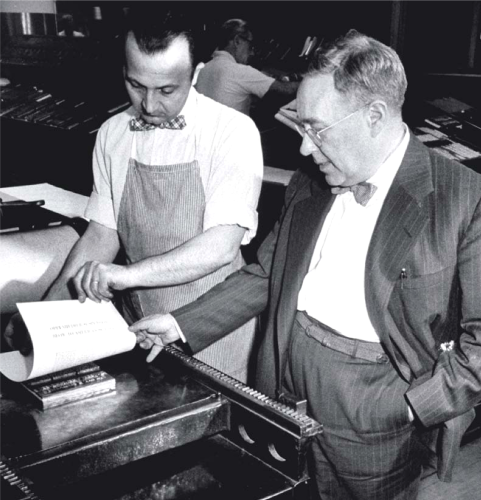
Rabinowitch overseeing the printing of the Bulletin on New Year's Day, 1954.
Émigré life
During those early years at MIT, my parents became close friends with the Harvard scholar Mikhail Karpovich and his wife Tatiana. The Karpoviches owned a farm in the lush Green Mountains of southern Vermont, where my family spent our summer vacations.
Life there was primitive–no electricity, indoor plumbing, or phone–but it was a beehive of émigré Russian life. Among the regulars were the writer Vladimir Nabokov, who spent the afternoons catching butterflies, Yale historian George Vernadsky, former Provisional Government prime minister Alexander Kerensky, Fordham University sociologist Nicholas Timashev, and historian and religious philosopher George Fedotov. Another frequent guest was the talented illustrator of children's books Fedor Rojankovsky, who lived with his family in a rented dacha on the road to the village. Rojankovsky decorated the Karpoviches' kitchen door with a whimsical menagerie of brightly colored animals that has survived to this day.
Excerpting Eugene
In late 1964, Bulletin founder Eugene Rabinowitch discussed his role in the Manhattan Project at the Metallurgical Laboratory in Chicago, and especially his part in authoring the Franck report, with noted documentarian Fred Freed for the television newsmagazine NBC Whitepaper: Decision to Drop the Bomb. The interview, a transcript of which was given to the Bulletin by the Rabinowitch family, provides a revealing, behind-the-scenes look at the politics inside the project and at the Chicago scientists' last-ditch attempt to convince government officials to think smarter, more rationally, and long-term about the bomb. Some of Rabinowitch's thoughts:
Mornings at the Karpoviches' began with a nearly two-mile walk to the local post office for the day's news, primarily as reflected in the Russian-language newspapers and in correspondence from around the world. Lively conversations about current events, especially about developments connected with Hitler's invasion of the Soviet Union and Russian literature and culture sometimes took place during leisurely walks in the surrounding woods and fields as guests hunted mushrooms or gathered berries. More frequently, they took place on the Karpoviches' front porch, usually during dinners around a table laden with Russian dishes. Many cool evenings were spent on the porch or in the living room reading by the warm, flickering light of kerosene lamps. On occasion, the children performed skits, and everybody sang familiar Russian folk songs.
In 1943, my father purchased his own farm several miles away (or less, if one walked on a straight path through the wooded mountains, as he loved to do). Soon our farm also became a bustling oasis of Russian émigré life.
The Manhattan Project
My father interrupted his research at MIT in early 1943 to join Franck at the University of Chicago. Franck had left Germany not long after my father, and he was now head of the chemistry division in the Metallurgical Laboratory of the Manhattan Project.
Dad arrived in Chicago soon after the first controlled chain reaction in the windowless cellars below Stagg Field on December 2, 1942. Prior to the first chain reaction, the feasibility of developing an atomic bomb was uncertain. After Enrico Fermi's success, the creation of a bomb became likely, and project scientists began discussing the international political implications of atomic energy and how to convey their insights and worries about the future to the highest levels of government. Many of these discussions had to be semi-clandestine because interaction between scientists in different divisions of the project was tightly controlled for security reasons.
My father first expressed his worries in notes for himself soon after his arrival. He continued discussing his concerns, often during long walks and hushed lunches, with Leo Szilard, Franck, or other senior project scientists. His first major contribution to formal consideration of these issues came in November 1944. He persuaded Robert Mulliken, information director of the Metallurgical Project and secretary of a committee formed to study post-war uses of atomic energy, to include a section in the committee's report on the political and social impact of atomic energy. The section, coauthored by him and Mulliken, emphasized the necessity of combining intensive development of nuclear energy with an effort to solve political problems worldwide. They argued that because it was inevitable that many nations would develop nuclear capabilities, a body to control military use of atomic energy must be created without delay. A final section of what came to be known as the “Jeffries report” emphasized the need to establish efficient international supervision over all military aspects of atomic energy and to educate the public on atomic energy and its dangers for world security.
Discussions about the future of atomic energy intensified in the spring and early summer of 1945, when senior scientists at Chicago became aware that an atomic bomb would soon be ready to test. The fear that Germany would develop a bomb before the United States, initially one of the main reasons for the project, was eliminated when the Nazis surrendered. However, international control of nuclear energy and the question of whether or not the bomb should be used against Japan suddenly became urgent issues. Franck, Szilard, and my father were also profoundly concerned about the lack of long-range thinking about atomic energy.
In June 1945, two months before Hiroshima, Franck had been appointed chairman of a committee to discuss the social and political implications of atomic energy. My father was a member of this committee. The result of its rushed deliberations was the Report of the Committee on Political and Social Problems, Manhattan Project–Metallurgical Laboratory (commonly referred to as the “Franck report”), the main draft of which my father wrote. (For more on the Franck report, see page 38.)
“It was unbearably hot in Chicago then,” he recounted in Robert Jungk's 1958 book Brighter Than A Thousand Suns: A Personal History of the Atomic Scientists. “As I walked through the streets of the city, I was overcome by the vision of crashing skyscrapers under a flaming sky. Something had to be done to warn humanity. Whether on account of the heat or my own inward excitement, I could not sleep that night. I began writing our report long before daybreak. James Franck had given me a draft of one-and-a-half pages as his contribution. But my own treatment of the matter became very much more detailed.”
The Franck report made two carefully reasoned points. First, the development of nuclear power was fraught with infinitely greater danger of mutual annihilation than all inventions of the past, that its secrets would not remain an American monopoly for more than a few years, and therefore the only way of avoiding a potentially disastrous nuclear arms race was to secure immediate agreement on international control of nuclear energy. Second, the possibility of such an agreement would be gravely undermined if the United States first used the bomb in an unannounced attack against Japan. Prospects for agreement would be optimized if the destructiveness of nuclear power was demonstrated for the world on an uninhabited desert or barren island and used only if the demonstration failed to induce Japan's unconditional surrender.
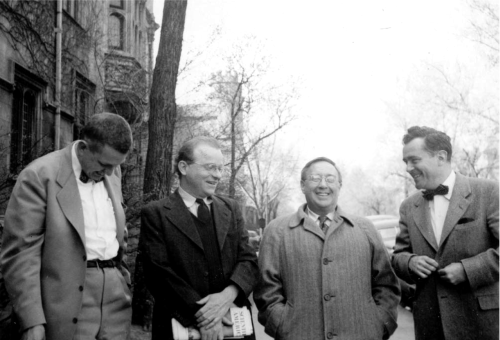
From left to right: Biochemist Harrison Davies, sociologist Edward Shils, Rabinowitch, and physicist John Simpson on the University of Chicago campus in 1946.
Franck tried, but he was unable to deliver the report directly to Secretary of War Henry Stimson. Eventually Stimson saw it but gave it only casual consideration.
During many sleepless nights, waiting with mounting frustration for a response, my father thought about whether he had a moral obligation to leak planning of the impending attacks on Japan to the media. But the thinking never went beyond sleepless nights. “The American war machine was in full swing, and no appeals to reason could stop it,” he opined 25 years later in the Bulletin. Nonetheless, upon publication of the Pentagon Papers in 1971, he remarked in a letter to the New York Times, “[I] would have been right to have done so.”
President Harry S. Truman and Stimson were consumed with ending the war. They had little interest in long-term global issues and paid no heed to the ethical concerns of the atomic scientists. On August 6, 1945, the bomb was dropped on Hiroshima, ushering in the atomic age. The second bomb was dropped three days later on Nagasaki, forcing the Japanese to surrender.
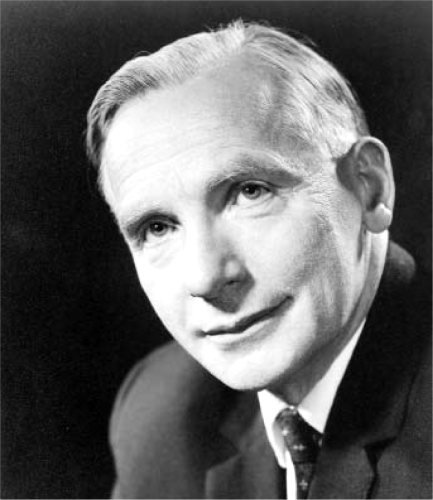
Sir Joseph Rotblat.
It has been suggested that the atomic scientists were elated by the success of their work and that this response was only erased by use of the second bomb. This was certainly not the case for my father. I remember his reaction to Hiroshima well. He was completely devastated and devoted much of the rest of his professional life to preventing other “Hiroshimas.”
Pugwash and the Bulletin
Dad's efforts to help save humanity from the threat of nuclear annihilation were channeled through the Bulletin of the Atomic Scientists and the Pugwash movement.
My father founded the Bulletin in December 1945 with physicist Hyman Goldsmith. He served as the magazine's editor-in-chief and guiding light from its inception until his death in 1973. “[The purpose of the Bulletin and the scientists' movement it grew out of] was to awaken the public to full understanding of the horrendous reality of nuclear weapons,” he explained in an editorial noting the twenty-fifth anniversary of the Trinity test, “and of their far-reaching implications for the future of mankind; to warn of the inevitability of other nations acquiring nuclear weapons within a few years, and of the futility of relying on America's possession of the ‘secret’ of the bomb.”
From early on, my father viewed problems of arms control, the nuclear threat, and world security as connected to more fundamental issues. These included the division of the world into sovereign nations less concerned with global problems than with their own narrow self-interests; the economic and social disparity between technologically advanced and technologically undeveloped parts of the world; the population explosion, and global ecological degradation.
Under his leadership, the Bulletin became a leading international forum for prominent thinkers from all over the world to discuss the issues related to the impact of recent scientific breakthroughs on society. At a time when the Cold War raged, the Bulletin, in its easy-to-understand layman's language, brought the insights of leading Soviet scientists to Western readers. This was a reflection of my father's immense respect for Russian science, as well as his conviction that all scientists, irrespective of national boundaries and international disputes, formed a community with shared values and critical perspectives, as well as a social responsibility to utilize them in the interest of human survival.
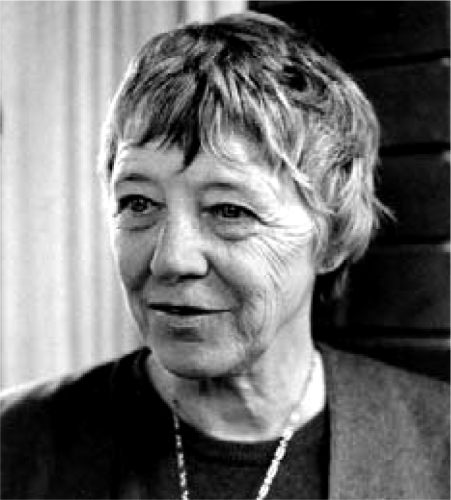
Ruth Adams.
Between 1945 and 1973, Dad wrote more than 100 articles for the Bulletin, many of them editorials clarifying the relevance of this or that burning contemporary issue to outdated and dangerous patterns of international behavior and institutional structures. Bernard Feld, a fellow project scientist and my father's successor at the Bulletin, wrote in the magazine that Dad's “prose had the beauty and precision that seems to be the hallmark of Russian writers who made English their adopted language.” To Sir Joseph Rotblat, the editorials were the “heartbeat of the Bulletin.”
The themes of many of these editorials manifested themselves in Pug-wash and vice versa. The first Pug-wash Conference was held in Nova Scotia in 1957. The initiative for it was strongly influenced by Rotblat, a Manhattan Project scientist who quit on moral grounds.
My father felt he and Rotblat were kindred spirits. Independently, both had begun thinking about convening an international forum of eminent scientists, including Soviet scientists, to help seek solutions to problems created by monumental advances in science and technology, in particular the development of nuclear weapons. During several visits my father made to London in 1954 and 1955, the two developed an agenda for such a forum.
Cleveland industrialist Cyrus Eaton offered to finance their proposed gathering provided that it be held at his birthplace in Nova Scotia, the town of Pugwash. After initially declining, the scientists accepted Eaton's offer, and 22 distinguished scientists from 10 countries came together for the first Pugwash Conference. Annual conferences continue to this day.
My father often acted as a moderator between Soviet scientists, with whom he quickly established a close rapport, and colleagues from other lands. This did not always go smoothly. At times, having started to help with nuances in interpretation and translation, he would become so caught up in a discussion or argument he would forget his role and address his American colleagues in Russian and vice versa.
The scientist
In addition to working closely with Franck, a second, equally important, development happened at Göttingen in 1929–my father discovered his passion for photosynthesis, the subject that would define his work as a scientist.
When he first arrived in America, photosynthesis dominated his professional life. In 1939 and 1940, he began writing his three-volume study of photosynthesis, which for decades was the standard text on the subject. “The reference work in the field,” Rotblat called it. A science reporter for Time wrote that his research appeared to presage an end to dependence on traditional forms of fuel and to point the way toward a limitless source of energy by “harnessing the 200 trillion horsepower which the sun pours on the Earth.”
After World War II, my father returned to his research, joining the Photosynthesis Research Project in the Botany Department of the University of Illinois at Urbana-Champaign. There, he completed his basic study of photosynthesis and, together with the great biologist Robert Emerson, he developed a school of leading specialists in photosynthesis. One of the fundamental purposes of their work was to help end global dependence on non-renewable energy–the exact goal described in Time in 1942.
During these years he rarely turned down a journalistic assignment or speaking engagement relating to science and public affairs from a newspaper, university, college, or community organization, however small. In 1966, in recognition of these tireless educational efforts, UNESCO awarded him the coveted Kalinga Prize for the popularization of science.
Yet, despite his numerous commitments throughout the world, he never wavered as a loving husband and engaged father. Much of the credit for this belongs to the Bulletin's longtime associate editor Ruth Adams. She played a key role in every aspect of the magazine–soliciting and editing manuscripts, planning special issues, and directing the fundraisers that time and again saved the Bulletin from extinction. When my father could not squeeze a train trip north to Chicago into his busy schedule, Adams journeyed to our home in Champaign to discuss pressing editorial matters. (She played an equally vital part in Pugwash's success as well.)
The golden years
During his stay at the University of Illinois from 1947 to 1969, my father spent each summer at his farm in Vermont. To be sure, a part of every day was spent working–primarily writing and editing Bulletin articles, and additional essays and speeches on science and public affairs for other forums.
Mainly, however, in the fresh mountain air, surrounded by family and close friends, he felt rejuvenated. My mother loved to cook, and my father loved to eat. Thus, each meal was an event to be savored. Nonetheless, each evening the light in his bedroom was on late into the night, as he engaged in what was probably his favorite hobby–writing and translating poetry.
After his retirement in 1969–if it can be called that, as he continued his work in the chemistry department and the Center for the Study of Science and Society (directed by my brother Victor) at the State University of New York at Albany–he began to draft a capstone book, intended to provide a summation of his three-decades-long crusade to awaken the world to the grave dangers and bright promise of momentous advances in science. Titled The Scientific Revolution and Its Social Consequences, it was to include four main chapters detailing the revolutions in science, warfare, economics, and politics.
He never completed it. On May 15, 1973, my father died of a stroke in Washington, D.C. Even as his life was nearing its end, he continued passionately pursuing peace and disarmament.
At a Pugwash Conference in Oxford eight months before his death, he criticized the Soviet-American détente as enforcement of the status quo and warned that Pugwash itself was becoming too complacent. One conference participant's last glimpse of him was as he walked back to Christ Church for lunch, oblivious to his surroundings and completely engrossed in conversation with a Soviet scientist.
“[Here were] two frail old men, well muffled against the September chill, shuffling surefootedly over the cobbles,” the unidentified Pug-washite recalled in the May 24, 1973 New Scientist.
Following my father's death, tributes poured in from all over the world. In a speech about him at the fiftieth Pugwash Conference, his “kindred spirit” Rotblat perfectly captured what he meant to all of us. “Eugene Rabinowitch was a man of many facets: a scientist and a teacher, a classics scholar and a modern philosopher; a poet and a man of letters; a journalist and an editor; a sociologist and a politician,” Rotblat said. “But his main characteristic was simply as a human being, with a warm heart, filled with love and tenderness, not only for his family and friends, but for the whole of mankind. This love of humanity, and his profound belief in the potential of science to ensure a happy life for all, were the guidelines throughout his whole life, the philosophy on which all of his activities were based.”