




Abstract
The installation of the Congress Party-led coalition government following India's May election has raised serious questions about the future of India's relations with Israel and the profitable Indo-Israeli arms trade. Despite the usual platitudes about continuity and consensus, it's clear that the Congress Party coalition headed by Manmohan Singh differs starkly in its opinion on Indo-Israeli relations from the Bharatiya Janata Party (BJP), which previously led India's government.
Under the BJP, cooperation between the two nations reached its zenith. The Congress Party of P. V. Narashimha Rao established official diplomatic ties with Israel in January 1992, but Indo-Israeli relations did not begin to thrive until the BJP came to power in 1998. Either by design or by accident, the preliminary arms negotiations initiated by the Congress Party proved fruitful only after the BJP took control.
The BJP wasted little time, detonating nuclear tests on May 11, 1998. Ironically, it was the U.S. sanctions that followed India's nuclear tests that pushed India and Israel closer together. After some initial hesitation, both countries began exploring a wide range of options for security cooperation. The quick supply of Israeli arms and ammunition to India during the 1999 Kargil War with Pakistan facilitated a better appreciation and understanding between the two nations.
Counterterrorism measures also proved to be an important common ground. Long before 9/11, terrorism plagued both India and Israel, and they quickly established a joint working group to help combat it. In the summer of 2000, India's Home Minister L. K. Advani led a high-level delegation of senior intelligence and security officials involved in counterterrorism to Israel to observe the anti-terrorism measures Israel had installed.
The BJP could conduct its dealings with Israel so openly because, unlike the Congress Party, the BJP is perceived as unsympathetic–if not outright hostile–toward India's Muslim community. Less beholden to the Muslim electorate, the BJP could pursue a transparent pro-Israeli foreign policy without fear of losing any of its constituency.
In addition, the BJP's determination to reverse traditional Indian rhetoric and befriend the United States dovetailed nicely with its desire to seek closer ties with Israel. Some of the BJP's most influential leaders even floated the idea of establishing a “triangular axis” between India, Israel, and the United States. This appeared to be a calculated response to Israel's troubled relations with the United States over arms exports.
In the summer of 2000, under intense American pressure, Israel was forced to cancel its lucrative deal to supply Phalcon advanced airborne early warning systems to China. This controversy highlighted how Israel's ability to pursue sensitive military exports depends on the goodwill of Washington. Not wanting to find itself in a similar situation, which could have jeopardized its cozy Israeli relations, India sought Washington's blessing. The strategy proved effective; in early 2004, India signed an agreement to purchase three Phalcon systems from Israel for more than $1 billion.
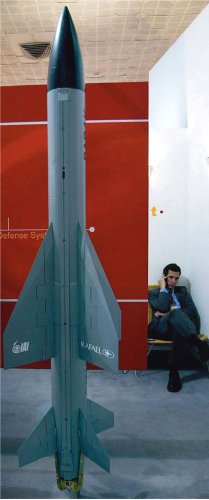
This was the most recent of many Indo-Israeli arms deals. During the past few years, New Delhi has signed scores of defense contracts with Israel; the largest was in August 2001, when India signed a series of defense deals worth more than $2 billion. Under these agreements, Israel promised to provide India with longrange surveillance equipment, night-vision systems, remotely piloted vehicles, and Barak anti-ship missiles, among other things.
The culmination of tightening Indo-Israeli ties occurred last September, when India hosted a red-carpet welcome for Israeli Prime Minister Ariel Sharon. The visit did not sit well with certain segments of the Indian population, especially the communists, on account of Sharon's growing international isolation. Nor did the visit's timing–during the Al Aqsa intifada–help matters. At the time, some feared that India and Israel might transform their bilateral ties into an ideological alliance between their respective hardline parties–the BJP and Likud. The BJP, however, managed to resist cooperating with Israel and Sharon against Islamic fundamentalism.
Trouble ahead?
Despite a growing cultural and commercial relationship, the perception persists that Indo-Israeli relations are highly militarized. And for good reason. Cooperation in the military-security and counterterrorism arenas has dominated, if not monopolized, Indo-Israeli relations.
At the same time, excessive focus on defense–especially when Israel is pursuing an aggressive, hardline stance toward the Palestinians–evokes a fierce negative reaction in India. Israel's assassinations of Palestinian leaders, along with its repeated threats against Yasser Arafat, have contributed to a resurgence of anti-Israeli sentiment in India. Most recently, the Communists, who emerged as players in the new government, have clamored loudly about India's pro-Israeli policies, going so far as to demand the Indian ambassador be recalled from Tel Aviv.
Unlike the BJP, the Congress Party stands in Jawaharlal Nehru's shadow and his support of the Palestinians. Despite normalizing relations with Israel, the previous Congress Party did not neglect its Arab and Muslim allies. Some of Singh's senior colleagues were highly critical of the BJP's pro-Israeli policies, which they thought hampered Indian relations with the Muslim world. Yet Indian relations with Arab and Islamic countries did not suffer during the BJP's reign.
February 5: An Israeli Barak missile on display at a New Delhi defense exposition.
Not unexpectedly, the new Congress government has cooled to Israel, which will inevitably harm defense-related ties.
In a highly symbolic move, Shri E. Ahamed, a junior minister in the foreign ministry, met Arafat at his besieged Ramallah headquarters in September. Ahamed warned against Sharon's “irresponsible statements” regarding the Palestinian leader and his relevance to the peace process.
The Congress Party's move to a more temperate Israeli policy is not without merit. Media reports have identified financial improprieties over the Barak anti-ship missile deal, and suggestions have lingered that some Israeli equipment has either underper-formed or been ineffective. New Defense Minister Pranab Kumar Mukerjee indicated recently that a review of some of the Indo-Israeli defense deals would be conducted in the near future.
Other problems with the arms sales from Israel have been less scandalous but equally important. For instance, because some of the suppliers were private Israeli companies that have since gone bankrupt, the Indian government has had trouble locating spare parts for the equipment it purchased.
Still, Israel has friends in New Delhi. Many senior Congress Party leaders–including Singh–visited Israel when they were ministers in the early to mid-1990s. Despite domestic pressures, Indo-Israeli relations will probably not suffer any drastic setbacks. How transparent India's future defense deals with Israel will be is an entirely different matter.