




Abstract
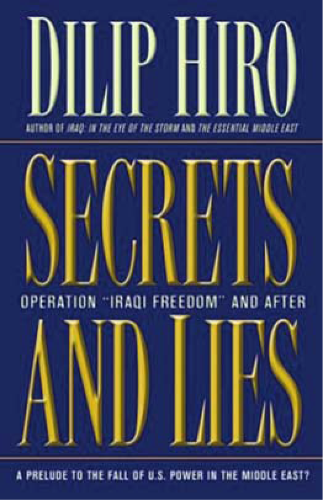
Secrets and Lies: Operation “Iraqi Freedom” and After By Dilip Hiro, Nation Books, 2004, 467 pages; $14.95
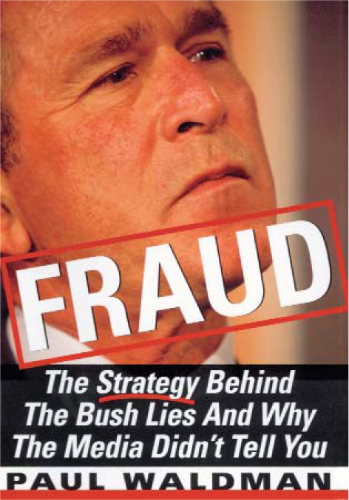
Fraud: The Strategy Behind the Bush Lies and Why the Media Didn't Tell You By Paul Waldman, Sourcebooks, 2004, 311 pages; $24.95
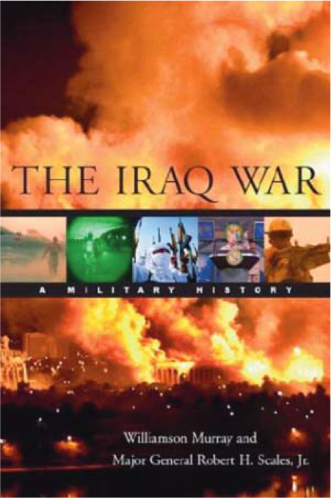
The Iraq War: A Military History By Williamson Murray and Maj. Gen. Robert H. Scales Jr., Harvard University Press, 2003, 312 pages; $25.95
At first, one might wonder why Williamson Murray and Maj. Gen. Robert H. Scales Jr. even wrote The Iraq War. After all, as they write, “The conflict with Iraq engaged an enemy who had virtually no military capabilities left after an air war of attrition lasting over 12 years.” Coalition forces not only had technologically superior weapons, but also engaged an enemy that had incompetent military leadership, soldiers unwilling to die for Saddam Hussein, and an air force that “could not get a single sortie into the air against the aerial onslaught that began on March 19.”
But the authors unexpectedly conclude that it was the “combination of discipline and initiative” of combat formations that was the most important factor in the coalition victory. More significantly, months before May 12, 2004–the date that Gen. Richard Myers, chairman of the Joint Chiefs of Staff, told a Senate committee that “there is no way to militarily win in Iraq”–Murray and Scales saw that America could lose due to weak human intelligence.
In fact, so “depressingly weak” is the “ability to interpret local languages, customs, and cultures,” say the authors, that unless U.S. military technological superiority is soon coupled with intelligent thinking, “improved technologies will ensure only that political and military defeats will come later, and at greater cost.”
Such post-invasion pessimism hardly squares with the pre-war hubris of the Bush administration or the arrogance displayed by its most credible and statesmanlike representative, Secretary of State Colin Powell. His first week in office, Powell told his staff “that the United States can do pretty much what it wants because its sophisticated democracy makes it politically and morally superior to the rest of the world–and even sometimes exempts it from international norms and treaties” (Los Angeles Times, January 28, 2001).
Not much later, in ostensible response to 9/11, the Bush administration unleashed a briefly victorious illegal preventive war opposed by most of the world but justified by strident assertions–subsequently proven to be false–about Iraq's weapons of mass destruction (WMD) and ties to Al Qaeda. The invasion also unleashed looting, murder, infrastructure destruction, widespread insurgency, a worldwide surge in terrorism, torture in Iraqi prisons, and beheadings.
Just 10 days after his inauguration, Bush held his first National Security Council (NSC) meeting. According to then-Treasury Secretary Paul O'Neill, who attended the meeting, the focus was Iraq. When Bush asked National Security Adviser Condoleezza Rice what they would talk about, she asserted that Iraq might be the key to reshaping the entire Middle East, as Ron Suskind recounts in The Price of Loyalty.
Bush did not emphasize Iraq during his presidential campaign. Indeed, in January 2000, Rice claimed there was “no sense of panic” about rogue regimes like Iraq and North Korea or even about their WMD because they are “living on borrowed time,” meaning that any attempt to use WMD would spell obliteration.
But O'Neill suspected Vice President Richard Cheney was writing the scripts. Cheney was influential in the appointments of Donald Rumsfeld and Paul Wolfowitz, and therefore instrumental in creating the cabal of neoconservatives obsessed with Iraq. O'Neill also was surprised by Bush's decision to withdraw America from the Palestinian-Israeli peace process. He didn't know that Rice's words about reshaping the Middle East and Bush's decision to withdraw appear to have been lifted from an advisory paper (“A Clean Break: A New Strategy for Securing the Realm”) written in 1996 for the prime minister of Israel by three Jewish-American neoconservatives–Richard Perle, Douglas Feith, and David Wurmser.
The paper is an ugly piece of work. As distinguished Middle East scholar Dilip Hiro notes in his exceptional book, Secrets and Lies, the paper urged Benjamin Netanyahu, Israel's newly elected Likud prime minister, to abandon the peace process with the Palestinians, reject “land for peace,” and strengthen Israel's defenses in order to confront Syria and Iraq, even with preemptive wars. Most significantly, the document recommended: “This effort can focus on removing Saddam Hussein from power in Iraq–an important Israeli strategic objective in its own right.”
(It also recommended that Israel use pretexts for its preemptive attacks in order to dupe Americans into supporting naked Israeli aggression. As James Bamford remarks in A Pretext for War, “It was rather extraordinary for a trio of former and potentially future, high-ranking American government officials to become advisers to a foreign government. More unsettling still was the fact that they were recommending acts of war in which Americans could be killed, and also ways to masquerade the true purpose of the attacks from the American public.”)
If the “Clean Break” recommendations sound like the Bush-Rice-NSC agenda of January 2001, it's no surprise, because all three authors became senior national security officials or advisers in the Bush administration, all with close ties to Paul Wolfowitz.
Wolfowitz joined Rice as a foreign policy adviser to Bush during his presidential campaign. According to Hiro, Wolfowitz's obsession with Saddam Hussein began in 1992, when the CIA funded the Iraqi National Congress (INC) and its leader, Ahmad Chalabi. Wolfowitz forged close relations with Chalabi, who subsequently referred Iraqi defectors possessing intelligence about WMD (subsequently proved bogus) to the Office of Special Plans–a rogue intelligence center created within the Defense Department in 2002 at Wolfowitz's suggestion. Chalabi's defectors also fed America's gullible and lazy news media.
“I stood up to be counted today, and they told me to take a number.”

Iraq dominated the private foreign policy agenda in 2001; missile defense the public agenda. In fact, Bush administration insider and terrorism expert Richard A. Clarke believes these obsessions prevented the United States from being as prepared as it could have been to prevent Al Qaeda's attacks on 9/11.
Worse, however, was the Bush administration's decision to use 9/11 as the pretext for invading Iraq. Not only were Rumsfeld and Wolfowitz “going to try to take advantage of this national tragedy to promote their agenda about Iraq,” but, as Clarke has said in his recent book, Bush told him to look for links between Saddam and Al Qaeda even though Bush knew that had already been done and had turned up no results.
Through numerous iterations during 2002, the Defense Department perfected its plan of attack for Iraq. But it ignored many questions concerning post-Saddam Iraq–a purposeful omission, according to James Fallows in his article “Blind Into Baghdad” (The Atlantic, January/February 2004). The lack of planning was deliberate, Fallows says, and designed to give Defense plausible deniability when asked by Congress or the public to project the problems and costs that might arise after the invasion.
The flip side of Defense's refusal of accountability was a widespread propaganda effort aimed at leveraging Americans' strong support for the global war on terrorism by deceitfully linking Iraq to Al Qaeda and Saddam to bin Laden.
Cheney was a powerful force pushing for war. And he was equally powerful when exerting pressure on the CIA and other intelligence agencies, making unprecedented visits to Langley in mid-2002 to speak with analysts there. When analysts wrote something about Iraq's WMD that didn't suit Cheney, he bombarded them “with a thousand questions,” including, “Why are you disregarding sources that are saying the opposite?” (The New Republic, December 1, 2003).
Cheney was referring to INC sources (now known to have lied) supplied by his friend, Chalabi. In a revealing outburst in the fall of 2002, Cheney asserted: “We're getting ready to go to war, and we're nickel-and-diming the INC at a time when they're providing us with unique intelligence on Iraqi WMD” (The New Republic, December 1, 2003).
Guided by Cheney, Hiro tells us, Bush gave his “axis of evil” speech on January 29, 2002, announced his policy of “regime change” in April, and floated his policy of preemptive war in June–a first for an American president.
By late summer 2002, the prospect of war was drawing attention and skepticism. To counter the skepticism, the White House Iraq Group was created to frighten the public into war. And it unleashed Cheney at the Veterans of Foreign Wars 103rd National Convention on August 26.
Cheney cleared his speech with Bush “to the last word,” according to Hiro. Making allegations that America and the world now know to be false, Cheney told his audience, “The Iraq regime has in fact been very busy enhancing its capabilities in the field of chemical and biological agents.” Worse, he claimed, “We now know that Saddam has resumed his efforts to acquire nuclear weapons.”
As evidence, Cheney cited the firsthand testimony of Saddam Hussein's son-in-law, Hussein Kamel Hassan. But Kamel could not have provided any recent information to support Cheney's claims: He had been executed in 1996.
Moreover, rather than supporting Cheney's ominous claims, a complete reading of Kamel's assertions actually contradicts them, raising questions about Cheney's very competence and integrity. Kamel also said: “All chemical weapons were destroyed. I ordered the destruction of all chemical weapons. All weapons–biological, chemical, missile, nuclear–were destroyed.”
Sitting on the stage behind Cheney during his VFW speech was a puzzled Gen. Anthony C. Zinni. As former chief of the Central Command (Centcom), Zinni had been responsible for enforcing the “no-fly” zones over Iraq and had access to the intelligence concerning Iraq's weapons of mass destruction. Yet, as Zinni has said, “In my time at Centcom, I watched the intelligence, and never–not once–did it say, ‘[Saddam] has WMD’” (Washington Post, December 23, 2003).
Cheney's speech took place just three days before President Bush signed a top secret National Security Presidential Directive titled “Iraq: Goals, Objectives, and Strategy” that committed the United States to the invasion of Iraq. That means Rumsfeld gave false testimony to Congress on September 19, 2002, when he said that Bush had not yet made the decision to go to war.
Cheney's bogus claims were followed by Rice's false assertions about Iraq's aluminum tubes, which she coupled with a despicably alarmist warning about proof of a smoking gun coming in the form of a mushroom cloud. Soon after, Rumsfeld claimed to possess “bulletproof” evidence that linked Iraq with Al Qaeda. The world still awaits Rumsfeld's evidence.
Although the decision for war already had been made, in October the CIA gave Congress its secret National Intelligence Estimate (NIE) on Iraq and issued a public White Paper on Iraqi WMD programs. The NIE drew conclusions about Iraq's WMD that would be disproved by weapons searches after the war, but it also contained footnotes indicating why specific intelligence agencies dissented from some of these conclusions. Secret CIA testimony on the NIE persuaded Congress to authorize the use of military force against Iraq.
But the public White Paper contained no dissent and was therefore much more categorical and alarmist. Moreover, in December 2003, Democratic Sen. Bill Nelson of Florida claimed that the secret briefings leading to the congressional resolution not only alleged that Iraq had WMD, but also “the means to deliver them to East Coast cities” (Florida Today, December 16, 2003).
The case for Iraqi WMD was full of holes, and the Bush team knew it. Nevertheless, they dressed it up and gave it to Powell to present to the United Nations on February 5, 2003. There, Powell fell on his sword for Cheney's benighted obsessions. It was the crowning display of the Bush administration's so-called political and moral superiority–until it all came undone by actual events in Iraq.
Hiro derides, among other things, the Bush administration's ignorance of history. “Baghdad was the capital of the Islamic Empire from 750 A.D. to 1258, with one interruption…. The occupation of Iraq by infidel troops was bound to inflame feelings in the Arab and Muslim world.” And consider Bush's directive from God. According to Hiro, on June 4, 2003, Bush confided to Palestinian Prime Minister Mahmoud Abbas: “God told me to strike at Al Qaeda and I struck them, and then He instructed me to strike at Saddam, which I did.”
Paul Waldman's book, Fraud, fuels the fire of those who have a hard time believing any of Bush's words. Waldman excoriates the news media and focuses on Bush's lies because “when George W. Bush realized that his alleged lack of intelligence in the eyes of the press gave him the opportunity to lie without consequence, he knew he had struck political gold.” The book is worth reading, if only because it yields one extremely relevant nugget concerning Iraq that speaks volumes about Bush's religious piety and character.
In a supposedly private moment just before his national address announcing that war had begun, Waldman writes that “a camera caught Bush pumping his fist as though instead of initiating a war he had kicked a winning field goal or hit a home run. ‘Feels good,’ he said.” Readers may have seen the Associated Press photo of Bush's tasteless fist-pump.
Given all of the above, the words of former U.S. Chief Justice Robert H. Jackson, speaking as chief U.S. prosecutor at the Nuremberg Trials in 1945, seem especially appropriate for the Bush administration: “Any resort to war–to any kind of war–is a resort to means that are inherently criminal. War inevitably is a course of killings, assaults, deprivations of liberty, and destruction of property. An honestly defensive war is, of course, legal, and saves those conducting it from criminality. But inherently criminal acts cannot be defended by showing that those who committed them were engaged in a war, when war itself is illegal.”