




Abstract
The U.S. plan to build a global missile defense has been gaining international support, but not because other governments believe it will make their countries safer.
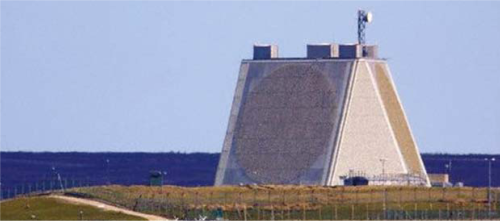
At left, the old radars at Fylingdales, replaced some time ago by the phased array radar below.

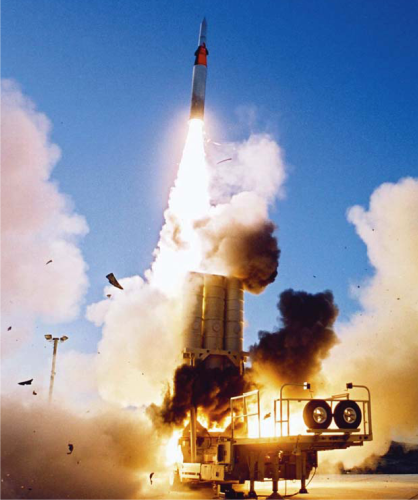
A test launch of an Israeli interceptor, the Arrow.
Missile defense is a complex and often misunderstood subject that tends to evoke strong emotional responses, and many continue to feel that missile defense poses a serious risk to international security. Nevertheless, there has been a surprising international movement toward supporting and cooperating with the Bush administration's global missile defense (GMD) project.
Earlier versions of missile defense maintained the distinction between national missile defense (NMD) and theater defenses. NMD is an anti-ballistic missile defense system that provides protection for a country as a whole against ballistic missile attack. Theater defenses provide protection in a theater of operation, countering missiles with a range of less than 3,500 kilometers. The distinction is important because national defenses may undermine strategic stability by threatening the ability of other countries to retaliate, which is the core of their deterrence. Theater defenses do not pose this danger.
George W. Bush's administration has changed all this, though, severely complicating an already intricate situation. Since 2002, Bush's version of global missile defense has effectively collapsed national and theater defenses together by envisaging the protection of the American “homeland” with NMD and the protection of American troops, bases, and allies abroad with theater missile defenses (TMD). Long-term American missile defense plans envision a layered system using land, sea, and air platforms to neutralize incoming missiles. The result has been to create a definitional and policy haze.
Countries that once supported only theater defenses now find themselves tacitly supporting global defense by association, while claiming that they are only participating in non-destabilizing forms of missile defense. Russia's previous policy of supporting TMD but vigorously opposing NMD has been compromised.
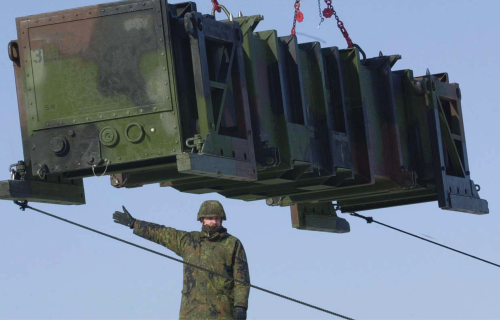
A section of a Patriot missile defense system arrives in Manching, Germany. Germany has a number of Patriot batteries.
Overall, this strategy has paid off for the Bush administration, as more and more countries hop aboard the GMD train. The first rudimentary parts of the American missile defense system will be deployed this fall with the basing of interceptor missiles in Alaska and California.
Why some support missile defense
The turning point for those countries wavering in their support of missile defense came in December 2001, when Russia seemingly acquiesced in the American abandonment of the Anti-Ballistic Missile (ABM) Treaty, thus removing other nations' earlier fears that cooperating with U.S. missile defense plans would jeopardize relations with Russia and undermine arms control regimes. Four key factors led to the apparently increasing support for American plans.
First, most states recognized that the Bush administration was resolutely determined to proceed with its missile defense project regardless of whether it had international support. It was not surprising that countries began deciding they would prefer to be inside the tent, where they could have some policy input, rather than outside the tent and out in the cold.
Second, cooperation with the United States was seen to offer political gains. President Vladimir Putin probably calculated that Russia was more likely to curb its biggest concern–unbridled American unilateralism–through limited cooperation rather than condemnation of missile defense. For other states, a good relationship with the United States is of paramount concern.
Third, there is a strong belief that significant financial, technical, and industrial gains will emerge. The United States suggested that Russian firms would be able to bid for lucrative missile defense orders, while European and Asian partners have already received profitable contracts.
Finally, there are clear military gains for some states from missile defense cooperation, most notably in troop protection.
The state of play
Cooperation on missile defense by North American and European nations has largely occurred within existing security architectures. In April, Canada agreed to an early warning system for North America to be operated by the North American Aerospace Defense Command (NORAD). Canada had little choice; if NORAD were sidelined, Canada would abdicate its control over continental air defense. This would be a significant loss–through NORAD, Canada has been able to exercise disproportionate influence in relation to its military expenditures and resources.
At the Prague summit in November 2002, NATO member states agreed to initiate a missile defense feasibility study to examine options for a layered TMD. The successful bidders for the study were announced in September 2003, and work is slowly progressing. Several member states are developing their own missile defense capabilities, which may later be integrated with a NATO system. Germany has several American Patriot I TMDs and is developing the Medium Extended Air Defense System in conjunction with the United States and Italy. Britain has finalized an agreement with the United States to upgrade the Fyling-dales early-warning radar, and has created the British Missile Defence Centre to interface with its American sister agency. However, Britain continues to insist that missile defenses need to be balanced with global nuclear deterrence, focusing its efforts on TMD and the protection of troops. The British government is also optimistic about the potential benefits for its defense industry.
In contrast to popular perception, Paris does not fully reject missile defenses. French and Italian firms are jointly developing the Aster TMD system. France's view is similar to that of Russia: TMDs are useful, but NMD is destabilizing. France's main objections to global missile defense are driven by a concern, shared by the British, that it will replace cooperative diplomacy and produce a spiralling arms race in a futile search for invulnerability.
In Asia, cooperation on missile defense is built on long-standing friendships with the United States. Japan has joint TMD programs with the United States, although Japan's Patriot IIs and Aegis destroyers operate independently. Tokyo's interest was catalyzed when North Korea lobbed a Taepodong-1 missile across the Sea of Japan in 1998. Japan also realizes that the United States, its only alliance partner, would regard failure to cooperate on missile defense to be a deal breaker. In December 2003, Japan announced that it would construct a layered missile defense system, using both Aegis destroyers and Patriot III missiles. Japan's gradual move away from its traditional pacifist stance is also seen in its March 2003 launch of two military satellites.
Another piece of the GMD puzzle fell into place in December 2003, when Australia announced its participation. The move was primarily justified in terms of the North Korean threat, and the Australian government insists there will be substantial economic dividends. In response, Indonesia issued a strongly worded warning that Australian-backed GMD could trigger an arms race and undermine regional stability. Indo-American cooperation also threatens the precarious regional balance by menacing both China and Pakistan. The U.S.-India Defense Policy Group meets regularly and in March held a simulated missile defense exercise. In January, the United States announced that it would give India access to sensitive space, nuclear, and missile defense technology. But this cooperation may now be downgraded, as the newly elected Congress Party and its leftist allies have been critical of India's unambiguous support for GMD.
Other governments began deciding they would prefer to be inside the tent, where they could have some policy input, rather than outside the tent and out in the cold.
Finally, Israel is the only Middle Eastern country cooperating on missile defense. American Patriot missiles were deployed in Israel during the first Gulf War and Israel subsequently developed its indigenous Arrow system with the United States. The Arrow was first deployed in 2002 and operates alongside Patriot III installations, but it has not been tested in combat.
Russia's conditions for cooperation
In both Europe and Asia, Russian theater defense policy is driven by three aims: to be a key player in the development of regional security structures; to ensure that regional structures are not directed against Russia; and to foster a multipolar international system, curbing perceived American unilateralism. Russia sees theater-defense cooperation as part of the global war on terror and as potentially yielding dividends for its defense industry.
The idea of a limited European TMD was first mooted in 1994, but a framework for cooperation was not developed until the NATO-Russia Council was established in May 2002. Under its auspices, NATO and Russia conducted groundbreaking exercises in Colorado from March 8 to March 12 to ensure that they can quickly and effectively work together to counter a missile threat against troops deployed on a joint mission.
Russian TMD efforts in Asia have been more restrained. In 2002, Russia proposed a regional missile defense system that would encompass Russia, China, the United States, and Japan, as well as bilateral cooperation with Japan and Pakistan. But attempts to propose an alternative to U.S. global missile defense have not been successful due to long-standing American missile defense interests in the region. The only concrete outcome is that in June Russia finalized the sale of S-300 surface-to-air missiles to China.
Beginning in September 2002, statements by Russian deputy foreign and defense ministers revealed a willingness to cooperate with Washington on missile defense. President Vladimir Putin explicitly backed this approach in late January 2003. The development was foreshadowed in May 2002, when the United States agreed to assist Russia in improving its early warning system through the establishment of a joint ballistic missile launch information-sharing center. But pledges to continue developing the Russian-American Observation Satellite warning system ended in February, when the system was dropped from the U.S. defense budget request for fiscal 2005. In April, a draft agreement called for establishing a missile attack early warning system and other land components of missile defense that do not involve the potential militarization of space. However, this attempt harks back to a failed 1998 Clinton-Yeltsin plan to develop a joint warning system in Moscow, for which there proved to be a significant lack of political will. It is difficult to imagine that meaningful progress will occur when even mundane and noncontroversial plans cannot be brought to fruition.
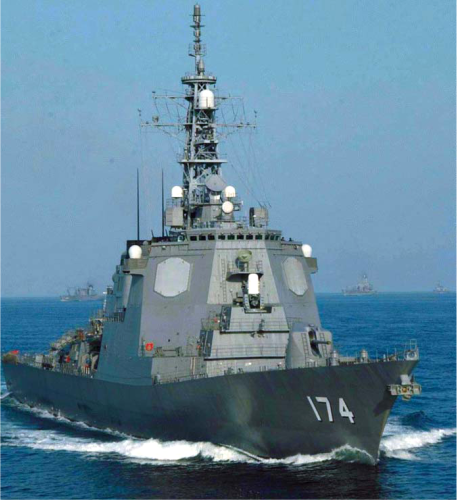
A Japanese Aegis destroyer in the Arabian Sea, February 2003.
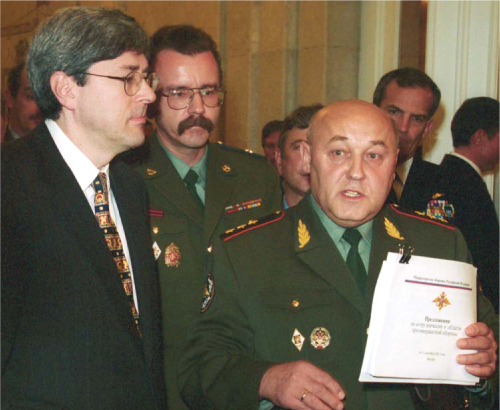
Russia has attached clear conditions to its cooperation with the United States on missile defense. First, GMD cannot threaten Russian national interests. Deputy Chief of the Russian General Staff Yury Baluyevsky has repeatedly said that the goal of Russian cooperation is to create systems that can defend against single missile launches by accident, by a rogue state, or by terrorists. Russia does not believe that current missile defenses threaten its nuclear forces, nor that defenses will be able to neutralize its large strategic offensive arsenal for the foreseeable future.
Second, cooperation needs to occur on the basis of equality, which reflects Russia's desire to be perceived and treated as an equal partner.
Third, Russian technologies and intellectual property must be protected from cunning Americans who may steal Russian ideas under cover of cooperation. Russia has operated an area missile defense around Moscow since the late 1960s, and Russians believe that defense has bequeathed them a legacy of potentially valuable experience and technology. The Kremlin is keen to protect and promote this potentially profit-making element of its defense sector.
Fourth, space must be demilitarized and GMD prevented from extending into space.
Finally, cooperation should be built around a legal framework. Russia has said that an agreement on missile defense is a precondition of cooperation. Moscow has persisted in attempting to encourage the United States to agree to a substitute for the now defunct ABM Treaty, but has been repeatedly rebuffed. Russia aims to maintain the link between offensive and defensive weapons with a view to protect strategic stability within a legal framework clearly delineating Russia and the United States as equal strategic partners.
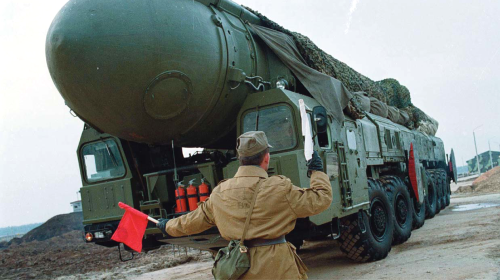
Russia considers its Topol-M missile a “silver bullet” against American missile defenses.
Russian and Chinese concerns
Russia and China share two key concerns about American missile defense plans: that their nuclear deterrent is threatened and that American missile defense plans will destabilize arms control. The threat posed is far more immediate for China, whose nuclear forces are Lilliputian in comparison to American and Russian nuclear arsenals.
Just as America insists its decision to withdraw from the ABM Treaty is not directed at Russia, says Putin, Russia's weapons modernization is not directed at the United States.
Both Russia and China have responded actively to the American abandonment of the ABM Treaty by developing asymmetrical measures to neutralize any potential threat. By withdrawing from START II, Russia was able to continue deploying multiple independently targetable reentry vehicles (MIRVs) on intercontinental ballistic missiles (ICBMs). Putin announced in October 2003 that Moscow intends to place on combat duty dozens of MIRVed SS-19s, and Russia has also extended the service life of its SS-18 heavy ICBMs. Russia has begun building the fourth-generation Borey class of submarines, is MIRV-ing its silo-based Topol-M, and is finishing testing the mobile version of the Topol-M. Russia regards its new Topol-M ICBMs, originally designed in the 1980s as a counter to Reagan's Star Wars, as a “silver bullet” against American missile defenses.
During Russia's nuclear military exercises in February, most attention focused on the failure of two submarine missile launches, with little attention paid to the successful testing of a new hypersonic “Crazy Ivan” warhead that follows a nonclassical scenario, changing flight altitude and course repeatedly, making it nearly impossible to track and target. Putin declared Russia able to penetrate any missile defense system with ease. With characteristic khitryi (sly) wit, Putin commented that just as the Americans insisted that their decision to withdraw from the ABM Treaty was not directed at Russia, Russia's modernization of its nuclear arms and other new weapons developments is not directed at the United States.
Russia has also upgraded the A-135 strategic single-site ABM system covering Moscow, the only such system currently in operation. In 2002, Russia began working in earnest on TMD and is currently developing several advanced missile interceptors, such as the S-500, which would add to its current arsenal of S-300 and advanced S-400 interceptors. Russia has also successfully tested ship-based interceptors.
Moscow, September 11, 2001: Undersecretary of Defense Douglas Feith meets with Russian Deputy Chief of the General Staff Yury Baluyevsky to talk about missile defense.
But the Kremlin has clearly indicated that it has no intention of keeping up with the Joneses on missile defense. Putin had said that while he does not rule out the development of a national missile defense at some point in the future, deployment would depend on how work moves ahead in other countries. Russia also continues to rebuild its ailing early warning system and to bolster its military satellite constellations. Since 2002, Russia has indulged in numerous military exercises, each increasing in size and ambition. The May 2003 exercises even involved hypothetical nuclear strikes on the United States and the neutralization of American satellites to blind Pentagon planners. All these measures have been buttressed by a steady increase in defense spending. Senior Russian figures, including Putin, have increased the frequency and import accorded to their visits to strategic military installations.
Both Russia and China appear unconvinced by American assurances that global missile defense is not directed against them, despite echoing American rhetoric about the need to defend against the terrorist threat. Senior Russian military and foreign affairs officials have argued that while the United States proclaims its partnership with Russia, its actions show anything but that. In January 2003, Russian Defense Minister Sergei Ivanov expressed particular concern about U.S. plans to enhance radar stations in Britain and Greenland, as the likely routes of missile launches from rogue states do not cross those areas. Washington's plans to develop “bunker buster” nuclear weapons only add to Moscow's and Beijing's unease. They are seen as having the potential to disrupt the existing parity of nuclear deterrence and drastically alter the threshold for the use of nuclear weapons.
General Baluyevsky, commenting on such developments, said: “It's very scary, extremely scary.” 1 Russian concerns are further aggravated by America's stated intention not to cut its nuclear arsenal to levels designated by the Moscow Treaty of May 2002–instead moving the missiles as well as the warheads into storage as a hedge against an uncertain future.
Beijing's distrust of American intentions is fueled by its belief that global missile defense is yet another manifestation of American unilateralism and a key component of an American attempt at worldwide domination. U.S. efforts to sharpen its swords and expand its shields are seen as posing a significant threat to China's nuclear deterrent. China's nuclear strategy is one of minimum deterrence–that potential enemies will be deterred as long as uncertainty remains about China's ability to launch retaliatory action.
China remains one of the few countries adamantly opposed to TMD. The U.S. decision to sell Patriot III missiles to Taiwan further destabilized the region. China remains fearful of nuclear blackmail on the Taiwan issue, and the deployment of TMD could encourage China to adopt a preemptive escalatory posture. China is also concerned that an American-Taiwanese missile defense would subsume Taiwanese military forces under American command. Japan and the United States already have a military alliance, and command integration for Taiwan could mark the beginning of an explicit U.S.-Taiwanese alliance against the mainland. Taiwan, which appears sensitive to the implications of such a move, appears to be gently stepping backward on missile defense by canceling maintenance contracts for its Patriot IIIs.
While China has been modernizing its forces since the 1980s, it has also been influenced more recently by projected American missile defense plans. Not surprisingly, Beijing is moving toward a more diversified, invulnerable, and combat-ready operational nuclear triad. China's current strategic deterrent consists of 20 silo-based Dong Feng-5 ICBMs, which are liquid-fueled and thus kept at low readiness with their warheads stored separately. China's newest intermediate-range ballistic missiles are solid-fuel mobile Dong Feng-21As, and China is developing mobile ICBMs as well. If China believes that American global missile defenses are undermining its nuclear deterrent, it could MIRV and attach decoys to its ballistic missiles. In a tense situation, as exists in the Taiwan Strait, missiles on high alert only aggravate the possibility of escalation or accidental or preemptive war.
Having identified America's military Achilles' heel–its increased dependence on vulnerable space-based assets–China has also accelerated its military space program, exploring ways to neutralize American military satellites in the event of conflict.
Second, Russia and China are very concerned that American missile defense plans will destabilize existing arms control regimes and forestall future agreements. Russia has repeatedly argued that GMD diverts resources from the war against terror and runs counter to the Bush-Putin commitment to reducing nuclear arsenals. China has declared that Japan's missile defense plans could undermine the regional balance and trigger a new arms race. It is not clear whether this is a threat or a prediction.
Russia, China, and other states express deep concern about the weaponization of space. In 2003, Russia and China proposed an agreement for the non-weaponization of space, and negotiations continue at the Conference on Disarmament in Geneva. Both Moscow and Beijing maintain that nonproliferation measures and policing regimes are a better way of dealing with weapons of mass destruction than attempts to develop missile shields.
The bottom line
The U.S. pursuit of global missile defense has some international support. But that support is not attributable to a shared commitment to America's strategic vision. Rather, it results from pragmatic calculations on how to engage with the world's only remaining superpower. In some ways, it is almost as if countries are simply waiting for the GMD storm to pass.
The real danger lies in the potential of GMD to disrupt delicate regional balances and to encourage the further development and deployment of nuclear weapons. The United States, China, and Russia have all stepped up their offensive weapons programs since the dissolution of the ABM Treaty.
The danger has been succinctly summarized by Mohamed El Baradei, head of the International Atomic Energy Agency: “If we don't stop using double standards, we shall be piled high with an even greater number of nuclear weapons.” 2 That would create the exact opposite of the professed objective of global missile defense: security for all who want it.
Footnotes
1.
Vladimir Isachenkov, “U.S. Nuke Development Concerns Russia,” Associated Press, November 26, 2003.
2.
Vladimir Simonov, “Commentary: The USA Should Not Be a Nuclear Club of One,” RIA Novosti, September 1, 2003.