




Abstract
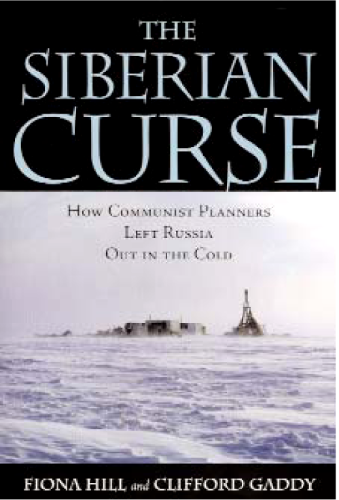
The Siberian Curse: How Communist Planners Left Russia Out in the Cold By Fiona Hill and Clifford Gaddy, Brookings Institution, 2003, 213 pages; $18.95
In early January, as I was waiting to take off from Yekaterinburg, in the Russian heartland, I could not help but appreciate just how cold Russia is. With ice crusting the airplane's wings, snow blowing fiercely, and the thermometer at 30 below zero, I had to wonder how–and why–1.2 million people live in remote, frozen Yekaterinburg, Russia's fifth-largest city.
Many scholars have written on the influence of the cold and the problems of distance in Russia. In The Siberian Curse, Fiona Hill and Clifford Gaddy seek to bring new rigor to the task. Using the concept of “temperature per capita,” they calculate the “cost of the cold” using mean temperatures in January and population concentrations. Their results indicate that even in 1930, Russians lived in far colder cities than Canadians, Americans, or Swedes. In addition, more than half the U.S. population lives in cities of more than 1 million people, while fewer than 16 percent of Russians do. As Hill and Gaddy note, concentration of people and resources increases the number of economic transactions, and thus economic value.
The authors argue that many of Russia's cities are therefore simply in the wrong places. Without Moscow's considerable muscle and money, the far-flung Siberian cities would never have grown to the size they are today, they write. Russia's geography is not manifest destiny, Hill and Gaddy maintain. Labor and capital can be redistributed and, in effect, warm up Russia. They point to the depopulating of Duluth, Minnesota, which its founders predicted would become one of America's leading metallurgical centers but instead became a textbook example of “locational mal-adjustment.”
But shrinking Russia is difficult. The authors catalog a number of reasons for this, from dependence on social networks to measures preventing migration to warmer cities, especially to Moscow. One wonders if even more factors may be at play, such as regional spirit, particularly of native peoples, or possibly even paid jobs (only costs are calculated in this book, though there are hints that some extraction industries in Siberia are actually profitable).
While the Duluth story is apt, some of the authors' other statements regarding the North American experience are questionable. They suggest that road construction in the United States was market-driven, unlike the follies of Soviet planners. However, the U.S. transportation system arguably benefited more from post-World War II highway construction, a government program designed to increase employment, than from any private toll roads. Los Angeles, on the other hand, abandoned early road-building plans after guessing that the city would never have a large enough population to need all of the planned arteries. It is difficult to predict how Russia's economy might develop if it undertook the huge short-run costs to improve transportation. A study of the options for tying Russia's outlying regions to Northeast Asia should be done, to see if long-term benefits might outweigh immediate costs.
“My name is Bob and I spent $12 billion on a jet fighter that doesn't fly.”

As Hill and Gaddy note, although Russia could improve its communications network (and thus decrease the cost of distance), nothing can be done to affect outside temperatures. The book outlines a plan for further research that calls for calculating Russia's economic cost per degree of cold. It would be helpful if, unlike in the present tome, Hill and Gaddy differentiated between the various costs of the cold: While the impact of cold on outdoor construction may be the same everywhere, the cost of heat, for instance, varies widely. The hydroelectric plants of Siberia produce far cheaper energy than the coal-fired and fuel oil plants of the Russian Far East. Calculating costs at the city level is the only way to determine whether a city's existence makes economic sense.
If cities downsize, where should people go? Siberian Curse implies that Moscow is the only place in Russia with a truly vibrant economy–the exception that proves the rule–and that it should stop preventing in-migration. But is increasing migration to the capital really the best way to help the periphery? It is a politically risky strategy, and besides, the authors themselves note that cities' costs do not decrease as population declines, since infrastructure must be maintained.
A future study might compare the impact of relocating people to the impact of changing federal policies regarding industries in the periphery–would Moscow have to subsidize fuel and food in Siberia if it did not collect so many taxes and other moneys there? This January, a new customs code came into effect, altering the way that foreign investors recoup value-added taxes from the Russian government. As a result, South Korean-owned clothing factories in the Russian Far East are shutting their doors. Federal policies should create a level playing field, but in the mid-1990s it was actually cheaper to import Japanese goods to Khabarovsk, a region on the Pacific coast, via Moscow rather than directly, due to preferential tariffs in the capital. One might also look at the impact of central subsidies on incentives to improve power production, insulation, heating tunnels, and the like in the provinces.
How should Siberia's resources be extracted? Hill and Gaddy contend that the existence of mineral wealth in the region does not mean that profits have to be spent there–or should be. They point out that Norilsk, in Russia's Far North, spends a great deal on welfare–attracting inmigration from welfare seekers. One wonders precisely how a market could be set up in which owners of Siberian industries spend their profits in warmer regions. Taxation is one possible answer, but hardly a market stimulus. Nevertheless, the idea of exploiting Siberia without subjecting so many Russians to the cold deserves exploration.
The book also touches on security issues, since Russians often argue Siberia must be populated to be secure. Early in the book, the authors point to the unpopulated parts of Alaska, Canada, and Scandinavia and note that they are secure. Only at the very end of The Siberian Curse do they acknowledge that Russia's neighbor, China, creates a very different security environment. Nevertheless, they suggest that population is not the answer and instead propose sensors, rapid reaction forces, and high-tech weapons, as well as international treaties. Although these are possibly good long-term suggestions, they fail to calculate short-term costs.
While Siberian Curse raises many questions, it also provides a new way to look at Russian reform. Soviet planners had a fixation on physical assets, a near-religious belief that if there was a natural resource, it had to be exploited. The authors show that this mentality continues. Instead, they say, Russia should concentrate on developing its human capital–Russia's problem is not underpopulation, but too many people of too poor quality. Hill and Gaddy show us that Siberia's development did not make sense. The question remains as to whether one million people need to suffer through winters in Yekaterinburg.