




Abstract
North Korea: Another Country By Bruce Cumings, New Press, 2004, 241 pages; $24.95
In a Washington Post op-ed last August, Nicholas Eberstadt, a heavy hitter at the neoconservative American Enterprise Institute, wrote that the notion that “North Korea might agree to conclude its nuclear confrontation through peaceful international negotiations” was sheer fantasy.
Put simply, suggested Eberstadt, North Koreans lie and cheat regarding their weapons programs. “Pyongyang has made it clear it will push its nuclear weapons project overtly when it can–and covertly when it must. With the right enticements, Pyongyang can be persuaded to promise to give up its nuke program. It just can't be persuaded to actually keep the promise.”
Eberstadt's view, which sums up the stance of the current administration, is that North Koreans wear all the black hats in the decade-old nuclear standoff between the Democratic People's Republic of Korea and the rest of the world.
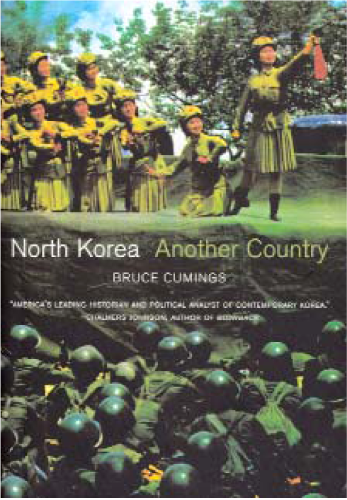
Bruce Cumings, a historian at the University of Chicago and one of the world's foremost academic authorities on North Korea, disagrees. There are black hats aplenty, many of which are worn in North Korea, but others top the heads of American leaders.
Cumings has been to North Korea several times, and he knows it to be a benighted police state and “the most astounding garrison state in the world.” It has pursued financially and politically costly nuclear weapons programs in violation of commitments it made under the terms of the Nuclear Non-Proliferation Treaty while hundreds of thousands of its people starve. It has so isolated itself from the rest of the world that even good-deed nongovernmental organizations, like Médecins Sans Frontières, Oxfam, and CARE, have trouble working there.
“I have no sympathy for the North,” writes Cumings, “which is the author of most of its own troubles, specializes in self-defeating behavior, treats like children the masses of its own population unlucky enough to be excluded from the elite, and indulges in such stereotypical hero worship, grandiose exaggeration, and wretched excess as to make even a scholar of East Asia reach for dusty old tomes with titles like ‘Oriental Despotism.’”
Cumings's description of the current leader, Kim Jong Il, son of North Korea's founder Kim Il Sung, is priceless. Kim Jong Il, says Cumings, is brighter and more rational than U.S. leaders give him credit for; still: “What can he possibly be thinking, standing there in his pear-shaped polyester pantsuit, pointy-toed elevator shoes, oversize sunglasses of malevolent tint, an arrogant curl to his feminine lips, an immodest potbelly, a perpetual bad hair day? He's thinking, get me out of here…. ‘Long live the Great Juche Idea!’ the banners read, but what good are 1930s notions of autarky and self-reliance in the century of globalized cosmopolitanism, a borderless world where you can be on the Riviera at one minute, in Bali the next?”
North Korea is in the news now, as it was in 1994, because of its apparent willingness to pursue a nuclear weapons program, openly or clandestinely. Cumings devotes a chapter to this on-again-off-again-on-again nuclear crisis. But the purpose of Another Country is not to explore the nuclear issue but to parse the culture of North Korea, particularly its warm and close family patterns and its lingering pride at having been the center of the resistance movement to the imperial Japanese, who brutally occupied the Korean Peninsula before and during World War II.
If we are to understand North Korea in the first decade of the twenty-first century, we must reach back to 1950 and the “forgotten war.” President Harry Truman's decision to send American troops under U.N. cover to repel the invasion of South Korea by North Korea made sense only if one believed–as did Truman and his advisers–that it was a cross-border aggression directed by Moscow.
In fact, says Cumings, the “invasion” was the start of a civil war, a war of liberation, “a war fought by Koreans, for Korean goals.” Cumings has been saying this for many years (see, for instance, his two-volume Origins of the Korean War, first published in 1981), and his viewpoint is now widely shared by historians of Northeast Asia. But it is still a zinger. Suppose newspaper headlines throughout the United States had said in June 1950: “Koreans Invade Korea.” Readers would have scratched their heads, wondered where Korea was, and then turned the page. Cumings approvingly quotes a memo written by Richard Stokes, a British official, who said on December 2, 1950, after Chinese “volunteers” had entered the war:
“In the American Civil War the Americans would never have tolerated for a single moment the setting up of an imaginery [sic] line between the forces of North and South, and there can be no doubt as to what would have been their reaction if the British had intervened in force on behalf of the South. This parallel is a close one because in America the conflict was not merely between two groups of Americans, but was between two conflicting economic systems as is the case in Korea.”
That interpretation lies at the heart of Another Country. The “holocaust that the North experienced during the Korean War” at the hands of the United States has skewed and colored the reactions of North Korea's leaders for more than a half century. “The North Korean population is constantly drilled to prepare for war, indeed for anything–including nuclear attack. It all goes back to the eruption of the war in June 1950.”
If the Korean War had ended in September 1950, says Cumings, after American-led U.N. forces had pushed the invading forces back to North Korea, the toll would have been substantial–some 110,000 South Koreans killed, 106,000 wounded, and 57,000 missing. Combat losses for North Koreans might have been about 70,000. American casualties by then totaled about 3,000 dead and more than 13,000 wounded. Terrible numbers, but in the context of the bloodiest century in the history of the world, perhaps bearable.
But the war didn't end. Cold War liberals opted for “rollback,” for toppling the North Korean regime, says Cumings. “We carried the battle to the North, thinking an easy victory was at hand, whereupon China entered the battle, and soon the world stood at the brink of general war…. Upward of three million North Koreans died, along with another one million South Koreans, and nearly a million Chinese. Fifty-two thousand more American soldiers died. And the war ended where it began,” roughly at the 38th parallel.
Cumings believes Pyongyang is mostly, though not entirely, blameless for the continuing tension between the United States and North Korea. The U.S. decision to divide Korea at the 38th parallel toward the end of the war with Japan was not carefully thought out, and it laid the foundation for civil war. Other U.S. decisions to give comfort and support to South Korean leaders, many of whom had collaborated with Japan, were tragically misguided, making civil war virtually inevitable. The true Korean patriots–including Kim Il Sung, who had fought the Japanese in northern Korea and in Manchuria before and during World War II–were largely concentrated in the North, says Cumings. Most were communists, to be sure, but they were also ardent nationalists.
Since the Korean War ended, the United States, from the 1950s to the present, has made it plain that it would resort to the use of nuclear weapons if North Korea got out of line. North Korea, says Cumings, has felt threatened by American nuclear might for 50 years. It still feels threatened, perhaps now more than ever with the Bush administration's talk of “preemptive war” against “rogue states,” among which it numbers North Korea.
Has the United States done anything right regarding North Korea over the past 50 years? Not really, says Cumings, although he credits Bill Clinton with finally making some positive moves that were too little and too late.
Does North Korea possess the many virtues that Cumings describes? While he criticizes the inanities of the North Korean regime, the tone of the book suggests that North Korea might have been a wonderful place if not for the baneful effects of American policies. Perhaps. At any rate, it is an unknowable thing. Meanwhile, occasional human rights reports on conditions in North Korea–starvation, gulags, schools teaching hatred of America to children–are chilling, if not downright horrific.
What we have in Northeast Asia, as Cumings clearly suggests, is a clash of two self-righteous states, an always-dangerous situation. One is a Marxist paradise gone exceedingly and brutally sour; the other a global power so rich and arrogant that it seldom troubles itself to understand the root causes of regional conflicts.
A century ago, Josiah Strong, perhaps the most popular and influential American religious leader of the day, a progressive, and an ardent apostle of “American exceptionalism,” asserted time and again in sermons, speeches, and books that America's divine destiny was to save the world. In its purest form, American exceptionalism is a magnificent expression of optimism, of an unquenchable belief that men and women, working together, can build a model society.
In its more malignant form, it has too often led to collective insensitivity, blindness, callousness, and even war. In the end, that is what Cumings is getting at. The United States has an attitude problem. It believes it is God's gift to the world. But if it could somehow dump that attitude and act with less hubris and more empathy, the crisis with North Korea would quickly sort itself out.
More than a decade of “dangerous cat-and-mouse diplomacy has now passed between the United States and North Korea,” says Cumings. Sooner or later, he says, an American president may come to understand North Korea's real goals: to finally bring the Korean War to a formal close and to enlist the United States in North Korea's preservation–to “keep the South from swallowing it.”
Once an American president understands that, “the crisis will end, embassies will be exchanged, and Americans will begin to enjoy touring this beautiful Hermit Kingdom and meeting its unknown but warm, proud, and dignified people.”
But is that kind of empathetic understanding in the cards? Cumings is not sure that “Americans can ever transcend their own experience and join a world of profound difference. When all your truths are self-evident and when the fondest hope of foreigners from Azerbaijan to Zimbabwe is to become a citizen of your country, it is difficult to understand that not everyone in the world wants to be an American.” For better or for worse, says Cumings–in italics–North Korea is their country.