




Abstract
The Energy Department is very proud of its faster, cheaper cleanup at the Hanford Site. But cutting corners is making tank-farm workers sick.
On September 15, 2003, the Government Accountability Project (GAP) released a report concerning the safety of workers at the Hanford Site nuclear reservation. 1 During the span of nearly two years, there had been a drastic increase in the rate of workers being exposed to chemical vapors at the site and requiring medical treatment, the report stated. On the same day, the Energy Department held a press conference to reward a contractor at Hanford, CH2M Hill Hanford Group (CHG), for meeting scheduled deadlines under its new Accelerated Cleanup program.
The Energy Department's congratulatory gestures hide the harsh reality of a faster, cheaper cleanup: Conditions at Hanford are making workers sick with increasing frequency. Poor safety standards, a decline in government oversight, a dismissive onsite healthcare provider, and a history of failing to adequately address health conditions signal an impending catastrophe. Energy continues to move toward its cleanup goals, but workers continue to be exposed to the very same chemical vapors that Hanford scientists previously determined could cause cancer.
Untold dangers
The Hanford Site is a former nuclear weapons facility located in southeastern Washington State. After 54.5 metric tons of weapons plutonium were produced at Hanford, a staggering quantity of deadly, high-level radioactive and chemical by-products remain. An estimated 53 million gallons of mixed chemical and nuclear waste are stored in 177 underground tanks, which are arranged into 18 “tank farms,” now managed primarily by CHG. The high-level waste forms noxious vapors that gather in the headspace of the tanks. In order to prevent pressure from building up and possibly rupturing the tanks, the vapors must be vented into the atmosphere. Workers at the site are sometimes exposed to these released chemical vapors.
The extent of the danger is not precisely known, because the compositions of the vapors vary greatly. Limited sampling has shown that the headspace vapors may contain any number of more than 1,200 organic and inorganic chemicals, in addition to radiation. 2 Benzene, chloroform, n-nitrosodimethylamine (NDMA), acetonetrile, carbon tetrachloride, and ethylene-dibromide (the last four are also liver toxins) are among the carcinogens and potential carcinogens that are released.
The presence of the vapors is often unmistakable. According to workers at the site, the vapors have a range of distinct smells: ammonia, rotten eggs, wine, old socks, must, diaper pail, garlic, whiskey, gasoline, wet cardboard, mint, fruit, chloroform, and butter.
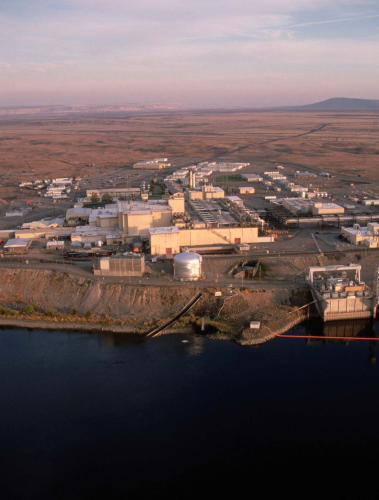
The Hanford Site in Washington State.
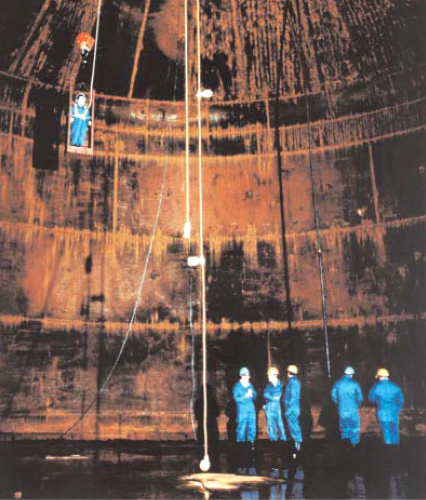
During construction in 1977, workers stand inside a million gallon double-shell waste tank. One hundred and seventy-seven tanks dot the Hanford reservation.
Some harmful chemicals potentially present, such as NDMA and carbon monoxide, have no odor. Monitoring equipment is necessary to detect these vapors, but at Hanford the monitoring equipment is inadequate to detect their location and makeup, according to the GAP report. Most of CHG's air-monitoring instruments can detect only a handful of the 1,200 chemicals potentially present in the vapors, and only within a certain range of concentrations. Workers have reported numerous instances when they smelled contaminants and experienced symptoms of exposure at levels not detected by monitoring equipment.
In order to improve its detection equipment, CHG recently acquired a highly touted RAE Systems parts-per-billion photo-ionization organics monitor, a system tested by the U.S. Army to detect airborne chemical weapons. Unfortunately, the system was found to perform so poorly in tests for agent sensitivity that the army discontinued testing. 3
Workers also complain that the company's monitoring records do not match readings taken at the time of exposure. In addition, chemical vapors are monitored only a fraction of the time tank-farm workers are in the field. CHG has not attempted to identify the vapors found in most of the headspaces. Rather than recognize the hazards of unknown and uncharacterized contaminants that cannot be monitored, CHG argues that according to the vapor monitoring equipment workers are not being exposed to dangerous levels; the company continues to weaken safety regulations.
CHG has reduced workers' rights to suspend work if they think they are endangered. The company has transferred tasks typically completed by trained technicians to construction workers who have little job security and limited job-specific training. Managers have been permitted to sign waivers to increase a worker's radiological exposure limits without the worker's knowledge, according to GAP investigators, and have increased the threshold of safe wind conditions from 10 miles per hour to 25 miles per hour (recently tank sluicing operations forged ahead even in 50 mile-per-hour winds).
CHG has sent workers into areas that have continually made workers sick with little or no respiratory protection. Basic respirators are not required in many of the tank farms, and workers are denied the use of supplied air. The new Documented Safety Analysis reduces the levels of personal protective equipment and administrative controls used by tank-farm workers.
The consequences of these conditions have been great. Between January 2002 and August 2003, workers were exposed to chemical vapors 45 times, causing 67 tank-farm workers to seek medical attention, according to the GAP report. By March 2004, the number of workers who sought medical attention following exposures had risen to 99. Workers have suffered a range of acute health effects, including nosebleeds, persistent headache, tearing eyes, rashes, metallic taste, sore throat, altered voice, burning lungs, cough, expectoration, difficulty in breathing, loss of lung capacity, dizziness, nausea, vomiting, and increased heart rate. But workers most fear the potential long-term effects from chemical exposures. The long latency period for the development of cancer–approximately 20 years–allows Hanford management to portray future injuries as merely speculative.
Accelerating cleanup
The vapor problems at Hanford are not new. Between 1987 and 1992, federal oversight bodies, including Energy's Office of Inspector General, the Occupational Safety and Health Administration (OSHA), and the Senate Committee on Governmental Affairs, launched large-scale investigations into working conditions at Hanford after workers were exposed to vapors and received medical attention 16 times. In April 1992, the Energy Department issued a Type B investigation into tank-farm worker exposure. As a result of the investigation, workers at 84 of the 177 tanks received supplied air, contractors were required to constantly monitor air at all sites where supplied air was not being used, and Energy required contractors to characterize tank contents and their vapors.
Morton Corn, a former assistant secretary of labor at OSHA, reviewed the 1992 investigation and concluded that “the failure of those in responsible management charge to assign resources to this problem in the presence of repeated violations would, without any doubt, have been viewed by OSHA as willful violations of the [OSHA] Act and subject to possible criminal penalties…. In 1989 with the reoccurrence of the episode, [an OSHA finding of] ‘imminent danger’ and a series of restrictive procedures akin to closure of a manufacturing facility probably would have been invoked.” 4 But 12 years later, after a substantial increase in the number of vapor exposures, Energy has done little to address safety concerns.
One explanation might be that Energy's new Accelerated Cleanup program contributes to unsafe working conditions. The more intense the cleanup effort, the more tank waste is agitated, escalating the release of pent-up toxic vapors into the work environment. As the cleanup proceeds, workers have been directly contaminated with both liquid and dried tank waste on several occasions.
The program also contributes to deficient oversight of contractors, as Energy appears mostly concerned with meeting cleanup goals. According to Hanford's Performance Management Plan, the cleanup of tank waste will be completed 20 years ahead of schedule and tank “closure” activities will be initiated 10 years ahead of schedule (40 tanks will be closed by 2006). Energy sets “milestones” for meeting cleanup goals and then rewards contractors financially for meeting deadlines. For example, CHG will receive a $1 million bonus for each tank that it “closes.”
By providing incentives, the accelerated cleanup effort will cut costs by $20 billion. 5 Counter to the apparent goals of Energy, implementing more stringent safety standards might slow cleanup progress at the site.
A self-regulating agency
The current state of affairs at Hanford has its roots in the 1954 Atomic Energy Act, which authorized the Atomic Energy Commission (AEC) to establish its own health and safety standards. The OSHA Act, passed in 1970, exempted any federal agency that exercised its own authority to prescribe or enforce its own health and safety standards from its jurisdiction. The Energy Department regulates the health and safety of its contractors' workers through unenforceable “orders” that mirror OSHA regulations, including its standards for Hazardous Waste Operations and Emergency Response (Hazwoper).
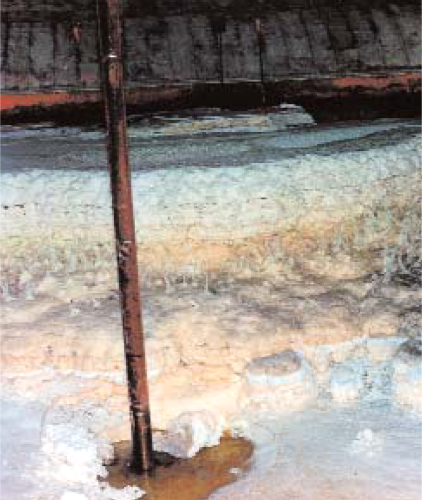
Mixed toxic wastes inside a tank; vapors rise to the top, creating pressure.
More than a decade ago, Congress's Office of Technology Assessment predicted the inadequate enforcement of this standard: “The lack of strong, centralized control over [Energy's] contractor organizations will hinder efforts to ensure consistent and comprehensive implementation of OSHA's Hazwoper standard and other health and safety standards during the [nuclear weapons complex] cleanup.” 6
Recognizing the need for enforceable health and safety standards, Senators Ted Kennedy, a Democrat from Massachusetts, and Jim Bunning, a Republican from Kentucky, included a provision in the 2003 Defense Authorization Act instructing the Energy Department to promulgate its existing industrial and construction health and safety orders as legally enforceable and then to enforce them within 12 months. Energy issued proposed regulations for public comment in December 2003; however, these regulations defied congressional intent. Energy proposed letting its contractors set the standards to which they will be held, rather than defining and enforcing minimum health and safety standards itself, as is done by OSHA at worksites across the country. In response to pressure from Congress, labor unions, public interest groups, and the Defense Nuclear Facilities Safety Board, Energy withdrew its proposed rule.
The Energy Department's long history of self-regulation has taken a human toll. In October 2000, Congress formally acknowledged for the first time that workers were harmed during the production of nuclear weapons and enacted the Energy Employee Occupational Illness Compensation Program Act (EEOICPA) of 2000. 7
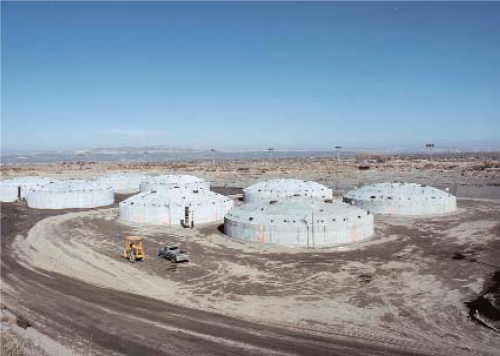
One of the tank farms as it looked during construction in 1985.
The law is divided into two main parts. In accordance with the first part, subtitle B, more than 52,000 claims have been filed, and approximately $793 million in benefits have been paid to Energy workers and their survivors.
Workers who contract occupational illnesses from exposure to toxic chemicals and hazardous substances are channeled to subtitle D of the act, which is administered by Energy. A panel of physicians then determines whether a worker's illness is work related. When there is a positive finding, Energy must direct its contractors not to contest state workers' compensation claims.
Under subtitle D, the Energy Department has failed to adequately respond to complaints. Energy has spent approximately $74 million to process the nearly 23,000 claims that it has received, but made little progress. To date, the physicians' panel has rendered findings on only 259 claims (1.2 percent), and Energy can identify only a single claimant who has been paid. Claimants will have to wait while Energy sorts through an estimated seven-year backlog in claims. 8
To exacerbate matters, the Energy Department continues to fund contractor legal defense against workers' compensation claims backlogged before the panels. From 1995 through most of 2001, Energy reimbursed contractors for 668 worker compensation claims. Until subtitle D is reformed, workers made sick from hazardous substances will see no benefit from EEOICPA.
Early warnings ignored
In a 1997 draft report, a Hanford contractor, Battelle's Pacific Northwest National Laboratory (PNNL), examined the potential health risks associated with vapors released from one Hanford tank, C-103. 9 The scientists identified 221 chemical gases released from C-103, but were uncertain of their toxic effects. They also did not know whether mixing certain chemicals would have an effect on the toxicity of the total mixture. They asserted that “many of the vapor-phase chemicals are in a volatile, reactive state” and that “the potential for synergism increases exponentially with the number of compounds making up the exposure.” Tank farm workers “may be at potentially greater risk than is commonly held for the Hanford Site. The scenario becomes more realistic as the maintenance of tank chemicals shifts to remediation.”
Because of OSHA's methodology for determining exposure to mixtures of chemicals, a tank worker may not receive a chemical vapor dose in excess of OSHA regulations, but still “be at risk of developing cancer or other chronic disease from the exposure,” according to the report. The PNNL scientists estimated that there could be a 1.6 in 10 risk of contracting cancer from exposure to the chemical vapors studied, and concluded that even this estimate “may not represent the highest potential risks.” If other nearby tanks were to vent to the outside–as all of Hanford's tanks do–then “the risks would be increased.”
Timothy Jarvis, a toxicologist and former senior scientist at PNNL, reviewed the 1997 report and was critical of the conditions at Hanford. “Sending workers into the tank farms with inadequate respiratory protection demonstrates callous disregard for human health and safety. Like every other employer in this country, it is incumbent upon CHG and the [Energy Department] to protect their workers from toxic chemical vapors.”
The Hewitt report
In July 1996, then tank-farm contractor Westinghouse released a report by one of its employees, Elton Hewitt. Hewitt concluded that new safety precautions had drastically reduced the risks posed by the tank farms. Controls around potential vapor release points were implemented and the contents and vapors of tanks had been characterized. “As a result of better communications regarding vapor odors and risks,” Hewitt reported, “employee exposure incidents have virtually ceased.” The vapor problem had been “resolved.” 10 As a result, the use of supplied air as a precautionary measure was eliminated at the Hanford tank farms.
Hewitt's report may have seemed conclusive, but it assumed that workers would become aware of a chemical vapor leak and leave the immediate area when they smelled ammonia, which has an easily detectable odor and consistently vents from the tanks. The report erroneously assumes that all chemicals vent from the tanks at the same time and ignores the fact that many of the constituents in the vapors are unknown and may act synergistically. Further, a worker's sense of smell is an unreliable measure of actual danger. Many of the chemicals that potentially leak from the tanks have no distinct odor, are in such a concentration that they cannot be smelled, or could cause biological damage before they are smelled. A worker with nasal congestion, or whose nose acclimates gradually to increases of odor, would be less able than others to detect a dangerous situation.
Despite its shortcomings, the Hewitt report continues to guide CHG's industrial hygiene practices today. CHG refuses to allow workers to use supplied-air respirators even if they request to do so after showing signs of exposure. This practice is contrary to CHG's stated procedures that workers be provided supplied air when a potentially hazardous atmosphere exists, when conditions are unknown or uncharacterized, or if contaminant levels are concentrated enough to be “immediately dangerous to life and health.” CHG refuses to consider tank-farm working conditions to be unknown or uncharacterized and insists that monitoring indicates conditions are not “immediately dangerous to life and health.”
In a sworn deposition that is part of a lawsuit against CHG, a senior industrial hygienist at the company, Lauri Marquardt, acknowledged a different opinion. There are indeed “unknown chemical constituents and compounds” emitting from the tanks “that cannot be tested with CHG's current air monitoring equipment,” the deposition reads. 11
Yet the problem is not only a lack of supplied air at the Hanford tank farms. It is a lack of any respiratory protection. In the overwhelming majority of exposure incidents, workers were wearing no respiratory protection at all. At other times, management issued dust masks, otherwise known as “nuisance masks,” for workers entering conditions known to be dangerous.
These precautions continue to be inadequate. On March 16, four workers were exposed to vapors due to a well-known mechanical failure in the tanks' exhaust system. The next day, two more workers were exposed in the same area.
Rob Barr, director of environment safety and quality for Energy's Office of River Protection, called the six exposures a “learning experience” for the contractor. “I think if they had to do it again, they would have put people in respirators because of what happened the previous day,” Barr said.
A worker checks monitoring equipment at Tank SY-101, Hanford's once-infamous “burping” tank.
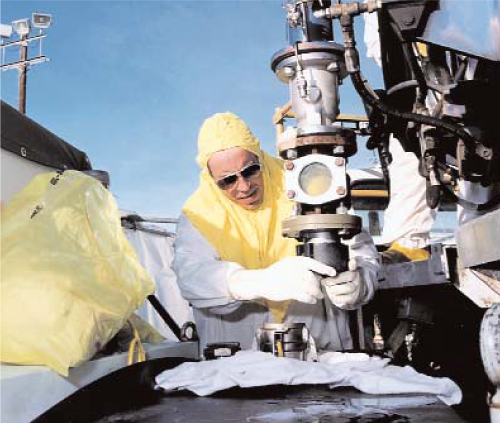
But then again on March 25, three more tank workers were exposed to vapors and taken to the hospital. The next day, CHG officials announced that all workers would wear respirators during a new review of safety policies.
On-site care
Once workers have been exposed to vapors and suffer symptoms, they are treated by the on-site occupational health services contractor, Hanford Environmental Health Foundation (HEHF). Unfortunately, HEHF appears riddled with the same institutional pressures to downplay risks to worker health and safety as other Energy Department contractors.
CHG safety representatives often work with HEHF to ensure that employees who have been exposed to vapors are seen by one particular doctor at HEHF. That doctor encourages medical personnel not to offer workers protection or medical restrictions beyond CHG's existing levels of protection from contaminants, according to documents obtained by GAP. 12 HEHF management and certain doctors consistently attribute symptoms of chemical vapor exposure to seasonal allergy or dismiss them as psychosomatic. Worker requests to refuse treatment from certain doctors are denied, and family, friends, and union representatives are prohibited from accompanying workers to medical examinations.
Current and former HEHF employees told GAP investigators that they have been instructed to alter medical records in order to reduce recordable incidents of occupational illnesses and injuries, to cover up errors, and to recreate lost medical records as if they were originals. Ambulatory-care triage is performed by high school graduates with little to no medical training. At the time of this writing, HEHF had laid off 50 percent of its nursing staff and was pushing medical technicians to perform nursing functions–a move that is being resisted by the nurses' union and the recently certified medical technicians' union.
HEHF's current medical director instructed staff in a memo not to encourage workers to file worker compensation claims and warned staff that they would “create a monster out there for the contractors and their recordability issues” if exams for workers exposed to vapors were not written up as “normal exams.”
A time for change
The Energy Department has learned little from its history. Recent events demonstrate that Hanford is now in the process of creating a new generation of sick and injured workers. The sweeping changes that followed the initial 16 exposures were short lived and not enough was done to protect workers permanently. As a consequence, the accelerated cleanup effort has had an enormous effect on the health of tank-farm workers.
What is most discouraging to many longtime observers of Hanford and the Energy Department is the recurring failure to institute long-term change in the way Hanford is operated. If the culture at Hanford changed and brought about safer working conditions, it might give more credence to its stated policy of “Safety First.” Instead, Hanford brazenly continues to repeat the mistakes of its past and perpetuates the cycle of preventable victimization. Energy officials have, thus far, not responded to the findings of the GAP report.
The health and safety crisis at Hanford is beginning to attract some attention. Several state and federal agencies have begun investigations. The Hanford Atomic Metal Trades Council, the bargaining agent for all unionized Hanford workers, recently issued a resolution calling for congressional hearings, an independent medical clinic for workers, external oversight of worker health and safety, and improvements to the EEOICPA.
It is once again time for Congress to recognize, as it did under Energy Secretary Hazel O'Leary, that the Energy Department and its contractors are incapable of self-regulation. The health of workers depends on the independent oversight and enforcement of health and safety standards at Hanford and all Energy facilities.
Footnotes
1.
2.
L. M. Stock and J. L. Huckaby, “A Survey of Vapors in the Headspaces of SingleShell Waste Tanks,” Pacific Northwest National Laboratory (PNNL-13366, October 2000).
3.
Teri Longworth and Kwok Y. Ong, “Domestic Preparedness Program: Testing of RAE Systems PPBRAE Volatile Organic Compound (VOC) Monitor Photo-Ionization Detector (PID) against Chemical Warfare Agents,” a summary report prepared for the U.S. Army, Soldier and Biological Chemical Command (ECBC-TR, September 2001, p. 16).
4.
Morton Corn, letter to Tara O'Toole, Office of Technology Assessment, July 27, 1992, cited in Office of Technology Assessment, Hazards Ahead: Managing Cleanup Worker Health and Safety at the Nuclear Weapons Complex, (OTA-BP-O-85, February 1993, p. 55-56).
5.
See Energy Department (RL-2002-47, rev. D, August 2002); Energy Department, “CH2MHILL, Integrated Mission Acceleration Plan,” is Hanford's Performance Management Plan for the high-level waste (RPP 13678, rev. 0, March 2003).
6.
Office of Technology Assessment, Hazards Ahead, p. 57. Hazwoper is defined on p. 29 (CFR 1910.120).
7.
This history is chronicled in the July/August 2001 Bulletin of the Atomic Scientists.
8.
General Accounting Office, “Energy Employees Compensation: Case Processing Bottlenecks Delay Payment of Claims,” (GAO-04-249T); see also Senate Energy Committee, Richard Miller, Government Accountability Project, testimony given on November 26, 2003, and H.R. 1758, filed by Cong. Ted Strickland, for detailed critiques of Energy's program and options for legislative reform.
9.
A. D. Maughan, J. G. Droppo and K. J. Castleton, “Health Risk Assessment for Short-and Long-Term Worker Inhalation Exposure to Vapor-Phase Chemicals from the Single-Shell Tank,” draft report prepared for Pacific Northwest National Laboratory (241-C-103, March 1997), available at  in the Nuclear Oversight Campaign section.
10.
Elton R. Hewitt, et al., “Tank Waste Remediation System Resolution of Potentially Hazardous Vapors Issue,” Westinghouse Hanford Company (WHC-SD-TWR-RPT-001, June 24, 1996).
11.
Lauri Marquardt, sworn deposition in connection with Stone, et al. v. CH2M Hill Hanford Group, filed with the Labor Department, May 7, 2003, p. 62.
12.
A typical restriction used by HEHF for tank-farm workers states, “No exposure to chemicals at or above_ (action level) the occupational exposure limits, either the TLV [Threshold Limit Value] or the PEL [Permissible Exposure Limits], whichever is more stringent.” The action level, when CHG moves to protect workers, for ammonia is 25 parts per million and for organics is 2 parts per million. Such a restriction, written for a worker who has been exposed to tank vapors resulting in nosebleeds, contact dermatitis, or respiratory distress sends a worker back into the same conditions that brought him/her to HEHF in the first place, with no additional protection. HEHF's medical director has explained away this discrepancy to HEHF providers by pointing out that, “The I.H. [industrial hygiene] people actually accompany the workers with direct measuring equipment to ensure protection.” Larry Smick, D.O. [doctor of osteopathic medicine], e-mail titled “Important Notice” sent to HEHF health care providers, January 23, 2003.