




Abstract
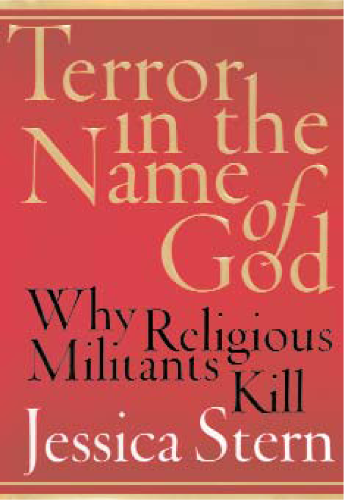
Terror in the Name of God: Why Religious Militants Kill By Jessica Stern, Ecco/HarperCollins, 2003, 368 pages; $27.95
The devastating attacks of 9/11 forced the American public to contemplate terrorism: Who were the attackers, and what had motivated them to commit acts of violence?
Many of the recent best-selling books on terrorism are full of admirable scholarship, but they lack an essential ingredient: face-to-face encounters with terrorists. Very few political scientists who study terrorism have had the nerve to get that close to their subjects; Jessica Stern has.
Terror in the Name of God draws readers deep into the world of religious militants and radicals. For four years, Stern explored the minds of men who kill out of extreme devotion to God, out of outrage against real or perceived oppressors, or simply out of a necessity to survive severe poverty and hopelessness.
Stern traveled alone, or sometimes with a female research assistant, to Israel, Palestine, Pakistan, Indonesia, Afghanistan, Kashmir, the Balkans, and throughout the United States. She shared tea and fruit in the homes and hideouts of militant Islamists and Jewish and Christian extremists. Her husband, she writes, observed with amusement that she is not scared when she should be and scared when she shouldn't be, which explains why she was willing to drink a cup of tea prepared by a jihadist who, under other circumstances, would try to kill her.
Stern describes herself as the kind of person to whom everyone tells their secrets. Indeed, some of the world's most dangerous individuals open up to her, talking about what led them to terrorism. This fascinating personal dimension sets the book far apart from others in the field.
Raised in a non-religious family, Stern felt she had to cultivate her spiritual side to better empathize with her subjects, nearly all of whom had crossed the line from religiously devout to religiously fanatic. Only by understanding their devotion to God could she interpret why and how “people who may be particularly sensitive to the suffering of others or to spiritual wrongs, who are motivated–at least initially–by a desire to purify the world of political and spiritual corruption, evolve from activists into murderers.”
Although Stern seems never to have betrayed fear, skepticism, or judgment to the men she interviewed, distrust sometimes developed–Stern, a Jewish-American woman, was intent on speaking to members of misogynistic, anti-Semitic, America-hating organizations as a peer. Not to mention that her credentials as a Harvard professor and ex-employee of the National Security Council caused some to think that she was CIA. In these cases, misapprehensions precluded revealing conversation. Those being interviewed thought they could spout rhetoric that would be reported back to the enemy.
The book has two parts. The first shows what causes people to turn to extremism. Using material from interviews, these chapters explain why people want to be part of violent groups and how leadership convinces them to kill in the name of God.
A former member of Covenant of the Sword reveals that his insecurities and need to feel important were manipulated by leaders, who encouraged feelings of alienation. In the Middle East, Stern brings to life the conditions of squalor that fuel the Palestinian group Hamas. And she illustrates how demographic imbalance can foment violence, as in Indonesia, where jihadi organizations were formed to quell the fighting that erupted between ethnic groups.
Stern sheds light on terrorists' motivations and the conditions that created them. Some live in unbearable filth, some in antiseptic cleanliness. Stern's detail of description is powerful; the reader knows the smell and taste of meals served by obsequious wives and the texture of the women's head scarves.
The book's strong second half introduces the structures and systems of organizations devoted to holy war, including the role of inspirational leadership; the dangers of lone-wolf avengers; commanders and their cadres; and different types of networks. In one particularly good chapter, Stern describes a convention of sorts at a Holiday Inn ballroom involving a bizarre cast of characters who believe that the murder of abortionists is religiously justifiable.
Her writing is not without humor, particularly when issues of social class become a factor. In one passage, Stern writes about her dinner with Kerry Noble, a former Armageddon cultist, and his wife. After puzzling over what one brings to a terrorist's trailer home as a hostess gift, she settles on a high-priced bottle, a “substantial merlot” that was “highly rated by Mr. Robert Parker,” for which Noble thanks her and promptly pops into the fridge. Describing a trip to Pakistan to interview the leader of a militant Islamic group, Stern makes herself the butt of the joke. When someone knocks on her hotel room door at 2 a.m., she's sure it's an assassin. She dials security, who arrive only to discover the hotel's laundry service trying to return clean clothes.
The writing style is lively and engrossing, although from time to time Stern lapses into academic language, introducing theoretical concepts that, while interesting, may not be appropriate for a general audience. Much of the material on virtual networks, swarming tactics, and other aspects of the study of terrorism may have been better in a separate book.
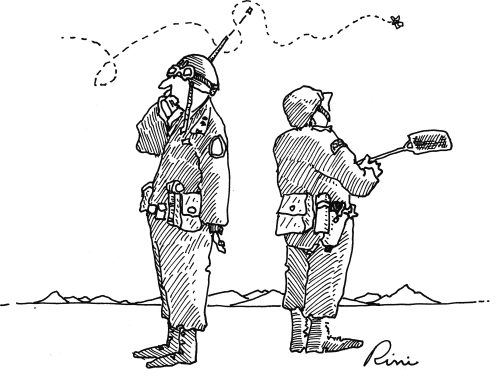
“Yes sir, incursions! Positive! One, maybe two, in the no-fly zone.”
The tendency to vilify rather than examine the enemies' objectives will not help in the fight against terrorism. But detailed intelligence about terrorists' personal choices, daily lives, and future hopes, will. Terror in the Name of God sets a new standard for terrorism studies. Readers and other students of this field will now expect more than a factual primer of names and places; they will want from other experts what Stern delivers–firsthand knowledge.