




Abstract
Insistent on gaining support for an unpopular war, Britain's Prime Minister Tony Blair put his reputation on the line.
January 4: Blair visits British troops in Basra, Iraq.
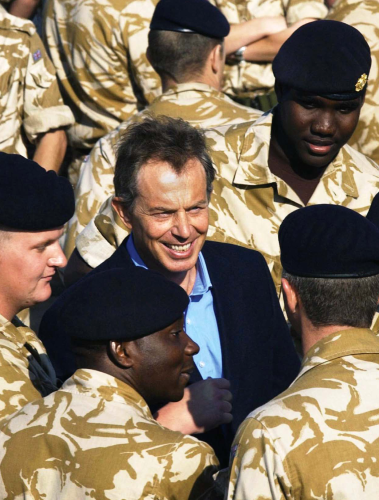
January 4: Blair visits British troops in Basra, Iraq.
British Prime Minister Tony Blair and President George W. Bush emerged from meetings at Bush's Crawford, Texas, ranch in early April 2002 with a shared vision that would ultimately rid the world of Saddam Hussein and his weapons of mass destruction. Bush was unequivocal in his remarks: “I explained to the prime minister that the policy of my government is the removal of Saddam and that all options are on the table.” Blair was equally direct and equally willing to consider all options. “The threat exists and we have to deal with it, that seems to me a matter of plain common sense,” he said.
A strong alliance was trumpeted by each administration. And it is thought that Blair committed himself to an invasion of Iraq during the meetings. 1 He was, and still is, convinced that Britain's strategic interests are best served by forging a close alliance with its transatlantic cousin.
But there was the matter of British public opinion and the reservations of members of Parliament (MPs)–many from Blair's own party–who were less willing to consider war as a means to an end and were weary of being simply a side party to America's interests. Blair was intent on winning their support and went to great lengths to present a case for war after the United Nations failed to explicitly approve military intervention.
It was after the course of his government's effort to persuade the public and Parliament that Britain needed to intervene in Iraq, however, that one of the country's leading experts on Iraq's weapons of mass destruction capabilities committed suicide. During the subsequent inquiry into his death, serious questions were raised about whether the prime minister had taken the country to war on false pretenses.
Winning the vote
Blair had already led his country into military actions in Kosovo, in Sierra Leone, and in Afghanistan against Al Qaeda and the Taliban. On each occasion he had won the overwhelming endorsement of domestic opinion. But Iraq was another story. In order to persuade Parliament and the public of the need to intervene in Iraq, Blair would have to demonstrate that Iraq's weapons of mass destruction capabilities posed a threat serious enough that it needed to be dealt with urgently.
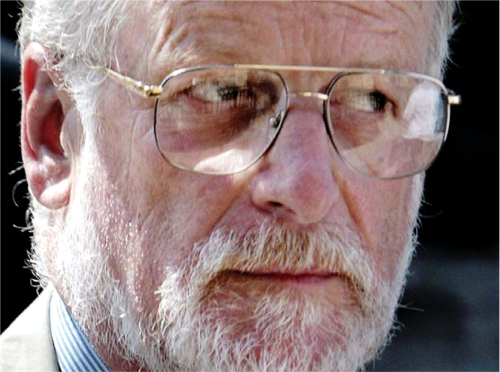
David Kelly, a government expert on weapons of mass destruction, expressed his doubts about Blair's Iraq claims to several reporters.
Before the Blair government would invade Iraq, the British people in general, and the Labour Party in particular, first had to be convinced that there was no other means of eliminating the threat. Britain supported U.N.-sponsored inspections but also sought the approval of a second U.N. Security Council resolution that specifically sanctioned the use of force should the inspection process prove unsuccessful. There were two important caveats. First, despite seeking a second resolution, the British government believed that the first resolution–Resolution 1441–was a sufficient basis on which to take military action. And second, if the adoption of another resolution was blocked by an “unreasonable” veto, that veto could not be allowed to thwart the wider will of the international community.
When the international inspectors failed to give Iraq a clean bill of health and, decisively, when France then appeared to say that it would block any second resolution come what may, Blair took his case for war to Parliament. 2 According to precedent, Blair did not need to secure a parliamentary vote in his favor, but the issue was of such national importance and the prospect of invading Iraq so controversial that he judged it vital to win the explicit backing of the legislature.
Critics of the impending war found a champion in Robin Cook, who resigned immediately before the decisive parliamentary debate from his cabinet post as leader of the house. Cook had also been foreign secretary throughout Blair's first term in office. In his resignation speech, Cook set out the case of those who remained unconvinced of the urgent need for war:
“On Iraq, I believe that the prevailing mood of the British people is sound. They do not doubt that Saddam is a brutal dictator, but they are not persuaded that he is a clear and present danger to Britain. They want inspections to be given a chance, and they suspect that they are being pushed too quickly into conflict by a U.S. administration with an agenda of its own. Above all, they are uneasy at Britain going out on a limb on a military adventure without a broader international coalition and against the hostility of many of our traditional allies.” 3
On the eve of the debate Blair received the opinion of the attorney general, Lord Goldsmith, that the use of force was legitimized through the combined effect of the three U.N. resolutions relevant to Iraq–the previous Resolutions 678 and 687, as well as Resolution 1441. This was vitally important as there had been extreme nervousness within Whitehall about launching an illegal military action. Despite this judgment, Foreign Secretary Jack Straw urged Blair to consider stopping short of full military engagement and offer political support and troops for postwar peace enforcement instead. 4 The advice was rejected.
In the face of loud opposition, the prime minister went in front of his peers in Parliament and explained to the British public, and the world, why it was necessary to invade Iraq. Blair knew that he could rely on the support of a large majority of the 160 or so Conservative members of the House of Commons, but he desperately wanted to secure the support of a majority of his own party as well. While Blair enjoyed the support of Labour Party members who were part of his government, just over half of the remainder–139 out of 264–voted against him. Nevertheless, the fact that “only” about one in three Labour members defied the prime minister was heralded as a triumph. The overall vote of 396 to 217 provided a comfortable margin of victory. By taking his case directly to Parliament and presenting condemning evidence against Iraq, Blair had won support for his war.
Things turn sour
Following a relatively short military campaign, the Iraqi regime was toppled and Saddam Hussein went to ground. The immediate outcome appeared to quell the doubts that many had previously held, and the public debate moved on to consider how best to ensure the successful rebuilding of Iraq into a thriving democratic state. The euphoria was not to last. Coalition forces failed to discover any weapons of mass destruction. And just as the occupation of Iraq started to become a more complicated, protracted, and bloody affair than had first been hoped, a furious political row erupted in Britain. It concerned allegations by an anonymous British official, described as a “senior intelligence source,” that the Blair government had deliberately used material it knew to be incorrect to make the case for war.
The accusation, broadcast on the BBC, was that the government's dossier on Iraq's weapons of mass destruction, published in September 2002, had been transformed in the week before publication to make it “sexier.” In other words, intelligence material had been manipulated for political purposes. Attention centered on the government's claim that Iraq had weapons of mass destruction ready for use within 45 minutes.
The Blair government furiously denied the accusation, but the issue of whether or not Iraq's weapons of mass destruction had posed a serious and current threat had been reignited, and Blair's truthfulness was put in question. In response, the prime minister agreed to an inquiry by the Parliamentary Intelligence and Security Committee (ISC), which holds its evidence sessions behind closed doors, to look into the government's use of intelligence and assessments in relation to Iraq. Another committee, the Foreign Affairs Committee (FAC), decided to conduct a separate inquiry of its own.
At the same time, the Blair government–and Alastair Campbell, his head of communications, in particular–sought to persuade the BBC to retract the most serious allegation delivered by one of its correspondents, Andrew Gilligan. The BBC refused. The already strained relationship between the Blair government and the BBC was further damaged and only threatened to get worse (“Blair v. the BBC,” p. 48). When a government official, David Kelly, then revealed himself to his Whitehall bosses as the possible source of the BBC story, his name soon leaked into the public domain. 5 Both the ISC and the FAC summoned Kelly to appear before them. The public grilling he received in front of the FAC proved most uncomfortable for Britain's leading authority on Iraq's biological weapons capability.
Kelly's evasive performance led the FAC to erroneously conclude that he was probably not the source of the BBC story. The Blair government had hoped that Kelly would confirm himself as the source and then demonstrate that Gilligan had distorted what he had been told. When this failed to happen they were far from pleased. As the political furor reached new heights, Kelly left his home one day, went for a walk in the countryside, and never returned. He had committed suicide.
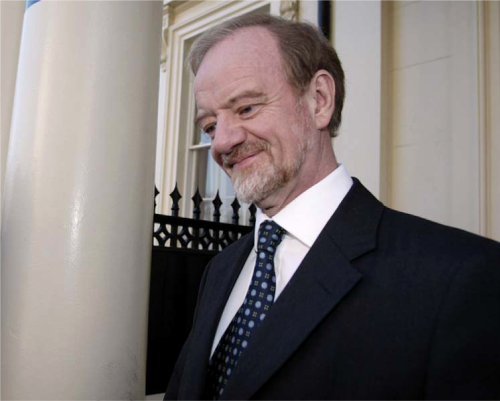
Robin Cook resigned from his post in Blair's cabinet to protest the push to war.
Under considerable and mounting pressure, the prime minister felt obliged to establish an inquiry, headed by Lord Hutton, the former Lord Chief Justice of Northern Ireland, to investigate the circumstances surrounding the scientist's death. The inquiry sought evidence from those most closely involved in the issues and circumstances surrounding Kelly's death, namely his family, colleagues, journalists, government officials, and leading politicians, including the prime minister himself. In the end, Blair, his government, and the BBC were cleared of responsibility for Kelly's death. The accusations that Blair and his government manipulated intelligence were deemed “unfounded.”
Notwithstanding the narrowness of the inquiry's remit, however, the inquiry provided a plethora of new information and focused the public's attention on the way the government had used intelligence to quantify the threat posed by Iraq's weapons of mass destruction and thereby made the case for war.
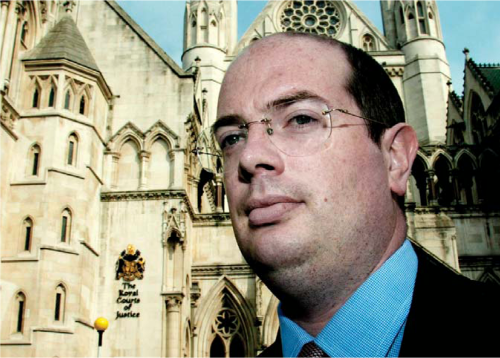
BBC correspondent Andrew Gilligan's May 29 report claiming the Blair government had “sexed up” intelligence led to parliamentary investigations.
Was the threat exaggerated?
The foreword to the Blair government's dossier “Iraq's Weapons of Mass Destruction: The Assessment of the British Government,” published in September 2002, declared that there was no doubt that Iraq represented a “serious and current” threat.
The threat was “serious” in that Iraq's weaponry could inflict significant casualties and that Saddam Hussein had the intent to use them against Britain's security interests. Blair was convinced that the use of weapons of mass destruction would inevitably have implications for Britain's security even if Britain itself was not the target. The threat was “current” in that Saddam already had those capabilities. Yet, in a number of respects this terminology appears to be stretching the truth of what the Blair government calculated to be the actual threat from Iraqi weapons of mass destruction.
During the course of the Hutton Inquiry a series of pertinent questions arose. What type of weapons of mass destruction was the Blair government talking about, and to what extent was the capability weaponized? Was the danger imminent, emerging, or longer term? Was the danger now more acute than it had been previously, or was it more of a stable, latent worry?
Blair v. the BBC
Following Andrew Gilligan's May 29, 2003 report that the Blair government had “sexed up” the intelligence it used to support its push for war, the Blair government lashed out.
The prime minister's then-director of communications, Alastair Campbell, writing on June 5, 2003 to Richard Sambrook, the head of news at the BBC, in response to a series of follow-up reports from Gilligan, was livid:
“You will, I imagine, seek to defend your reporting, as you always do. In this case, you would be defending the indefensible…. We are left wondering why you have guidelines at all, given that they are so persistently breached without any comeback whatsoever,” Campbell wrote.
This letter was among the correspondence submitted as evidence to the Hutton Inquiry.
The BBC and the Blair government were locked in a fierce standoff about the allegations contained in Gilligan's report, but the bitterness between the two was about more than a single controversial report.
Since winning election as prime minister in 1997, Blair and his government have had a series of run-ins with the BBC. Following the air strikes on Iraq in 1998, Campbell criticized the BBC's coverage of the attacks and complained that reports were inadequately qualified.
The BBC's early coverage of the 2003 Iraq war also earned a response from 10 Downing Street. In a letter concerning a field report by Gilligan, Campbell questioned where the evidence supporting the report had been gathered. He also listed a series of the BBC's own rules he felt had been violated in the report.
The Blair government had a great interest in the war news that was being broadcast to the British public, but in its complaints the government seemed to suggest it knew best how the BBC should be doing its job. The BBC understandably thought differently.
In a June 27 response to a general critique of the BBC's coverage of the war, which had became part of the government's campaign following the May 29 allegations, Sambrook responded, “As we told you in correspondence before the war started, our responsibility was to present an impartial picture and you were not best placed to judge what was impartial.”
Other factors served as a backdrop to the dramatic confrontations of June and July 2003. The BBC is, after all, a publicly funded corporation and operates under a charter granted by the queen of England. Since being granted its first charter in 1926, the BBC has earned the reputation of an independent voice around the world, but some have questioned whether there will be changes in the BBC's operation when its current charter is up for review in 2006.
In 2002, Blair was criticized for supporting a liberalization of media rules to allow a more diverse ownership of television stations that would increase competition. The Blair government is also reported to be considering whether to support handing oversight of the BBC to Ofcom, the newly created communications regulatory body charged with improving “public service broadcasting.” Ofcom will also decide whether public funding will be shared with other broadcasters, besides the BBC.
The Blair government's general attitude toward the BBC was not lost on Gavyn Davies, then-chairman of the BBC. In the July 27, 2003 Sunday Telegraph, he accused the government of attempting to destroy the independence of the BBC.
“We are chastised for taking a different view on editorial matters from that of the government and its supporters. Because we have had the temerity to do this, it is hinted that a system that has protected the BBC for 80 years should be swept away and replaced by an external regulator that will ‘bring the BBC to heel,’” wrote Davies.
When Lord Hutton released his findings on January 28, the possibility that the BBC's independence could be curtailed increased.
He criticized the manner in which Gilligan's report was reviewed and vetted, and labeled the allegations in Gilligan's May 29 report “unfounded.” He also pointed out that Kelly broke the law by speaking to reporters. Following the release of the report, both Davies and Gilligan resigned.
If one of Britain's most valued news sources is brought to heel, and government critics silenced, the consequences to British democracy will extend long past Blair's term in office.
The misleading term “weapons of mass destruction” was scrutinized early on in the inquiry. Robin Cook, who as foreign secretary had a responsibility for dealing with Iraq, had already highlighted the importance of establishing a common understanding of what the term meant when during his resignation speech before the war he claimed that “Iraq probably has no weapons of mass destruction in the commonly understood sense of the term–namely a credible device capable of being delivered against a strategic city target. It probably still has biological toxins and battlefield chemical munitions.” 6 The statement was telling in itself, but when considered after the war when no such weapons were found, it demonstrated a significant problem in the debate.
In common parlance the term weapons of mass destruction includes anything from a mustard-gas-filled artillery shell with a range of a few kilometers to a nuclear warhead on a missile that can travel many thousands of kilometers. This point was acknowledged by Martin Howard, the deputy chief of Defence Intelligence, in response to a question from Lord Hutton. 7 Yet, in terms of effect, it is clear that some types and usages of chemical and biological weapons would not constitute weapons of mass destruction, a point accepted by a former head of the scientific branch of the Defence Intelligence analysis staff, Brian Jones. 8
Against unprotected populations the use of chemical and biological weapons (CBW) can indeed be devastating. If poisons and diseases are effectively and efficiently weaponized they are capable of killing many thousands of people–we only have to recall the massacre of Kurds at Halabja in 1988. But, unlike nuclear weaponry, the impact of CBW against properly protected armed forces would be more an inconvenience than a lethal threat. As Kelly said: “The threat from Iraq's chemical and biological weapons is, however, unlikely to substantially affect the operational capabilities of U.S. and British troops.” 9
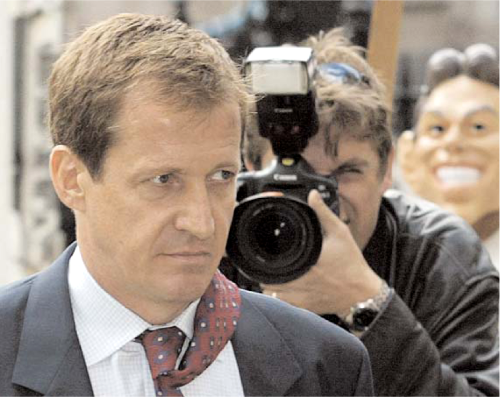
Alastair Campbell, Blair's former director of communications.
Another important factor, therefore, is the degree to which the Iraqis were able to efficiently and effectively weaponize their CBW agents. A clear distinction has to be made between actual weapons and weapons programs. Research and development of chemical and biological agents in the laboratory, which is relatively straightforward, can be referred to as “weapons programs.” Honing those agents into a form that can be delivered effectively to a target by means of artillery shell, air-launched bomb or missile warhead–thereby constituting actual weapons–is the next stage and a far more challenging proposition. It came to light during the Hutton Inquiry that one of the earlier drafts of the government's September dossier had referred to Iraq's weapons of mass destruction programs, but the word “programs” was erased by the time of final publication with the clear implication that Iraq had actual weapons.
It was far from clear that Iraq was continuing to produce chemical and biological weapons as the dossier claimed. The assessment was that production had taken place, but British intelligence did not know what had been produced and in what quantities. This claim worried Defence Intelligence's Jones to the extent that he wrote a formal minute to complain: “We had not seen the weapons being produced. We had no evidence of any recent testing or field trials and things like that.” 10
The dossier's claim that Iraq continued to develop its nuclear weapons program and had sought to acquire uranium from Niger also proved controversial. The International Atomic Energy Agency (IAEA) said that the documents it had received relating to the claim were forgeries. The British government, however, still refuses to accept that the intelligence it received on this matter was inaccurate.
Perhaps the most controversial aspect of the government's September dossier was the assertion that some of Iraq's weapons of mass destruction were deployable within 45 minutes. When he launched the dossier in the House of Commons the prime minister was very explicit: “[The dossier] concludes that Iraq has chemical and biological weapons, that Saddam has continued to produce them, that he has existing and active military plans for the use of chemical and biological weapons which could be activated within 45 minutes.” 11
The 45-minute figure seemed to support the contention that Iraq posed an immediate threat and certainly caught the media's eye. David Kelly privately expressed his fear to Susan Watts of BBC's Newsnight that the emphasis placed on this element of intelligence in the foreword to the dossier went too far, and that it turned a potential capability into an imminent threat, which proved to be a critical part of the government's case for war. 12
What's the difference?
There has not yet been a thorough, public investigation into the intelligence the Bush administration used to justify invading Iraq. The manner in which intelligence is susceptible to politicization in the United States, and the administration's apparent indifference to detail are two reasons why prewar intelligence deserves a closer look.
In one of the administration's many presentations of intelligence before the invasion, on February 5, 2003 Secretary of State Colin Powell cited the intercept of a batch of aluminum tubes on its way to Iraq as proof that Saddam Hussein was attempting to reconstitute his nuclear weapons program.
Despite Powell's confident presentation, the purpose of the tubes was a matter of great dispute. To set the record straight, David Albright, president of the Institute for Science and International Security, prepared a postwar study on the tubes' characteristics, their probable use–based in part on information obtained from Iraqi officials–and the process by which the administration came to its conclusions.
CIA officials backed the idea that the tubes were to be used in gas centrifuges for uranium enrichment. But knowledgeable officials from the Energy Department, the International Atomic Energy Agency, and the State Department's Bureau of Intelligence and Research disagreed. Yet the Bush administration sided with the CIA's conclusion despite evidence to the contrary, reported Albright.
“The case serves to remind us that senior decision makers have a special responsibility to insist that the intelligence community properly vet information and to use intelligence community assessments fairly. This case shows that our leaders are not above misusing technical and scientific analysis to bolster their political goals,” concluded Albright.
Sir Roderick Braithwaite, the former chairman of Britain's Joint Intelligence Committee, reached a similar conclusion about the way intelligence is used in the United States.
“Americans believe the truth emerges from a dialectical clash of opinions. In Washington different intelligence agencies generate different interpretations. These may only reconciled [sic] when they get to the White House. This enables the political leadership to pick the interpretation that feeds prejudices,” said Braithwaite in a speech to the Royal Institute of International Affairs on December 5, 2003.
Then there are fears of retribution. In the case of the aluminum tubes, “Several of those who rejected the CIA's claim have expressed their fears privately about the threats to their careers or future funding if they continued to oppose the CIA's position,” Albright reported.
The risk associated with questioning the administration's use of intelligence is demonstrated all too clearly in the case of former ambassador and diplomat Joseph C. Wilson.
Wilson initiated an inquiry by the press into the Bush administration's prewar case against Iraq when he questioned Bush's claim that Iraq had tried to obtain uranium from Africa in a July 6, 2003 New York Times opinion piece. Wilson had found that claim unsubstantiated when he investigated it in Niger on behalf of the CIA in February 2002.
The Bush administration found itself on the defensive trying to explain how the claim, which was based on forged documents, had made its way into the president's State of the Union speech.
A week after Wilson's piece was printed, conservative columnist Robert Novak wrote that Wilson's report was “regarded by the CIA as less than definitive,” and cited “senior administration officials” who said Wilson was given the task in Niger because his wife, a CIA operative, suggested sending him.
Novak's column incited another controversy by naming Wilson's wife. After a brief clamor, the Justice Department opened an investigation into who had leaked the name of the active CIA operative, a federal offense. (Attorney General John Ashcroft later recused himself.) The press took Bush's assurances that “This is a very serious matter, and our administration takes it seriously,” and the controversy quickly died down. The Bush administration succeeded in isolating the inquiry into prewar claims by simply changing the subject.
Although an investigation, similar to the Hutton Inquiry, might better explain U.S. involvement in Iraq and elsewhere, the Bush administration has proved unwilling to explain how it uses (or doesn't use) intelligence reports in other circumstances, namely the congressional investigation of 9/11. [See “Slow-Walked and Stonewalled,” March/April 2003 Bulletin.]
Moreover, Bush has personally shown indifference to the information intelligence does provide, even when the lives of U.S. soldiers hang in the balance. During an interview with Diane Sawyer on December 16, 2003, days after Saddam Hussein was captured, Bush was asked to clarify whether his administration had believed that Saddam currently had prohibited weapons, or whether it was possible for him to acquire them. Bush's response was: “So, what's the difference?”
The conjunction of this piece of information with another of the dossier's claims–that Iraq was constructing a “new engine test-stand for the development of missiles capable of reaching the UK Sovereign Base Areas in Cyprus”–created a startling headline in the London Evening Standard on the day of the dossier's publication: “45 minutes from attack.”
Amusingly, during the Hutton Inquiry an e-mail was revealed in which the Prime Minister's chief of staff, Jonathan Powell, actually asked Alastair Campbell, “What will be the headline in the Standard on the day of publication?” No reply was forthcoming, but the government's legendary spin machine and the dossier's claims had certainly helped to generate a headline suggesting that British bases were less than an hour from being attacked. Yet it became obvious from the Hutton Inquiry hearings that the threat was far from as imminent or as significant as the headlines had suggested.
Indeed, this reality was acknowledged inside the Blair government. No lesser official than the prime minister's chief of staff concluded in an e-mail to John Scarlett, the chairman of the Joint Intelligence Committee (JIC), a week before the dossier's publication, that the dossier included “nothing to demonstrate a threat, let alone an imminent threat from Saddam.” He had gone on to stress to the prime minister that “we will need to make it clear in launching the document that we do not claim that we have evidence that he is an imminent threat.” 13
The prime minister sailed fairly close to the wind in this respect. Instead of referring to an “imminent” threat, Blair described it as “serious and current.” The wordsmiths inside 10 Downing Street were trying to find words that implied immediacy but were also consistent with the government's own analysis that the threat was more latent than extant. The Blair government's case for taking action against Saddam rested more on what he might be capable of in the future than what he was capable of doing at the time. As Powell said in one of his e-mails: “In the penultimate para you need to make it clear Saddam could not attack us at the moment. The thesis is he could be a threat to the UK in the future if we do not check him.” 14
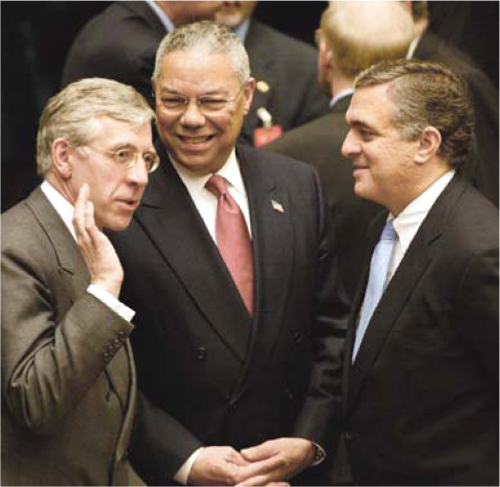
February 5, 2003: British Foreign Secretary Jack Straw, Colin Powell, and CIA Director George Tenet before Powell's U.N. presentation.
This distinction was not just a matter of semantics. Blair and the rest of Whitehall were extremely sensitive to the possibility that Britain might undertake an illegal invasion of Iraq. They were well aware that international law makes provision for states to act preemptively in self-defense, but to act on the basis of preventing a possible future threat is far more questionable. Kelly himself alluded to this: “That was a real concern–not so much what they had now, but what they would have in the future. But that unfortunately was not expressed strongly in the dossier, because that takes the case away for war–to a certain extent.” 15
It was in the Blair government's interests to attempt to play up the urgency of meeting the threat while not actually describing it as imminent. As a result, the government not only attempted to instill the greatest degree of immediacy that it could, it also sought to remove references that downplayed the extent of the threat. For example, the September 10/11, 2002 draft of the prime minister's foreword to the dossier read: “The case I make is not that Saddam could launch a nuclear attack on London or any other part of the U.K. (he could not).” 16 This draft also mentioned that reports Iraq could produce smallpox were “uncorroborated” and that Saddam abandoned work on a radiological bomb after failing to make progress beyond the “research stage.” 17 Yet all of these points were excised during the drafting process and failed to appear in the final copy. This led to charges from some critics that the government had made the final dossier “sexier” by omission.
On August 26, John Scarlett further detracted from the scale of the threat by revealing to Lord Hutton that the weapons being referred to in the context of the “45-minute claim” were “related to munitions, which we had interpreted to mean battlefield mortar shells or small caliber weaponry, quite different from missiles.” 18
In actuality, the intelligence pointed to the possibility that Iraq had plans in place to use some of its dispersed weapons of mass destruction at short notice on the battlefield. Not that it was about to activate those plans, but that it possibly had the capacity to do so. This led to the next question. Under what circumstances might Iraq use any of the weapons in its possession?
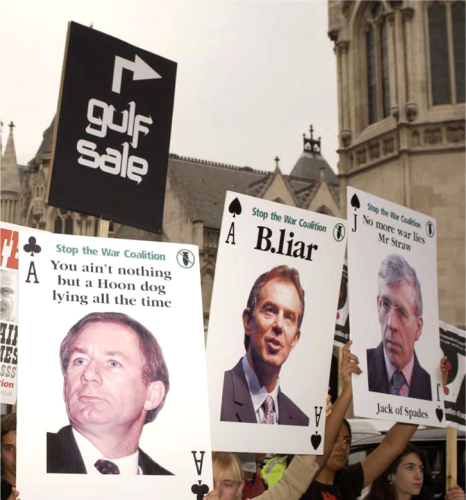
August 28, 2003: Protesters gathered outside the Royal Courts of Justice on the day Blair was scheduled to testify.
Some months after the war, Robin Cook revealed that on March 5, 2003 he had asked the prime minister if he was concerned that Saddam might use chemical munitions against British troops. According to Cook, Blair's response was: “Yes, but all the effort he has had to put into concealment makes it difficult for him to assemble them quickly for use.” This led Cook to conclude that although Blair may have believed that Iraq had weapons ready for use within 45 minutes when he published the dossier the previous September, he no longer believed it to be true. This left Cook feeling “deeply troubled.” 19
If one accepts that Iraq had a certain chemical and biological weapons capability, then it is necessary to clearly identify an intention to use that capability before the threat can be considered “serious and current.” But what intent did Saddam have to use CBW? Was Saddam mad enough to provoke the certainty of devastating U.S. retaliation by using his weapons of mass destruction in a first strike against a vastly superior adversary? The historical evidence hardly suggests so. Saddam's use of chemical weapons against Iran and the Kurds was enacted in the knowledge that neither had the capacity to topple him from power as a consequence. In Kuwait in 1991, Saddam did not deploy these weapons, presumably because he calculated that by doing so he would have legitimized an extension of the war beyond liberating Kuwait to include destroying him and his regime. This demonstrated a degree of rationality that he appeared to have maintained since.
One is left pondering how and why Saddam would start threatening to use CBW in an aggressive manner. Jonathan Powell could not find the answer in the British government's dossier–“it did not demonstrate that he had a motive.” 20 The most likely circumstance in which the Iraqi dictator would use CBW was if his country was invaded first and the future of his regime was threatened; in other words, in the very scenario being pursued by both the Bush and Blair governments. When an early draft of the dossier pointed in this direction, Powell described it as a “bit of a problem” because it suggested that the threat would only manifest itself “if we attack him.” 21 The text was changed.
Another important aspect of the prime minister's case for disarming Iraq was the fear that its weapons of mass destruction capability might one day fall into the hands of terrorist groups hostile to Britain. Undoubtedly this was a genuine concern, but there was also a counter argument that the JIC put to the prime minister in February 2003, namely: “The JIC assessed that any collapse of the Iraqi regime would increase the risk of chemical and biological warfare technology or agents finding their way into the hands of terrorists, not necessarily Al Qaeda.” 22 The prime minister failed to pass on this piece of the JIC assessment to Parliament and the public, although he had publicly disclosed other assessments that were more supportive of the case for taking military action.
The cost to Blair
On January 28 Lord Hutton issued his findings that the Blair government had based its dossier on Iraq's weapons capabilities on known intelligence. Lord Hutton acknowledged, however, that the government's interest in presenting as strong a case as possible against Iraq might “have subconsciously influenced Mr. Scarlett and the other members of the [Joint Intelligence Committee] to make the wording of the dossier somewhat stronger than it would have been if it had been contained in a normal JIC assessment.”
Lord Hutton balked on the broader question of whether the evidence Blair presented was based on intelligence of “sufficient strength and reliability” to justify the invasion of Iraq. “I concluded that a question of such wide import, which would involve the consideration of a wide range of evidence, is not one which falls within my terms of reference,” he stated.
When he met with David Broucher, the British ambassador to the disarmament conference in Geneva, Switzerland, in February 2003, David Kelly believed there was only a 30 percent probability that Iraq had chemical weapons and if it had any biological weapons left, they would not amount to very much. Kelly described Iraq's weapons of mass destruction program as “small.” In the aftermath of war this assessment looks to have been far more accurate than evidence put forward by the U.S. and British governments suggested. A growing number of government critics in Parliament agree and called for an investigation of the larger matter the same day the Hutton report was released.
In a speech to Parliament following the release of the report, Blair appeared vindicated. “The allegation that I or anyone else lied to this House or deliberately misled the country by falsifying intelligence on WMD is itself the real lie,” he said. Still, the domestic political cost to the prime minister–not to mention the danger of setting a precedent for preemptive war–has been high, both in terms of damage to his standing within the Labour Party and in terms of the wider electorate's trust in his word. Whatever Blair says about Lord Hutton's ruling, it is Parliament and the people who will have the final word.
Footnotes
1.
John Kampfner, Blair's Wars (London: Free Press, 2003), p. 152.
2.
Ibid., a British government official is quoted as saying, “We needed to show that it was Chirac who scuppered the whole thing, that if it hadn't been for him, we would have got agreement, the U.N. would not have been torn apart,” p. 288.
3.
Cook, Speech to House of Commons, March 17, 2003, Hansard Parliamentary Debates, vol. 401, col. 728.
4.
Kampfner, Blair's Wars, p. 303.
5.
The precise means and procedures by which Kelly's name came to be known by the media was a major element of the Hutton Inquiry into the scientist's death.
6.
Cook, Hansard, vol. 401, col. 727.
7.

8.
Testimony to Hutton Inquiry, September 3, 2003, paragraphs 66-67.
9.
“Only Regime Change will Avert the Threat,” The Observer, August 31, 2003, p. 9.
10.
Cited by Paul Waugh and Kim Sengupta, “Intelligence Officers Vindicated in Worries over Dossier,” The Independent, September 12, 2003, p. 4.
11.
Blair, Speech to House of Commons, September 24, 2002, Hansard Parliamentary Debates, 6th ser., vol. 390, col. 3.
12.
Susan Watts memoranda, evidence submitted to Hutton Inquiry, August 12/13, 2003.
13.
Cabinet Office memoranda, e-mail from Jonathan Powell to John Scarlett, evidence submitted to Hutton Inquiry, September 17, 2003.
14.
Jonathan Powell, e-mail to Alastair Campbell and Sir David Manning referring to the revised foreword to the dossier, September 17, 2002.
15.
Watts memoranda.
16.
Quoted by Nigel Morris in The Independent, August 25, 2003, p. 6.
17.
Ibid.
18.
Testimony to Hutton Inquiry, August 26, 2003, paragraph 144.
19.
Robin Cook, Point of Departure, (London: Simon & Schuster, 2003), p. 310.
20.
Cabinet Office memoranda, e-mail from Jonathan Powell to John Scarlett.
21.
Jonathan Powell, e-mail to Alastair Campbell and John Scarlett, evidence submitted to Hutton Inquiry, September 19, 2002.
22.
23.
Testimony to Hutton Inquiry, August 21, 2003.
24.
Cook, Point of Departure, p. 310.