




Abstract
It is astonishing to see how quickly the Bush administration has squandered British goodwill after 9/11.
When the United States decided to go to war in Iraq without the U.N. Security Council's endorsement, Prime Minister Tony Blair took British troops in too, overriding strong domestic and international opposition. Determined to show President George W. Bush he could count on Britain through thick and thin, Blair underestimated the strength of opposition to a war that many believed was unnecessary in security terms, lacking specific provocation or a convincing or imminent threat.
Counting on the generally pro-American sentiments of the British public, most recently illustrated in the spontaneous outpouring of concern following the destruction of the twin towers on September 11, 2001, Blair thought he could marginalize the opposition by exaggerating the Iraqi threat and emphasizing the special Anglo-American relationship. But the popular sense of “cousinhood” with Americans turned out not to include blind allegiance.
Although the war may have been the catalyst, Bush's unapologetically ideological policies and his neoconservative cohorts have crystallized growing unease about U.S. positions on a range of security, environmental, and economic issues that Britons–across the political spectrum–care about.
Well before the war, informed public opinion was critical of the Bush administration's attitude toward international agreements like the Comprehensive Test Ban Treaty (CTBT) and the treaty banning landmines, the U.S. refusal to participate in the International Criminal Court, and its scuppering of the verification protocol for the Biological Weapons Convention. As evidence of the dangers of global warming and climate change has grown more compelling, Europeans were particularly incensed by the U.S. withdrawal from the Kyoto Protocol. These short-sighted U.S. policies have fed the perception that American policy makers are overly financially dependent on big business, particularly on the energy, defense, and pharmaceutical industries.
A desire to show support for Americans following 9/11 meant that those concerns were temporarily swept under the carpet. The war on Iraq brought them back into the open, together with a complex and sometimes contradictory mix of political and emotional responses to the dominant military, economic, and political role of the United States as the “hyperpower” of the post-Cold War world.
While Bush's reelection campaign was indisputably boosted by the capture of Saddam Hussein, Blair's standing has been irreparably damaged by the coalition's failure to find the weapons of mass destruction his case for war depended on. He continues to be wounded by the ongoing incompetencies and continuing bloodshed of the occupation.
Blair had hitherto been credited with sound political instincts, so his decision to ally himself so closely with George Bush and take Britain into such an unpopular war is particularly interesting. His assessment that mainstream Britain believes in its special relationship with the United States was largely accurate, notwithstanding important debates about what this means.
Britain is also a nuclear-weapon possessor and not traditionally opposed to military action. Many Britons remain wary of the European Union and its Franco-German leadership, so there is resonance for Blair's notion of a British bridge between Europe and the United States, although commentators have highlighted that bridges are weak or useless if they are not firmly anchored on both sides. Political cartoons have also depicted Britain-the-Bridge as being walked all over, chiefly by a grinning Bush and his pals. At the same time, there is widespread, though not uncritical, support for the United Nations and other international institutions, particularly among Labour party supporters.
Maintaining strong ties with the United States has been an important strategic objective for successive British governments, bolstered by dependence on U.S. nuclear collaboration, the NATO alliance, and perceived historical, economic, and cultural ties. As the twentieth century progressed, the relationship became increasingly unequal, but there was still an expectation of some reciprocity of interests and influence, even if the details were not for public consumption.
But the neoconservative project underpinning the Bush administration leaves little room for the national or strategic concerns of others, including its allies. Blair's apparent inability to influence the Bush administration where it counted–delaying the war until the U.N. Monitoring, Verification, and Inspection Commission had had more time to finish its search for Iraqi weapons of mass destruction, for example, or more recently, ensuring release or fair trials for the detainees held at Guantánamo Bay, which include several British Muslims–undermined his argument that by supporting Bush, Britain can help to moderate U.S. policies. This has led to Blair being satirized as Bush's poodle, preening and yapping at his heels, but ignored by the master when he becomes inconvenient.
In evaluating British attitudes toward U.S. policy, it is important to recognize that, in contrast to the war on Iraq, there was a relatively high degree of mainstream support for the immediate, post-9/11 action against Al Qaeda and its Taliban supporters in Afghanistan. Criticism grew, however, about U.S. treatment of prisoners, which revived earlier concerns that America regarded itself as above international law.
Mainstream British opinion was not opposed to the idea of war per se, but rather viewed the war on Iraq as the wrong war at the wrong time and for the wrong reasons. Specifically, war was considered an inappropriate mechanism for dealing with the problems associated with Saddam's regime, likely to create more opportunities for terrorism and regional instability.
While there were still relatively high levels of support for America's desire to defend against terrorism, few in Britain accepted Bush's assertion of a link between Al Qaeda and Saddam Hussein's regime. Additionally, sympathy with the U.S. need to assuage the humiliation of 9/11 began to bleed away with the realization that instead of completing the job of routing Al Qaeda and rebuilding Afghanistan, the Bush administration was hellbent on a new war, with far less reason.
If the war on Iraq was the first test of the September 2002 National Security Strategy, it has raised more questions than it answered. If anything, the experiences in Iraq and Afghanistan reveal the limits of the Bush doctrine of preemption and preventive war. Sophisticated weaponry and military power may overwhelm adversaries in the short term, but these wars and their aftermaths prove how inappropriate and ineffective they are for dealing with opposition on the ground. Contrary to the policies' intentions, Americans have been exposed as more vulnerable than would previously have been calculated, both at home and abroad.
The military-dependent, capabilities-based approach exemplified in the new security strategy is seen to be counterproductive. Having suffered decades of sporadic city-center bombings, Britons are derisive of the oversim-plistic approach represented by “war on terror” and “axis of evil” rhetoric. Britons will more readily support policies aimed at choking off terrorists' funding and blocking access to arms and explosives, especially weapons of mass destruction, than military adventures and occupations perceived as exacerbating grievances and threats.
Unlike Bush, Blair was hampered in his attempts to portray opposition to the war as support for terrorism or appeasement for Saddam's regime, since significant opponents had led the way in condemning Saddam Hussein's atrocities and opposing the British government's collaboration and arms sales to his regime in the 1980s and early 1990s, as exposed during the 1996 Scott Inquiry.
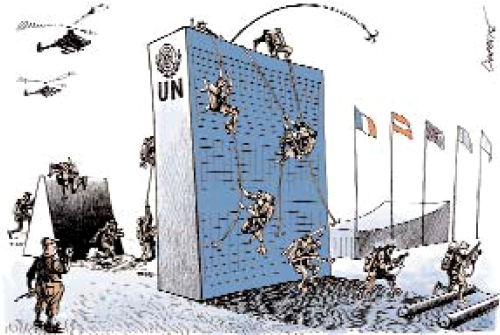
Given the U.S. record of supporting tyrants and human rights abusers among its strategic allies (where convenient), the sudden interest in toppling Saddam because of his barbarity towards his own people appeared to those outside the United States as hypocritical and self-serving. Blair knew this, and so chose to bolster his case for war with exaggerated and unrealistic threat assessments, including the misleading allegation that Iraqi weapons of mass destruction could be activated in 45 minutes. As the Hutton Inquiry into the death of the government's foremost bioweapons expert, David Kelly, has exposed, many in the British defense and intelligence establishments communicated their skepticism about these and other hyped claims before either of the “dodgy dossiers” were published and endlessly cited by the proponents of war. It appears that Blair ignored these warnings because his overriding goal was to deliver international or, failing that, British backing for the war.
In Britain, where the majority is predisposed to be pro-American, it has been astonishing to see how quickly the Bush administration managed to squander the immense sympathy and goodwill felt after the 9/11 attacks. Two examples illustrate British ambivalence: Despite major protests against President Bush's visit, which disrupted London last November, a Guardian/ICM poll found 62 percent supporting the view that the United States was “a force for good, not evil, in the world”; while on December 31, 2003, the BBC's flagship news program Today interspersed end-of-year news discussions with investigative analyses of missile defense, world trade, and the politics of oil, with emphasis on the driving role of the United States, and the dangers for Britain of tagging along.
Undoubtedly, the perception of Bush and his cohorts, notably Donald Rumsfeld, John Ashcroft, and Dick Cheney, as arrogant, corrupt, venal bigots, pursuing greedy policies of short-term benefit to their friends and long-term cost to the rest of the world, has acted as a lightning rod, making anti-Americanism almost fashionable. There is growing anxiety that if Bush is elected to a second term, the worldwide damage from his policies could be irreversible. Already many fear that environmental destruction and climate change have gone too far, but they still want policies that would slow down the devastation.
Among frequently cited concerns is the specter of a new, destabilizing arms race if missile defense leads to weapons in space and if the resumption of testing for new nuclear weapons destroys the CTBT and, in consequence, the Nuclear Non-Proliferation Treaty. The U.S. defense budget is greater than the combined defense budgets of the next 15 largest states, and U.S. exports of small arms and light weapons, perhaps half the exports covered by the U.N. Register of Conventional Arms, contribute to insecurity and instability in a number of countries and regions. There is a sense of helplessness, therefore, that though the rest of the world will be profoundly affected by the U.S. election in November, we have no say.
But while a more environmentally and internationally responsible American leader would be welcomed, it is considered unlikely that a new president would change the overall thrust of U.S. policies very much, especially in areas relating to defense and foreign relations. It has not gone unremarked that President Bill Clinton squandered the opportunity created by the end of the Cold War to offer a different kind of international leadership, largely shirking the important task of analyzing the transformed geostrategic and security environment.
The failure of the Democrats to come up with an appropriate post-Cold War security strategy based on international cooperation left the way open for the neocons to impose their vision, based on power projection and ever-expanding military capabilities to protect U.S. interests and investments. Such notions, which underpin and drive the escalating defense budget, the search for more usable nuclear weapons, missile defenses, and potentially the weaponization of space, are profoundly worrying even to America's closest allies, who have competing economic interests. Fed by post-9/11 fears and scare-mongering, the neocon vision of “full spectrum” military dominance has now found wider support in the American heartland and will be more difficult for future U.S. leaders to challenge.
Though there would be some important differences, not least more genuine participation in nonproliferation and arms control regimes, few believe that a Democrat would not also put short-term U.S. interests and investment at the center of his policies, to the detriment of international and security considerations.
Listening to those who sound off in pubs, post offices, and radio phone-ins, it might appear that Britain is becoming increasingly anti-American. Because the neocon attitude is so crude, it may simply have made it easier for Britons' opposition to come out into the open. If that is all that current levels of animosity indicate, a more conciliatory U.S. administration might repair damaged relations quickly. Less quick to assuage would be the growing, underlying fears about America's unwillingness or inability to address its own role in undermining human rights and civil liberties, international agreements and security regimes, from its gas-guzzling habits to its nuclear irresponsibility and arms sales.
Concerned at the ineffectiveness of Blair's policy of bridge-building and the risk of confrontation inherent in Franco-German attempts to make the European Union a more significant counterweight to U.S. power, a growing number of critics are calling for more drastic measures to restructure world order and improve the international security environment. It would be nigh impossible as things stand to persuade a significant group of nations to exert collective leverage on the hyperpower through boycotts or the mass transfer of investments from dollars to an alternative currency like the euro, but it is important to recognize that such ideas are gaining a foothold beyond the radical anti-globalization movement.