




Abstract
According to John Ashcroft's Justice Department, even U.S. citizens are not entitled to their constitutional right to legal representation.
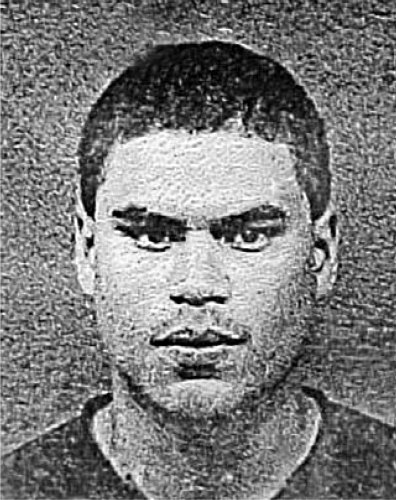
On May 8, 2002, 31-year-old Brooklyn-born Jose Padilla was arrested by FBI agents at Chicago's O'Hare International Airport and held as a witness in connection with the September 11, 2001, attacks.
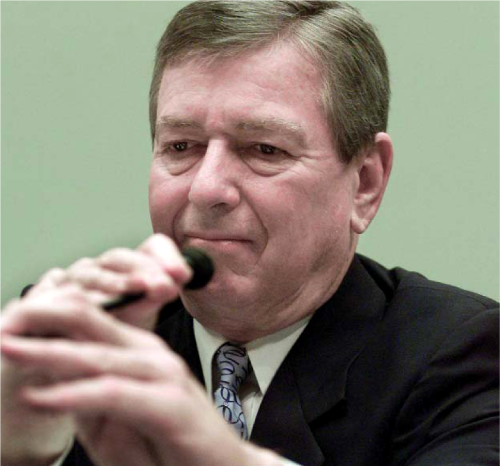
Speaking at a special news conference in Moscow a month later, U.S. Attorney General John Ashcroft accused Padilla of being a new kind of terrorist bomber. Ashcroft professed no doubts and offered no equivocation–just a flat out accusation: “We have captured a known terrorist who was exploring a plan to build and explode a radiological dispersion device, or ‘dirty bomb,’ in the United States.” Ashcroft said the arrest of Padilla “disrupted an unfolding terrorist plot,” one that could have caused “mass death and injury.” President George W. Bush accused Padilla of “conduct in preparation for acts of international terrorism” and declared him an “enemy combatant.” Using the little understood USA Patriot Act, Padilla was denied access to an attorney.
In a matter of minutes, the 40-plus-year history of Miranda rights was swept away. At the time of this writing, Padilla is still sitting in a cell at the Consolidated Naval Brig in Charleston, South Carolina, subject to an unknown number of hours or days or months of questioning, ignorant of his legal rights and the charges against him, and without the advice of an attorney. The government contends Padilla falls under a special exception to the Constitution, but a host of legal scholars feel otherwise.
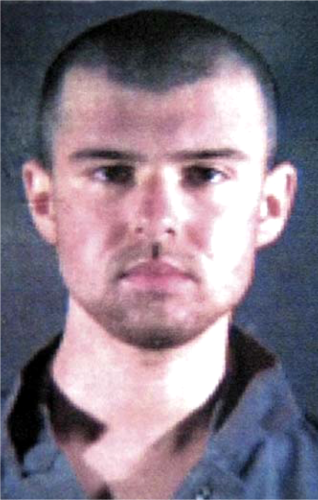
Jose Padilla.
You have the right …
Anyone with a television set is familiar with Miranda rights; they've been repeated on thousands of cop shows: “You have the right to remain silent. Anything you say can and will be used against you in a court of law. You have the right to speak to an attorney, and to have an attorney present during any questioning. If you cannot afford a lawyer, one will be provided for you at government expense.” The Miranda warning stems from the 1960 case of Clarence Earl Gideon, a two-bit criminal charged and convicted of breaking and entering the Bay Harbor Poolroom in Panama City, Florida, and stealing some coins and wine. The Supreme Court decided that Gideon had been wrongly denied the right to a lawyer in his criminal trial.
Never before in the history of the Justice Department, or solely through an assertion by the attorney general, has an American citizen been deliberately deprived of his rights.
Six years later, the Supreme Court applied similar principles to Ernesto Miranda, a man arrested and accused of kidnapping and raping a mildly retarded 18-year-old woman. The court ruled Miranda deserved to have an attorney present at his questioning.
Thus, one would surely think that in 2002 a man publicly described by the attorney general of the United States as a “known terrorist,” whose arrest disrupted an unfolding plot to attack the United States by exploding a dirty bomb, would be entitled to legal counsel.
As Pulitzer Prize-winning journalist Anthony Lewis asked in an April 20, 2003, New York Times magazine article, who but an advocate for Padilla could challenge Ashcroft's statement? Who but Padilla's lawyer could challenge the news media to test the truth of the accusation? By denying Padilla an attorney, Ashcroft's comments amounted to “conviction by government announcement,” Lewis wrote.
In light of the threat from Al Qaeda, exactly how far should the government be allowed to go in denying its citizens constitutional guarantees and rights? How far is too far? Should Jose Padilla, an untried, unconvicted, alleged dirty bomber, be denied his constitutional rights and guarantees? As an enemy combatant, is Padilla in the same class as foreign soldiers captured in Afghanistan and now held for questioning and perhaps military tribunals at Guantanamo Bay?
The Sixth Amendment employs clear and precise language: “In all criminal prosecutions, the accused shall enjoy the right to a speedy and public trial, by an impartial jury of the state and district wherein the crime shall have been committed … and to be informed of the nature and cause of the accusation; to be confronted with the witnesses against him; to have compulsory process for obtaining witnesses in his favor, and to have the assistance of counsel for his defense.”
Padilla has not had a speedy public trial nor is it known if he has been fairly confronted with the nature of the charges against him–nor has he had “the assistance of counsel for his defense.” Never before in the history of the Justice Department, or solely through an assertion by the attorney general, has an American citizen been deliberately deprived of these rights.
A likely suspect?
Fear, uncertainty, and doubt
Physicist Gene Amdahl first identified the concept of motivation by fear, uncertainty, and doubt (FUD). Amdahl worked as the director of advanced computer systems at International Business Machines (IBM) before leaving to form the Amdahl Corporation and other companies based on his proprietary technological innovations.
While all his companies successfully competed with IBM, Amdahl recognized that it was difficult–sometimes nearly impossible–to outsell Big Blue because of IBM's FUD-based sales techniques. According to Amdahl, “FUD is the fear, uncertainty, and doubt IBM salespeople instill in the minds of potential customers who might be considering other [allegedly unsafe or unproven] products.” As the IBM sales staff often said, “No one ever got fired for buying IBM products.”
Generating FUD is now a nationally abused, manipulative technique, honed to perfection by those claiming to have specialized knowledge or insight, used to effectively promote a policy or an idea. FUD-based pronouncements emanate daily from government offices, including the White House, FBI, CIA, and Defense and Energy departments. FUD is heard in the halls and hearing rooms of Congress, uttered by witnesses and congressmen alike. The language is carefully crafted by speechwriters at the direction of political operatives, written and rewritten, rehearsed, and uttered with complete earnestness. The public, synapses at rest, awaken to the sounds of FUD-inspired phrases like “domino effect,” “electronic Pearl Harbor,” or “weapons of mass destruction.”
FUD sells papers and yields higher Nielsen ratings. Often, newsgathering and information sources incestuously feed off one another's FUD. Take the Council on Foreign Relations's Web site, www.terrorismanswers.com. The site, in a white paper on dirty bombs, flatly states, with no attribution, “In January 2003, British officials found documents in the Afghan city of Herat that led them to conclude that Al Qaeda had successfully built a small dirty bomb.”
I pressed the Council's Michael Glennon for the unnamed source of the story. He responded by citing a January 31, 2003 BBC News world edition story: “Al Qaeda had successfully built a small dirty bomb.” The BBC, in turn, claimed it was given evidence of dirty bomb plans, which it then had evaluated by an “expert on Al Qaeda”–Mustafa Alani, an associate fellow at the Royal United Services Institute for Defense and Security Studies, a British think tank. Alani was quoted as saying of the “evidence,” “I think this is genuine. It is credible. This is proof that Al Qaeda put a lot of effort into collecting information and educating other members of the organization. It is possible to produce this sort of weapon.”
The BBC left the clear impression that Alani had some measure of expertise in physics or dirty bomb-making. But in fact, his so-called expertise is in “Islamic extremism.”
Who is Jose Padilla? Does he possess the intellectual sophistication and the organizational skills to gather a half dozen capable thieves, including at least one person with enough knowledge in nuclear engineering, to successfully obtain enough radioactive material, fuse it with explosives, and detonate a dirty bomb?
Born October 18, 1970, in Brooklyn, New York, Padilla moved with his family to Chicago when he was four. His childhood nickname was Pucho–Spanish for “Pudgy.” He enjoyed playing basketball and spent time studying, according to those who lived in his Logan Square neighborhood. But starting in the mid-1980s, Padilla built up a substantial police record and associated himself with the Latin Disciples street gang. In 1985, when he was 15, he was charged as a juvenile in connection with a murder. Padilla and a friend were convicted of robbing and stabbing a drunken man. Padilla kicked the unconscious, bleeding man in the head while he lay on the street, later telling police he did it because he “felt like it.” Confined to an Illinois juvenile detention facility, he was released at 18 and started a string of menial jobs, all the while using a variety of aliases, including Hernandez and Rivera. 1
In 1989, while working as a $420-a-month dishwasher, Padilla reportedly punched a police officer in a dispute over a doughnut. In 1990, he moved to southern Florida, where he shot at a motorist who offended him, an offense that cost him 303 days in the Broward County jail. After his release, Padilla began studying at the Masjid Al-Iman mosque in Fort Lauderdale and making contacts within the local Muslim population. He converted to Islam and in June 1994 filed for a name change with Broward County. Padilla wanted to be called Ibrahim, and later began referring to himself as Abdullah al Muhajir. 2 He allegedly interacted with Adham Hassoun, an outspoken and fanatical 40-year-old supporter of Palestinian causes, including two charities–the Benevolence International Foundation and the Global Relief Foundation–both of which have been shuttered for allegedly funneling money to Al Qaeda. (Hassoun denied having met Padilla.)
Padilla studied Arabic for a while at the Darul Uloom Institute in Pembroke Pines, Florida, then claimed he was going to study religion in Egypt and left the United States. According to government documents, in the late 1990s he traveled to Saudi Arabia and Pakistan. During this time, the U.S. government contends, he began associating with people who knew people in Al Qaeda. It is also likely that in his travels and meetings, Padilla unknowingly encountered one or more individuals who were on the payroll of the CIA.
Attorney General John Ashcroft.
On May 8, 2002, Padilla arrived back at O'Hare, with a reported $10,000 cash in his pocket, and was promptly arrested by FBI agents as Chicago police trailed behind, perhaps wondering why all the federal firepower for a punk gangbanger.
A day after the Ashcroft announcement, Deputy Defense Secretary Paul Wolfowitz told the CBS Early Show's Jane Clayson that Padilla “came into this country with the intention, by various means [not just the dirty-bomb idea], of killing hundreds and maybe thousands of Americans.” In other television appearances, Wolfowitz claimed Padilla “was working on plots to do the most horrendous things in this country,” including exploding a bomb that would spread radioactive materials over a large area. 3
At the same time that Ashcroft and Wolfowitz were offering their take on Padilla, unnamed U.S. intelligence officials, in not-for-attribution interviews with reporters, quietly began backing off the idea that Padilla was an Al Qaeda operative with the skills and knowledge to build and detonate a dirty bomb.
Could he have built a bomb?
The components of a radiological dispersion device, at first glance, may seem obvious and easy to obtain. Building a dirty bomb requires a source of radioactivity, explosives, and someone to put the two together.
Although some materials from hospitals, research universities, and other facilities are radioactive enough to be lethal, it would be very difficult to deliver high doses to more than a few people. (On the other hand, an attack with such materials could create panic and might cause a great deal of economic damage.)
The richest source of radioactivity is spent fuel rods. But spent nuclear rods are not exactly lying around like piles of abandoned automobiles. Terrorists looking to get the “dirt” for a dirty bomb from spent nuclear fuel rods would have to get them from a nuclear facility.
Putting aside the controversy surrounding security at U.S. nuclear power plants, a would-be dirty bomber faces a Herculean task. A spent fuel rod weighs about 28 kilograms, with 36 rods weighing more than a metric ton. Heavy shielding and remote controls are required in their handling, because each rod exposes anyone standing nearby (within a meter) to a lethal dose within seconds. To prevent a quick death from radiation, the thieves would need to encase the rods in a 40-plus-ton, lead-lined shipping cask (18 rods will fit in one cask) and use shielding and remote handling equipment to move the rods at every stage of the operation. After securing the rods in a protective cask, the thieves would need to move them to a location where they could be matched with explosives, then move them to the target site. All that shuttling means the gang would need a specialized truck built to handle the rods and cask. These trucks are, as one can imagine, large, cumbersome, slow-moving, and easily identifiable–not exactly stealthy.
Of course, one can chance the move without the cumbersome shipping cask. That would suggest a scenario of this sort: A group of six people approaches an area where spent-fuel rods are assembled. These rods are two and a half years old. From a distance of 300 meters, gamma rays are beginning to be distributed in enough quantity to become lethal. The group spends 20-30 minutes approaching and absorbs a five-gray dose. The closer they get to the rods, the greater the amount of gamma rays absorbed. Even if they were to cease their operations and flee the scene at this point, they would die of radiation poisoning in a few weeks. If they carried on, they would absorb even more radiation as they gathered the spent rods and placed them in lead-lined concrete containers. To be generous, the group would spend at least another 20-30 minutes in close proximity to the rods, absorbing more lethal gamma rays. Now the bombers would have a week to live. Next, after moving the stolen rods to a safe house (let's estimate two hours' travel time) the rods would have to be uncrated (one hour) and united with the to-be-constructed explosive device. One can be charitable here, but using Oklahoma City bomber Timothy McVeigh's record as an example of bomb-construction time (without radioactive materials), it would take more than three hours. 4 Then there would be the time used in wedding the radioactive materials to the explosives. Another hour, perhaps. And finally the time necessary to transport the dirty bomb from point B to its destination, point C. (In McVeigh's case that took three hours.)
Dirty laundry
What makes a more lasting, concept-changing impression: rational, moderated voices of thoughtful scientists, or “dirty bomb” scenarios based on fear, uncertainty, and doubt?
In a documentary on the dirty bomb, broadcast on February 25, 2003, the acclaimed television series Novabegan with a hyped scenario that negated the serious content found in the presentation's more responsible interviews.
The program's narrator noted that in 2001 U.S. forces in Afghanistan discovered papers containing research on a new weapon of terror (never offered for evaluation by independent U.S. experts). This was followed by an interview with non-nuclear physicist Vince Cannistraro, ex-chief of counterterrorism for the CIA, who claimed, “One of these [captured] documents spells out in very great detail how to make a dirty bomb. The understanding was basically at a fairly advanced physics level. It is a pretty well thought-out scenario on how to make the most deadly kind of dirty bomb imaginable.”
No evidence of what Cannistraro considers “very great detail” or “fairly advanced physics level” or “a pretty well thought-out scenario” was presented. His conclusion that the weapon was “the most deadly dirty bomb imaginable” seems fanciful in light of expert findings that dirty bombs aren't very deadly at all.
The documentary offers two misleading scenarios. In the first, 10 pounds of plastic explosives and 74,000 gigabequerels of cesium chloride, “the contents of just one Soviet seed-irradiating device–just a handful of powder, but highly concentrated,” is exploded in Trafalgar Square in the heart of London. Only later does the narrator explain: “The good news is that there would be few immediate health problems. The radioactivity in this hypothetical dirty bomb would disperse so quickly that no one is likely to get a strong dose.” A more honest account would have admitted at the beginning that there would likely be few if any health problems.
A second scenario starts with the small amount of cesium found inside a typical industrial gauge–1,000 times less powerful than the hypothetical Trafalgar Square bomb. In this scenario, the material is coupled with store-bought fireworks and set off in the Washington, D.C., Metrorail. What sort of threat would that pose?
The narrator says, “the typical consumer would receive twice the background dose [of radiation] they get in the course of an average year, but only for a short period–an average of 15 minutes.” Physicist Charles Ferguson, who along with a few others on the program presents a voice of thoughtful moderation and sanity, remarks that in the Metro scenario, “You'd probably have more death due to traffic accidents than due to ionizing radiation.” But Cannistraro believes panic would ensue: “The news media comes on [and] says a small device has been exploded in Washington. What is the reaction of the public? How do you control that? What do you say to them?”
Andrew Karam, an expert in radiation safety at the University of Rochester (and another of the saner voices on the program), puts the panic reaction in perspective. “I think, initially, people would get the hell out. Emergency workers would have to deal with the real peril from panic. And that's something that presumably, hopefully, city emergency planners are working on right now.”
The key concept here is “presumably.” But the Department of Homeland Security has failed in its obligation to educate Americans against panic. There is no reason to believe that overburdened, underfunded, cash-starved state and local emergency services departments can cope with panic in the case of such an event. And the Homeland Security Web page isn't much help with banalities like “Don't be afraid. Be ready,” “Make a kit,” “Make a plan,” and “Be informed.”
Our gang of thieves would have, at the very least, spent almost 10 hours within seven feet of unshielded spent nuclear rods, absorbing, conservatively, 5,000 grays, enough radiation to make them burnt toast. 5
What would it deliver?
For the sake of argument, let's say Padilla's gang was able to gather the materials and construct the device without killing themselves. How powerful–how destructive–would such a bomb be? The answer depends on who is asked. There is wide disagreement when it comes to describing a dirty bomb's destructive capabilities.
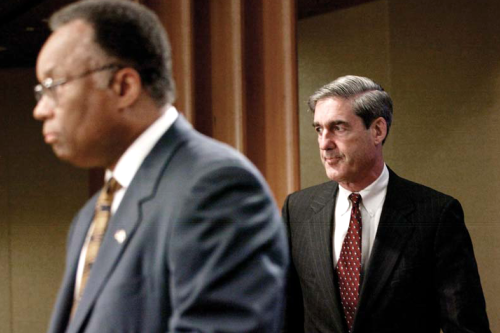
June 10, 2002: FBI Director Robert Mueller (right) and Deputy Attorney General Larry Thompson announce Padilla's capture and classification as an enemy combatant.
For instance, Bruce G. Blair, president of the Center for Defense Information, told the St. Louis Post-Dispatch on October 21, 2001: “Detonation of a dynamite-laden casket of spent fuel from a power plant would not kill quite as many people as died on September 11…. But if it happened in Manhattan, you could expect 2,000 deaths and thousands more suffering from radiation poisoning.”
No, not exactly.
What Blair failed to calculate is that the intensity of the dynamite explosive would scatter the radioactivity over a wide area, lessening by a significant degree its potential lethality. Furthermore, in an urban environment like New York City, many people in the blast area would be protected from radiation by the shielding of the buildings and the offices in which they live and work. They would receive a much lower dose of radioactivity than those walking down the street near the explosion. And people on the streets outside the immediate blast zone would be exposed to a very small dose of dissipating radiation, made even more diffuse by the explosion itself.
Dirty bomb No. 1
It may come as a surprise, but the first person to think up a “dirty bomb” was physicist Enrico Fermi in 1942 after he and his colleagues had developed the first controlled chain reaction in a uranium pile at the University of Chicago. Fermi and his colleagues had little doubt that Adolf Hitler had already done or would soon be able to do the same.
As Robert Jungk put it in one of the first histories of the bomb, his 1956 book Brighter than a Thousand Suns, “If a uranium reactor of this kind had now been produced in Chicago, after the American atomic project had got off to such a slow start, it might also have been constructed somewhere in Germany. Fermi and the physicists around him at Chicago began to believe it was possible since they assumed the Germans had already enough radioactive matter in their piles to poison all the large cities of their enemies.”
In December 1942, some were convinced that Hitler, to head off Allied bomb efforts, would risk the first air raid on the United States, with Chicago, the center of U.S. atomic research, as the target. “The whisper around Chicago's Metallurgical Laboratory was that the Germans would probably drop not the usual explosive bombs, but great quantities of radioactive dust to poison the air and water of the city,” wrote Jungk.
Of course, as it turned out, the Germans never came close to achieving a controlled nuclear reaction. Yet, 60 years later, millions of tons of radioactive materials are being used or stored throughout the world, all of which inherently poses a security risk because of their potential as “added value” in a radiological dispersal device–Fermi's dirty bomb.
Richard Garwin, an expert on nuclear weapons and nuclear power, has been a member of the scientific advisory group to the Joint Chiefs' Joint Strategic Target Planning Staff and was a member of the Rumsfeld commission that assessed the ballistic missile threat to the United States. In his essay “The Many Threats of Terror,” Garwin describes the estimated consequences of a hypothetical explosion of one kilogram of plutonium in Munich, Germany: “The average population density of Munich is about 4,300 people per square kilometer. The study estimated that 12 cancers would occur per milligram of inhaled plutonium. Under the pessimistic assumption that very still air would cause the radioactive cloud to hover over the city for 12 hours, about 120 deaths from cancer would eventually be anticipated. (This would be in addition to the 400,000 people in the city who would likely die of cancer from natural causes.)”
Garwin cites a 1983 report by Sandia National Laboratories' California branch (located at Lawrence Liver-more National Laboratory) on the results of a hypothetical explosive attack on a shipping cask containing spent nuclear fuel. The Nuclear Regulatory Commission indicated that for the most densely populated area studied (as many as 200,000 persons per square mile), at evening rush hour on a business day there would be no immediate fatalities and fewer than three fatalities from latent cancer. The scenario projected a six-inch diameter hole releasing three grams of radioactive fuel as aerosol–fine particles wafted in the air. As with the hypothetical example for Munich, more harmful consequences could be achieved by using conventional explosives in a sports stadium.
When it comes to the use of low-level radioactive sources, the Centers for Disease Control notes in “Radiation Emergencies,” in the “Terrorism and Public Health” section of the agency's Web site: “If low-level radioactive sources were to be used, the primary danger from a dirty bomb would be the blast itself. Gauging how much radiation might be present is difficult when the source of the radiation is unknown. However, at the levels created by most probable sources, not enough radiation would be present in a dirty bomb to cause severe illness from exposure to radiation.”
There are millions of commercial radioactive sources globally, but only a fraction, “perhaps several tens of thousands, pose inherently high security risks because of their portability, dispensability, and higher levels of radioactivity,” say Charles Ferguson, Tahseen Kazi, and Judith Perera, in “Commercial Radioactive Sources: Surveying the Security Risks,” a report for the Monterey Institute of International Studies' Center for Nonproliferation Studies. Those sources include americium 241, californium 252, cesium 137, cobalt 60, iridium 192, plutonium 238, and strontium 90. Some of the isotopes (americium 241, californium 252, and plutonium 238) would pose health hazards only if ingested or inhaled; others would present both internal and external health hazards because the ionizing radiation they emit penetrates the outer layer of human skin. Even with “perhaps several tens of thousands” of commercial, high-risk radioactive isotopes throughout the world as potential contaminants for a radioactive delivery device, those dirty bombs “will have so little radioactivity as to pose little, if any danger to the public,” Ferguson, Kazi, and Perera write.
Thus, scientific evidence puts in doubt the suggestion that Padilla possessed the ability to pull off an attack with a dirty bomb and cause a public health crisis.
Where to now?
After being arrested in Chicago, Padilla was taken to the Metropolitan Correctional Center in New York. He appeared before Michael B. Mukasey, U.S. district judge of the Southern District of New York. Mukasey, regarded as a no-nonsense jurist, insisted that legal charges be leveled against Padilla. But Justice Department attorneys claimed Padilla was a witness who needed to give testimony before a federal grand jury and that they couldn't foresee how long that requirement would last, so there was no end in sight to Padilla's detention.
In response to objections from Mukasey, the FBI reluctantly managed to cough up a paper affidavit created by Special Agent Joseph Ennis that claimed (without proof or cross examination) that Padilla “appeared to have knowledge of facts relevant to a grand jury investigation into the September 11 attacks. That investigation includes an ongoing inquiry into the activities of Al Qaeda, an organization believed to be responsible for the September 11 attacks, among others, and to be committed to and involved in planning further attacks.”
Neither Ashcroft nor Ennis appeared in court to support those claims.
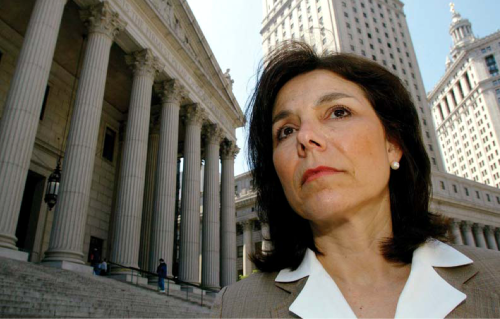
Just as the Supreme Court reasoned in 1962 that Clarence Earl Gideon deserved to have his own attorney, Mukasey reasoned in 2002 that Padilla, charged with being a terrorist and dirty-bomber for Al Qaeda, certainly deserved an attorney, maybe even a gaggle of them. So Mukasey appointed Donna Newman to represent Padilla. Newman met with Padilla on at least two occasions, then asked the judge to vacate the warrant for Padilla because he had not been charged with a crime. (Newman was quickly joined by some legal heavy hitters from the American Civil Liberties Union, the New York Civil Liberties Union, the Center for National Security Studies, the New York State Association of Criminal Defense Lawyers, and the National Association of Criminal Defense Lawyers.)
Donna Newman, Padilla's court-appointed attorney.
Entering the Twilight Zone
The government insisted on an ex parte (private) meeting with Mukasey. The Justice attorneys told the judge something to the effect of, “Oops, sorry about that, Judge, but the witness subpoena for Padilla is being withdrawn.” Mukasey promptly signed papers vacating the warrant. Then the Justice attorneys announced that President Bush had designated Padilla an “enemy combatant,” and before you could say Mr. Mxyztplk, Padilla was whisked off to the Consolidated Naval Brig, 769 miles away from his attorney. Outraged, Newman conferred with government attorneys–she wanted to see and speak with her client. She was told that she would not be permitted to speak with Padilla. She could write to him, but he might not receive the correspondence.
The government argued that Padilla should not be allowed to see a lawyer because he might pass messages to his fellow terrorists through his attorney. Mukasey didn't buy it. The idea that Padilla would pass on secrets for Al Qaeda through his attorney was, in Mukasey's words, “gossamer speculation.” Padilla had already met with Newman, so whatever damage might have been done by those conversations was already done. And finally, “there was no reason that military personnel cannot monitor [within limits] Padilla's contacts,” Mukasey said.
When pressed in open court by the angry Mukasey, on August 27, 2002, three and a half months after Padilla's arrest and incarceration, the government finally produced its first “evidence” against Padilla. This was a finding or “declaration” by Michael Mobbs, an obscure Pentagon bureaucrat with the title “Special Adviser to the Under Secretary of Defense for Policy,” who claimed that “Padilla and his associate conducted research in the construction of a ‘uranium-enhanced’ explosive device … in particular, they engaged in research on this topic at one of the Al Qaeda safe houses in Lahore, Pakistan … [a plan in which] Padilla and his associate [would] build and then detonate a ‘radiological dispersal device’ (also known as a dirty bomb) within the United States, possibly in Washington, D.C.”
There are problems with this declaration. In a footnote, Mobbs reveals that the information about Padilla came from two confidential sources. “It is believed,” the footnote reads, “that these confidential sources have not been completely candid about their associations with Al Qaeda and their terrorist activities.” It then goes on to explain: “Much of the information from these sources has, however, been corroborated and proven accurate and reliable.” On the other hand, it went on, “some information by the sources remains uncorroborated and may even be part of an effort to mislead or confuse U.S. officials.” But not to worry, or as Mad Magazine's Alfred E. Neuman puts it, “What, me worry?” The Mobbs footnote concludes, “One of the sources, for example, in a subsequent interview with a U.S. law enforcement official recanted some of the information he provided, but most of this information has been independently corroborated by other sources. In addition, at the time of being interviewed by U.S. officials, one of the sources was being treated with various types of drugs to treat medical conditions.”
Padilla's attorneys as well as the judge were unable to cross-examine Mobbs. The government offered a written statement, unaccompanied by Mobbs himself, on the witness stand. June 2003 reports suggest that some of the translations of captured sources may have been deliberately mistranslated by American translators working as Syrian spies.
The government, in what many believe is a highly unusual legal move, also appealed Mukasey's decision to grant Padilla the right to an attorney, sending it on to the court of appeals. A group of 14 legal scholars, world-class attorneys, and former federal court appellate judges, many of whom served in high positions with the federal government, filed amici curiae briefs with the court of appeals, demanding Padilla be accorded constitutional protections. They noted that Padilla is an American citizen, arrested on American territory. Even John Walker Lindh, who was arrested in Afghanistan, armed and attempting to kill U.S. forces, had an attorney throughout his legal negotiations and public trial.
No case
The government's case rests on an unusual argument. The spokesman for the Justice Department's Criminal Division, Bryan Sierra, contends that U.S. Code 18, section 4001(a), which reads, “No citizen shall be imprisoned or otherwise detained by the United States except pursuant to an Act of Congress,” provides no check on the president's powers as commander in chief. Instead, Sierra cites section 4001(b)(1), which reads, “The control and management of federal penal and correctional institutions, except military or naval institutions, shall be vested in the attorney general.” And to whom does the attorney general report? The president. In other words, in the Justice Department's tortured logic, as commander in chief, the president is not bound by Congress's rules on imprisonment and detention.
Even John Walker Lindh, who fought against U.S. troops in Afghanistan, was allowed legal representation.
But it gets even more tenuous. According to Sierra, “It is our [Justice's] position that Congress drafted the law not to restrict the president's power, and according to the record, that point was even noted by then-Rep. Abner Mikva during the debate.”
But Mikva, an eminent jurist and now a visiting professor at the University of Chicago Law School, says the law was not about giving the president more power, but rather, taking it away. 6 The “debate,” Mikva told me, had to do with delegitimizing American internment camps, such as those authorized by the president and built at the outset of World War II to house American citizens of Japanese ancestry. It was passed during the heyday of Sen. Joseph McCarthy and the House Un-American Activities Committee, when rumors were rampant that the government was building camps to house Americans suspected of leftist leanings. Mikva's position then and now (as a signatory to the amicus brief in Padilla) was to restrict the president (or his chain of command) from exercising extralegal powers to detain or imprison without fulfilling the letter of the law.
Ashcroft's argument is based on a single Civil War case: In 1864, one man, Lambdin P. Milligan, a U.S. citizen from Indiana, was tried on charges of conspiracy before a military commission and sentenced to be hanged. The Supreme Court rejected the verdict, holding that “military courts could not function in states where federal courts were open and operating,” as Louis Fisher writes in his book Nazi Saboteurs on Trial: A Military Tribunal and American Law.
Congress was not pleased with the Supreme Court decision, Fisher says, and “passed legislation to limit the court's jurisdiction to hear cases involving martial law and military trials.” The statute reads: “No civil court of the United States, or of any state, or of the District of Columbia, shall have or take jurisdiction of, or in any manner reverse any of the proceedings had or acts done as aforesaid.” But this was in 1867, and it's a slim legal reed for Ashcroft to rest his case against Padilla on.
Ron Sievert, a University of Texas at Austin law school professor and U.S. assistant attorney, in his comprehensive book Cases and Materials on U.S. Laws and National Security, questions the powers of so-called military commissions, especially when a military commander, including the president acting as commander in chief, substitutes “military force for and to the exclusion of the laws and punish[es] all persons, as he thinks right and proper, without fixed and certain rules.”
If unchecked, such power would mean that republican government, and liberty regulated by law, would come to an end. With such powers, martial law could be used to destroy every guarantee of the Constitution, and effectually render the military independent of and superior to civil power. The idea was deemed such an offense by this country's founders that they cited it as one of the main reasons for declaring independence from England. “Civil liberty and this kind of martial law cannot endure together; the antagonism is irreconcilable; and, in the conflict, one or the other must perish,” Sievert writes.
During the turbulent Civil War years, Abraham Lincoln declared an emergency, suspended the writ of habeas corpus, and declared martial law both in 1861 and 1862. Chief Justice of the Supreme Court Roger B. Taney ruled that Lincoln did not have that right. In 1866, after the end of the Civil War, the Supreme Court reinstated habeas corpus. Despite the reinstatement, the government now contends it can hold Padilla incommunicado and subject him to constant and endless questioning without allowing him an attorney, or presenting him in court.
With such powers, martial law could be used to destroy every guarantee of the Constitution and render the military independent of civil power.
Illegal, say other former federal appellate court judges and legal scholars, whose amicus curiae brief states, “The right to habeas corpus–that is, to have a court determine the legality of detention–was one of the few individual rights enshrined in the Constitution itself, even before the Bill of Rights.” The brief notes that President Bush's declaration of Padilla as an enemy combatant “would also strip away the most basic due process rights of notice and an opportunity to be heard by forbidding Padilla from even learning about this case or communicating in any manner with his counsel–or even with the court.”
Roosevelt's rules
The most important precedent for denying Padilla legal representation comes from a World War II example where the prisoners were in fact accorded legal representation, some of it outstanding. Eight ill-equipped “spies” were sent by Germany to work against the United States in 1942. They were far from rocket scientists. Most had previously worked in the United States for a short while as fry cooks, chauffeurs, or tool and die makers; one worked in the meatpacking industry. After four months of spy and saboteur training, they were put aboard submarines and shipped to the United States.
When four of the eight landed on Long Island, the first person they encountered on the beach was an unarmed U.S. Coast Guardsman, Frank Collins, whom they tried to bribe. When Collins returned to base that night, he told his superiors, who then hurried to the beach, where they found Nazi paraphernalia and explosive devices. Five days later, when the four spies were in New York City, one of them, George Dasch, phoned the FBI in an effort to turn himself and his cospies in. The FBI didn't believe him. Dasch then phoned government information and was told to call the Adjunct General's Office, but the secretary said her boss wasn't in.
In desperation, Dasch called the FBI again, and while the agent really didn't believe him, he was nevertheless told to go to a specific office in the Justice Department. The FBI agents still thought they were wasting their time until Dasch opened a suitcase with $82,550 in cash.
A few days later, four other German spies landed in Florida, but by now the FBI was hot on the case, and they were all rounded up.
President Franklin D. Roosevelt did not want the eight spies tried in a civilian court; the most prison time they might serve would be two years. Roosevelt wanted them dead, period. He wanted a trial by a military commission, something akin to a military tribunal. Roosevelt issued Proclamation 2561, creating a military tribunal referencing what he called the “law of war”–not all that different from President Bush calling an American citizen arrested on American territory an “enemy combatant.” If Roosevelt had cited the Articles of War, he would have had to conform to the laws established by Congress for court-martial. But this way, “acts of war” could mean whatever Roosevelt and Attorney General Francis Biddle meant them to be, and the trial could be run by their rules, including allowing a two-thirds vote of the commission/tribunal to approve the death penalty and closing all proceedings to the public, except for 15 minutes when a few photographers snapped pictures and a few reporters took notes. Roosevelt got his way, and six of the eight were sentenced to death.
What makes the Padilla case different from the Nazi spy case is that even with the formation of Roosevelt's ad hoc, make-the-rules-up-as-you-go-along plan, no one argued that the Nazi spies did not deserve to have defense attorneys. In fact, one defense attorney, Col. Kenneth Royall, acknowledged that he worked under the military chain of command and would cease his efforts if so ordered. But his orders were for him to do what he thought was right, and Royall was rigorous in his defense, contending that his commander in chief, Roosevelt, had acted illegally in forming the commission. Once the verdict was rendered, Royall pressed for the case to be heard by the Supreme Court. The public, too, began to tire of all the secrecy and demanded more openness. The hearings before the Supreme Court were open to all, though it would take almost three months before a full-blown decision could be handed down.
The Supreme Court found in favor of the commission–months after six of the spies were executed. Later, Justice Felix Frankfurter said the finding “was not a happy precedent. The American legal system would do well not to see its like again.” 7
A year after the spies were caught, Hans Haupt, the father of one of the men, was arrested and sentenced to death because he had hidden some of his son's cash. In reversing that conviction, the appellate court in the Seventh Circuit unanimously denounced the Supreme Court's decision in the Nazi spy case for its failure to protect the fundamental right of a jury trial:
“Of the many rights guaranteed to the people of this Republic, there is none more sacred than that of trial by jury. Such right comprehends a fair determination, free from passion or prejudice, of the issues involved. The right is all-inclusive; it embraces every class and type of person. Those for whom we have contempt or even hatred are equally entitled to its benefits. It will be a sad day for our system of government if the time should come when any person, whoever he may be, is deprived of this fundamental safeguard. No more important responsibility rests upon courts than its preservation unimpaired. How wasted is American blood now being spilled in all parts of the world if we at home are unwilling or unable to accord every person charged with a crime a trial in conformity with this constitutional requirement.” 8
Ashcroft would have it otherwise. In remarks before the Senate Judiciary Committee on December 7, 2001, Ashcroft denounced those who had voiced opposition to the extrajudicial, extralegal steps the Bush administration was taking: “Your tactics only aid terrorists, for they erode our national unity and diminish our resolve. They give ammunition to America's enemies and pause to America's friends.”
A day after the Judiciary Committee hearing, the Justice Department announced that Ashcroft had not intended to discourage public debate; what he found unhelpful to the country were “misstatements and the spread of misinformation about the actions of the Justice Department.”
But, according to Fisher, “Ashcroft appeared to claim that tribunals are created under the exclusive authority of the president and that according to judicial precedents Congress may not limit that authority. The legal and historical record of military tribunals presents quite a different picture: The creation of tribunals is typically decided jointly by Congress and the president; Congress has not recognized a unilateral presidential authority to create those tribunals; and the Supreme Court has repeatedly held that Congress has the constitutional authority to create tribunals, decide their authorities and jurisdiction, and limit the president if he acts unilaterally by military order or proclamation to create those tribunals.”
In the Padilla case and other “terrorist” cases, American justice is sailing into uncharted territory.
If the science of Jose Padilla's dirty bomb most closely resembles alchemy, the legality of Padilla's arrest and confinement is in an invisible legal dimension where, as Lewis Carroll noted, legal logic is turned on its head.
“‘Let the jury consider their verdict,’ the King said, for about the twentieth time that day. ‘No, no!’ said the Queen. ‘Sentence first–verdict afterwards.’”
Footnotes
1.
Lucio Guerrero, Carlos Sadovi, Frank Main, and Robert C. Herguth, “A Couple Years Back, I Knew He Entered a Cult,” Chicago Sun-Times, June 11, 2002.
2.
Lynn Sweet and Frank Main, “Terror Suspect Says He Came Here to Visit Son,” Chicago Sun-Times, June 12, 2002.
3.
Ibid.
4.
Lou Michel and Dan Herbeck, American Terrorist: Timothy McVeigh and the Tragedy at Oklahoma City (New York: Regan Books/HarperCollins), p. 219.
5.
These calculations were made by Mike Rosing, PhD, a nuclear engineer with several years' experience at Argonne National Labs as an engineer and physicist. They are estimates: At one meter the gang would receive two grays per second, or about 50,000 grays in seven hours. At two meters they would receive 0.2 grays per second, which is still 5,000 grays in seven hours. Since a fuel rod is four meters long and the gang would average about two meters away from the rods, it is as if the fuel rods would “wrap around” them and radiate them from all sides. If they should accidentally touch the rods with their bare hands, they would be dead in seconds.
6.
Interview with Abner Mikva, October 20, 2003.
7.
Louis Fisher, Nazi Saboteurs on Trial: A Military Tribunal & American Law (Lawrence, Kansas: University of Kansas Press, 2003), p. 171.
8.
Ibid, p. 81.