




Abstract

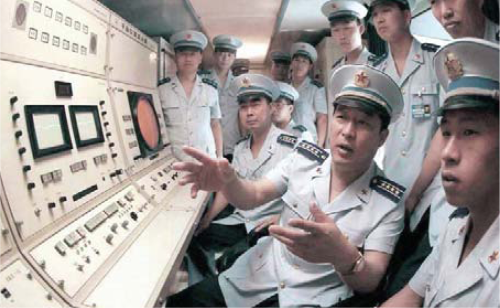
Chinese air force officers undergo command center training.
China is gradually retiring its DF-3A medium-range ballistic missiles after more than 30 years in service.
The two-stage, liquid-fueled DF-4 long-range missile is cave-based and rolled out for launch from a transporter-erector-launcher (TEL).
The DF-5/5A, also liquid-fueled, is deployed in silos and elevated for launch. The exact number of DF-5s is unknown but estimated to be 20. In June 2000, the Pentagon reported that China had built 18 DF-5 silos; the U.S. National Air Intelligence Center reported that as of 1998, China's deployed DF-5 force had “fewer than 25” missiles. According to one senior administration official, China stores its nuclear warheads separately from the missiles. Older DF-5s are being replaced with longer-range DF-5As, an upgrade that may be completed around 2005.
The two-stage, solid-propellant DF-21A is carried in a canister on a TEL and supplements the aging inventory of DF-3As. China has converted some DF-21s to conventionally armed missiles.
China is modernizing its missile force as part of a program begun nearly two decades ago that features mobility, solid fuel, improved accuracy, lighter warheads, and a more robust command, control, communications, and intelligence (C3I) system. A new missile, the three-stage, solid fuel, mobile DF-31, is the program's mainstay. Its range is estimated at 8,000 kilometers, and its circular error probable (CEP), or accuracy, at 300-600 meters for its single warhead. At maximum range, the DF-31 may be able to hit Hawaii and Alaska, but not the continental United States. The last of three DF-31 test flights was conducted in November 2000 and involved decoy warheads traveling over a shorter flight path. The DF-31 will likely be targeted primarily against Russia and American bases and facilities in Asia. It is expected to begin deployment in 2004 or 2005.
China is also developing a modified version of the DF-31, the DF-31A. With an extended range of up to 12,000 kilometers, the DF-31A is sometimes confused with the DF-41, now canceled. Its precise range is unknown. Deployment is predicted to occur between 2006 and 2010. It may replace or supplement the DF-5A. According to the CIA, the DF-31A may be targeted against the United States and be tested “within the next several years.” With a shorter range and a lighter payload than its predecessor, the DF-31A will be less capable of penetrating a potential U.S. missile defense system.
China has had the technical capability to develop multiple reentry vehicle systems (MRVs) for 20 years, including a multiple independently targetable reentry vehicle (MIRV) system, but has chosen not to do so. The CIA estimates that it would take only a few years for China to develop and deploy a simple MRV or MIRV on silo-based DF-5s, using a DF-31-type RV. On the other hand, the CIA has concluded that “Chinese pursuit of a multiple RV capability for its mobile ICBMs [intercontinental ballistic missiles] and SLBMs [submarine-launched ballistic missiles] would encounter significant technical hurdles and would be costly.” The agency predicts that by 2015, “most” of China's missile force will be mobile.
Taiwan's defense minister has referred to the 600-kilometer DF-15 (an export version is designated the M-9) and 300-kilometer DF-11 (M-11) as nuclear capable, but that assessment is unconfirmed and not included in declassified CIA or Defense Department estimates. The short-range ballistic missiles based in the Nanjing military region opposite Taiwan are most likely conventional. Improvements to make them more accurate continue.
Suspected missile bases and brigades
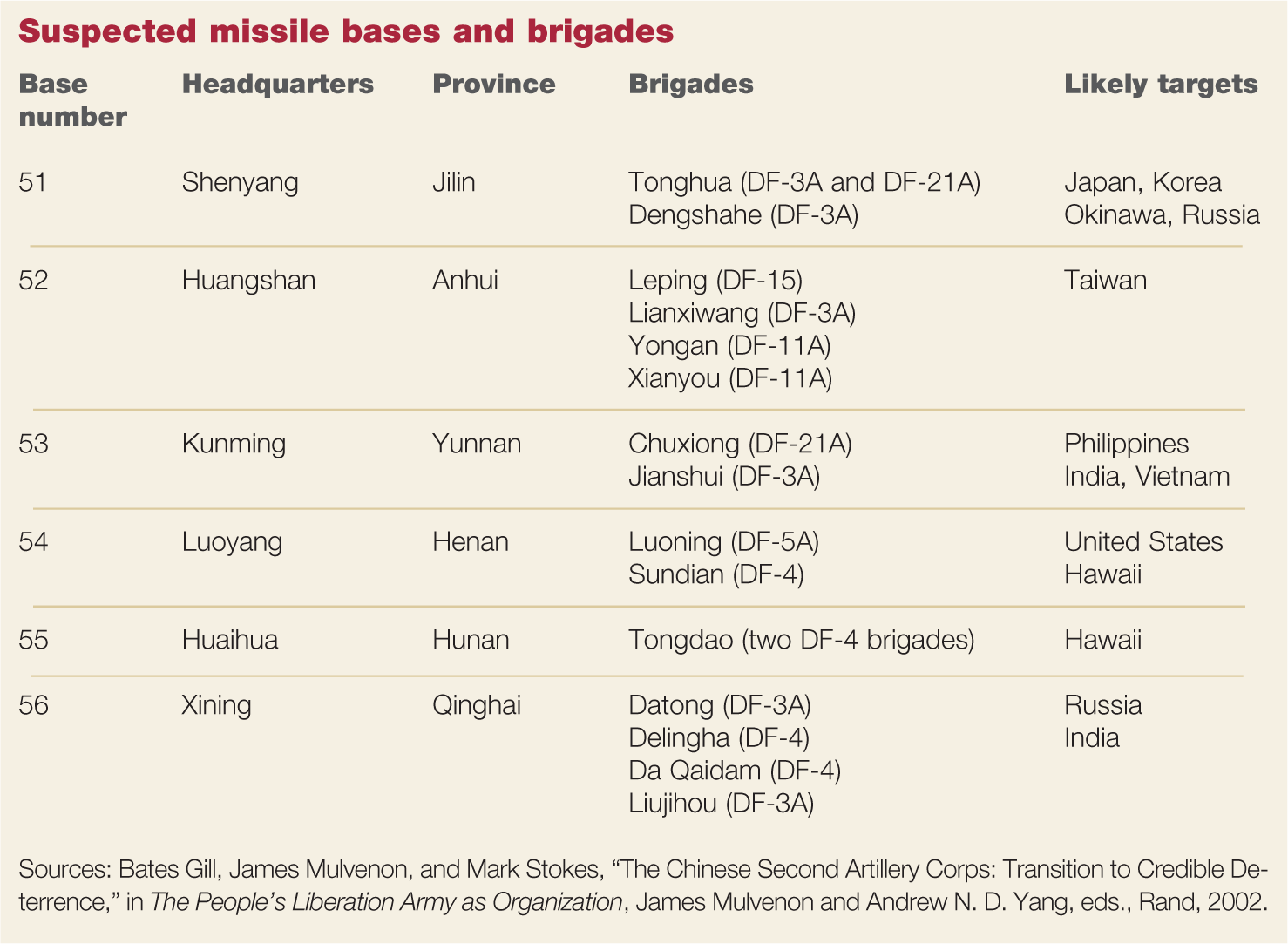
Sources: Bates Gill, James Mulvenon, and Mark Stokes, “The Chinese Second Artillery Corps: Transition to Credible Deterrence,” in The People's Liberation Army as Organization, James Mulvenon and Andrew N. D. Yang, eds., Rand, 2002.
Several scholars have studied the Second Artillery Corps, the independent branch of the People's Liberation Army that operates China's missile force, and have provided the basic structure and suspected locations of six missile bases and their missile brigades (see table above).
The Xia is not fully operational, even after a recent four-year overhaul, and it has never sailed beyond China's regional waters. The Pentagon estimates that China has extended the Xia's service life to at least 2010 and that “China is expected to deploy the [Julang I] medium-range SLBM aboard the Xia SSBN in 2003.”
The Xia carries 12 single-warhead Julang I SLBMs, which have an estimated range of 1,700 kilometers. The Julang I was first test-launched from a Golf-class diesel sub in late 1982; an attempt to launch a missile from the Xia in 1985 reportedly failed. The first successful full-scale launch from the Xia took place in September 1988. In 1989, China deployed the sub to Jianggezhuang Submarine Base, where nuclear warheads for Julang I missiles are believed to be stored. The Xia's missile system is not fully operational; the CIA and the Pentagon characterize Julang I missiles as experimental.
China has begun work on a new SSBN called Project 094. This sub is expected to carry 16 three-stage Ju-lang II SLBMs, a variant of the DF-31 missile, with an estimated range of up to 8,000 kilometers. According to one report, the DF-31/Julang II was tested in 1997 for a submarine launch role. Some speculate that the Julang II may be equipped with multiple warheads, but, as cited above, the CIA believes it unlikely. Equipping the Julang II with multiple reentry vehicles would also reduce its range. Given the significant problems China has had with the Xia, deployment of a Project 094 submarine and its new missile is many years away.
The H-6 dropped live weapons in nine of China's atmospheric nuclear tests, including one test of a 4-megaton thermonuclear explosion in November 1976. Some early Soviet model H-6s may have limited refueling capability, and at least 10 H-6 bombers have been converted to H-6U tankers. An H-6U refueled fighter aircraft over the South China Sea in April 2000. China will convert several Russian Il-76 transport aircraft into tankers.
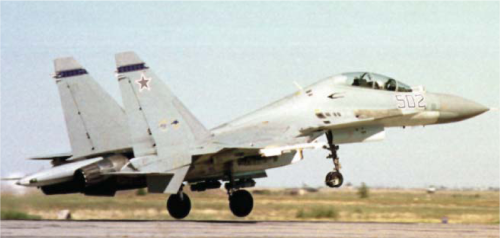
China has unsuccessfully sought an H-6 replacement for decades. Its attempts in the mid-1990s to buy Russian Tu-22 Backfire bombers failed. Medium-range bombers, like the Chinese H-7 or the Russian Su-32/34, have been considered, but their shorter ranges and smaller payloads make a nuclear role doubtful. A more likely choice for the nuclear strike mission may be the Russian Su-30, which has a range, weapon load, and maximum ceiling similar to the H-6. Russia has delivered about 80 of the two-seater, fighter-bomber Su-30MKKs to China so far. In early 2003, China signed a contract for delivery of Su-30 upgrades, the Su-30MK2 and Su-30MK3.
Although increasingly obsolete as a modern strike bomber, the H-6 may gain new life as a platform for China's emerging cruise missile capability. The naval air force has used the H-6 to carry the C-601/Kraken anti-ship cruise missile for more than 10 years, and Flight International reported in 2000 that up to 25 H-6s would be modified to carry four new YJ-63 land-attack cruise missiles. Despite several unofficial reports that China is developing a nuclear land-attack cruise missile similar to the U.S. Tomahawk, neither the CIA nor the Defense Department mention such a weapon in their declassified projections on Chinese force developments.
In April 1984, the Defense Intelligence Agency (DIA) stated, “A lack of basic doctrine or training may indicate that the Chinese have only recently considered integrating nuclear weapons into ground force operations. The Chinese nuclear weapons technological capability would limit the current ground force nuclear force support to atomic demolition munitions (ADMs), bombs, and missiles such as the CSS-1; it would not include artillery-fired nuclear projectiles. We also estimate that the Chinese maintain ADMs in their inventory, although there is no evidence confirming their production or deployment.” Six months later the DIA seemed more convinced that China had not produced or deployed such weapons: “China is not now assessed as having any stockpile of tactical nuclear rockets, guided missiles, or atomic munitions.”
The vague profile of a tactical nuclear arsenal may partly reflect China's countervalue doctrine, which is based on a retaliatory force rather than a counterforce strategy. In addition, China's long-declared no-first-use pledge may have served to limit the introduction of a tactical war-fighting capability. However, the most recent annual report from the Pentagon on China's military capabilities states: “Despite Beijing's ‘no first use’ pledge, there are indications that some strategists are considering the conditions under which Beijing would employ theater nuclear weapons against U.S. forces in the region.”
China's Russian-built Su-30MKKs may have a nuclear strike mission in the future.
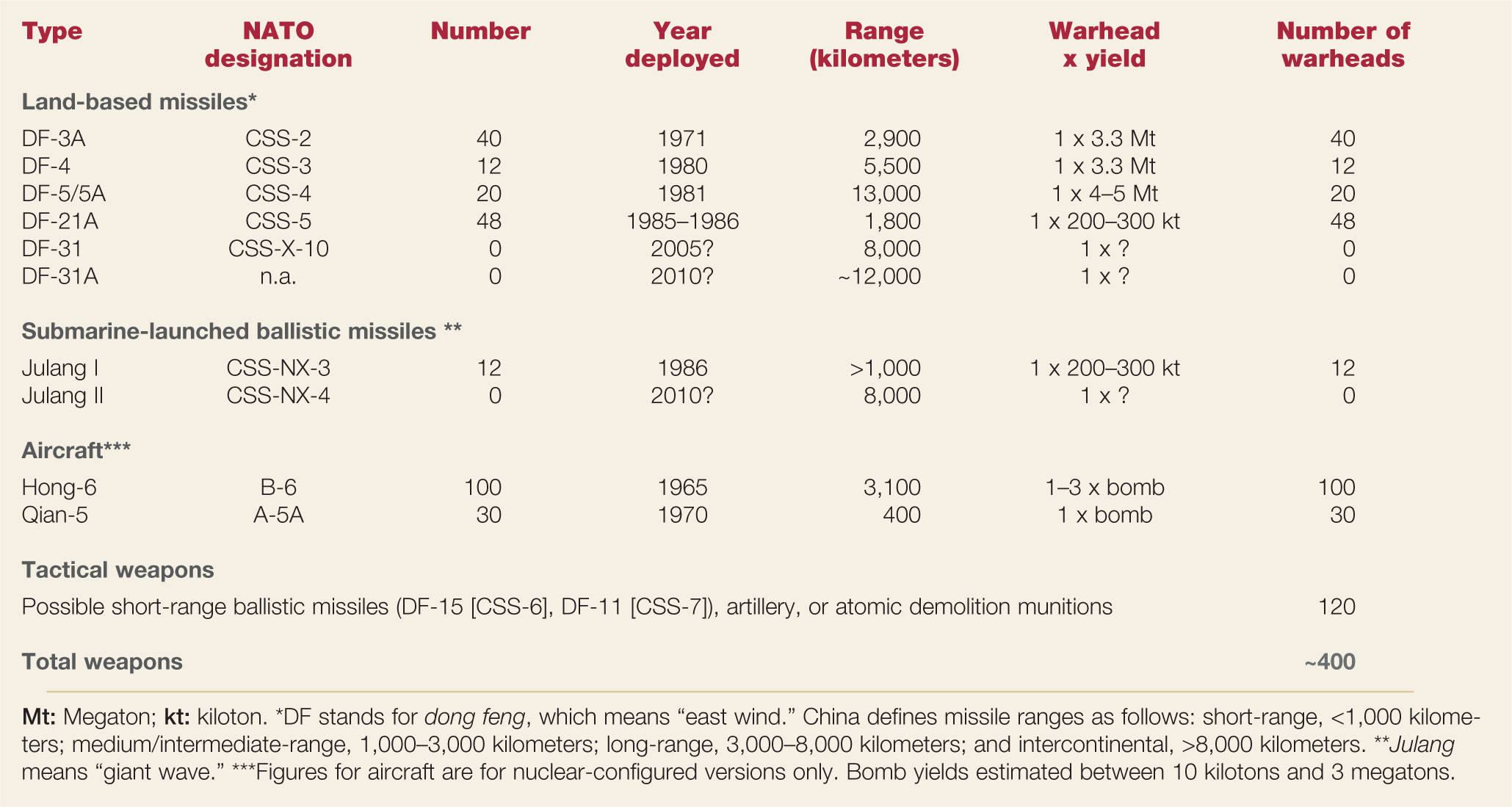
Mt: Megaton; kt: kiloton.
DF stands for dong feng, which means “east wind.” China defines missile ranges as follows: short-range, <1,000 kilometers; medium/intermediate-range, 1,000-3,000 kilometers; long-range, 3,000-8,000 kilometers; and intercontinental, >8,000 kilometers.
Julang means “giant wave.”
Figures for aircraft are for nuclear-configured versions only. Bomb yields estimated between 10 kilotons and 3 megatons.
Past predictions about China's nuclear arsenal have proven highly inaccurate and exaggerated. For example, in the 1960s, U.S. Pacific Command estimated that China could have 435 nuclear weapons by 1973–that's three times as many as China actually had. In 1984, the DIA set “the best estimate” for the projected number of Chinese nuclear warheads at 592 in 1989 and 818 in 1994–approximately 50 and 100 percent above actual force levels for those years.
The fact is that China's stockpile plateaued at approximately 400 warheads in the early 1980s.
These errors should be remembered when considering the latest predictions. Although it is possible that the number of warheads targeted primarily against the United States could increase “several-fold” between now and 2015, the overall size of the total Chinese stockpile will probably remain about where it is today.
Accurate predictions are difficult because of several unanswerable questions: Will China deploy more DF-31As than its currently deployed DF-5s (about 20)? Has China developed smaller and lighter warheads? Will China develop and deploy multiple reentry vehicles on its ICBMs? What countermeasures decisions might China take in response to a U.S. missile defense system? Only time will answer those questions accurately.