




Abstract
Siting advanced bioweapons germ research at secretive nuclear labs could be a serious mistake, especially given Energy's poor security, safety, and environmental records.
For months, U.S. and coalition forces have scoured Iraq searching for biological weapons and the labs that might have made them; the possibility of these labs' existence led broadcasts around the world.
Meanwhile, in the United States, with very little media attention or public discussion, the Bush administration is quietly pursuing plans to build biowarfare agent facilities of its own. The new labs will handle, modify, and experiment with some of the most harmful agents known to humanity, including live anthrax, plague, Q fever, and botulism.
But what should be even more controversial is where some of these biofacilities are being built: at nuclear weapons design sites–Lawrence Livermore National Laboratory in California and Los Alamos National Laboratory in New Mexico.
Proponents say the new facilities will improve U.S. biodefense. But mixing biowarfare research and nuclear weapons design might not be such a good idea; it could not only be dangerous for the communities near the labs, but could also ultimately undermine global security.
And considering the seriously troubled security and safety histories both Livermore and Los Alamos have had, is it really wise to give the labs the added responsibilities of advanced bioresearch facilities?
The biodefense building boom
In the wake of the September 11 terrorist attacks and the anthrax mailings that followed, Congress hastily appropriated $6 billion for biodefense. The stimulating scent of big money caused an all-out rush by many federal agencies to expand, upgrade, and/or create wholly new high-containment research facilities and programs to handle dangerous bioagents–the potential tools of potential terrorists.
Agencies petitioning for funds included the Centers for Disease Control and Prevention (CDC), the National Institutes of Health (NIH), the National Institute of Allergy and Infectious Diseases, the Agriculture Department, the Environmental Protection Agency (EPA), the Food and Drug Administration, the Defense Department, the Energy Department's National Nuclear Security Administration, and the Department of Homeland Security.
Biodefense proposals have popped up in more than a dozen states. Non-governmental organizations (many with members who live near the planned facilities) noted that although construction was put on the fast track, there was precious little information available to the public about the plans, no visible coordination between agencies, and no overarching plan to guide the building boom.
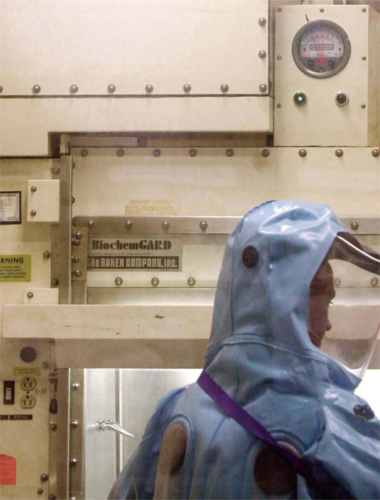
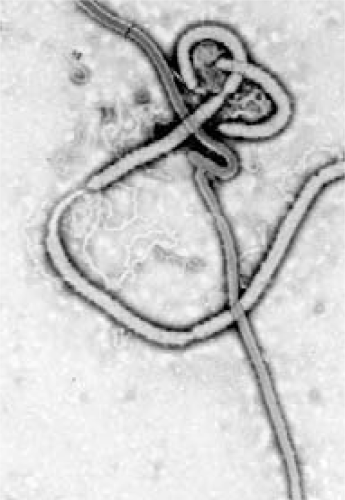
Above, the Ebola virus. At left, a worker at the Centers for Disease Control and Prevention models a BSL-4 biohazard suit.
The public discovered the Bush administration did not even have an all-inclusive list of the proposed facilities and upgrades across its agencies. Nor was there a comprehensive assessment of current biodefense capabilities, what future facilities might be needed, and for what purpose.
Further, there has been no overall review of the health and environmental risks new biolabs would pose to workers and the public. Although some agencies said that their new biodefense facilities will undergo the Environmental Impact Statement process in compliance with the National Environmental Policy Act (NEPA), other agencies with similar or even riskier bioproposals said no.
The sheer number of proposed facilities is sobering. Thirty expanded or new labs are being considered nationwide, according to biodefense analysts and community groups that have painstakingly tracked them across multiple government agencies. Right now, there are six identifiable Biosafety Level 4 (BSL-4) facilities in the United States; 14 more are on the drawing board. Sixteen new BSL-3s are planned or under construction.
Biological labs are classified according to the safety measures required to contain the infectious agents being studied. BSL-4 and BSL-3 labs require the highest and second highest levels of protection; BSL-2 and BSL-1, the second lowest and lowest levels. In BSL-3 facilities, scientists work with potentially life-threatening microorganisms like live anthrax and bubonic plague; BSL-4s house pathogens for which there are no known cures, such as Ebola and Marburg (see table on page 29).
For every new BSL-3 or -4 facility that is built, the possibility of an accidental or deliberate release of deadly, infectious agents increases. Moreover, each new biodefense lab could itself become a potential terrorist target. The ill-considered profusion of new labs and programs will not only proliferate biowarfare agents, but will also increase the number of people who will have access and the knowledge to use them.
Edward Hammond, director of the Austin, Texas-based Sunshine Project, estimates that each of the proposed facilities could average between 150 and 300 scientists and technicians, totaling 4,500 to 9,000 employees. Not included in this tally will be the approved pathogen couriers (UPS, FedEx, or the U.S. Postal Service) and others with more limited access.
Those numbers are troubling in light of the fact that the culprit behind the October 2001 anthrax mailings may well have worked for a government bioprogram. The strain of anthrax used came from a U.S. biodefense facility. And although the attacker has not been caught, the FBI's chief “person of interest” who has been investigated in connection with the crime is a former employee of the bioprogram at the Defense Department's Fort Detrick, Maryland, facility.
Over the past year, a growing number of academics, scientists, medical doctors, policy analysts, and public watchdog organizations have questioned the Bush administration's approach to combating bioterrorism. The biodefense building boom is “likely to undermine U.S. national and environmental security,” according to the founding statement of a new national coalition of nongovernmental organizations. The coalition includes groups from California, New Mexico, Texas, Montana, Utah, and Massachusetts. It has issued a statement calling on Congress to freeze funding for new construction pending a national reassessment of biodefense spending.
Energy's biowar bid: global consequences
The case against Energy
This August, two non-profit organizations, in alliance with community members living near the Los Alamos and Livermore labs, filed suit against the federal government over the labs' proposed biodefense activities. Under the National Environmental Policy Act (NEPA), all proposed “major federal actions” must undergo public environmental review, and federal agencies must respond to public concerns and comments–requirements that Tri-Valley Communities Against a Radioactive Environment of California and Nuclear Watch of New Mexico say have not been met.
The groups say that the Energy Department's National Nuclear Security Administration (NNSA) acted capriciously and arbitrarily when it issued “Findings of No Significant Impact” and subsequent “Records of Decision” to Los Alamos and Livermore, giving the labs the go-ahead to build advanced bioweapons research facilities.
The coalition of non-profits and local residents believes that the existing environmental assessments are inadequate and that more comprehensive Environmental Impact Statements should be required, since this is the first foray by the NNSA into far more advanced biodefense research. Given the inherent risks of new bioprojects, in combination with their location at secret nuclear weapons labs and Energy's poor safety, security, and environmental records, the plaintiffs have asked the court to vacate the NNSA's Findings of No Significant Impact.
They also seek injunctions against the continued construction and operation of the Livermore and Los Alamos BSL-3s. The plaintiffs say the advanced biolabs must not be allowed to proceed until the NNSA offers greater safety, security, and transparency to the public through more comprehensive site-specific public reviews.
The plaintiffs have also asked the court to find the NNSA in violation of NEPA because it failed to prepare a “programmatic” Environmental Impact Statement for Energy's Chemical and Biological National Security Program (CBNP). NEPA requires proposed new federal programs that join different activities and facilities together to undergo broad programmatic public review; NNSA denies that a programmatic review is required.
The first court hearing is expected later this year.
The Energy Department has had a Chemical and Biological National Security Program (CBNP) since fiscal 1997. Until the September 11 attacks, its funding was modest. In fiscal 2002, the CBNP's funding grew by 115 percent, to $87 million. Its still-growing budget has now been transferred to the newly created Department of Homeland Security, where operations are so opaque that a Freedom of Information Act request filed months ago has so far yielded no response.
The Energy Department is quick to fend off criticism of its growing bio “footprint” by saying that it and its predecessor agencies have done biological research since the early days of the Cold War. It is true that the Energy Department's weapons labs at Los Alamos and Livermore have long had BSL-1 and BSL-2 facilities. But this low-risk research is a far cry from the advanced capabilities Energy is now pursuing.
If Energy's work on nuclear weapons is any indication of how it will approach its new biodefense work, there is ample reason for concern that it will use the facilities to secretly develop and improve capabilities for offensive chemical and biological weapons, according to Robert Civiak, a physicist and policy analyst who served as White House Budget Examiner for Energy's weapons program. The Energy labs spend eight times as much money on developing new and improved nuclear weapons as they do on controlling nuclear weapons proliferation and reducing nuclear arsenals, Civiak said.
The research to be conducted at the Energy labs is inherently dual purpose. A fine line separates “defensive” (for example, detecting bioweapons agents) from “offensive” research (weaponizing an agent). Sergei Popov, a former Soviet bioweaponeer, stated the problem plainly for the television program NOVA. In the initial stages of defensive and offensive research, it's the “same process.” In short, it is essentially the intent of a bioprogram, not a technical or material difference, that separates defensive from offensive capability.
So how will other nations gauge U.S. intent if it conducts research at highly classified centers for the development of nuclear weapons? Energy's entry into biowarfare research could spark deep suspicion and cripple international efforts to build an effective nonproliferation regime for bioweapons.
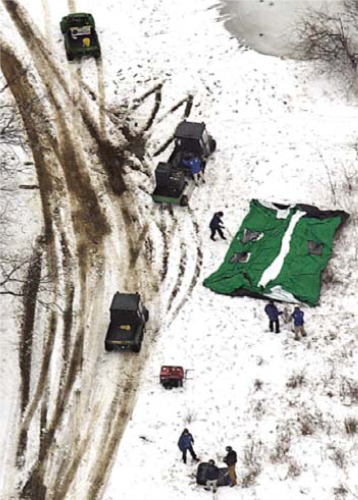
December 12, 2002: FBI agents search an area near Frederick, Maryland, as part of their ongoing anthrax investigation
As Livermore and Los Alamos forge ahead with the designs for new and modified nuclear weapons (like “mini-nukes” or the Robust Nuclear Earth Penetrator), concepts that fly in the face of U.S. disarmament obligations under the Nuclear Non-Proliferation Treaty, there is growing alarm that the labs' planned foray into bioresearch could drive a coffin nail into the already fragile Biological and Toxin Weapons Convention (BWC).
The Bush administration single-handedly quashed negotiations on strengthening the BWC through verification and enforcement. The U.S. position focused on protecting biosecrecy and rejected all effective disclosure requirements. Barbara Hatch Rosenberg, chair of the Federation of American Scientists' working group on the BWC, calls the commingling of nuclear weapons and biodefense “a very serious mistake.”
“This makes it possible for the government to say we can't allow any kind of inspections or visits from outside the government because nuclear security depends on it,” Rosenberg told the Livermore-area Alameda Newspapers Group.
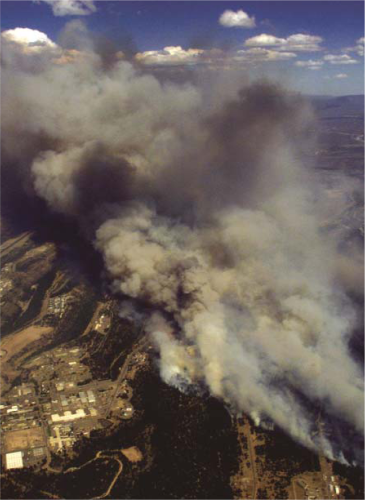
Not so safe: In May 2000, a major forest fire caused a near-total evacuation of Los Alamos (above); Livermore is in an earthquake zone.
Disturbingly, it seems the United States is moving toward the position that its BWC obligations are limited solely to the activities of the Defense Department biodefense program, and that bioresearch conducted by Defense subagencies or other agencies like Energy need not be evaluated for treaty compliance. The February/March 2003 issue of Disarmament Diplomacy cites a U.S. government report on the BWC that recommends, “if there are promising technologies that [Defense] is prohibited from pursuing, set up MOA” (memorandums of agreement) with the Energy Department.
At the labs
The BSL-3 facility under construction at Los Alamos will be 3,000 square feet and will include two individual BSL-3 labs, two BSL-3 mechanical rooms, and one BSL-2 lab. It is expected to cost around $5 million and be completed late this fall. The proposed date for introducing pathogens is spring 2004. The facility is slated to operate for at least 30 years.
At Livermore, the BSL-3 will be 1,500 square feet. An existing, adjacent BSL-2 facility will be used to store materials needed to operate the BSL-3, but that do not themselves require a higher level of containment (like disinfectants). The Livermore biofacility will include three individual BSL-3 labs. One of them will be devoted to aerosolizing bioagents and to conducting what Energy calls “challenges” on up to 100 small animals at a time, mainly rats, mice, and guinea pigs. At the end of each study, the animals will go into a tissue digester, a sort of high-temperature blender that yields an aqueous solution and some ash. Making deadly pathogens airborne and conducting animal challenges with them is particularly provocative because these are key steps to weaponization. Further, aerosolizing bioagents could lead to their accidental release into the environment, as has happened often at Livermore with radioactive materials.
Energy plans to use a “permanent prefabricated” building to house Livermore's BSL-3; it is expected to cost around $2 million and will probably be finished in early fall. The introduction of pathogens may be on the same schedule as Los Alamos. The Livermore BSL-3 is also expected to operate for 30 years.
Energy has given Los Alamos and Livermore carte blanche for the “select agents” their BSL-3 labs can choose to work with, although the Department says that “select agents have historically been associated with weaponizing efforts.” These include “approximately 40 viruses, bacteria, rickettsia, fungi, and toxins” listed by the CDC. Some of the more familiar agents are anthrax, tularemia, plague, Q fever, botulism, brucellosis, tuberculosis, staphylococcus, and salmonella bacteria, and hepatitis, HIV, herpes, hantavirus, and influenza viruses.
According to Energy documents, in addition to agents listed by the CDC under the BSL-3 category, the new biofacilities “could handle other bacterial or viral infectious organisms not specifically or currently regulated by CDC or other federal agencies.” This means Livermore or Los Alamos could use genetically modified pathogens–for which the virulence and health effects are unknown, for which the CDC does not offer guidance, and for which there are no known cures.
This could not only bump up against the BSL-4 hazard category without BSL-4 containment, but also the bioweapons treaty, which hopes to stem this very type of research.
Energy is explicit about its plans to use genetically modified agents in its BSL-3 research. For example, in writing about the Livermore facility, Energy states that it will “require the ability … to produce small amounts of biological material (enzymes, DNA, ribonucleic acid [RNA], etc.) using infectious agents and genetically modified agents under conditions that would require management of the facility at the BSL-3 level.”
Paltry environmental reviews
In its rush to build BSL-3s, Energy has put the cart before the horse by issuing environmental assessments to Los Alamos and Livermore without first preparing a “Programmatic Environmental Impact Statement” for its entire bioprogram. Energy is the landlord for biological activities spread across nine different sites within the nuclear weapons complex, and there are indications that other Energy sites, like Hanford and Oak Ridge, will seek BSL-3 facilities in the future. Energy's refusal to conduct appropriate program-wide review is potentially dangerous.
Thumbing its nose at environmental regulations, Energy granted itself a cursory “finding of no significant impact” in order to green-light the BSL-3 facilities at Livermore and Los Alamos. Neither site has had the benefit of either a program-wide or location-specific Environmental Impact Statement to analyze the risks and identify alternatives to the biolab plans, and construction continues. In taking this tack, Energy ignored both the National Environmental Policy Act and more than 1,000 documented requests from the public. NEPA requires government agencies to do environmental reviews for major federal proposals that could adversely affect the environment.
Moreover, through NEPA, Congress directs that all federal agencies “recognize the worldwide and longrange character of environmental problems and, where consistent with the foreign policy of the United States, lend appropriate support to initiatives, resolutions, and programs designed to maximize international cooperation.” Operating BSL-3 facilities at Energy's super-secret weapons labs seems unlikely to foster international cooperation on environmental matters, much less on nonproliferation or BWC compliance.
For its advanced biofacilities, Energy prepared quick and simple “environmental assessments” instead of the more rigorous and comprehensive full-impact statements. This is like a doctoral candidate offering a book report instead of a dissertation, and then deciding to grant himself the degree. The assessments presume that no adverse environmental effects will occur from the BSL-3 facilities. This presumption is largely based on the idea that Livermore and Los Alamos will comply with CDC requirements and guidelines. But the weapons labs have a poor history of complying with environmental regulations. Both labs have caused substantial toxic and radiological contamination–both on site and in surrounding communities. Livermore is on the EPA's Superfund list of most contaminated sites in the country, and New Mexico recently issued a “corrective action order” to force cleanup at Los Alamos.
Moreover, as the Los Alamos environmental assessment points out, by law the CDC does not have legal jurisdiction over Energy “with regard to the required approval of procedures used in [Energy Department] biological research activities and does not have a local presence with regard to Los Alamos National Laboratory.” This is, of course, equally true at Livermore.
Energy's past performance with its lower-risk biological research is hardly confidence inspiring. In February 2001, Energy's inspector general released a report called “Inspection of Department of Energy Activities Involving Biological Select Agents.” It concludes that biological select agent activities at Energy's labs lacked organization, coordination, and direction. Specifically, Energy's activities “lacked appropriate federal oversight, consistent policy, and standardized implementing procedures, resulting in the potential for greater risk to workers and possibly others from exposure to biological select agents and select agent materials.” The report found that some Energy labs “were not adhering to [CDC] requirements,” that procedures for conducting research activities involving these agents varied significantly among the laboratories, and that Energy had not developed policies to ensure that the laboratories follow “best practices” in the conduct of their biological activities.”
High-risk research
Source: CDC-National Institutes of Health
Regarding Los Alamos biological special agent research, the Inspector General found that personnel had not conducted biosafety assessments and evaluations that were required by Los Alamos's own regulations. The lab had mistakenly conducted research with contaminated pathogen DNA, demonstrating inadequate screening procedures at the facility. The report faulted Los Alamos for not developing specific procedures for handling damaged packages, even after the lab had received a severely damaged package containing a select biological agent. It also pointed out the absence of a biological hazard control plan for the lab.
Self-assessment
The environmental assessments Energy conducted in order to give its biofacilities the go-ahead leave much to be desired.
Commercial delivery services, the U.S. Postal Service, or “other authorized entities” will transport the potentially lethal bioagents to and from the weapons labs. But the environmental assessments for Liver-more and Los Alamos BSL-3 labs failed to analyze transportation risks, which could include damage to containers, dispersal of agents, terrorism, theft, or sabotage.
Also ignored in the assessments were security risks, such as the threat from terrorists or disgruntled employees. Nor did Energy analyze in any depth risk and accident scenarios for its BSL-3 facilities. The environmental assessments simply say: “Accident scenarios usually envisioned for [Energy] facilities, that would normally be seen to exacerbate or enhance a release or spread of the hazardous materials, would for the BSL-3 facility potentially render these materials innocuous (heat, fire, and wind).” This presumes total destruction of the pathogens and ignores the very real possibility of partial destruction and subsequent dispersal.
The assessments rely heavily on “hazard control plans” for addressing emergency response procedures and safeguards. But these plans have never been publicly released and may not yet exist; if they do, there is no reason to assume they would help in the event of an accident.
In short, the assessments include only generalizations. There is no real analysis of health or environmental hazards, no suggested solutions should accidents occur. This creates the dangerous situation in which hazards may exist, but no one has considered how to mitigate them, leaving workers and the community at risk.
The environmental assessments are deficient in their site-specific analyses as well. For example, the Los Alamos assessment does not consider the effects of wildfire on the BSL-3 facility. Yet only three years ago, the immense Cerro Grande fire forced a near-total evacuation of the lab.
Ensuring their future
The Livermore assessment is even shoddier. (It is perhaps no accident that the Los Alamos assessment was released first, possibly as a trial balloon. Some two-thirds of the Livermore text appears to have simply been lifted from the Los Alamos assessment.)
Livermore's environmental assessment pays little attention to how its BSL-3 prefab building will hold up to an earthquake. The Livermore BSL-3 lab is in an area crisscrossed by major fault lines, including the San Andreas. A 1980 quake on the nearby Greenville fault was reported to have caused $44 million in damage at Livermore, knocking a laser off its supports and causing a radioactive leak, among other things. Furthermore, the Las Positas fault is 200 feet away from the site.
That little security thing
Though terrorism and security are issues that drove the biodefense expansion, Energy failed to adequately analyze security risks to its biofacilities in the environmental assessments it prepared. This is true even though both Livermore and Los Alamos have suffered major security breaches over the past several years.
Los Alamos security problems are notorious. There is the Wen Ho Lee debacle of 1999-2000, in which lab and Energy officials claimed that the nation's national security “crown jewels” had been stolen. Although all of the espionage charges were eventually dropped against Lee (after he spent a half-year in solitary confinement), he pleaded guilty to a misdemeanor charge of downloading classified information onto an unclassified computer–something many say is a common occurrence at the lab.
Perhaps even more serious were the missing hard drives of spring 2000. These portable drives reportedly contained the designs of many nuclear weapons, both domestic and foreign, and theoretical designs of what terrorists might use in an attack. In other words, these highly classified hard drives really were crown jewels. Nevertheless, they somehow went missing while the lab was evacuated during the Cerro Grande fire, only to mysteriously reappear nearly two weeks later behind a copier in a highly secure room that had already been searched a number of times. Nobody was ever seriously disciplined for this.
Examples of security problems at Los Alamos abound. The security director resigned under intense pressure last January following management scandals and the sacking of two investigators turned whistleblowers. Still unaccounted for are some 60 missing laptops, some of which could contain classified information. Then there were this June's widely reported missing vials of plutonium.
At Livermore, equipment, computers, and even a laser have disappeared. In 2000, according to Livermore security officers, management mishandled a bomb threat to the lab's plutonium facility, which is authorized to store up to 1,540 pounds of the radioactive metal. In 2001, Energy's Office of the Inspector General found that trucks routinely entered the site uninspected. More recently, keys to classified locations have gone missing. The first set of missing keys went unreported to authorities for several weeks, giving intruders or other unauthorized persons access to almost every sensitive area on site. In a separate incident, an electronic access badge was discovered to have been missing for six weeks. The badge, when used with an electronic punch code, could have unlocked an estimated 3,000 doors, many in top-secret areas. This July, a third set of keys went missing over a weekend. Earlier in the month, on July 4, a main perimeter gate–at an entrance four lanes across–was left open for an undetermined length of time. A lab employee says it may have been wide open all night; Livermore public relations said it was open for an hour; and an Energy spokesperson said that Livermore officials told him it was open for several hours. And in April, William Cleveland Jr., a top Livermore security official, resigned after it was revealed that he had a long-term affair with a woman now accused of spying for China. According to news reports, the lab has launched an investigation into his nine-year tenure there.
In response to questions about biolab security, the weapons labs simply respond that safety and security concerns related to the BSL-3 labs will be addressed in “future documents” that won't be available to the public.
No to mixing germs and nukes
Energy's labs have expertise in DNA signatures and have conducted research on biodetection equipment since the mid-1990s. Until now, researchers have used on-site BSL-2s and, when necessary, BSL-3s located at the CDC. At issue is not whether Energy has a role to play, but whether Energy's ambitious rush to build its own biowarfare agent labs may create more problems than it solves.
It is inappropriate to locate advanced bioresearch labs at secret nuclear facilities. The safety, security, and environmental records of both Los Alamos and Livermore labs, inadequate environmental review, and the total lack of programmatic review of Energy's rapidly growing biological program are all extremely troubling. So too is the terrible precedent these facilities will set.
Decisions are being made behind closed doors, with little or no opportunity for public review.
Biodefense programs may be an unfortunate necessity in today's world, but the Energy Department is the wrong agency to carry out such work. Its leadership in, and control of, advanced biological facilities will divert resources from more appropriate bodies such as public health providers and emergency first responders.
If the Energy Department's plans cannot be prevented, perhaps litigation will prompt it to prepare site-specific and programmatic environmental impact statements for its biological programs. That is the least the public should expect.