




Abstract

This summer I did something that would have been unthinkable 15 years ago: I visited Kaliningrad, Russia's geographically isolated enclave on the Baltic Sea, a place of such strategic importance that in Soviet times no tourists were allowed in for any reason.
But there we were, nearly 300 journalists, scientists, politicians, and religious leaders, attending a shipboard symposium on the sea's environmental problems, pulling into the port of Baltisk, headquarters of Russia's Baltic Sea Fleet, in our modest ocean liner.
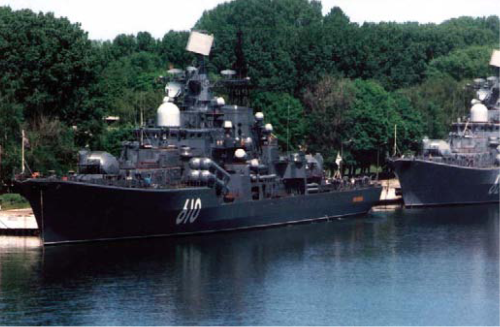
Bishops and oceanographers stood on the Lido Deck, taking snapshots of guided missile frigates and attack submarines as we docked at the Russian Navy's ultrasecret Pier 75. We sipped espresso as sailors drilled on the deck of a neighboring destroyer. We wandered across the pier for a better look at a pair of massive hydrofoil landing ships without receiving the slightest sign of admonition from the guards posted there.
Later, loaded on buses bound for the city of Kaliningrad, we passed more warships, circled through rows of naval barracks, and were waved through the navy checkpoints, one of which is at the entrance to the town of Baltisk itself, which remains off limits to most Russians. Kaliningrad, long a forbidden city, has once again thrown its gates open to the world.
But, ironically, just as Kaliningrad is opening up to the world, the enclave's neighbors are erecting new barriers around it. Next year, Poland, Lithuania, Latvia, and Estonia will join the European Union. Kaliningrad will not only be cut off from the rest of Russia, it will be surrounded by the European Union, with its strict visa and customs regimes. Already a Russian island, Kaliningrad has suddenly become an enclave of have-nots amid a continent-wide community of haves.
EU expansion has already created a host of new uncertainties in Boris Chubarenko's life. When I spoke with him in June, Chubarenko, a researcher at the Russian Academy of Sciences' Shirshov Institute of Oceanography, was preparing to lead a school group on a tour to Germany. Problem was, while the group was still in Germany on July 1, Lithuania and Poland were slated to introduce strict new visa requirements in preparation for joining the EU. The Kaliningrad students' transit visas might not be honored on their return trip through Poland.
“I don't know how we will get back,” Chubarenko said. Neither did the Polish consular staff in Kaliningrad, who told him that the issue had yet to be worked out.
Ships of Russia's Baltic Sea Fleet at Baltisk.
And it's not just travel to the West that will become more difficult. Lithuania, which previously required no transit visas for Russians traveling between Kaliningrad and the rest of their country, would also be imposing visas on July 1. With all the uncertainty, Chubarenko's mother, who had been visiting him for the summer, decided to cut her visit short, fearing that if she waited until after July she might encounter problems getting back home to the Russian Urals. With air tickets prohibitively expensive, Chubarenko and his wife fear they may be cut off from friends and family in Mother Russia.
“This makes for more isolation,” he said, “which is bad because we were already rather isolated from the rest of our country.”
Kaliningrad hasn't always been a Russian enclave. Until 1945, when it was captured by the Red Army, the region was a part of East Prussia, and the German-speaking city in its center was called Königsberg. Joseph Stalin cleansed the city and region of virtually all its inhabitants and renamed both after Mikhail Kalinin, one of the dictator's many unpleasant colleagues, who had recently passed away, apparently of natural causes. Russian settlers moved into the region, which Stalin made part of the Russian Republic because he didn't trust neighboring Lithuania with control over what remains Russia's only ice-free Baltic port.
In Soviet times, it didn't matter that Kaliningrad was more than 350 miles from the rest of Russia; the Soviet Union was all one country, after all. But since its collapse, Kaliningraders have found themselves increasingly isolated. In the early 1990s, newly independent Lithuania imposed customs duties on goods moving to and from the enclave, while a sharp increase in the cost of train, bus, and air tickets made traveling to Moscow or St. Petersburg prohibitively expensive for many of its 900,000 inhabitants.
EU expansion will make matters worse. Kaliningrad's trucks will suddenly have to meet EU safety standards in order to leave the enclave. Few of the region's products are likely to meet EU quality standards, which means that as of next year they can no longer be exported to Poland or the Baltic republics, currently amongst the Kaliningraders' most important trading partners. Tighter border security is likely to put an end to the brisk cross-border smuggling of vodka, cigarettes, and gasoline that has provided a livelihood for thousands of Kaliningraders.
The Kaliningrad issue has triggered a diplomatic crisis between Moscow and Brussels, with Russian President Vladimir Putin accusing Europe of building a new Berlin Wall around the region's residents. Last year, Putin said the EU's behavior was “worse than the Cold War, because it divides the sovereignty of Russia,” something his government has vowed not to accept. Brussels has proposed creating some sort of expedited visas for Kaliningraders, but Moscow is holding out for visa-free travel across Lithuania in special “sealed trains.”
Even if the visa issue is resolved, Kaliningrad's economic problems will remain. Once an important industrial and military center, the region is now one of Russia's poorest, with nearly four in 10 residents living below the nation's official poverty line. Foreign investment levels are half the Russian average. Per capita GDP is a fifth that of Lithuania, an eighth that of Poland, and a fortieth that of the EU.
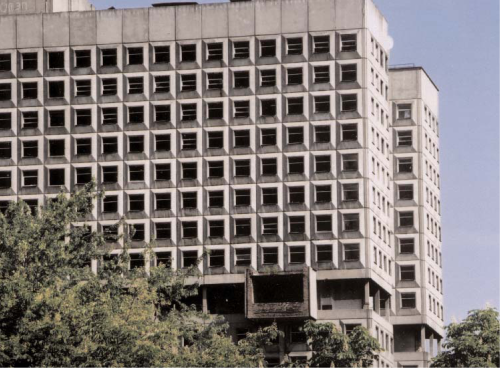
Kaliningrad's “Monster,” a never-completed Soviet government building.
The countryside is incredibly beautiful, largely because the agricultural sector has collapsed. Wildflowers and tiny saplings carpet the abandoned fields lining the region's narrow roads. Birds are everywhere, including large numbers of nesting storks, an endangered animal that thrives along with the frogs, snakes, and other creatures it likes to hunt in the overgrown fields and abandoned farm buildings.
Road signs remain unchanged from Soviet days. We drove through the countryside on Soviet Way and into the city on Lenin Prospect. In the city center, a tall statue of Lenin still presides over a vast expanse of weed-choked concrete and speeding traffic, although a new Russian Orthodox church is being constructed behind his back. Sixteenth- and seventeenth-century buildings in the city center were destroyed in a massive British air raid in August 1944, which left much of the city in ruins. By the time the Red Army captured the city in 1945, little of the past remained standing.
There were two major exceptions, however. The first was the remains of a thirteenth-century castle built by the Teutonic knights who founded the city. They didn't last long. In the late 1950s, Soviet authorities ordered engineers to dynamite the castle remains to make way for the new House of the Soviets, a massive concrete office tower surrounded by concrete plazas and staircases. The castle was obliterated, but the House of the Soviets, begun in 1972, was never completed. The massive hulk now looms over the town like something out of a postapocalyptic movie, surrounded by decaying staircases and a plaza of four-foot high grass. Residents refer to it simply as “the Monster.”
Plans to turn the Monster into a business center or hotel fell through. This spring a newspaper announced it would be converted into a gigantic multilevel garage, but that turned out to be an April Fool's joke. At present there are no plans to do anything with it at all. “The authorities have decided it will be cheaper to let it decay on its own than to tear it down,” explained Olga Danilova, who shows tourists around. Only vagrants and drug addicts make use of the facility.
But just across the street from the Monster, Königsberg's fourteenth-century cathedral is, surprisingly, still standing. The Soviets' religious fervor was sufficiently muted that they never repaired the extensive bomb damage the structure suffered in the war, but they didn't tear it down, either. The church was spared, ironically enough, because it contains the mausoleum of Immanuel Kant, the city's most famous son, who created the philosophical underpinnings of contemporary agnosticism. Marxists, fortunately for the cathedral, regarded Kant as a precursor to G. W. F. Hegel and Karl Marx himself. The Soviet Union continued to publish Kant's work, and his tomb was revered, not destroyed.
Now the cathedral is finally being repaired with donations from Germany. Scaffolding fills the main chamber, which is being restored to its prewar condition. The clocks in the bell tower chime again, as they did in the days when the kings of Prussia were crowned within the church. The city, it seems, is recovering a small bit of its European past. Whether Europe is willing to embrace Kaliningrad remains to be seen.